Categories
FCPA Compliance Report

FCPA Compliance Report – Billy Jacobson on Building a Boutique Law Firm

Welcome to the award-winning FCPA Compliance Report, the longest-running podcast in compliance. In this episode, Tom Fox welcomes Billy Jacobson, well-known to the compliance community, who recently opened a new boutique law firm, Jacobson Lopez. We talk about why he co-founded the firm, the type of work it takes on, and where he hopes it might grow.

Billy Jacobson is a seasoned attorney with a rich background in white-collar law and compliance, having served as a DOJ attorney and worked on high-profile fraud cases such as the Enron trials and as CCO at Weatherford. His experience and knowledge of AML, FCPA, and BSA practices shape his viewpoint on Jacobson Lopez, a boutique law firm that specializes in compliance and investigations. With his partner, Jonathan Lopez, Billy co-founded Jacobson Lopez, a boutique law firm offering specialized services in compliance work, internal investigations, government enforcement, and individual representation. They aim to provide big law firm expertise at more modest rates, with greater flexibility and no conflict issues, positioning their firm as an alternative to larger law firms. To gain more insights into Billy’s perspective and the work of Jacobson Lopez, join Tom Fox and Billy Jacobson on this FCPA Compliance Report podcast episode.

Key Highlights:

  • Boutique White Collar Law Firm in DC
  • Organic Growth and Strategic Partnerships in Law
  • Federal Prosecution Experience: Navigating Complex Legal Issues

Resources:

Billy Jacobson on LinkedIn

Jacobson Lopez

Tom Fox

Instagram

Facebook

YouTube

Twitter

LinkedIn

Categories
All Things Investigations

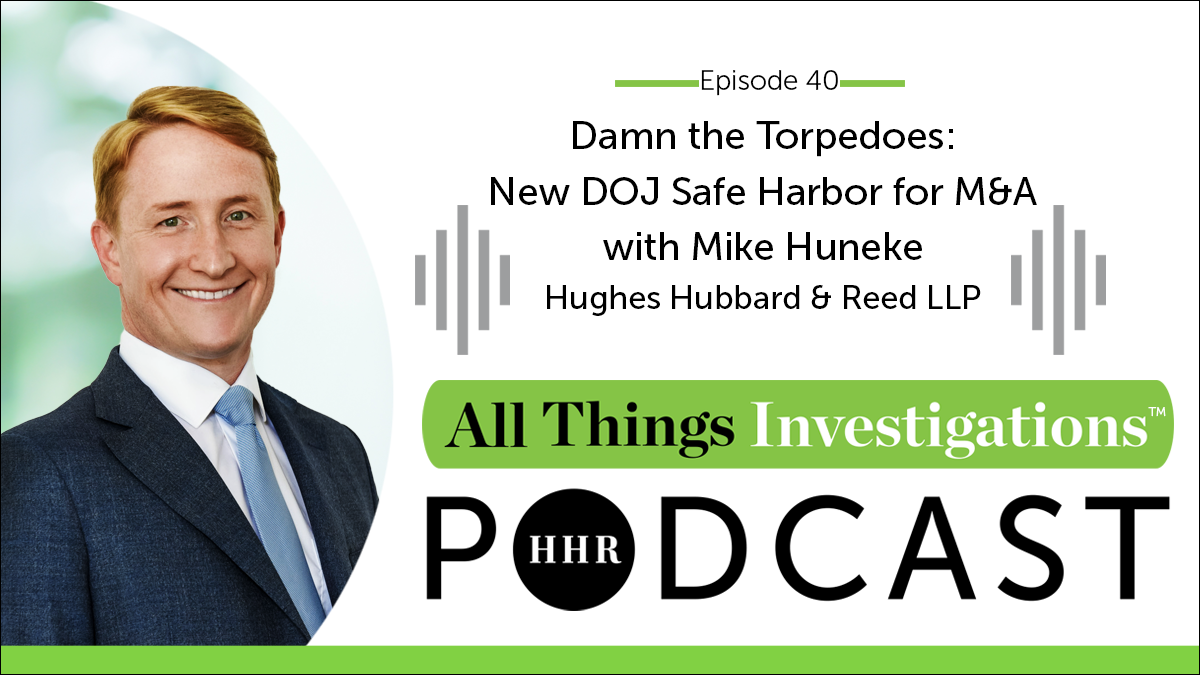
All Things Investigation: Episode 40 – Damn the Torpedoes – New DOJ Safe Harbor for M&A with Mike Huneke

How can companies adequately prepare for the DOJ’s aggressive new deadlines for M&A disclosures? In this episode of All Things Investigations, Tom Fox discusses the implications of the DOJ’s new M&A Safe Harbor policy with Mike Huneke. They explore best practices for meeting the 6-month and 1-year deadlines, how to approach pre-acquisition due diligence, and whether this policy will lead to more or fewer disclosures.

Mike Huneke is a partner in Hughes Hubbard & Reed’s Washington office. He advises clients on the navigation and resolution of multi-jurisdictional criminal or Multilateral Development Bank (MDB) anti-corruption investigations. He also assists companies subject to post-resolution monitorships or other commitments and designs and executes risk-based strategies for due diligence on third parties.

You’ll hear Tom and Mike discuss:

  • The 6-month post-closing deadline to disclose is extremely quick for large, complex companies. Compliance teams need to get involved very early in the M&A process to spot potential issues adequately.
  • Sellers must also prepare for more scrutiny from buyers under this policy. They should proactively assess compliance programs in their portfolio companies, anticipate buyer due diligence questions, and address any issues to maximize sale value.
  • The policy’s criminal liability focus means boards and senior execs must now approve disclosures. This may lead to more hesitation in disclosing, as companies lose the ability to “test run” disclosures. 
  • Companies must apply an “anti-corruption mindset” to issues like sanctions and export controls now that those areas have potential criminal penalties. Cross-train compliance and trade professionals to instill this mindset.
  • Pre-acquisition due diligence should identify the root causes of any issues so companies can prioritize remediation post-close. Have a detailed, documented integration plan ready.
  • Managing investigations and remediation simultaneously with tight deadlines will be challenging. A strong tone from the top will be crucial for integration.
  • It is unclear if other agencies like the SEC will follow the DOJ’s approach. Disclosers may hesitate if issues span multiple regulators.
  • Overall, the policy adds certainty around timelines, though meeting them will be difficult. It forces compliance to have a seat at the M&A table.

KEY QUOTES

“And so the more that things are criminal and the larger the penalties, the more you’re going to have boards get involved, the more you’re going to need very senior management to be involved. And that may result in just more hesitation to make a voluntary disclosure…” – Mike Huneke.

“So sellers should be looking at this and anticipating that there will be more questions from buyers and more questions from buyers’ counsel.” – Mike Huneke.

“So identifying the root cause is absolutely key and then realistically you’re not going to be able to integrate an entire company into your compliance program in one year. Make sure you have a plan that’s well documented and based on the due diligence for prioritizing what’s coming in first.” – Mike Huneke.

Resources

Hughes Hubbard & Reed website 

Mike Huneke on LinkedIn

Categories
Corruption, Crime and Compliance

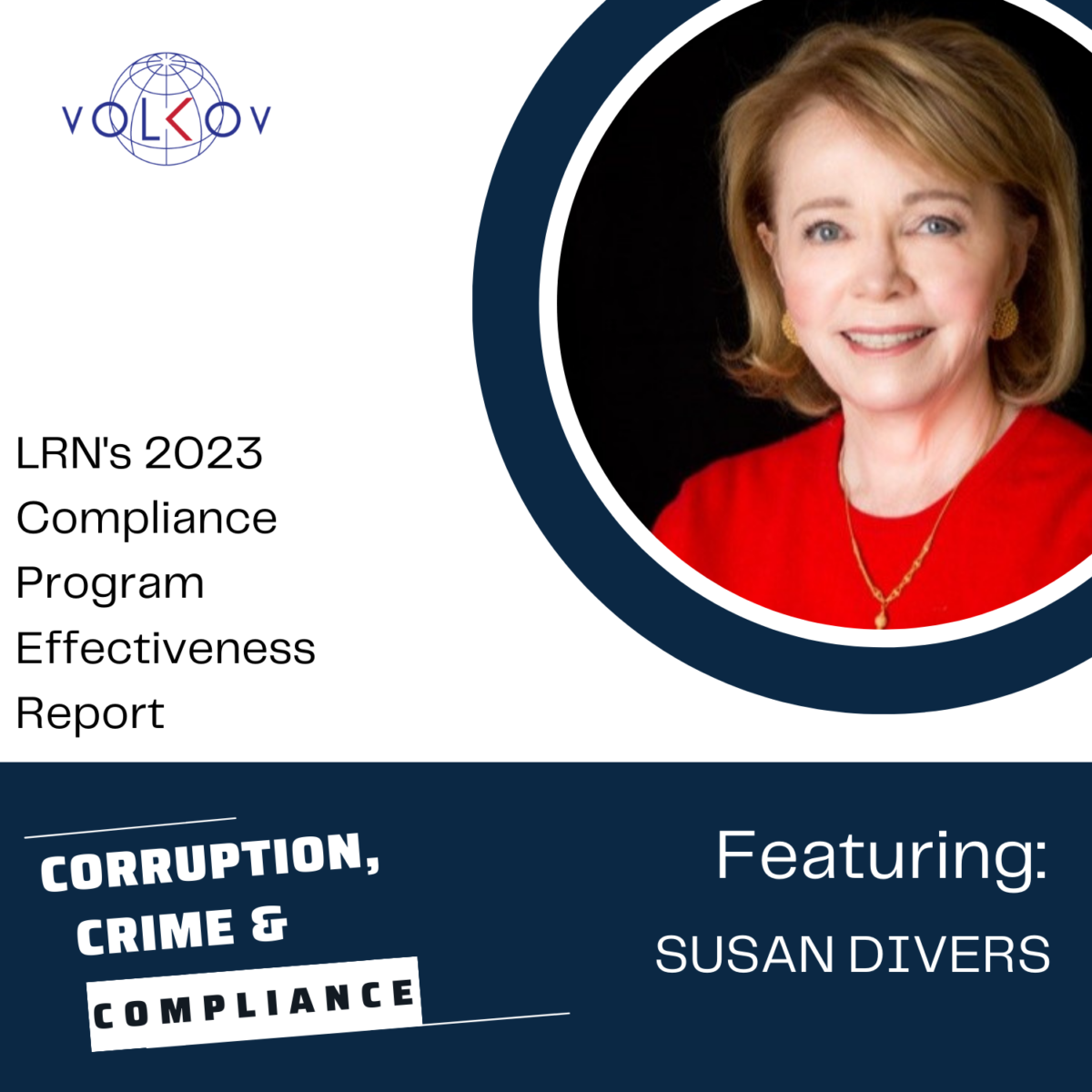
Susan Divers on LRN’s 2023 Compliance Program Effectiveness Report

Is your company’s compliance program truly effective, or is it just ticking boxes? In this episode of Corruption, Crime, and Compliance, Michael Volkov dives deep into LRN’s PEI survey with Susan Divers. Susan sheds light on the global nature of ethics and compliance programs, challenging the misconception that they are solely US-centric. They discuss the power of values, the shift from a cop to a coach approach, and the revolutionary trends in employee-centric training, especially in the age of remote work. 

Susan Divers is the Director of Thought, Leadership, and Best Practices at LRN. She has a wealth of experience as a former Chief Compliance Officer, and her emphasis on values over rules in compliance programs has made her a trailblazer in the industry. 

You’ll hear Michael and Susan discuss:

  • The LRN PEI survey challenges the perception that ethics and compliance are US-centric; many programs worldwide share common features such as codes of conduct, training policies, and audits.
  • Examining a decade of data, the report delves into how ethics and compliance programs responded to the disruptions caused by the pandemic.
  • LRN’s data reinforces the idea that ethics and compliance programs relying on values and ethical cultures are more effective than those solely based on rules. Shifting from a cop approach to a coach approach enhances program effectiveness.
  • Ethical companies experience lower employee misconduct rates, higher employee satisfaction and productivity, and achieve greater sustainable financial performance.
  • The pandemic prompted a shift in focus from content-driven training to employee-centric, relevant, and mobile-friendly modules. Shorter modules, just-in-time training, and tailored approaches are emerging as best practices.
  • Ensuring accessibility through web-based policies and procedures, coupled with interactive capabilities and data analytics, becomes crucial in bridging the gap between remote workers and compliance initiatives.
  • Gathering data on employee interactions provides insights into the effectiveness of compliance programs. Metrics such as completion times, pass rates, and group performance allow for targeted efforts to enhance the program’s impact.
  • Michael emphasizes the challenge for compliance officers in handling the plethora of available data. Choosing the right metrics, setting standards, and ensuring the usability of metrics over time are crucial considerations.
  • The report highlights that high-performing ethics and compliance programs are integral to the decision-making processes of companies. 70% of respondents reported modifying or abandoning a business initiative due to an ethics and compliance risk assessment.
  • Susan introduces the concept of embedding a short Ethical Culture survey at the end of training courses. This real-time survey, known as the Ethical Pulse Culture survey, serves as a powerful tool to gauge and improve the ethical culture within organizations.
  • The Ethical Pulse Culture survey becomes a game-changer, operationalizing compliance by offering a moving average of data insights. This survey, incorporated into scorecards, provides business managers with valuable insights into their business unit’s ethical culture over time.

KEY QUOTES

“… if you have to make a tough decision and you come down on the side of your values, then your [compliance] program is working.” – Susan Divers

“If you’re relying on rules, almost inevitably you’re incentivizing people to game the rules. … So the more companies really realize that and move from a cop approach to a coach approach, the more effective their programs are going to be.” – Susan Divers

“The research shows that asking people to answer ethical questions after they’ve taken training is much more effective and accurate than doing it separately. And what we’re seeing with our clients that are doing that is a 95%, sometimes 97% participation rate … And the other advantage of this is it’s a moving average, it’s not a one and done. But they were able to show over time how that particular business unit is doing…  and they’re allowing their business managers or their business unit heads to see that data. This is another example of operationalizing compliance.” – Susan Divers

Resources

Susan Divers on LinkedIn | Email

LRN

Categories
31 Days to More Effective Compliance Programs

One Month to a More Effective Compliance Program Through Culture: Day 9 – Fostering Culture with Psychological Safety

How can you improve corporate culture through speaking up? In an MIT Sloan Management Review, Summer edition, entitled “Fostering Ethical Conduct Through Psychological Safety” authors Antoine Ferrère, Chris Rider, Baiba Renerte, and Amy Edmondson asked such questions as “How do organizations encourage people to speak up about ethical breaches, whether inadvertent or deliberate?” and “Why do some employees choose to remain silent when others report misconduct?” Additionally, they “analyzed the perceptions of those who report misconduct against those of “silent bystanders” to help “better understand both the drivers and derailers of speaking up — and revealed insights into how leaders and compliance officers can encourage employees to make such reports.’”

The authors believe today, “it is more essential than ever that when misconduct happens or difficult problems arise, there is a strong ethical climate for surfacing information so leaders can respond quickly and appropriately. An environment in which employees feel comfortable reporting such issues is also vital to preventing future misconduct.”

The authors believe that a “healthy organizational culture is one in which speaking up and listening go hand in hand, reinforcing ethical standards. If concerns are expressed, changes can be made promptly.” This is important because it moves from the detect prong to the prevent prong, which is by far the most important and effective prong in any compliance regime. Further ideas or innovations, rather than simply reporting untoward actions, can make a company more efficient and more profitable. This means a company can receive far more benefits than monetary fines or penalty avoidance if psychological safety exists.

 Three key takeaways:

  1. How a speak-up culture improves your culture.
  2. What is the role of psychological safety in improving culture?
  3. What is the role of externals in your corporate culture?

Do you want to improve your culture? How can you assess your culture and develop a strategy to improve it going forward? In this free webinar on the new tool, The Culture Audit with Tom Fox and Sam Silverstein on Tuesday, November 28, 12 CT. For more information and registration, click here.

Categories
Innovation in Compliance

The Future of Communication in Financial Compliance: Part 1 – Current Status

This week, I have a special five-part podcast series sponsored by Verint on the Future of Communication in Financial Compliance. My guest in this series is Phil Fry, VP and GTM of Financial Compliance Strategy at Verint. Over this series, we will take a deep dive into the current status of communications in financial institutions, how to be or not be compliant, analysis and insight into the area, and how to avoid accentuating the negative and the human element in compliance. This first podcast considers the current communications status in financial institutions.

Phil Fry, the VP and General Manager of Financial Compliance Strategies at Verint, brings over forty years of experience in the financial compliance industry and a deep understanding of the challenges financial firms face in adhering to regulations amidst evolving communication modes. Fry’s perspective on “adapting financial compliance solutions to evolving communication modes” is shaped by the significant transformations in the financial compliance environment due to factors such as COVID, hybrid working, and the adoption of Generative AI.

Fry acknowledges the complexities of using different communication modes and the increasing challenges for compliance solutions to keep pace. Phil emphasizes the need for a holistic compliance solution to capture the entire communications environment and highlights Verint’s pioneering efforts in utilizing generative AI-driven transcription, communications, pre-surveillance, and speech analytics capabilities. Join Tom Fox and Phil Fry on this episode of the Future of Communication podcast as they delve deeper into this topic.

Key Highlights:

  • Transforming Financial Compliance in the Digital Age
  • Verint’s Holistic Compliance Solution for Financial Institutions
  • Regulatory Fines and Compliance Solutions

Resources:

Phil Fry on LinkedIn

For More Information check out Verint.

Categories
Riskology

Riskology by Infortal Episode 13: Deputy AG Lisa Monaco’s Announcement at SCCE

How can companies navigate the evolving compliance landscape and new risks posed by geopolitical events? Dr. Ian Oxnevad and Chris Mason discuss the recent DOJ guidance on compliance priorities and tips for managing risk. Businesses face a growing array of geopolitical risks, such as sanctions regimes, political instability, and supply chain disruptions. These risks can have a significant impact on a company’s bottom line, reputation, and overall operations. To effectively mitigate these risks, companies must adapt their compliance programs and develop a comprehensive understanding of the evolving geopolitical landscape.

Infortal Worldwide is a global risk management and investigations firm that specializes in helping businesses navigate complex risk landscapes. The company’s focus extends to various areas, including economics, politics, and geopolitical risk. By delving into these interconnected realms, Infortal Worldwide aims to provide clients with comprehensive insights that empower them to make informed decisions, especially in critical areas such as mergers and acquisitions, private equity investments, and other strategic moves.


You’ll hear Chris and Ian discuss:

  • The DOJ is making enforcement of corporate compliance a top priority, especially relating to national security. They are hiring 25 additional prosecutors specifically for this purpose.
  • Compliance programs must evolve to address today’s complex geopolitical risks. Programs can’t be static or analyzed just annually. There must be dynamic assessment as global conditions change.
  • Sanctions and regulations have cascading impacts on markets and business operations in ways that may not seem directly related. Thorough analysis of geopolitical risks is required.
  • Compliance failures at large, sophisticated companies demonstrate the need for effective geopolitical risk management. Significant reputational damage can occur.
  • Ensure executive compensation packages properly incentivize compliance-minded behavior. Penalties should exist for compliance failures.
  • New DOJ Safe Harbor policy formalizes practices for self-disclosing issues found during mergers and acquisitions. 
  • For M&A, extensive due diligence should begin on day one of deal consideration. Analysis must include geopolitical risks like bribery and FCPA violations.
  • Due diligence should continue for 6 months after an acquisition closes to uncover hidden risks. Issues should be self-disclosed to the DOJ.
  • Compliance must permeate entire organizations. New expertise in geopolitical risk may need to be developed across legal, marketing, and other departments.
  • Corporate compliance plays a role in national security by avoiding risks like products being misused by terrorists or transactions violating sanctions.


KEY QUOTES

“…the last thing that the Department wants to do is discourage companies with effective compliance programs from lawfully acquiring companies with ineffective compliance programs and a history of misconduct. Instead, we want to incentivize the acquiring company to timely disclose misconduct uncovered during the M&A process.” – Chris Mason


“Your company is an element to sociopolitical and geopolitical stability. And unfortunately, the world has gotten so complex and so potentially dangerous, although there’s tons of opportunities to be had, that it really behooves companies to look at deals and partnerships and risks before they act in any given transaction, but also after the fact in order to rectify risks.” – Dr. Ian Oxnevad

“Just the risk environment in general now are forcing companies to have to build new skills and potentially new personnel and areas of expertise where they would not have had to before now, because of the executive liability. Executives certainly have an incentive now by law or at least by enforcement, to understand geopolitical risk… So you’re looking at the creation of a whole new area of expertise and demand within the compliance space and in the corporate space in general in terms of how to understand geopolitical risk.” – Dr. Ian Oxnevad


Resources

Infortal Worldwide 

Dr. Ian Oxnevad on LinkedIn

Chris Mason on LinkedIn

Categories
Blog

Transforming Financial Communications Compliance in the Digital Age

This week I have a special five-part podcast series, sponsored by Verint on the Future of Communication in Financial Compliance on the Innovation in Compliance podcast series on the Compliance Podcast Network. My guest in this series is Phil Fry, VP and GTM of Financial Compliance Strategy at Verint. Over this series, we will take a deep dive into the current status of communications in financial institutions; how to be or not be compliant; an analysis and insight into the area; and how to avoid accentuating the negative and the human element in compliance. In this first post, we consider the current status of communications in financial institutions.

The financial industry’s compliance landscape has undergone significant changes in recent years, driven by factors such as hybrid working, Generative AI, and diverse communication modes. These changes have presented challenges for compliance solutions and vendors, making it harder than ever to keep up with evolving regulations. In this episode of the podcast “Future of Communication,” hosted by Tom Fox and featuring Phil Fry, the topic of adapting financial compliance solutions to evolving communication modes is explored in depth.

Financial firms today face more demanding challenges in adhering to regulations than ever before. The increase in unified communications, mobile phones, and changing client demands has transformed the way traders conduct business. Instead of traditional one-to-one conversations, there is now a growing use of conference calls and persistent interactions involving varying numbers of people. This shift, termed as non-binary communications by Verint, a leading provider of compliance solutions, adds complexity to compliance efforts.

Verint recognizes the need for a comprehensive solution that captures the entire communications environment, including voice and persistent chat. They are also at the forefront of pioneering generative AI-driven transcription, communications, pre-surveillance, and speech analytics capabilities. By aligning their solutions with the three lines of defense – business compliance, internal audit, and IT – Verint aims to provide financial firms with a holistic compliance solution.

One of the key challenges in adapting financial compliance solutions to evolving communication modes is the inconsistency in enforcing fines. While Tier one banks have borne the brunt of regulatory fines, there is still a lack of consistency in holding smaller financial institutions accountable. This inconsistency creates a sense of complacency among some institutions, leading them to believe they can get away with non-compliance. However, the increasing number of fines related to communication technologies like WeChat and WhatsApp highlights the importance of controlling all aspects of operations.

Compliance capture has traditionally been associated with fraud prevention. However, in the modern world, the focus has shifted towards managing conduct risk within organizations. Compliance technology solutions, such as Verint’s, play a crucial role in ensuring users act with integrity, due skill, care, and diligence. These solutions also help organizations treat customers fairly, adhere to market conduct standards, and support the needs of their employees.

When it comes to adapting financial compliance solutions, it is essential to consider the tradeoffs involved. Financial institutions often rely on highly advertised solutions that fall short of fulfilling regulatory requirements. For example, some vendors claim to capture Microsoft Teams chat compliantly but can only capture one-off sidebar conversations, not persistent chats with attachments. This lack of technology hampers compliance controls and exposes institutions to unnecessary risks.

In conclusion, adapting financial compliance solutions to evolving communication modes is a complex task. Financial firms must navigate the challenges posed by non-binary communications and changing regulatory landscapes. Compliance solution providers like Verint are at the forefront of addressing these challenges by offering comprehensive solutions and leveraging generative AI-driven technologies. As financial institutions face increasing fines and scrutiny, they must prioritize compliance and consider the impact of communication modes on their operations. By doing so, they can ensure they meet regulatory requirements and maintain the trust of their stakeholders.

For More Information check out Verint.

Categories
Sunday Book Review

Sunday Book Review: November 12 , 2023 The Corporate Governance (Larcker and Tayan) Edition

In the Sunday Book Review, I consider books that would interest the compliance professional, the business executive or anyone who might be curious. It could be books about business, compliance, history, leadership, current events or anything else that might interest me. In today’s edition of the Sunday Book Review, Tom considers three books by Stanford professors David Larcker and Brian Tayan on corporate governance.

  • The Art and Practice of Corporate Governance by Larker and Tayan
  • Corporate Governance Matters (3rd ed)  by Larker and Tayan
  • A Real Look at World Corporate Governance by Larker and Tayan
Categories
10 For 10

Top Compliance Stories For the Week Ending November 11, 2023

Welcome to 10 For 10, the podcast that brings you the week’s Top 10 compliance stories in one podcast each week. Tom Fox, the Voice of Compliance, brings the compliance professional the compliance stories you need to be aware of to end your busy week. Sit back, and in 10 minutes, hear about the stories every compliance professional should be aware of from the prior week. Every Saturday, 10 For 10 highlights the most important news, insights, and analysis for the compliance professional, all curated by the Voice of Compliance, Tom Fox. Get your weekly filling of compliance stories with 10 for 10, a podcast produced by the Compliance Podcast Network.

  • ESG helps in hiring the best and brightest.  (FT)
  • The UK hits Russia with new sanctions. (WSJ)
  • Indian anti-corruption journalist targeted in spy op. (Reuters)
  • GE Aerospace to pay $9.4M in DOJ false claims case. (Compliance Week)
  • WeWork files for bankruptcy.  (FT)
  • ICO apologizes to ex-Nat West chief.  (FT)
  • Integrity in cricket. (University of Sussex)
  • Portuguese PM resigns over corruption. (The Guardian)
  • Supreme Court refuses to take up PdVSA bribery case. (LatinLawyer)

You can check out the Daily Compliance News for four curated compliance and ethics-related stories each day, here.

Connect with Tom 

Instagram

Facebook

YouTube

Twitter

LinkedIn

Categories
Kerrville Weekly News Roundup

Kerrville Weekly News Roundup: November 11, 2023

Welcome to the Kerrville Weekly News Roundup. Each week, veteran podcaster Tom Fox and his colleagues Andrew Gay and Gilbert Paiz get together to go over a couple of their favorite stories from the past week from Kerrville and the greater Hill Country. Sit back, enjoy a cup of morning coffee, and listen in to get a wrap-up of the Kerrville Weekly News. We each consider two of our favorite stories and talk about the upcoming weekend’s events which we will enjoy or participate in this weekend.

In this episode, Tom is on assignment so Gilbert and Andrew take the helm to discuss the following stories that caught his attention over the past week.

  • A new Kerr County County Clerk is formally appointed.
  • New crosswalk art at Clay and Water Street.
  • State voter-approved property tax relief.
  • Star Party at Schreiner University.
  • Happy Birthday to the Marine Corps.
  • Thank a Veteran.

Resources:

Tom Fox on LinkedIn

Gilbert Paiz on LinkedIn

Andrew Gay on LinkedIn

Texas Hill Country Podcast Network