Categories
Diabetes: The Metabolic Bully

Diabetes: The Metabolic Bully – Introduction to Podcast

Welcome to “Diabetes: The Metabolic Bully,” where we delve deep into the world of one of the most prevalent chronic conditions that lurks in our society. Diabetes doesn’t just knock on our doors; it bullies its way into our lives, altering our metabolism and dictating our daily routines.

In each episode, we aim to unpack the science and myths surrounding diabetes. From understanding how our bodies succumb to this metabolic bully, to the latest research and treatments, our podcast aims to provide listeners with comprehensive insights.

In this inaugural episode, Dr. Byron Black, an expert in exercise science and health promotion, emphasizes the importance of a holistic approach to fitness and wellness in a podcast episode with Tom Fox. He discusses his background in the Air Force, where he served as a ground radio technician and later worked as a base exercise physiologist and fitness director.

Dr. Black now runs a fitness clinic in Kerrville, Texas and advocates for a comprehensive approach to overall well-being. He also provides insights on managing diabetes through exercise and proper nutrition, highlighting the importance of seeking guidance from healthcare professionals. The episode emphasizes the interconnectedness of various aspects of health and the need for collaboration among professionals in providing comprehensive care.

Join us as we confront diabetes head-on, empowering ourselves with knowledge, compassion, and resilience. Whether you’re newly diagnosed, a long-time warrior, or simply someone keen to learn, this podcast is your go-to guide in the vast world of blood sugars, insulin, diet, and beyond. Together, we’ll stand up to diabetes, the metabolic bully that has picked on too many for too long.

Key Highlights

·      Academic and Professional Background

·      Fitness and Holistic Wellness

·      The Impact of Diabetes

·      Diabetes and Fitness

Resources

Medical Fitness Clinic of Kerrville

Categories
The ESG Report

The ESG Report – Yoram Ashery – Unlocking the Power Within: Nostromo’s Clean Energy Storage

The ESG Report podcast is hosted by Tom Fox. Looking for innovative solutions to tackle climate change? Look no further than The ESG Report! In this episode, Tom speaks with Yoram Ashery, CEO at Nostromo Energy and we discuss zero carbon energy storage.
In this episode, we discuss Nostromo Energy’s innovative clean energy storage technology for buildings. By storing cold energy in small cells filled with water, buildings can become giant batteries, reducing dependence on the grid and advancing the energy transition. The use of cloud-based energy storage management allows for remote control and optimization of energy storage systems, creating a virtual power plant that responds to grid demands. This technology offers environmental benefits, and financial advantages, and helps in reducing carbon emissions. The podcast also highlights the challenges and solutions in transitioning to clean energy, emphasizing the need for capital, regulation, consumer participation, and innovative technologies like Nostromo.

Key Highlights

·       Nostromo Energy: Clean Energy Storage

·       Cloud-based energy storage management

·       Clean energy storage and carbon reduction

·       Renewable Energy Revolution

·       Challenges and Solutions in Transitioning to Clean Energy

Resources

Yoram Ashery on LinkedIn

Nostromo Energy

Tom Fox 

Connect with me on the following sites:

Instagram

Facebook

YouTube

Twitter

LinkedIn

Categories
Daily Compliance News

Daily Compliance News: August 10, 2023 – The Leaving China Edition

Welcome to the Daily Compliance News. Each day, Tom Fox, the Voice of Compliance brings to you compliance-related stories to start your day. Sit back, enjoy a cup of morning coffee, and listen in to the Daily Compliance News. All, from the Compliance Podcast Network. Each day we consider four stories from the business world, compliance, ethics, risk management, leadership, or general interest for the compliance professional.

  • Dentons leaving China. (NYT)
  • Biden Administration bans investment in Chinese tech. (WSJ)
  • Kellogg cereal workplace attacked as ‘woke.’ (Reuters)
  • Eradicating toxic team behavior. (FT)
Categories
31 Days to More Effective Compliance Programs

One Month to a More Effective Compliance Program: Day 8-Executives and Compliance Compensation Incentives

The lack of personal consequences for senior executives responsible for corporate malfeasance is explored in this podcast episode. Executives are incentivized to take excessive risks, knowing they won’t have to pay any fines, while shareholders bear the brunt of penalties. Proposed solutions include the concept of “skin in the game,” where executives contribute a portion of their compensation to a pool of money that can be used to pay penalties. Another suggestion involves forfeiting the performance bond of senior management in the case of large fines. A third approach suggests creating a contract that would enforce a reduction in pay for failures of corporate governance. These proposals aim to hold senior executives personally accountable for compliance failures and align executive compensation with compliance objectives. HR professionals play a crucial role in designing and implementing positive incentives to foster a culture of compliance and ethical conduct within organizations.

When it comes to compliance failures, the penalties are usually paid by shareholders, leaving senior executives largely untouched. This lack of personal accountability creates a disconnect between executive actions and the consequences of those actions. It’s high time we bridge this gap and ensure that senior executives are held personally responsible for compliance failures. What are some proposed solutions:

1. “Skin in the Game”. One proposed solution, advocated by William Dudley, former president of the Federal Reserve Bank of New York, suggests that senior management and material risk takers should forfeit their performance bond in the case of large fines. This approach would discipline individual behavior and decision-making, incentivizing individuals to flag issues when problems arise.

2. Automatic Pay Reductions. Another approach, proposed in an article titled “Ties That Bind Codes of Conduct,” suggests automatic reduction of pay for officers, directors, and advisors for failures of corporate governance. Executives would agree to pay back a portion of their gross compensation for a specified period before the beginning of any improprieties, regardless of their knowledge of misdeeds within the company.

Benefits of Accountability for Senior Executives:

1. Aligning Incentives. Corporate leaders cannot afford to turn a blind eye to compliance failures anymore. Holding senior executives accountable ensures that their compensation is directly tied to compliance objectives, aligning incentives and promoting ethical business practices.

2. Addressing Perverse Incentives. Perverse incentives in corporate pay, such as additional compensation based on company performance, can lead to unethical behavior and non-compliance. By implementing accountability measures, we can address these perverse incentives and create a culture of ethical behavior within organizations.

3. Driving Positive Change. Creating positive incentives within organizations is crucial to driving ethical behavior and compliance. HR professionals play a pivotal role in designing and implementing these incentives, ensuring that they are effective in promoting a culture of compliance.

Three key takeaways:

1. Perverse incentives are named that for a reason; they really are bad.

2. How can you create positive incentives in your organization?

3. There is a business response to this legal issue. Employ it.

For more information, check out The Compliance Handbook, 4th edition, available on LexisNexis.com.

Categories
It's art

It’s art, let’s talk about it – Billy Schenck – Painting Contemporary Western Art

The Museum of Western Art is dedicated to excellence in the collection, preservation, and promotion of Western Heritage and the education and cultural enrichment of our diverse audiences. The Museum serves as a bridge between the past and the present, ensuring that the legacy of the American West will be preserved for the future. Western Art is as engaging and important as ever. In this podcast series, Museum Executive Direct Darrell Beauchamp visits with the artists who work in this western heritage to talk about their work, the legacy of Western Art and why talking about it is so important today.

In this episode, we will be exploring the artistic journeys of Billy Schenck, who has left an indelible mark on the Western art genre, pushing boundaries and creating captivating works that merge pop art with photorealism. Join us as we uncover their unique approaches, discuss their notable series, and delve into the challenges they faced in the art world.

Schenck’s artistic style is a testament to his ability to blend pop art with photorealism seamlessly. He reveals his unconventional approach to creating imagery by utilizing the paint-by-numbers technique. This technique allowed him to produce convincing images, even without traditional drawing or painting skills. His first gallery show in New York City was a resounding success, selling out before it even opened. This early triumph set the stage for a prolific career that would span over five decades.

One of Schenck’s notable series is the Phaedra series, which showcases nude cowgirls riding in the Mythic West. This series captures the essence of the Western genre while adding a contemporary twist. Additionally, Beauchamp has created captivating series centered around surfer girls and landscapes, particularly in the Southwest. Notably, he started incorporating landscapes without figures around 1999-2000, using big clouds and sweeping vistas to evoke a sense of awe and grandeur in his paintings.

Schenck’s unique artistic vision often placed him on the edge of the mainstream Western art world. He faced challenges in New York City, where Western subject matter was not considered contemporary. However, he persisted and refined his painting style, ultimately gaining recognition and exhibiting alongside renowned artists such as Andy Warhol and Roy Lichtenstein.

Schenck’s dedication to preserving and promoting Western art extends beyond his own work. He has purchased a plot of land to build the Billy Shank Museum and Foundation, which will showcase his body of work and his personal collection of contemporary Western painters. Additionally, the foundation aims to preserve a world-class collection of prehistoric pottery and the archives of the Membranes Foundation and other amateur archaeologists. This initiative provides a safe space for collectors to donate their collections, ensuring their legacy lives on.

Billy Schenck has made significant contributions to contemporary Western art, pushing boundaries and challenging traditional norms. His unique style, blending pop art with photorealism, has captivated audiences worldwide. Despite facing challenges, Schenck has left an indelible mark on the art world, showcasing the importance of preserving and promoting Western art.

Remember to visit the Museum of Western Art in Kerrville, Texas, to explore the rich tapestry of Western art and support these talented artists.

So, why should you listen to this episode? If you’re an artist yourself, or simply someone who is interested in the creative process, Schenck’s story offers inspiration and insight into what it takes to pursue a career in art. As hosted Darrell Beauchamp has noted, “We’ll talk about why talking about Western art is so important.”

 Resources

Museum of Western Art

Darrell Beauchamp on LinkedIn

Billy Schenck

Categories
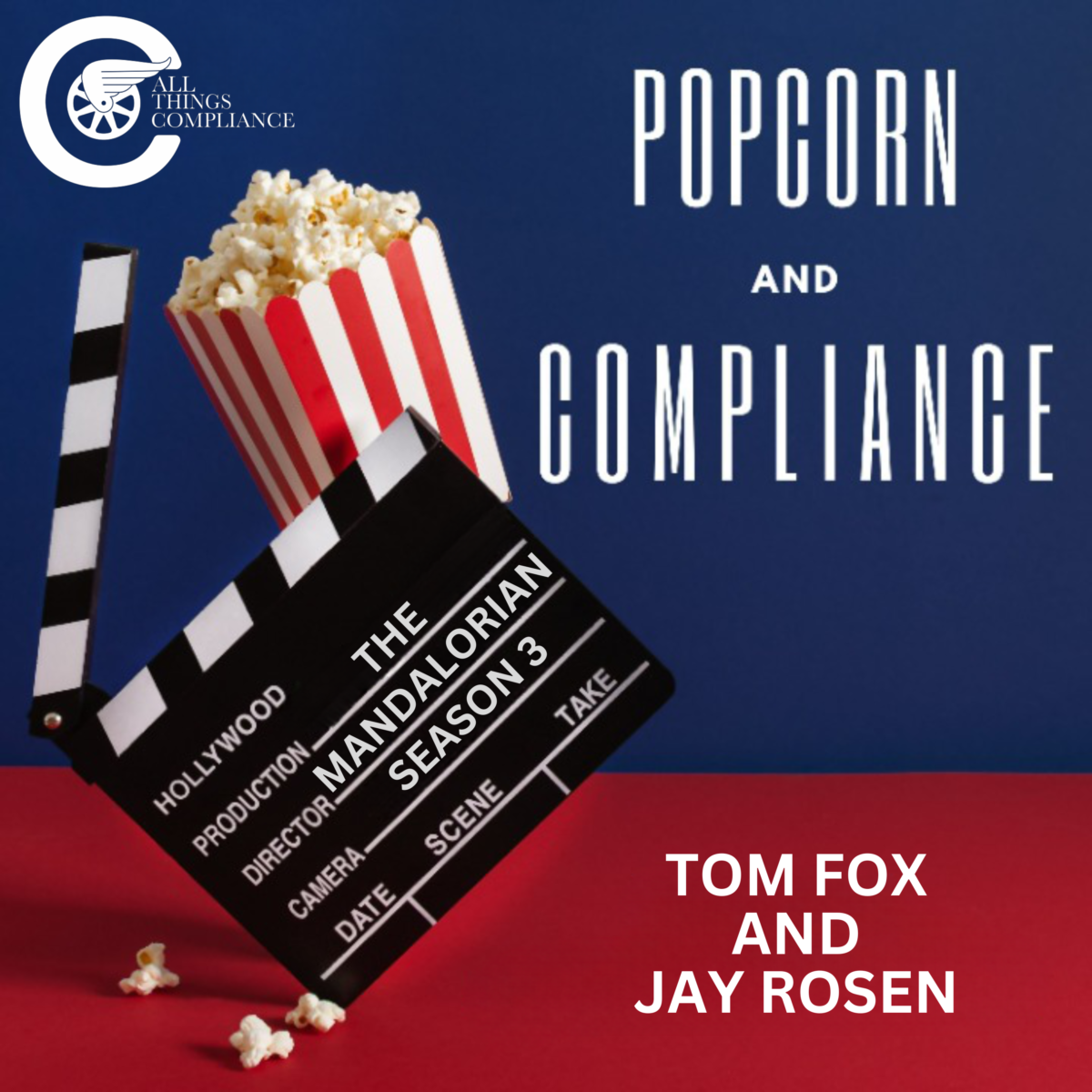
Popcorn and Compliance

Popcorn and Compliance: The Mandalorian, Season 3 – Episode 2, The Mines of Mandalore

Tom Fox and Jay Rosen are back with a special summer season of Popcorn and Compliance. In this special series, Tom and Jay will review the Mandalorian, Season 3. Get ready for a ton of fun, insights and all things Grogu and Mandalorian.

Welcome back, fellow “The Mandalorian” enthusiasts! In this blog post, we’ll be diving deep into the plot and themes of “The Mines of Mandalore,” an episode that takes us on an exhilarating journey alongside our beloved protagonist, Dinjardin. Get ready for a thrilling adventure filled with comedic encounters, unexpected alliances, and thought-provoking messages. So, grab your helmets and let’s explore the intricacies of this captivating episode!

In this episode, Tom and Jay delve into the key components and events of The Mandalorian episode. The discussion centers around the quest of the main character, Dinjardin, as he seeks the waters and atmosphere below Mandalore, despite being warned by Bo Katan that the planet is poisoned. Along his journey, Dinjardin encounters a malfunctioning IG unit and a comedic repair shop owner played by Amy Sederis.

They dive into the significance of the IG unit’s malfunction and the confusion surrounding a scene where Dinjardin jumps into healing waters. They speculate about the meaning of a Mythosaur seen by Bo Katan in the water. The episode’s ecological message, depicting the destruction of Mandalore as a climate disaster caused by nuclear war, is also discussed. The strained relationship between Mandalorians and Jedi is explored, with references to their past interactions. Overall, the conversation offers insights into the episode’s plot and character development, while addressing speculative elements.

Key Highlights

  1. The Power of Friendship: Amy Sederis’s Character and the Journey Begins. Our hero, Dinjardin, embarks on a quest to save Mandalore from poisoned waters and mines. Along the way, he encounters the hilarious repair shop owner, played brilliantly by Amy Sederis. With the help of her team of jawas and repair droids, she becomes an unexpected ally in his mission. This reminds us of the importance of friendship and how even the most unlikely companions can make a significant impact on our journey.
  1. The Perils of Mandalore: A Nefarious Encounter and a Call for Help. As Dinjardin heads to Mandalore, he faces a dangerous encounter with a mysterious character, possibly half-robot with organic material, who seeks to harm him. In a nail-biting moment, Dinjardin calls upon Grogu, his loyal companion, to go back and seek assistance from Bo Katan. This teaches us the value of relying on our support network during challenging times and the importance of communication.
  1. Strained Relations: Animosity Between Mandalorians and Jedi. During the episode, Bo Katan mentions the animosity between Mandalorians and Jedi, hinting at a complicated history. While it remains unclear where this tension stems from, it adds an intriguing layer to the narrative. This serves as a reminder that even in fictional worlds, conflicts can arise between different groups, emphasizing the need for understanding and open dialogue.
  1. Mythosaur Symbolism: Unraveling the Mystery. One of the most captivating scenes in “The Mines of Mandalore” involves Dinjardin and Bo Katan in the healing waters. As they immerse themselves, Bo Katan catches a glimpse of a mythosaur, a symbol deeply rooted in Mandalorian mythology. The mythosaur represents a time when Mandalorians thrived, and its appearance holds significant meaning. Although the exact interpretation of this scene remains elusive, it adds an air of mystery and intrigue to the storyline.
  1. Ecological Message: A Climate Disaster Unveiled. “The Mines of Mandalore” also shines a light on the destruction of the planet, caused by a devastating nuclear war. This ecological message serves as a powerful reminder of the consequences of our actions and the urgent need to protect our environment. The episode’s portrayal of a climate disaster resonates with real-world concerns, emphasizing the importance of addressing environmental issues in our own lives.

“The Mines of Mandalore” takes us on a thrilling adventure, filled with unexpected alliances, mysterious symbolism, and thought-provoking messages. Through the comedic encounters and perilous situations, we learn the value of friendship, the significance of relying on our support network, and the importance of understanding between different groups. Additionally, the ecological message reminds us of our responsibility to protect our planet. As we eagerly await the next episode, let’s reflect on the lessons learned from this enthralling chapter in “The Mandalorian” saga.

“The Mandalorian” continues to captivate audiences with its compelling storytelling, memorable characters, and breathtaking visuals. Jon Favreau’s stewardship of the series strikes a perfect balance between nostalgia and innovation, leaving fans eagerly anticipating each new episode. As we eagerly await the next installment, titled “The Mines of Mandalore,” let’s celebrate the remarkable journey this show has taken us on so far.

 This is The Way!

Categories
Blog

Farewell to Robbie Robertson and a Welcomed District Court Decision in the FCPA World

Robbie Robertson died this week. He was the lead songwriter and one of the five members of a rock and roll group that was so impactful, it was simply known as The Band. Robertson came from Canada but wrote in a genre which is now called ‘Americana’. He had one of the sharpest senses for songwriting I fhave ever seen or more appropriately heard. According to his New York Times (NYT) obituary, “wrote for the Band used enigmatic lyrics to evoke a hard and colorful America of yore. With uncommon conviction, they conjured a wild place, often centered in the South, peopled by rough-hewed characters, from the defeated Confederate soldier in “The Night They Drove Old Dixie Down” to the tough union worker of “King Harvest Has Surely Come” to the shady creatures in “Life Is a Carnival.””

Robertson himself said of his musical writing, in a 1995 interview for the public television series “Shakespeare in the Alley”, “I wanted to write music that felt like it could’ve been written 50 years ago, tomorrow, yesterday — that had this lost-in-time quality. We just went completely left when everyone else went right.”

We recently saw the release of one of the most significant decisions ever involving internal investigations in the Foreign Corrupt Practices Act (FCPA) arena, that in the case of US v. Coburn and Schwartz or more colloquially known and the Cognizant investigation decision as it came from FCPA declination awarded to the company Cognizant Technologies even with allegations of Chief Executive Officer (CEO) and General Counsel (GC) involvement in the bribery scheme.

One of the central themes emphasized by the court’s decision is the significance of independence in company investigations. The reason is that if a company or their outside counsel act as a proxy for the government can compromise the integrity of the investigation process. Indeed the defendants in this criminal action wanted the entire investigation and everything that flowed from it thrown out of court in their criminal case. In its decision, the court firmly established the need for companies to maintain independent decision-making and avoid being coerced or directed by the government. This highlights the importance of conducting thorough and unbiased internal investigations.

The underlying Cognizant Technologies case was extremely significant under what was then the FCPA Pilot program as the company was able to obtain a Declination even with alleged C-Suite involvement. This decision turned many heads in the compliance arena and this procedural decision demonstrates importance of self-disclosure by companies before the involvement of the Department of Justice (DOJ). In the case discussed, Cognizant’s board became aware of bribery and corruption allegations and promptly made a self-disclosure to the DOJ. This proactive step demonstrates the value of companies taking responsibility and initiating the investigation process themselves. It also aligns with the FCPA corporate enforcement policy, which encourages extensive cooperation.

The Timeline on the claims that the DOJ directed this investigation are significant. From the Order it states

On  August 20, 2016 Cognizant’s outside counsel DLA Piper interviewed Srimanikandan Ramamoorthy, Cognizant’s Vice President of Administration. He stated that Cognizant’s General Counsel, Steven Schwartz, and its President, Gordon Coburn, authorized a $2.5 million payment to Indian officials to obtain a planning permit for a Cognizant facility in Chennai. Schwartz and Coburn were immediately removed from all aspects of DLA’s pending internal investigation.

Cognizant insisted that Schwartz and Coburn cooperate with the internal investigation, in particular by submitting to interviews.

On August 28, 2016, DLA conducted its first interview with Schwartz. The DLA attorneys who interviewed Schwartz, including Buch, set and enforced strict ground rules for the interview, including prohibiting Schwartz from having more than one lawyer present and not allowing that lawyer to take notes or ask questions.

Coburn was also interviewed by DLA in August 2016 but did not have a lawyer present.

On September 1, 2016, DLA contacted an attorney at the DOJ. During a meeting on the following day, DLA self- disclosed, on behalf of Cognizant, Cognizant’s potential FCPA violations. DLA also informed the Government of the company’s intention to “fully cooperate with the DOJ and the SEC” and asked that Cognizant “be considered for inclusion in the FCPA Pilot Program.” DLA had engaged in no contact with the Government on behalf of Cognizant prior to those communications.

So clearly there was a decision to self-disclose after the defendants were interviewed. This means the DOJ could not have directed the investigation. But there were several points that bear consideration for the court’s Order.

A crucial aspect highlighted by the court’s Order is the need for companies to document investigations thoroughly. This includes justifying decisions made during the investigation and building a fully documented record to address potential legal challenges or claims. Additionally, fair employee interviews play a significant role in the investigation process. The court’s opinion raises concerns about restrictions placed on employee interviews, such as not allowing note-taking. Companies should ensure that employees have proper legal representation and are given a clear choice while respecting the need for confidentiality.

The court’s decision emphasizes the importance of a fully developed record, which serves as a roadmap for conducting investigations. In complex investigations with a vast amount of information, maintaining a comprehensive record can be challenging. However, it is essential to meet this challenge head-on. A systematic approach, including investigative planning, document review, and retention, is crucial. This not only helps defend against potential challenges from the DOJ or individual prosecutions but also provides a solid foundation for shareholders and other stakeholders.

The recent district court decision has far-reaching implications for companies conducting internal investigations in FCPA cases. By emphasizing the need for independence, self-disclosure, and robust record-keeping, the court has set a standard for future investigations. Companies must take note of these practical insights and data-driven recommendations to navigate the complex landscape of FCPA cases successfully. By doing so, they can ensure compliance, protect their interests, and maintain the integrity of their internal investigations.

Categories
31 Days to More Effective Compliance Programs

One Month to a More Effective Compliance Program: Day 7 – Designing Compensation to Operationalize Compliance

In this podcast episode, Tom Fox highlights the importance of incorporating compensation systems into a company’s compliance program. He discusses how the DOJ and SEC view monetary structures as a way to reinforce compliance and reward employees who adhere to compliance programs. Fox advises compliance practitioners to revise incentive systems to align with the goals of the compliance program, ensuring simplicity, alignment with company values, and immediate behavior change. He also emphasizes the need to align compensation programs with compliance goals and shares examples of how this can be done effectively. These episodes provide valuable insights into the role of compensation in promoting compliance and integrating compliance into HR practices, emphasizing the importance of transparency and immediate action in implementing effective compensation structures for compliance.

When it comes to compliance programs, many companies focus primarily on policies, procedures, and training. However, designing a compensation system that reinforces compliance is equally crucial. According to the Department of Justice (DOJ) and the Securities and Exchange Commission (SEC), rewarding employees who conduct business in compliance with their employers’ programs is an effective way to promote compliance.

  1. Incorporating Compliance Incentives:

To align your compensation system with your compliance program, consider revising your incentive structure. Fox advises compliance practitioners to ask themselves three key questions: Is it simple? Is it aligned with company values? Does it affect behavior immediately?

Keeping the compensation plan simple is essential to prevent employees from reverting to old, non-compliant behaviors. By aligning the goals of compliance practitioners with the entity’s compliance goals, you can ensure that the compensation program effectively drives desired behaviors.

2. The Impact of Sales Compensation:

Salespeople often generate the majority of a company’s revenue, making their alignment with compliance goals crucial. Immediate implementation of incentive structures is important, but it should also incentivize employees to support compliance initiatives. Transparent communication with employees or third-party sales bases is necessary for effective implementation.

3. Transparency and Accountability:

Transparency plays a vital role in gaining acceptance for compliance initiatives. While designing the incentive system may not be a democratic process, openness is essential. Employees should appreciate the transparency in the compensation structure, leading to accountability and their acceptance of compliance goals.

4. Integrating Compliance Incentives:

The podcast suggests incorporating compliance incentives into the compensation program. Even a small percentage of a discretionary bonus can be significant to employees. For example, a discretionary bonus program based on overall sales can be a starting point for incorporating compliance incentives. Fox recommends allocating 5-10-20% of the discretionary bonus program towards compliance incentives.

5. The Role of HR in a Fully Operationalized Compliance Program:

To fully operationalize compliance, it is essential to integrate compliance into HR practices. HR can play a crucial role in ensuring transparency, simplicity, and alignment of the compensation structure with company values. By making compliance part of the incentive structure, employees will understand and support the evolving business model and strategy of the organization.

As compliance practitioners, it is our responsibility to prioritize integrity, ethics, and compliance within our organizations. Incorporating compensation systems into our compliance programs is a powerful tool in driving desired behaviors. By aligning our incentive structures with compliance goals, keeping them simple, and fostering transparency, we can create a culture of accountability and acceptance.

Three key takeaways:

  1. The DOJ and SEC have long advocated compensation to motivate employees into ethical and compliant behaviors.
  2. Keep the compliance aspects of your compensation structure simple and easy for your employees to understand.
  3. Have full transparency in the frame of your compensation structure.

For more information, check out The Compliance Handbook, 4th edition, available on LexisNexis.com.

Categories
Hill Country Authors

Hill Country Authors Podcast – Kimberly Fish – The Town of Comfort as a Character

Welcome to the award-winning The Hill Country Authors Podcast. In this podcast, Hill Country resident Tom Fox visits with authors who live in and write up the Texas Hill Country. In this episode, Tom visits with author Kimberly Fish who features Comfort in many of her books.
This podcast episode explores how the history of the Texas Hill Country has impacted two authors’ writing careers. Tom Fox and Kimberly Fish discuss how German immigration to the region in the mid-1800s left a lasting impact on the state. As a result of this influence, Comfort, Texas was founded by German immigrants and has its language, customs, and monument. Tom Fox and Kimberly Fish bring the Hill Country to life through their work, with Tom Fox incorporating Comfort, Texas as a character in his stories and Kimberly Fish creating a fictionalized version of the town to introduce readers to the nuances of the Hill Country of Texas.

Key Highlights

·       Texas Hill Country

·       German Immigration to Texas

·       Comfort’s History

·      Creating a Character Town

Resources

Kimberly Fish

Tom Fox

Instagram

Facebook

YouTube

Twitter

LinkedIn

Categories
Investing in the Future

Investing in the Future: Ry’lee Paxton – Leading with KAYLA: Unlocking Community Success

How do small towns and rural counties invest in their future? Tom Fox and Andrew Gay explore this topic in their new podcast series Investing in the Future – Developing Leadership in Kerr County. Leadership Kerr County is the premier leadership program in the Hill Country which enables men and women to learn more about the issues and topics that face Kerrville, Kerr County, and the Hill Country on a daily basis; everything from education and social services to economic development and health care. Kerr County has made the decision to invest in its citizens to create future leaders and lay a foundation for their future involvement in the leadership of Kerrville and Kerr County. This podcast is produced and hosted by the Texas Hill Country Podcast Network.

KAYLA is an incredible organization that provides high schoolers in Kerr County with the opportunity to develop their leadership skills and gain exposure to the inner workings of their local community through the Leadership Academy and Youth Leadership Program. Through these programs, students learn important concepts like civic engagement and budgeting, as well as develop relationships with their peers and city officials. By attending the Academy, students gain an understanding of municipal government roles and responsibilities. Meanwhile, the Youth Leadership Program educates students on the importance of local job opportunities and building meaningful relationships. With KAYLA, young people can become successful leaders in their own communities.

 Key Highlights

·       Youth Leadership in Kerrville and Kerr County

·       City Budgeting

·      Leadership Academy

·      Kerr County Youth Leadership Program

 Resources

Kayla

Tom Fox

Instagram

Facebook

YouTube

Twitter

LinkedIn