Categories
FCPA Compliance Report

Susan Divers on 2023 LRN Program Effectiveness Report

Welcome to the award-winning FCPA Compliance Report, the longest running podcast in compliance. In this special episode, I am joined by Susan Divers, Director of Thought Leadership at LRN to discuss LRN’s 2023 Program Effectiveness Report.  In this episode, Susan and I discuss making your ethics and compliance program is as effective as possible. We include a consideration of the gulf between high performing and less effective programs as well as the impact of the pandemic on compliance;  the importance of empowering middle managers and involving them more in ethics and compliance. Susan also explains why companies need to upgrade their systems to make them more effective, particularly in the data component.

Key Takeaways:

[00:04:50] The Pandemic’s Effects on Compliance Programs

[00:09:17] Decreased Engagement of Senior Management in Ethics and Compliance Throughout the Pandemic

[00:13:52] The Importance of Upgrading Data Systems for Optimal Compliance

[00:18:26] Proof the Program has Been Successful in Improving Student Achievement.

Act now and use the link below to obtain a copy of the Report at no cost. It’s the perfect way to learn more about ensuring your ethics and compliance program is as effective as it should be.

Resources:

Connect with Tom Fox

Connect with Susan Divers

Download the LRN 2023 Program Effectiveness Report

Categories
Great Women in Compliance

Ellen Smith – Trade Compliance

Welcome to the Great Women in Compliance Podcast, hosted by Mary Shirley and Lisa Fine. Today’s episode on Trade Compliance, with Ellen Smith, is a celebration of male allyship.  Ellen was nominated to be on the Great Women in Compliance podcast by Matt Silverman.  It is always a joy for Lisa and Mary to see men supporting women and leveraging off the #GWIC podcast to achieve this.

Ellen joins Mary and walks us through some Trade Compliance hot topics of the moment and helps us understand what boycotts are and how they fit into the Trade Compliance landscape.  She also shares her journey about how she came to specialize in this subject matter area and tell us about hanging her own shingle in the space.

One other way you can improve your workplace is with employee recognition, and Mary’s “Living Your Best Compliance Life” column at Corporate Compliance Insights can provide some great insights on the benefits of doing so and some ideas that can brighten someone’s day.

The Great Women in Compliance Podcast is on the Compliance Podcast Network with a selection of other Compliance related offerings to listen in to.  If you are enjoying this episode, please rate it on your preferred podcast player to help other likeminded Ethics and Compliance professionals find it.  If you have a moment to leave a review at the same time, Mary and Lisa would be so grateful.  You can also find the GWIC podcast on Corporate Compliance Insights where Lisa and Mary have a landing page with additional information about them and the story of the podcast.  Corporate Compliance Insights is a much-appreciated sponsor and supporter of GWIC, including affiliate organization CCI Press publishing the related book; “Sending the Elevator Back Down, What We’ve Learned from Great Women in Compliance” (CCI Press, 2020).

If you enjoyed the book, the GWIC team would be very grateful if you would consider rating it on Goodreads and Amazon and leaving a short review.  Don’t forget to send the elevator back down by passing on your copy to someone who you think might enjoy reading it when you’re done, or if you can’t bear parting with your copy, consider it as a holiday or appreciation gift for someone in Compliance who deserves a treat.

You can subscribe to the Great Women in Compliance podcast on any podcast player by searching for it and we welcome new subscribers to our podcast.

Join the Great Women in Compliance community on LinkedIn here.

Categories
Compliance Into the Weeds

Activision Blizzard Settlement with SEC

The award winning, Compliance into the Weeds is the only weekly podcast which takes a deep dive into a compliance related topic, literally going into the weeds to more fully explore a subject. In this episode, Matt and I take a deep dive into the recent Activision Blizzard settlement with the SEC for the company’s failings around internal controls regarding the detection and prevention of sexual harassment and its whistleblower protection laws.

Some of the highlights include:

·      The background facts.

·      The toxic culture which led to the claims.

·      The denials by company officers that anything was wrong or to the validity of the claims.

·      How does this ruling tie into the Delaware court decision on the duty of oversight?

·      Must there be a material risk for the creation of an information system?

·      What about CCO certification?

·      What does it all mean for CCOs going forward?

 Resources

SEC Order

Matt Kelly in Radical Compliance

Categories
Daily Compliance News

February 8, 2023-the Dry at MSG Edition

Welcome to the Daily Compliance News. Each day, Tom Fox, the Voice of Compliance, brings you compliance-related stories to start your day. Sit back, enjoy a cup of morning coffee, and listen to the Daily Compliance News. All from the Compliance Podcast Network. Each day we consider four stories from the business world, compliance, ethics, risk management, leadership, or general interest for the compliance professional.

Stories we are following in today’s edition of Daily Compliance News:

  • No beers at MSG? (Reuters)
  • Corps want business data protected under EU Data Act. (FT)
  • Singapore may review the non-prosecution of Keppel Offshore. (Bloomberg)
  • Crypto rebrands. (WSJ)
Categories
31 Days to More Effective Compliance Programs

One Month to More Effective Internal Controls – Assessing for Internal Controls in International Operations

How should you assess your internal controls regime for international operations? It is incumbent that you need to review as much information as you can to understand an entity’s financial and operational structure and how it is integrated with the corporate headquarters or the U.S. business unit’s financial and operational structure if the foreign operation is part of a U.S. business unit.

You could begin with the TI-CPI to garner a sense of the reputation of the country in which your business unit is located, as well as the CPI for all other countries in which the location either markets business or has current customers. Another area for inquiry or review is the scope of your foreign operations. Other areas of inquiry should include whether your company’s finance and accounting staff produce financial statements that are integrated into the parent’s financial statements, whether your international business locations utilize a local bank account for local sales receipts as well as funds transfers from the U.S. and whether the account has local check signers and whether dual signatures are required on the checks. You may also want to consider the extent to which disbursements are made in the local currency and whether there is a local petty cash fund.

As with many other areas around internal controls, it is important to consider the local DOA and whether it is consistent with your corporate DOA. Some of the considerations regarding the local DOA should extend to which corporate or U.S. business unit approvals are required for transactions initiated locally, such as 1) approval of vendor invoices; 2) disbursements of funds, including wire transfers; 3) execution of facilities leases; 4) execution of contracts with agents; and 5) approval of pricing and credit terms to customers and distributors. You should also review whether the local DOA provides appropriate SODs at the local business unit level.

These reviews, questions, inquiries, and analyses are designed to locate the pressure points involved in any company’s sales processes. This is because pressure is a key element of occupational fraud, and the risk of fraud, including corruption, increases as the pressure increases. Since corruption is viewed as a subset of fraud, it might be a good time to review the “fraud triangle,” which lays out a breeding ground for fraud in the corruption context.

 Three key takeaways:

1. You must understand your company’s financial and operational structure and how that structure outside the U.S. is integrated with the corporate headquarters.

2. Are your financial statements and reporting systems integrated?

3. Always consider the fraud triangle.

Categories
Innovation in Compliance

Key Board Issues Going Forward with Christina Bresani

What are some of the challenges facing board members in providing meaningful oversight? Christina Bresani, head of William Blair’s Corporate Advisory Team, is here to share her take. Host Tom Fox and Christina are going to delve into the current state of the corporate world, touching on the challenges faced by boards of directors. They’ll also discuss the increase of unsolicited offers and the importance of being prepared for them. This is a thought-provoking conversation that will shed light on the current landscape of the corporate world.

Christina Bresani is a seasoned investment banker with over 25 years of experience. She joined UBS right after graduation from Wellesley College where she studied economics and Spanish. After 20 years at UBS, she joined William Blair and currently leads the Corporate Advisory Team, a team that focuses on advising public companies on all things mergers and acquisitions.


Key points you’ll hear them discuss:

  • Christina tells Tom, “About 85% of the transactions that we’re seeing right now start with an unsolicited proposal.” They are advising clients on being prepared for unsolicited proposals and valuations in an uncertain market.
  • How William Blair works with clients to optimize their portfolio and their process for evaluating selling or spinning off businesses.
  • ESG is a focus area for boards. It’s now considered a “must-have” and not a “nice-to-have”. Boards and management teams focus on ESG as a day-to-day part of their decision-making process. Christina is happy to see companies take a more holistic oversight around ESG at the board level.
  • There has been an increase in shareholder activism and companies are worried about it and seeking help in preparing for it.
  • “Ultimately, what companies need to be thinking about is how to create shareholder value,” Christina tells listeners. This is what should be top of mind for boards going forward, she remarks.


KEY QUOTE:

“There are always intertwined relationships between boards and companies, and the real goal is to get all the brains together in a room to figure out if a deal makes sense for both sets of shareholders.” – Christina Bersani


Resources

Christina Bresani on LinkedIn


Categories
Everything Compliance - Shout Outs and Rants

Everything Compliance – Episode 111, Shout Outs and Rants

Welcome to the only roundtable podcast in compliance as we celebrate our second century of shows with our fan-fav Shout Outs and Rants section.

1. Matt Kelly shouts out to the State of Texas Legislature for creating a ‘Gold Card’ for physicians who have over 90% of all requested procedures covered by insurance.

2. Jonathan Marks rants about the Pentagon’s failure to shoot down a Chinese spy balloon.

3. Tom Fox shouts out to Hindenburg Research and all other short sellers who help uncover fraud, waste, and abuse.

4. Karen Woody shouts out to Amtrak and asks us all to ‘ride the train more often.’

5. Jay Rosen shouts out his twin daughters on their 15th birthday.

Categories
Daily Compliance News

February 7, 2023 – The Spotting Ponzi Schemes Edition

Welcome to the Daily Compliance News. Each day, Tom Fox, the Voice of Compliance, brings you compliance-related stories to start your day. Sit back, enjoy a cup of morning coffee, and listen to the Daily Compliance News. All from the Compliance Podcast Network. Each day we consider four stories from the business world, compliance, ethics, risk management, leadership, or general interest for the compliance professional.

Stories we are following in today’s edition of Daily Compliance News:

  • FTX judge considers independent investigation. (Reuters)
  • Chinese soccer is under corruption scrutiny. (Global Times)
  • 7 ways to spot a Ponzi scheme. (WaPo)
  • How to build successful sustainability programs. (WSJ)
Categories
31 Days to More Effective Compliance Programs

One Month to More Effective Internal Controls – Internal Controls in International Locations

While a CCO should expect (or at least hope) that internal controls at locations outside the U.S. are of the same effectiveness as internal controls within U.S. business units and at the U.S. corporate office, unfortunately, that might not always be the case, it is often the case that corporate level internal controls are stronger than those in foreign business units. There may well be several reasons for this. First, the CFO may be paying closer attention to the corporate level internal controls, with the idea that the corporate level internal controls are the final “filter” to detect issues. This follows partly from the focus in most companies on the controls over financial reporting, which does not include all controls needed for compliance. A second reason is that many companies were built through acquisitions, resulting in many business units (both in and outside the U.S.) having completely different accounting, ERP, and internal control systems than the corporate office. There is often a tendency to leave acquired companies in the state where they were acquired rather than trying to integrate their controls and conform them to those of current business units. After all, the reason for the acquisition was the company’s profitability, and nobody wanted to be accused of negatively impacting profitability.

A third situation may exist at locations outside the U.S. with what began simply as a sales office and then expanded its scope of operations to become a business unit with its accounting and data processing functions. Unfortunately, it is not often a situation where there was a master plan for internal controls as the location’s scope grew. Processes are usually added and designed by the local personnel, which, in practice, means the country manager has total control over financial affairs and is not truly accountable to the corporate office. This can be particularly true if a country’s business unit’s profits continue. In such situations, there will rarely be any focus on effective preventive internal controls for compliance risk.

Where should a CCO begin in any of the above scenarios? The first step is to determine the extent of centralization or decentralization of relevant processes or, put another way, to what extent are relevant processes performed at the corporate offices? The second step for the CCO is to determine the possible universe of risks and to assess the risks to result in a priority of how attention will be focused. One useful approach is to perform a location risk assessment, whose purpose is to capture each location outside the U.S. where your company conducts business in one place and assess the compliance risks posed by the nature of operations at each location. Once the risks at each location have been properly categorized, you can prioritize your approach to dealing with the risks.

 Three key takeaways:

1. Modifying your internal controls can work to operationalize your compliance program more fully.

2. Check the effectiveness of your internal controls for your international locations.

3. Revisit your internal controls when a country or region experiences large growth or disruption.


Categories
Corruption, Crime and Compliance

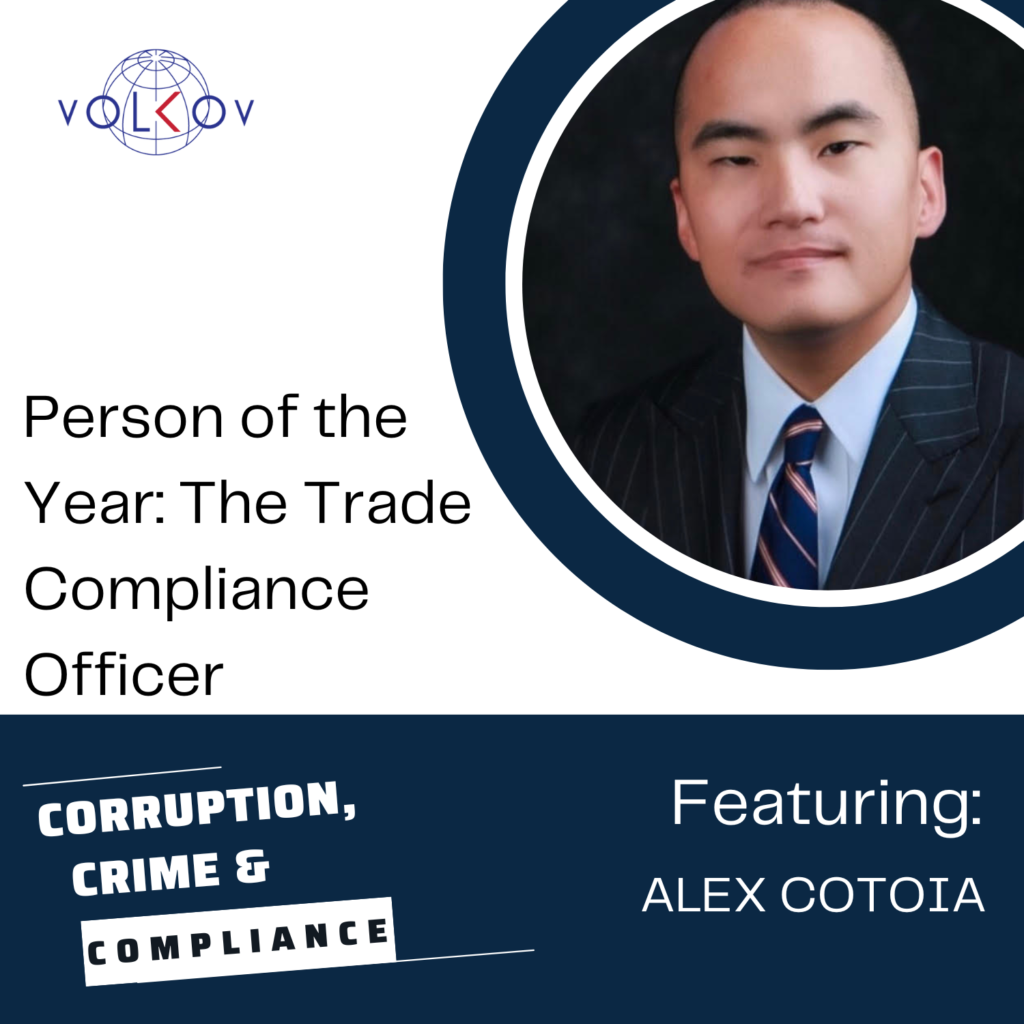
Person of the Year: The Trade Compliance Officer Featuring Alex Cotoia


Trade compliance officers were recognized as the “Person of the Year” in 2022. Michael Volkov welcomes Alex Cotoia, Regulatory Manager, to discuss this development. Alex sheds light on the challenges faced by these professionals over the past year: from navigating the global pandemic to ensuring compliance with sanctions regulations, trade compliance officers have done it all. 

Alex Cotoia, Regulatory Manager at The Volkov Law Group, is a seasoned trade compliance expert with extensive knowledge across ITAR compliance, BIS compliance of commerce, and opacity sanctions. She brings valuable insights on the crucial role of compliance in the world’s rapidly changing landscape.


Key ideas you’ll hear Michael and Alex discuss:

  • The unprecedented challenges faced by trade compliance professionals. The global pandemic and the rapid and constant changes in the regulatory climate had a major impact on trade compliance professionals.
  • The importance of trade compliance professionals was demonstrated this year, as they were seen as unsung heroes who played a crucial role in ensuring compliance with regulations.
  • The invasion of Ukraine by Russia led to a more fulsome political response compared to the invasion of Crimea in 2014, which further highlights the significance of trade compliance in today’s world.
  • The recommended approach for trade compliance is to consider the market exposure to sanctions risk and adopt measures that are reasonably designed to deter and detect infractions.
  • Increased importance of end-user certificates: The use of end-user certificates became more important in ensuring compliance with regulations in exports to Russia.
  • Michael and Alex emphasize the need for verifying the end use of products purchased from a third party to ensure it’s for a permissible purpose. 
  • Alex stresses the need for international organizations with broad exposure to invest heavily in trade compliance, including having a trade compliance officer and choosing the right tools. Michael highlights the importance of integrating the overall trade compliance function into the overall ethics and compliance function. This requires a strategic approach for trade compliance and sanctions risks, including education, internal controls, and technology solutions that integrate sanction screening, third-party risk management, incident reporting, and trade compliance.
  • The responsibility for internal controls lies with the leadership team and the board of directors.
  • Trade compliance should be part of compliance education.
  • Trade compliance is an industry that’s here to stay.


KEY QUOTE:

“Consider where the greatest sanction risk lies from a market exposure perspective and then adopt measures that are reasonably designed to deter and detect inflections.” – Alex Cotoia


Resources:

Alex Cotoia on LinkedIn | Email

The Volkov Law Group