In today’s edition of Daily Compliance News:



Richard Lummis and Tom Fox conclude their series on leadership lessons from Theodore Roosevelt. We will look at lessons from Roosevelt’s early years in New York up to his cowboying days in Montana; the second phase of his public career, from NYC Police Commission to Assistant Secretary of the Navy, San Juan Hill and the Vice Presidency; his leadership from his Presidency; his life in the post-Presidency and the election of 1912 and we will end with leadership lessons from his post Bull Moose Party life, World War I and event surrounding his death. In this fourth episode, we consider the leadership lessons learned from Roosevelt’s years after the end of his second term up through his run for President at the head of the Bull Moose Party in 1912.
Highlights of this podcast include:
Roosevelt goes big game hunting and holds meetings with political leaders across all of Europe. What led to the schism in the GOP and Roosevelt’s defeat at the GOP 1912 Convention? The formation of the Bull Moose Party and his survival of an assassination attempt. The election of 1912, his loss to Wilson but his overwhelming defeat of his former protegeé, William Taft. We conclude this episode with three key leadership lessons, including: 1. Change when the facts change; 2. Don’t be afraid of making unpopular decisions; and 3. Leaders are Learners.
Resources
Doris Kearns Goodwin’s 10 Leadership Lessons from the White House
6 Leadership Hacks From The Rise of Theodore Roosevelt
10 top Leadership Principles of Teddy Roosevelt
The Roosevelts: Eight presidential lessons in leadership
Lessons in Leadership from 100 years ago
Theodore Roosevelt on Leadership
10 Theodore Roosevelt Leadership Lessons

Sarah Dadush is a business and human rights law practitioner with a background in international development. She also teaches Contracts, Business & Human Rights, and Consumer Law at Rutgers Law School. Susan Maslow is an experienced business attorney with a focus on transactional corporate law, and a co-founder and partner at Antheil Maslow & MacMinn. They join host Gwen Hassan to discuss how contracts can be used as preventative measures against human rights violations.
Upon coming across the Model Contract clause 1.0 (also called standard contractual clauses), Sarah was taken by the idea of using contracts as a tool for improving the human rights performance of international supply chains. As contracts are well within the dominion of firms, there was something promising about using these legal links in the supply chain to serve a new purpose. Unfortunately, the 1.0 had a significant pain point, but the updated 2.0 intends to solve it.
This pain point, Susan shares, is that model clauses’ definition of non-conforming goods did not address the buyer’s desire to call them non-conforming or even use traditional contract remedies. Soccer balls that are black and white and perfectly stitched look like conforming goods, even if they were made with forced labor. “The first step in [our process] was to define goods that were tainted by forced labor, child labor, or other human rights abuses as defective,” she adds.
Resources
Sarah Dadush on LinkedIn
Susan Maslow on LinkedIn
AMM Law – Susan Maslow
In today’s edition of Daily Compliance News:
Last week, the Attorney General and a host of other Department of Justice (DOJ) officials announced the settlement of a massive Foreign Corrupt Practices Act (FCPA) and market manipulation case against Glencore plc (Glencore). Over the next several blog posts, I will be reviewing the matter and mining it for lessons learned for the compliance community. Today, in Part III, we take a detour into the Commodity Price Manipulation Case and see how this matter should be studied by compliance professional.
In this case separate and apart from the FCPA enforcement action, Glencore admitted to a muti-year scheme to manipulate fuel oil prices at two of the busiest commercial shipping ports in the United States. Under the terms of the Commodities Future Trading Commission (CFTC) resolution, the company will pay a criminal fine of $341,221,682 and criminal forfeiture of $144,417,203. Under the terms of the Plea Agreement, the DOJ will credit over $242 million in payments that the company makes to the CFTC.
According to the CFTC Press Release, Glencore’s manipulative and fraudulent conduct—including conduct relating to foreign corruption—defrauded its counterparties, harmed other market participants, and undermined the integrity of the US and global physical and derivatives oil markets. Platts physical oil benchmarks, including those that were the subject of Glencore’s manipulative conduct, serve as price benchmarks for end-users and market participants, and are incorporated as reference prices for the settlement of numerous derivatives. (For a copy of the CFTC Order, see link in the CFTC Press Release.)
According to the CFTC Order, Glencore had a global commodity trading business, which included trading in fuel oil. Between approximately January 2011 and August 2019, Glencore conspired to manipulate two benchmark price assessments published by S&P Global Platts (Platts) for fuel oil products, specifically intermediate fuel oil 380 CST at the Port of Los Angeles (Los Angeles Fuel) and RMG 380 fuel oil at the Port of Houston (US Gulf Coast Fuel Oil). The Port of Los Angeles is the busiest shipping port in the US by container volume. The Port of Houston is the largest US port on the Gulf Coast and the busiest port in the US by foreign waterborne tonnage.
As part of the conspiracy, Glencore employees sought to unlawfully enrich themselves and the company, by increasing profits and reducing costs on contracts to buy and sell physical fuel oil, as well as certain derivative positions the company held. The price terms of the physical contracts and derivative positions were set by reference to daily benchmark price assessments published by Platts—either Los Angeles Fuel or US Gulf Coast Fuel Oil—on a certain day or days plus or minus a fixed premium. On these pricing days, Glencore employees submitted orders to buy and sell (bids and offers) to Platts during the daily trading “window” for the Platts price assessments with the intent to artificially push the price assessment up or down.
In an example from the CFTC Order, if Glencore had a contract to buy fuel oil, employees submitted offers during the Platts “window” for the express purpose of pushing down the price assessment and hence the price of the fuel oil that Glencore purchased. The bids and offers were not submitted to Platts for any legitimate economic reason by company employees, but rather for the purpose of artificially affecting the relevant Platts price assessment so that the benchmark price, and hence the price of fuel oil that the company bought from, and sold to, another party, did not reflect legitimate forces of supply and demand.
Between approximately September 2012 and August 2016, Glencore Ltd employees conspired to manipulate the price of fuel oil bought from, and sold to, a corrupt counterparty (Company A) through private, bilateral contracts, by manipulating the Platts price assessment for Los Angeles Fuel. Between approximately January 2014 and February 2016, Glencore engaged in a “joint venture” with Company A, which involved buying fuel oil from Company A at prices artificially depressed by Glencore’s manipulation of the Platts Los Angeles Fuel benchmark. Finally, between approximately January 2011 and August 2019, company employees conspired to manipulate the price of fuel oil bought and sold through private, bilateral contracts, as well as derivative positions, by manipulating the Platts price assessment for US Gulf Coast Fuel Oil.
The CFTC also noted Glencore was involved in market manipulation through illegally obtaining confidential information by improperly obtained nonpublic information from employees and agents of the state-owned enterprises (SOEs), including Pemex in Mexico. This information was material to Glencore’s business and trading. Pemex agents who had access to confidential information and owed a duty to Pemex under Mexican law and Pemex internal policies to keep the information confidential—disclosed nonpublic information, “including information material to Glencore’s transactions with the SOE or to related physical and derivatives trading, to Glencore. Glencore traders in knowing possession of the confidential information then entered into related physical transactions and derivatives transactions.”
Finally, as we noted in yesterday’s recitation of the FCPA allegations, Glencore made corrupt payments to employees and agents working at SOEs in Brazil, Cameroon, Nigeria, and Venezuela. Glencore or its affiliates made the corrupt payments in exchange for improper preferential treatment and access to trades with the SOEs. Glencore’s conduct was designed to increase Glencore’s profits from certain physical and derivatives trading in oil markets around the world, including US physical and derivatives markets. Glencore also engaged in this corrupt conduct in connection with derivatives such as swaps and futures contracts subject to the rules of Commission-registered entities.
Tomorrow we will consider the settlement.
Is there a little voice in your heart telling you it’s time to take a different path, but your head doesn’t want to follow?
Are you afraid to show who you are because you think you have to be tough or show up a certain way?
Do you think you are the only one putting one foot in front of the other but feel like you are tripping over your own feet?
Well, my friend, you are not alone.
I was blessed to spend time with my friend Ashanti Branch, Founder and Director of Ever Forward, on #jammingwithjason. When you listen to this episode, you will see this man’s big heart, and he is one of my heroes who is doing some amazing things to change the world positively.
This is an authentic discussion where we talk about living our purpose, taking off our masks so the world can see who we are; you can’t put a price tag on changing lives for the better, emotional maturity, providing people space to be themselves, and so much more. You will relate to Ashanti’s story, and the fact that you are reading this means there is something you need to hear in this #podcast episode.
Learn more about Ashanti and the great work Ever Forward Club is doing at: https://everforwardclub.org/ and while you are there, donate so they can help more people 🙂
Create your mask at: https://millionmask.org/ and join the revolution of letting the world see who you are! You will know you are not alone.
FOR FULL SHOW NOTES AND LINKS, VISIT:
LIKED THE PODCAST?
If you’re the kind of person, who likes to help others, share this with your friends and family. If you found value, the will too. Please leave a review [https://itunes.apple.com/us/podcast/jamming-with-jason-mefford/id1456660699] on Apple Podcasts to reach more people.
OTHER RESOURCES YOU MAY ENJOY:
My YouTube channel [https://www.youtube.com/c/jasonleemefford] and make sure to subscribe
My Facebook page [https://www.facebook.com/jammingwithjasonmefford]
My LinkedIn page [https://www.linkedin.com/in/jasonmefford/]
My website [https://jasonmefford.com]
STAY UP TO DATE WITH NEW CONTENT:
It can be difficult to find information on social media and the internet, but you get treated like a VIP and have one convenient list of new content delivered to your inbox each week when you subscribe to Jason’s VIP Lounge at: https://jasonmefford.com/vip/ plus that way, you can communicate with me through email.
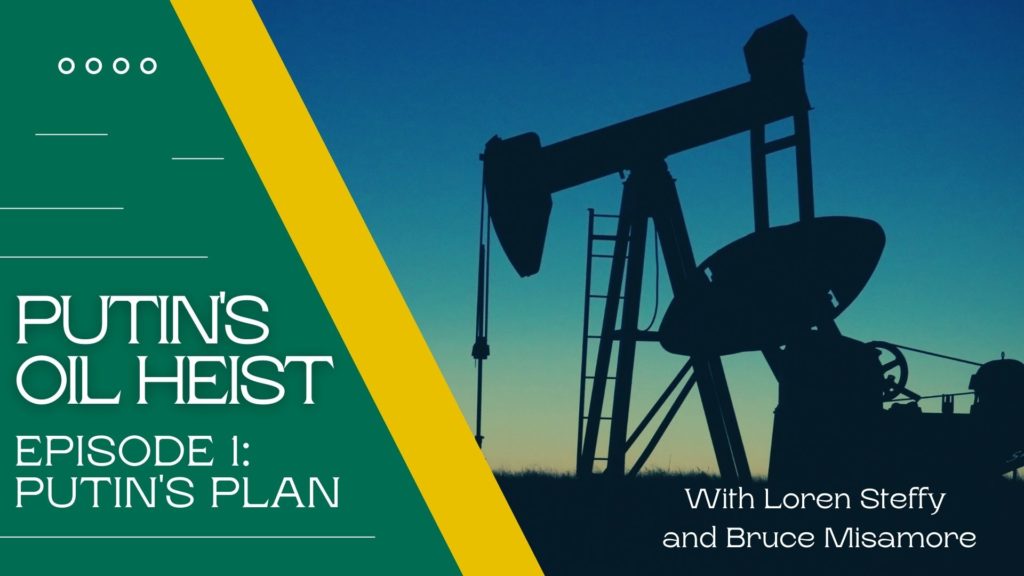
“If you want to understand the story behind the story of Russia’s invasion of Ukraine, you can draw a straight line back to the Yukos Affair.” The demise of Yukos, Russia’s second-biggest oil company, marked the first time that Vladimir Putin tested the West, watching to see how the West would respond to the seizing of the company’s assets, Bruce Misamore says. Putin’s Oil Heist is an insider’s account of the Yukos Affair. In this pilot episode, host Loren Steffy explores how it unfolded, with first-person accounts from Misamore, the company’s former Chief Financial Treasurer.
Listen to the Episode now:
Learn About:
Resources
Loren Steffy on LinkedIn
Stoney Creek Publishing

In this episode of Career Can Do, Mary Ann Faremouth chats with Freya Krishnan, who is Leadership Development Manager at Women of the World Network. Freya is a visibility and confidence coach, speaker, and best-selling international author with a background in software development and a broad understanding of computer environments. As the founder of Chasing Happy Mondays, she is passionate about living a balanced life, empowering women, and advocating for small businesses. Freya talks about her personal and professional journey and shares insights about how she helps women entrepreneurs.
As a business coach, Freya focuses on giving women the confidence and the tools to become more visible in their business. Both success and failure build confidence, she claims – not the failure itself, but how we overcome it and develop the skills to help us be better in future attempts. “It’s about progress and not perfection,” she says. She talks about her experience as President of the Society of Women Engineers, and how she coaches women to overcome their fears.
There are so many entrepreneurs who have the most amazing ideas, the best services, and the greatest products, but there’s something stopping them, Freya says. They either don’t have the confidence or don’t know the right strategies to get themselves seen. Freya helps them identify which visibility channels work best for them.
Resources
Freya Krishnan on the web | LinkedIn | Facebook
Faremouth.com
Welcome to The Hill Country Podcast. The Texas Hill Country is one of the most beautiful places on earth. In this podcast, Hill Country resident Tom Fox visits with the people and organizations that make this the most unique areas of Texas. Join Tom as he explores the people, places and their activities of the Texas Hill Country. In this episode, I visit Louis Amestoy, EIC of the The Lead, an online local news show in Kerrville. We discuss the recent Kerrville city and country elections.
Resources
The Lead
Welcome to the Great Women in Compliance Podcast, co-hosted by Lisa Fine and Mary Shirley.
It’s the 150th episode of the Great Women in Compliance podcast. This is a special episode because Mary and Lisa decided to do a joint episode in the middle of a season. And in honor of the 150th episode, they have brought back the GWICies. This year, they call out some things that resonated with them – the best new podcast, the best innovation this year, the best swag at a conference, the program that can be a phoenix and rise up, while still providing lessons to learn, and the best “outside compliance,” success story, among others.
The other part of the episode is a recap of the recent Compliance Week conference. Lisa and Mary give their feedback about some highlights and some lessons learned in the panels. They both felt very fortunate to be a part of this live conference, and the opportunity to connect in person.
Lastly, Lisa and Mary want to thank the Compliance Podcast Network and Corporate Compliance Insights for their ongoing support and sponsorship – they couldn’t do it without them. They are also grateful for the entire #GWIC community – who have made this such a wonderful experience for them.
The Great Women in Compliance Podcast is on the Compliance Podcast Network with a selection of other Compliance related offerings to listen in to. If you are enjoying this episode, please rate it on your preferred podcast player to help other likeminded Ethics and Compliance professionals find it. You can also find the GWIC podcast on Corporate Compliance Insights where Lisa and Mary have a landing page with additional information about them and the story of the podcast. Corporate Compliance Insights is a much appreciated sponsor and supporter of GWIC, including affiliate organization CCI Press publishing the related book; “Sending the Elevator Back Down, What We’ve Learned from Great Women in Compliance” (CCI Press, 2020).
You can subscribe to the Great Women in Compliance podcast on any podcast player by searching for it and we welcome new subscribers to our podcast.
Join the Great Women in Compliance community on LinkedIn here.