Categories
Daily Compliance News

March 14, 2022 the Call BoJo Edition


In today’s edition of Daily Compliance News:

  • Blacklisted Taliban picked to lead Afghanistan Central Bank. (WSJ)
  • More Kazak corruption arrests.  (USNews)
  • Can you believe a serial liar? (NYT)
  • Want to purchase Chelsea FC, call BoJo. (Retuers)
Categories
Blog

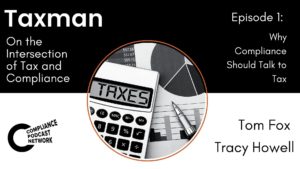
Tax and Compliance: Why Compliance Should Talk to Tax

What is the intersection of tax and compliance? Why does a Chief Compliance Officer (CCO) or compliance professional need to sit down with the corporate head of tax? How does a corporate tax function fit into a best practices compliance program? It turns out there is quite a bit a compliance professional can learn from a tax professional. Moreover, there are many aspects of tax which should be considered by a CCO and compliance professional from an overall risk management perspective. Unfortunately, these questions are rarely explored in the compliance community.
To explore these issues (and remedy this lack of awareness) I recently sat down with noted tax professional Tracy Howell to explore these and other questions. We tackled these issues and others in a five-part podcast series for Innovation in Compliance. We begin with why compliance should talk to tax and why tax needs to have a seat at the table when it comes to a best practices compliance program.
All publicly traded companies and all organizations have an Enterprise Risk Management (ERM) system. Companies, especially compliance professionals, work diligently to assess and then monitored the identified risks. Moreover, significant efforts are put in place to mitigate and manage these risks. A key risk that every multinational company’s faces is corporate tax. Unfortunately, as Howell noted, “many times corporate tax risk remains under the radar from what is characterized as your normal risk. An entity normally will identify the risk, a legal risk, environmental risk, transactional risk, supply chain risk, and others. But one of the risks that frequently doesn’t get much attention in a formalized ERM program is tax risk.”
These tax risks can be substantial, especially for multinational companies operating in many jurisdictions. Across the globe, jurisdictions are in different stages of development economically and Rule of Law sophistication, which includes tax jurisprudence. This means there are different levels of risk associated with where a company is performing its work, what type of work it is it doing, how it is delivering goods and services and the overall development of the jurisdiction.
Howell asserted that experienced international tax professionals and multinational entities are usually very good at identifying and mitigating tax risk. Unfortunately, such specialized risk management talent does not usually get outside the visibility of a tax department. Howell provided an example of a transactional risk where a company manufactured in one country and then sold the goods through a foreign affiliate in another country to a customer in a third country. “An Indian affiliate contracted with a customer in outside India. The Indian entity needed for the sale of a manufactured good in the US, but it was a drop shipment. The sale was between the Indian entity and a third-party for the delivery in a third country. Legally, the contract went from US to India to the third party in the third country. However, the flow of goods went in a different way; going directly from the US directly to the third country. Internally, the India subsidiary reported the third-party sale as income and then India was trying to deny the deduction for those goods because the goods never entered the territory of India. In other words, India is saying, okay, we’re going to tax the revenue, but we’re not going to let you deduct the cost of goods. And that’s because the goods never entered and left, were exported for the country. It was a tax risk, and it was huge.”
Typically, such a series of events would have no visibility to the corporate compliance function. Now imagine that same series of events where a tax dispute arises and goes on for literally years. Would compliance ever have visibility into it? What would happen if a bribe was paid, or other type of illegal conduct was involved to resolve it? Now you can perhaps begin to see the issue, more particularly if you consider the Lisa Monaco October 2021 speech about the Department of Justice (DOJ) reviewing all disputes and corporate culture.
This type of problem is amplified globally because of the differences in maturity of governmental tax functions across the globe. I asked Howell about this key difference. He said, “it’s the difference between night and day. I lived and worked in Canada, a very mature, sophisticated and developed tax regime, great environment for jurisprudence. And one of the things you learn once you go outside of the US to get rid of the idea of asking the question, well, this is different, why does it work that way? You focus on the rules, laws, and regulations.”
Howell then compared the maturity and sophistication of the tax regime in Canada with that in Russia. He said, “You compare it to some of the other jurisdictions that I’ve lived and worked in, most jurisdictions will all have a tax code, but the street rules or the rules of the jungle play, those are in play. You go into the remote parts of a country that’s five time zones away where it’s very cold and you’re summoned by a tax official in a very remote place, they want to audit you, you’re a multinational. You’re thinking in a traditional sense, this is very organized, there’s a tax law which is your taxable on profits, but the conversation goes something like the following, “Okay, how much tax are you going to pay me?” That’s the question that was asked by a tax official. And I said, “Well, it’s all calculated based on profits, you have the tax returns.” He said, “No, I want to know, how much are you going to pay me now to resolve this?” And he says, “I have a budget and I have to have some contributions.””
This means the tax function must establish the fact that you do not pay bribes, you do not make facilitating payments regarding tax issues, or any other types of payments and, as Howell noted, “you make it real clear. The reality is if you are doing business outside the US more than likely your organization will have complicated tax issues and while it may seem more expensive to deal with them above board, the bottom is you have to follow the Foreign Corrupt Practices Act (FCPA) so you do not put the company at risk, but you have to be strong and you have to be firm.”
Join us tomorrow when we discuss transfer pricing. Check out the full podcast series Taxman: On the Intersection of Tax and Compliance on the Compliance Podcast Network. Check out Tracy Howell on LinkedIn.


Categories
Sunday Book Review

March 13, 2022 the WWII Spy Memoirs edition


In today’s edition of Sunday Book Review:

  • Dead on Time by Jean Claude Guiet
  • The Man Who Never Was by Ewan Montague
  • Triple Cross by Frank Owen
  • Full Moon to France by Devereaux Rochester
Categories
Popcorn and Compliance

MCU Series-Guardians of the Galaxy I


In this podcast series, two complete MCU fans, Tom Fox, founder of the Compliance Podcast Network and Megan Dougherty, co-founder of One Stone Creative indulge in passion for all things in the Marvel Cinematic Universe by re-watching each movie and then podcasting on every movie in the MCU. If you want to indulge in your love for the MCU with two fans who are passionate about all things MCU, this is the podcast series for you. For this offering, we consider Guardians of the Galaxy 1.
Some of the highlights include:
Ø  The story synopsis.
Ø  What are the key plot points?
Ø  What were some of our favorite cookies?
Ø  How does this movie fit into the overall MCU?
Ø  How is this movie an homage to prior non-MCU movies?
Next up in our series Guardians of the Galaxy 2.

Categories
Daily Compliance News

March 12, 2022 the Judge Wants to Know Edition


In today’s edition of Daily Compliance News:

  • Deutsche Bank monitorship extended. (WSJ)
  • Judge wanted to know who at First Energy who paid bribes.  (News-Herald)
  • Secret deal between Google and FB. (NYT)
  • Musk lawyer said $420 tweet truthful. (Bloomberg)
Categories
Corruption, Crime and Compliance

Episode 227 – The Russia Sanctions and Export Controls


In an unprecedented and sweeping set of actions, the United States has implemented a robust set of sanctions and export controls against Russia designed to cripple Russia’s economy in coordination with its allies and partners. The unprecedented actions against Russia are intended to deter Russia from continuing its violent invasion of Ukraine and attacks against the Ukrainian people. The Department of Treasury Office of Foreign Asset Control and the Department of Commerce Bureau of Industry and Security has issued comprehensive sanctions against Russia’s financial industry, government investment funds, and oligarchs. The Russian sanctions and export controls raise significant compliance challenges for the U.S. and global companies conducting business in Russia in scope and complexity.
In this episode, Michael Volkov surveys the sanctions and export controls.

Categories
Jamming with Jason

Flashback Friday: Let Your Freak Flag Fly


I’ve been thinking a lot about flags recently, so here’s a whole #jammingwithjason #podcast episode. Flags are a way to let others know who we are and what we stand for. We might fly a flag of our favorite sports team, our country, et… as an example (maybe even a pirate flag, arghhh 🙂
Most people are afraid to proudly share with the world who they are since others may judge us, but the reality is… we are all a little different, unique, quirky, freaky in our way. That is what makes us interesting and truly loved by those who know us.
Listen in as we discuss flags, ice cream, and so much more in this episode.
Listen in at: https://www.jasonmefford.com/jammingwithjason250/.

Categories
Compliance Kitchen

EU Bans Russian Banks


EU bans some Russian banks from SWIFT; issues more restrictions.

Categories
A Yank at Oxford

Assessments, Leadership and Markets and Rowing on the Thames


Tune in every quarter to learn how David Simon, a 53-year-old lawyer from the US, navigates the ancient world of Oxford University in pursuit of an MBA. David is a Partner at the white shoe law firm Foley and Lardner, who has dedicated his career to white collar compliance with a heavy international focus. “My practice touches a lot on some of the sanctions and international trade issues that typically come up on international matters,” he says. In A Yank in Oxford, David and host Tom Fox will talk about what inspired his decision to pursue an Executive MBA, and his hopes for where the journey may lead. In this Episode 3, David discusses his academic journey through his second quarter in the Oxford MBA program. Highlights include:
1.         Assessment or what we Yanks would call exams. Very open ended but designed to determine if you have done the assignments, participated and most importantly grasped the materials.
2.             Analytics and Leadership Fundamentals.
·       In my Leadership Fundamentals assessment, David delved into lawyer decision making and team building.
·       Lawyers have a lot to learn here:
§  Can improve decision-making quality by building systems to slow down the process and to help recognize and mitigate against cognitive bias
§  Can also really improve the way we advise and otherwise serve our clients by being much more mindful of how we put together and manage our engagement teams
·       Don’t be reflexive and just build every team the same
·       Think about different functions needed and who can play them.
·       Beldin’s 9 roles – partners try to play too many roles.
·       Voice of the client?
3.         Firms & Markets assessment
·       Market analysis of legal industry.
·       Industry dynamics are shaped largely by regulatory burdens to entry and other restrictions.
·       If and when those restraints loosen (and there are some signs they are starting to), industry is ripe for disruption
§  PE ownership
§  Investment in process and technology
§  Less “super-hero” lawyer based
§  Lower compensation for lawyers (with other trade-offs)
4.         He concludes by detailing that the people he has met are really amazing. Faculty and staff have been terrific – responsive, engaged, open. Gotten so much value from my classmates. Smart, experienced, open. Getting to know people better and more people are now able to come in person. Explored Oxford, found a favorite pub – The Rickety Press – in Jericho and is now a member of the EMBA S 21 rowing club, thanks to my classmate Matthew. It is hard!

Categories
Classroom Insiders

Acknowledging Misappropriation Theory


Andrew Pompa is 2L at Washington and Lee University with a background in economics and finance. Though his career path is undecided, he is very interested in securities regulation and insider trading. In this episode of Classroom Insiders with Professor Karen Woody, Andrew explores how misappropriation theory became legitimized by the court as a proper theory. 


Andrew shares the differences between misappropriation theory and the classical theory of insider trading. In the classical theory, liability is premised on a breach of fiduciary duty, whereas misappropriation premises liability on a breach of confidentiality in a way that encapsulates people who would be deemed corporate outsiders. Carpenter v. SEC paved the way for the court’s acknowledgement of misappropriation theory.
 
Carpenter was an individual who received information from a Wall Street Journal reporter and traded it to stockbrokers, making roughly $690,000. The SEC successfully argued in the lower court that Carpenter and his accomplices breached a duty of confidentiality towards Wall Street Journal on the premise of misappropriation theory. 
 
Resources
Karen Woody on LinkedIn