Categories
Blog

Messaging Compliance in a Shifting Regulatory Landscape: Part 4- Compliance Communications in 2023

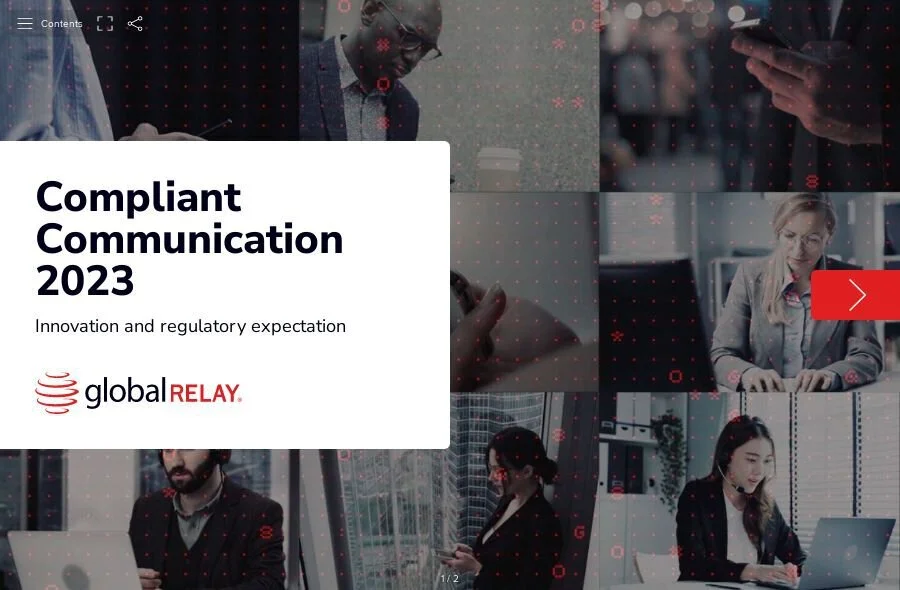
Are you ready to learn how to implement electronic communications capture and supervision in your firm for better compliance and prevention of regulatory violations? Is messaging compliance giving your compliance function headaches. Welcome to a special 5 part blog post series on messaging compliance in a shifting regulatory landscape, sponsored by Global Relay. For this Part 5, I visited with Jennie Clark about the recently released Global Relay report, Compliant Communications in 2023.

With the report indicating that 59% of respondents have banned messaging applications such as WhatsApp and WeChat, it’s evident that businesses need to find better solutions. There is significant challenge of senior managers’ compliance and the need for regulators to apply more accountability to individuals. What are the key challenges for compliance professionals?

As regulatory agencies across the globe continue to crack down on non-compliant firms, the role of UK regulators cannot be understated. UK regulators have joined forces with their US counterparts, ensuring that businesses adhere to the required compliance standards.  Jennie Clark mentioned the recent events surrounding regulatory fines and penalties, where total fines issued within a month exceeded $2 billion. She noted that UK regulators’ active involvement in addressing non-compliance is indicative of the importance of understanding and adjusting to these shifting regulatory landscapes.

Navigating modern communication channels presents numerous compliance challenges. These include managing communications across various messaging applications while avoiding the risks of non-compliant information exchange. In turn, compliance officers are responsible for ensuring businesses remain within regulatory requirements to avoid costly penalties.  The report found the ongoing struggle businesses face in terms of addressing their compliance concerns.

As a compliance officer, ensuring that your organization’s messaging apps are in line with industry regulations is vital to your professional success and your company’s reputation. In this blog, we discuss the importance of evaluating current compliance practices, developing targeted educational programs, implementing corporate phone policies, and staying updated on regulatory changes. By following these steps, you can confidently navigate the complexities of messaging apps compliance and maintain a compliant and efficient communication environment. Listen to our podcast to gain expert insights and practical tips for overcoming these challenges.

Here are the key steps:

  • Evaluate current messaging app compliance practices
  • Develop targeted educational programs for staff
  • Consider adopting advanced technology solutions

1. Evaluate current messaging app compliance practices.

As the digital landscape continues to evolve, compliance officers are faced with the challenge of managing messaging apps in a way that adheres to regulatory guidelines. One critical step in this process is to evaluate the current messaging app compliance practices to find areas for improvement. With the rise of platforms like WhatsApp, WeChat, and other messaging applications, businesses have struggled to find the appropriate balance between enabling effective communication and ensuring compliance. By thoroughly assessing current practices, organizations can determine which applications should be allowed, and how to monitor the content exchanged through these platforms.

With a majority of the respondents stating that they have prohibited the use of WhatsApp, WeChat, and other messaging applications in their organizations, it is apparent that establishing a compliant communication process is of utmost importance. Jeannie also emphasized the need for educating employees on the consequences of non-compliance and recognizing the benefits of adopting technological solutions and corporate phone policies as alternatives.  The significance of this key step in evaluating messaging app compliance practices cannot be overstated. As regulatory fines and penalties continue to increase, it is essential for organizations to prioritize compliance and avoid financial setbacks. Beyond financial consequences, ensuring compliant communication channels also safeguards an organization’s reputation, while fostering trust with regulatory bodies. Moreover, understanding the urgency of this issue and adapting accordingly enables businesses to make the best use of available opportunities.

 2. Develop targeted educational programs for staff.

To tackle this challenge, it is essential for businesses to develop targeted educational programs for staff members, ensuring that they are well-versed with the rules and guidelines pertaining to each messaging platform being used within the organization. A structured approach to educating employees can not only mitigate the risks associated with non-compliant messaging but also foster a culture of accountability throughout the company.  The report noted the significance of contextualizing the consequences of non-compliance with communication channels. This calls for tailored training sessions that address the specific challenges faced by employees using different messaging apps, and the potential ramifications of non-compliant communication on the firm’s overall reputation and regulatory standing.

By leveraging real-world scenarios and relatable examples, businesses can educate their staff in a more engaging and effective manner, ensuring that they not only understand the rules but also the underlying reasons for their existence.  The importance of targeted educational programs for staff members cannot be overstated in the current regulatory environment that sees businesses grappling with unprecedented levels of scrutiny and enforcement actions. It is crucial for companies to invest in proactive measures aimed at reducing the likelihood of non-compliant communications. Implementing educational programs and raising awareness among employees is a key step that not only empowers them with the necessary knowledge but also underscores the organization’s commitment to upholding compliance standards. By doing so, businesses can minimize potential risks, safeguard their reputation and ultimately, create a robust foundation for long-term success in an increasingly regulated world.

 3. Consider adopting advanced technology solutions.

Managing compliance in the rapidly changing world of communication platforms can be challenging, especially for companies that rely on popular messaging apps for business communications. Industry experts increasingly recommend adopting advanced technology solutions to help address these challenges. Implementing the latest technological tools in the compliance process can provide businesses with greater control and oversight of their communications while helping prevent non-compliant behavior and fostering a culture of accountability and transparency.

Advanced technology solutions could be leveraged to streamline the compliance process. The deploying robust tools and systems that can effectively manage and monitor the myriad of communication platforms employees use in their day-to-day work is critical. This may include utilizing cutting-edge technology such as AI-driven monitoring, advanced search capabilities, and data analysis to identify and mitigate potential compliance risks. By embracing these advanced solutions, compliance officers can focus on more strategic tasks while ensuring their organization stays compliant with the latest regulatory requirements and industry best practices.

The key step of considering and adopting advanced technology solutions cannot be overstated for compliance officers seeking to manage messaging app compliance. Modern technology has the potential to dramatically enhance a compliance officer’s ability to monitor communications, automate routine tasks, and identify potential concerns. Not only does this result in increased efficiency and effectiveness of compliance programs, but it also helps reduce the likelihood of costly fines and penalties due to non-compliant communications. As the landscape of communication platforms continues to evolve, companies that stay on top of emerging technology trends and harness the power of advanced tools will be better positioned to navigate the complexities of compliant communications and maintain a proactive approach to regulatory compliance.

In today’s fast-paced business environment, staying on top of messaging app compliance is crucial for compliance officers, as this can help them overcome the challenges they face daily. By evaluating their current practices, developing educational programs for staff, adopting advanced technology solutions, implementing corporate phone policies, and monitoring regulatory updates, they can effectively maintain a compliant communication system. So, take these steps to heart and embrace the opportunities they present in ensuring a more secure and compliant future for your organization.

To obtain a copy of the Insights Report, Compliance Communications 2023, click here.

Categories
Innovation in Compliance

Messaging Compliance in a Shifting Regulatory Landscape: Part 4 – Global Relay Industry Insights Report

Is messaging compliance giving your compliance function headaches? Welcome to a special 5 part podcast post series, messaging compliance in a shifting regulatory landscape, sponsored by Global Relay. Over this series, I will visit with Chip Jones, Executive Vice President – Compliance at Global Relay; Alex Viall, Chief Strategy Officer at Global Relay; Rob Mason, Director, Regulatory Intelligence at Global Relay; Jennifer Clarke, Head of Content at Global Relay; and Raewyn Danvers, Sales Manager, Unified Communications. Over this series, we will consider the US and UK regulatory framework for messaging apps, consider if business innovation is being stifled by regulatory action, preview the Global Relay Report: Compliant Communications in 2023, and look down the road on how to stay Ahead of regulation with the compliant communications in one app.

In this Part 4, I visit with Jennifer Clarke, Head of Content at Global Relay, on the recently released Global Relay Report: Compliant Communications in 2023 and the fines faced by companies. Discover how they gathered information from customers and industry experts to contextualize these findings. Find out why 59% of respondents from regulated industries, mainly financial services, have banned apps such as WhatsApp and WeChat. Explore the more creative solutions discussed in the report, including the idea of corporate-issued devices rather than BYOD. Gain insights into communication compliance challenges and how education and training around compliance culture can help employees understand the consequences of non-compliance. Take advantage of this insightful conversation on Global Relay Industry Insights Report.

Key Highlights:

  • Global Relay’s “Compliance Communications 2023” Report
  • Regulating Communication Channels in Businesses
  • Communication Compliance Challenges and Business Opportunities

For more information, go to Global Relay.

Click here to obtain a copy of the Insights Report, Compliance Communications 2023.

Join us in our concluding episode, which discusses Compliant Communications in One App.

Categories
Everything Compliance

Everything Compliance – Episode 121, with Kristy Grant-Hart Sitting in

Welcome to the only roundtable podcast in compliance as we celebrate our second century of shows. Everything Compliance has been honored by W3 as the top podcast talk show. In this episode, we have the quartet of Jay Rosen, Matt Kelly, and, as special guest Kristy Grant-Hart, with Tom Fox sitting in on this episode and considering various topics which caught our collective interest and concluded with our fan-fav Shout Outs and Rants section.

1. Matt Kelly looks at the controversy at Harvard surrounding Francesca Gino. He rants about Sam Alito and his paid trip by a billionaire who later had a case at the Supreme Court.

2. Special guest Kristy Grant-Hart looks at the new UK law on preventing fraud. Kristy rants about the DOJ taking until 2023 to build a criminal conviction database for public use when her firm built one in 2007.

3. Tom Fox looks at the Impeach proceedings and upcoming Senate trial for disgraced Texas Attorney General Ken Paxton. He shouts out to John Aceti, a 93-year-old Kerrville resident who just published his 8th book, his autobiography.

4. Jay Rosen unpacks the Ja Morant scandal and hopes Morant can get help to get his life in order. Rosen rants about NE Patriots player Jack Jones who chastised Ja Morant for his gun waving and then was caught going through airport security with packed guns.

The members of Everything Compliance are:

•       Jay Rosen– Jay is Vice President, Business Development Corporate Monitoring at Affiliated Monitors. Rosen can be reached at JRosen@affiliatedmonitors.com

•       Karen Woody – One of the top academic experts on the SEC. Woody can be reached at kwoody@wlu.edu

•       Matt Kelly – Founder and CEO of Radical Compliance. Kelly can be reached at mkelly@radicalcompliance.com

•       Jonathan Armstrong –our UK colleague, an experienced data privacy/data protection lawyer with Cordery in London. Armstrong can be reached at jonathan.armstrong@corderycompliance.com

•       Jonathan Marks can be reached at jtmarks@gmail.com.

•       Special Guest Kristy Grant-Hart is the founder of Spark Consulting.

The host and producer, ranter (and sometime panelist) of Everything Compliance is Tom Fox, the Voice of Compliance. He can be reached at tfox@tfoxlaw.com. Everything Compliance is a part of the Compliance Podcast Network.

Categories
It's art

It’s art, let’s talk about it – Sarah Harless on the Importance of Art Education

The Museum of Western Art is dedicated to excellence in the collection, preservation, and promotion of Western Heritage and the education and cultural enrichment of our diverse audiences. The Museum serves as a bridge between the past and the present, ensuring that the legacy of the American West will be preserved for the future. Western Art is as engaging and important as ever. In this podcast series, Museum Executive Direct Darrell Beauchamp visits with the artists who work in this Western heritage to talk about their work, the legacy of Western Art, and why talking about it is so important today.

In this episode, Darrell welcomes artist and art educator, Sarah Harless, who discusses her experiences as a teacher and artist and highlights the importance of visiting museums to truly appreciate the texture and movement in art pieces. Listen in as the conversation shifts to Sarah’s personal journey into art and her love for cowboy art. Don’t miss out on this emotional episode where Sarah talks about the impact of mentorship on her art and her life. With engaging topics like these, the “It’s Art, let’s talk about it” podcast is a must-listen for all art enthusiasts!

Here are three tips to keep in mind:

1.     First, it enables students to develop creative thinking skills that are transferable to other aspects of their education and future careers.

2.     Second, it provides a unique outlet for self-expression, enabling students to process and express their emotions.

3.     Lastly, it fosters an appreciation for the beauty of art and can enhance students’ quality of life.

Sarah’s passion for art and teaching is evident throughout the podcast. As she shared, “Being an art teacher fulfills me both as an artist and as an individual.” To learn more about the importance of art education, listen to the full podcast episode on It’s art, let’s talk about it.

 Resources

Museum of Western Art

Darrell Beauchamp on LinkedIn

Sarah Harless

Categories
Sustainability

Sustainability: The Business Opportunity of the 21st Century – Achieving Net Zero Emissions: Approaches and Opportunities

Are you ready to take on the business opportunity of the 21st century? We are at a moment of enormous global change and even greater business opportunity. Climate change is the single, biggest commercial opportunity of our time. In this podcast Tom Fox and Sustainability guru Richard Blundell explore the opportunities open to businesses which embrace sustainability from the business perspective. Find out why sustainability is the greatest opportunity of the 21st century and you can prepare your business to take advantage of the unprecedented global opportunity.

In this episode, they delve into three methods, including sustainability as a source of innovation to drive circular growth and influencing customer behavior, which is essential to achieve net 0 emissions. They also talk about the role of banks and asset managers in transition towards a net zero outcome and the importance of embedding sustainability in everyone’s performance measurement. Learn about the importance of frontline employees in improving sustainability practices and the shift towards safety culture in the energy industry. Discover how even those in an office setting should be mindful of safety hazards and see sustainability as another aspect of this culture. The episode ends with praise for companies that are implementing net zero journey throughout the supply chain, and the hosts express excitement for future episodes. Tune in and be inspired to take actionable steps towards a sustainable future!

 Key Highlights

·      Approaches to Achieving Net Zero Emissions

·      Asset Managers’ Role in a Net-Zero Future

·      Bringing Sustainability Decisions to Frontline Business

·      Changing Safety Culture and Sustainability Practices

·      Net Zero Companies and Upcoming Episodes

Listen to the full episode to gain insights and practical tips for incorporating sustainability into business practices. Richard’s enthusiasm and practicality will leave you inspired to explore sustainability as a business opportunity.

Resources

Richard Blundell

Tom Fox

Instagram

Facebook

YouTube

Twitter

Categories
31 Days to More Effective Compliance Programs

One Month to a More Effective Board – Vin DiCianni on Board Inquiries into Compliance

Where does “tone at the top” start? With any public and most private U.S. companies, it is at the Board of Directors. But what is the role of a company’s Board in compliance? We start with several general statements about the role of a Board in U.S. companies. First, a Board should not engage in management but should engage in oversight of a CEO and senior management. The Board does this by asking hard questions, risk assessment, and identification.

A white paper by Deloitte & Touche LLP, entitled, Risk Intelligence Governance—A Practical Guide for Boards, laid out six general principles to help guide Boards in the area of risk governance. These six areas can be summarized as follows:

• Define the Board’s role. There must be a mutual understanding between the Board, CEO and senior management of the Board’s responsibilities.

• Foster a culture of risk management. All stakeholders should understand the risks involved and manage such risks accordingly.

• Incorporate risk management directly into a strategy. Oversee the design and implementation of risk evaluation and analysis.

• Help define the company’s appetite for risk. All stakeholders need to understand the company’s appetite or lack thereof for risk.

• How to execute the risk management process. Maintain an approach that is continually monitored and has continuing accountability.

• How to benchmark and evaluate the process. Systems need to be installed which allow for evaluation and modifying the risk management process as more information becomes available or facts or assumptions change.

All of these factors can be easily adapted to compliance and ethics risk management oversight. Initially it must be important that the Board receive direct access to such information on a company’s policies on this issue.

 Three key takeaways:

1. The Board’s role is to keep really bad things from happening to a company.

2. There are six general areas the point can inquire into and lead from.

3. A Board should have direct access to information on the company’s compliance program.

Categories
Daily Compliance News

Daily Compliance News: June 29, 2023 – The Spy v. Spy Edition

Welcome to the Daily Compliance News. Each day, Tom Fox, the Voice of Compliance, brings you compliance-related stories to start your day. Sit back, enjoy a cup of morning coffee, and listen to the Daily Compliance News. All from the Compliance Podcast Network. Each day we consider four stories from the business world, compliance, ethics, risk management, leadership, or general interest for the compliance professional.

Stories we are following in today’s edition:

  • Larry Householder to be sentenced. (WCPO)
  • Big guns testify at FTC v. Microsoft hearing. (NYT)
  • Who is spying on whom? (WSJ)
  • Climate changes rankle the insurance industry. (WSJ)
Categories
Innovation in Compliance

Messaging Compliance in a Shifting Regulatory Landscape: Part 3 – Regulatory Changes on the Horizon for UK Firms

Is messaging compliance giving your compliance function headaches? Welcome to a special 5 part podcast post series, messaging compliance in a shifting regulatory landscape, sponsored by Global Relay. Over this series, I will visit with Chip Jones, Executive Vice President – Compliance at Global Relay;  Alex Viall, Chief Strategy Officer at Global Relay; Rob Mason, Director, Regulatory Intelligence at Global Relay; Jennifer Clarke, Head of Content at Global Relay; and Raewyn Danvers, Sales Manager, Unified Communications. Over this series, we will consider the US and UK regulatory framework for messaging apps, consider if business innovation is being stifled by regulatory action, preview the Global Relay Report: Compliant Communications in 2023, and look down the road on how to stay Ahead of regulation with the compliant communications in one app.

In this Part 3, I visit with Rob Mason, Director of Regulatory Intelligence at Global Relay, on the current and upcoming UK regulatory landscape. Rob shares his experience, having worked with Lloyds Banking Group, UBS, and the UK’s conduct regulator. The podcast delves into current UK regulatory priorities, data protection issues, and the importance of operational risk management, compliance, and surveillance in the banking industry.  Hear Rob’s insights on the evolution of the remit of the FCA, the role of monitoring communication effectively without breaching data privacy, Brexit, and data protection issues, and the need for closer monitoring to avoid scandals. If you want to learn how to manage risk and compliance from industry experts, tune in to UK Regulatory Landscape.

Key Highlights:

  • Latest UK Regulatory Priorities
  • Comparison of FCA and SEC Regulations
  • Data Protection and Operational Resilience in the UK
  • Impact of the Merger of Credit Suisse and UBS

For more information, go to Global Relay.

Join us in our next episode, where we examine the Global Relay Report: Compliant Communications in 2023.

Categories
Blog

Messaging Compliance in a Shifting Regulatory Landscape: The Current and Shifting UK Regulatory Landscape

Are you ready to learn how to implement electronic communications capture and supervision in your firm for better compliance and prevention of regulatory violations? Is messaging compliance giving your compliance function headaches. Welcome to a special 5 part blog post series on messaging compliance in a shifting regulatory landscape, sponsored by Global Relay. For this Part 3, I visited with Rob Mason on the current state of UK regulations on messaging apps and where it may be headed.

Staying ahead of the curve when it comes to the shifting UK regulatory landscape is vital for financial institutions and their compliance professionals. Keeping pace with the FCA’s evolving priorities, as well as ensuring ongoing compliance with GDPR and data protection, can have significant effects on the smooth functioning of your institution. Enhancing operational resilience and implementing effective employee communication monitoring are essential steps to take, in addition to exploring resources for regulatory technology solutions. By remaining updated and flexible, compliance professionals in the UK can successfully navigate the complexities of regulatory changes, ultimately resulting in an improved understanding of current and upcoming UK regulations.

Here are some key steps:

  • Understand FCA’s evolving priorities and focus
  • Keep up-to-date with GDPR and data protection
  • Enhance operational resilience in your institution
  • Implement effective employee communication monitoring
  • Explore resources for regulatory technology solutions

 1. Understand FCA’s evolving priorities and focus.

Navigating the shifting UK regulatory landscape as a financial institution can be complex, but a key step is understanding the evolving priorities and focus of the Financial Conduct Authority (FCA). As the FCA shifts its focus towards a broader oversight approach, financial institutions must remain up-to-date with emerging regulations and adapt their internal processes accordingly. This comprehensive understanding of FCA priorities is vital for compliance professionals, as it enables them to mitigate potential risks, ensure data protection, and maintain operational resilience in an ever-changing regulatory environment.

Mason noted the FCA’s increased focus on retail and consumer financial services in addition to wholesale markets, which has led to a broader oversight approach and also highlighted the importance of data protection and the impact that GDPR regulations and Brexit have had on the UK’s regulatory environment.  Understanding the FCA’s evolving priorities and focus is crucial for compliance professionals in the UK, as it allows them to better adapt to the rapidly changing regulatory landscape. Being knowledgeable about current regulations and anticipating future changes can help institutions maintain compliance, safeguard data, and ensure operational resilience in the face of potential challenges. By staying informed and proactive, compliance professionals can successfully navigate the shifting UK regulatory landscape and contribute to the overall success and stability of their organizations.

 2. Keep up-to-date with GDPR and data protection.

With the ever-changing regulatory landscape in the UK, remaining up-to-date with GDPR and data protection is more crucial than ever for financial institutions. One of the significant changes that has come to focus in recent times is the GDPR, which greatly impacts how businesses collect, store, and process personal data. Data protection concerns have now begun to take center stage not only in Europe but also across the globe. By understanding the requirements of GDPR and other data protection laws, financial institutions can adapt to the changes and avoid costly fines or reputational damage.

Mason said that Europe has been ahead of the curve when it comes to data protection concerns, and how new developments, such as Brexit, have further emphasized the significance of GDPR in the UK. He also discussed how monitoring employee communications became increasingly critical for large organizations to prevent scandals. By keeping up with these regulatory changes and understanding the impact they have on organizations, compliance professionals can better equip themselves to face the challenges that lie ahead.  The importance of staying up-to-date with GDPR and data protection for compliance professionals in the UK cannot be understated.

These regulations help build a strong framework that ensures the protection of customer data, which is at the heart of any financial institution. Besides preventing financial and reputational damage, being compliant with GDPR and data protection laws allows organizations to maintain customer trust, demonstrate transparency, and ultimately contribute to the long-term success of their business. For financial institutions, being knowledgeable about these laws is not just a matter of regulatory compliance, but also a vital factor in creating a sustainable, ethical, and client-centric business. As the regulatory environment continues to evolve, staying ahead of the curve will prove indispensable for financial institutions and their compliance professionals.

 3. Enhance operational resilience in your institution.

In today’s rapidly changing regulatory environment, financial institutions must be agile and proactive in order to stay ahead of the curve. Enhancing operational resilience is a key step in achieving this goal, as it allows organizations to effectively manage unexpected disruptions and challenges. A strong operational resilience framework not only prevents potential losses but also helps maintain stability and reputation in the face of adversity. To successfully navigate the shifting UK regulatory landscape, financial institutions must invest in the necessary resources, infrastructure, and skill sets required for effective risk management, business continuity, and crisis response mechanisms. In this context, it is crucial for these institutions to regularly assess their resilience measures and adopt best practices in line with emerging industry trends and regulations.

Strengthening operational resilience safeguards the institution from potential losses and reputational damage, ensuring long-term success in a capricious regulatory landscape. Moreover, addressing operational risks effectively is crucial in mitigating negative consequences on a larger scale, preventing widespread financial contagion. As the UK financial sector undergoes constant transformation, compliance professionals must be equipped to adapt quickly to emerging challenges. By prioritizing operational resilience and staying abreast of the latest industry trends, these professionals will be better prepared to navigate the shifting UK regulatory landscape, protecting both their institutions and their clients from potential adverse effects.

As a compliance professional in the UK, it’s essential to keep up with the shifting regulatory landscape in order to ensure your financial institution can effectively overcome any obstacles. Staying informed about the FCA’s priorities, GDPR, and data protection regulations is key to maintaining a strong compliance strategy. Additionally, focus on enhancing operational resilience, monitoring employee communications, and seeking out resources for regtech solutions. By doing so, you’ll not only stay compliant but also foster a more secure and thriving financial institution.

Join me tomorrow where we review the recently released Global Relay report, Compliant Communications 2023.

For more information on Global Relay, click here.

Categories
Compliance Into the Weeds

Compliance into the Weeds: What is Driving Compliance Engagement at the Board?

The award-winning, Compliance into the Weeds is the only weekly podcast that takes a deep dive into a compliance-related topic, going into the weeds to explore a subject more fully and looking for some hard-hitting insights on sanctions compliance. Look no further than Compliance into the Weeds!

In this episode, co-hosts Tom Fox and Matt Kelly dissect the Navex 2023 State of Risk and Compliance Report. Tom and Matt delve into Navex’s annual benchmarking report, which surveyed 1,300 compliance professionals. The report revealed that 53% of respondents described their compliance programs as mature. Matt and Tom question whether the board is driving the conversation or if compliance officers request updates due to potential liability. The report’s findings on cybersecurity and privacy concerns, survey results on where compliance should reside in a company, and the importance of having a mature anti-bribery anti-corruption compliance program are all discussed. Tune in to hear more about how compliance officers can address pressing concerns such as cybersecurity breaches and attacks.

Key Highlights:

  • Navex’s benchmark report on compliance programs
  • Board-Compliance Officer Relationship & Cybersecurity in Compliance
  • The necessity of Dedicated Compliance Committees
  • Survey Finds Diverse Views on Compliance Placement in Companies
  • The Importance of Anti-Bribery Compliance for Cybersecurity
  • Compliance Officer Reporting to CISO Dynamics

 Resources:

Matt 

LinkedIn

Blog Post in Radical Compliance

Tom 

Instagram

Facebook

YouTube

Twitter

LinkedIn