


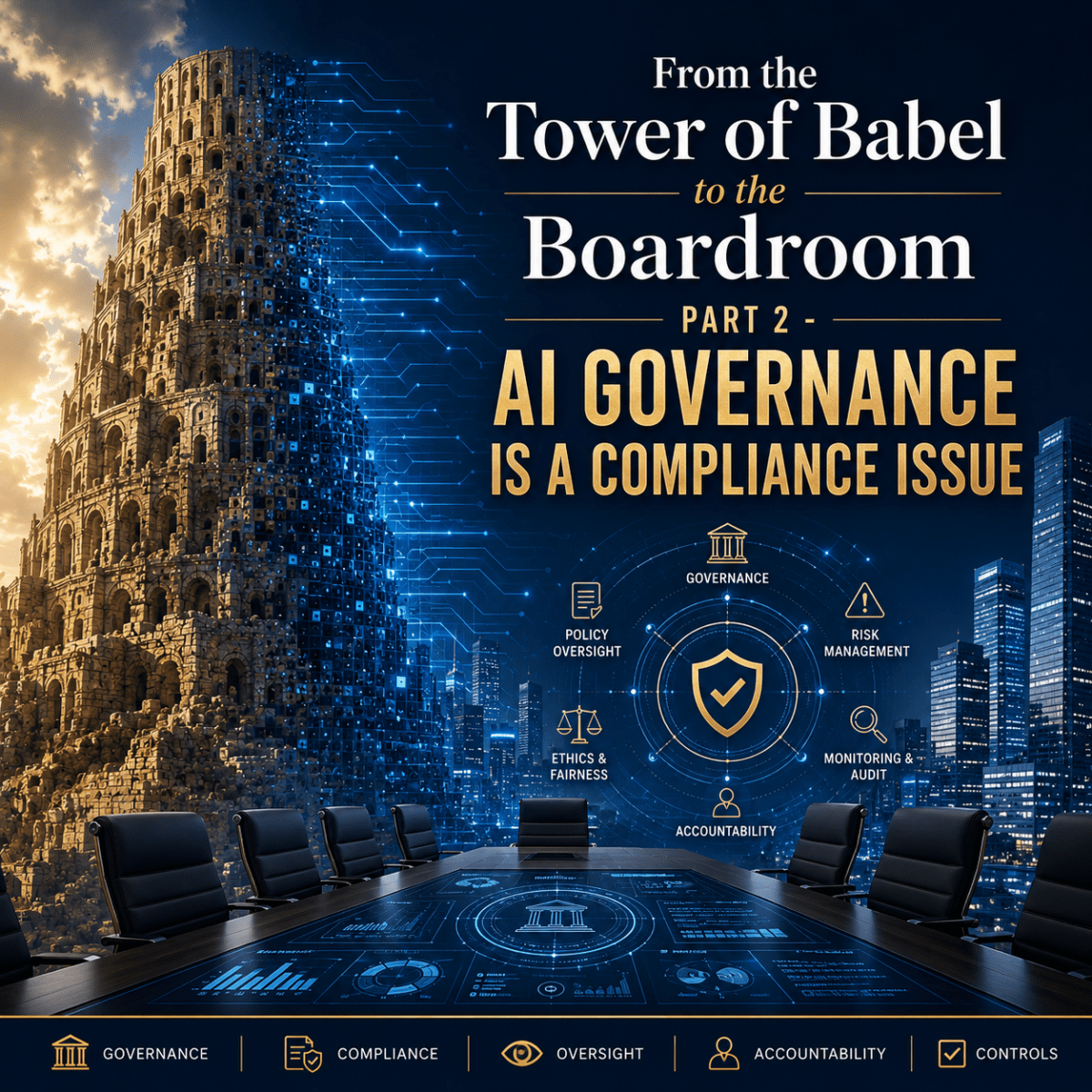
In the first post in this series, we used Magnifica Humanitas to frame the choice facing every board and compliance leader in the age of artificial intelligence. Companies can build a new Tower of Babel, driven by speed, scale, efficiency and power without adequate governance. Or they can follow the path of Nehemiah, rebuilding with discipline, shared responsibility, accountability and the human person at the center. That choice now moves from principle to program design.
AI governance cannot remain in the innovation lab, the IT department or the digital transformation office. It belongs inside the compliance program. Not because compliance should own every AI decision, and not because the CCO should become the chief technologist. AI governance belongs in compliance because AI creates the very risks compliance programs are designed to manage: legal risk, ethical risk, data risk, third-party risk, culture risk, internal controls risk, reporting risk, investigation risk and board oversight risk.
Magnifica Humanitas makes this point in moral language. Pope Leo writes that the use of AI is never a purely technical matter when it enters processes that affect people’s lives, rights, opportunities, status and freedom (Magnifica Humanitas, ¶102). For the modern compliance professional, that is familiar terrain. These are the risks an effective compliance program must identify, assess, control, monitor and remediate.
AI Is Not an Adjacent Risk
The first mistake companies make is treating AI as an adjacent risk. The business says AI is a productivity tool. IT says AI is a systems issue. Legal says AI is a regulatory issue. Privacy says AI is a data issue. Cybersecurity says AI is an access issue. HR says AI is a workforce issue. Internal audit says AI is a control issue. Procurement says AI is a vendor issue. They are all correct.
That is precisely why AI governance must be cross-functional, risk-based and integrated into the compliance program. AI does not respect organizational charts. It moves through data, workflows, vendors, platforms, communications, decisions and employee behavior. It may be embedded inside software already used by the company. Employees may adopt it without formal approval. Vendors may deploy it before procurement or legal fully understands how the tool works. It may be used by compliance itself for monitoring, investigations, hotline triage, third-party due diligence, sanctions screening or training.
The DOJ Has Already Put AI on the Compliance Agenda
The Department of Justice has made clear that AI is now part of compliance program evaluation. The DOJ’s Evaluation of Corporate Compliance Programs (ECCP) asks whether a company has a process for identifying and managing emerging risks, including risks related to new technologies such as AI. It asks how the company assesses the impact of AI on compliance with criminal laws, whether AI risk is integrated into enterprise risk management, how the company governs AI in commercial operations and in the compliance program, whether controls monitor trustworthiness and reliability, whether AI is limited to intended uses, what human decision-making baseline is used, how accountability is enforced and how employees are trained.
This is where the Encyclical and the ECCP align. Pope Leo calls for responsibility to be clearly defined at every stage, from those who design and develop AI systems to those who use them and rely on them for concrete decisions (Magnifica Humanitas, ¶105). The DOJ asks whether the company has translated that responsibility into risk assessment, controls, testing, training and accountability.
For CCOs, the message is direct. AI governance should be reflected in the risk assessment, policies and procedures, training, third-party risk management, internal controls, monitoring, investigations, discipline, incentives and board reporting. A company that cannot explain how it governs AI will struggle to demonstrate how its compliance program keeps pace with the business.
The CCO’s Role in AI Governance
The CCO does not need to own AI. The CCO does need a seat at the table. Compliance should inform the design of the company’s AI governance model. That model should include a cross-functional AI governance committee with representation from compliance, legal, privacy, cybersecurity, IT, HR, internal audit, procurement, finance and the business. It should define approval rights for high-risk use cases. It should establish documentation standards. It should require risk classification. It should identify prohibited uses. It should provide escalation channels for AI incidents and concerns.
This is the corporate version of Nehemiah’s wall. Pope Leo writes that everyone is given a section of the wall and that shared responsibility across disciplines and communities is the way to build for the common good (Magnifica Humanitas, ¶13). AI governance works the same way. Legal cannot do it alone. IT cannot do it alone. Compliance cannot do it alone. The governance model must assign roles so the whole enterprise can rebuild with discipline.
The CCO should also insist on an inventory of AI use cases. This is the foundational control. The company cannot govern what it cannot see. The inventory should include the business owner, tool name, vendor, purpose, data categories, decision impact, risk rating, applicable policies, human review requirements, testing history, approval date, renewal date and control owner.
From Encyclical Principle to Corporate Governance Requirement
The bridge from Magnifica Humanitas to corporate governance is straightforward. The Encyclical does not give companies an AI procedure manual. It gives them governing principles. The compliance task is to translate those principles into requirements that can be owned, tested, evidenced and improved. Pope Leo is explicit that digital processes should not be imposed from above in opaque or unilateral ways, but should be directed toward the common good with transparency, accountability, meaningful participation, independent checks, algorithmic transparency, equitable access to data and avenues for recourse (Magnifica Humanitas, ¶71).
Human dignity becomes human impact assessment and human review. The common good becomes enterprise risk governance and stakeholder impact. Subsidiarity becomes cross-functional participation, with decisions made close enough to the risk to be informed and accountable. Solidarity becomes attention to affected employees, customers, communities and vulnerable populations. Social justice becomes bias testing, access, recourse and a refusal to let opaque systems create hidden exclusion.
NIST AI RMF and ISO/IEC 42001 as Practical Architecture
Two frameworks can help compliance leaders translate AI principles into program structure. They give operational force to Pope Leo’s warning that it is not enough to invoke ethics in the abstract. He instead calls for robust frameworks, independent oversight, informed users, and institutions capable of governing AI’s effects (Magnifica Humanitas, ¶106). That is precisely the move compliance must make, from AI principles to an AI management system.
The NIST AI Risk Management Framework organizes AI risk management around four functions: Govern, Map, Measure and Manage. For compliance leaders, that is highly practical. Govern means the company has assigned authority, accountability, policies and risk appetite. Map means the company understands the context, purpose, users, affected stakeholders and potential impact of each AI use case. Measure means the company evaluates performance, reliability, bias, data quality, security and control effectiveness. Manage means the company prioritizes risks, implements controls, monitors outcomes, remediates problems and documents decisions.
ISO/IEC 42001 provides a management system model. It focuses on establishing, implementing, maintaining and continually improving an AI management system. For a compliance program that supplies the discipline of policy, objectives, roles, processes, risk assessment, controls, monitoring, performance evaluation, corrective action and continual improvement.
From Policy to Controls
A policy is necessary, but it is not sufficient. A company can have a well-written AI policy and still have a weak AI governance program. The issue is whether the policy has an operational effect.
Pope Leo explains why. Technology is never neutral because it takes on the characteristics of those who devise, finance, regulate and use it (Magnifica Humanitas, ¶9). He later adds that every technical tool embodies choices and priorities through what it measures, what it ignores, what it optimises, and how it classifies people and situations (Magnifica Humanitas, ¶104). For compliance, this means the control environment must cover design, data, use, monitoring, output, and remediation.
COSO has warned that generative AI poses risks of cyber exposure, prompt manipulation, opaque reasoning, model drift, and frequent configuration changes that can affect operations, reporting, and compliance if not addressed with robust internal controls. That is the compliance challenge. AI governance must become a control activity.
Compliance Can Use AI Responsibly
Compliance should not stand outside the AI transformation. AI can help compliance become more effective. It can identify patterns in transactional data. It can assist with third-party risk scoring. It can support sanctions screening. It can help analyze hotline trends. It can improve training design. It can help prioritize monitoring. It can summarize large document sets in investigations. It can support control testing.
Magnifica Humanitas is direct on this point. AI may imitate functions of human intelligence, but it does not possess conscience, experience, responsibility or the capacity to judge good and evil (Magnifica Humanitas, ¶99). It can also create excessive reliance, the impression of objectivity and a weakening of personal judgment (Magnifica Humanitas, ¶100). Compliance professionals should use AI, but they should never surrender professional judgment to it. Human primacy remains the central control.
5 Lessons for the CCO
- Treat AI as a human dignity and compliance risk. AI is now part of legal, ethical, operational, data, third-party and cultural risk. The Encyclical reminds us that AI affects rights, opportunities, status, and freedom when it enters into consequential decisions (Magnifica Humanitas, ¶102).
- Build and maintain an AI inventory because governance begins with visibility. Every AI use case should have an owner, a purpose, a risk rating, a data classification, a control set, an approval status, and a review cycle.
- Govern compliance’s own use of AI because accountability starts at home. Compliance should use AI, but it must document purpose, controls, human review, validation and accountability.
- Move from policy to controls because technology is never neutral. AI governance requires approval workflows, data restrictions, testing, monitoring, escalation, remediation and auditability (Magnifica Humanitas, ¶9, ¶104).
- Report evidence to the board because accountability requires more than aspiration. Boards need dashboards and documentation showing where AI is used, what risks exist, what controls apply, who is accountable and whether the governance program is effective (Magnifica Humanitas, ¶105).
Conclusion: From Governance Principle to Control Discipline
Magnifica Humanitas challenges us to place the human person at the center of technological transformation. For compliance leaders, that means AI must be governed through risk assessment, controls, accountability, transparency, human oversight and evidence. The DOJ ECCP makes clear that prosecutors will ask how companies govern AI in the business and in compliance. NIST AI RMF and ISO/IEC 42001 provide practical architecture for doing so. COSO gives the internal controls discipline.
The compliance profession should embrace AI. It can make compliance more effective, more data-driven and more responsive. But embracing AI does not mean surrendering judgment to it. The right model is not fear. The right model is governed by adoption.
In the next post, we will move from formal AI governance to the most immediate AI control challenge inside many companies: Shadow AI and Internal Controls. Employees are already using AI tools because they are fast, useful and accessible. The compliance question is whether the company can turn hidden use into governed use before shadow AI becomes the next major control failure.