Categories
Innovation in Compliance

Integrity Matters: AML Trends for 2022


Welcome to this special podcast series, Integrity Matters sponsored by K2 Integrity. For this series, I visit with Koby Bambilia, Managing Director, and Olivia Allison, Senior Managing Director. Over the series, we look some issues and trends going forward into 2022. In this Part 2, I am joined by Koby Bambilia who looks at trends regarding AML going into 2022. Some of the highlights include:

  • Impact has there been to-date from the  passage of the AML Act of 2020?
  • What has been on the mind of clients and others in the market?
  • Has COVID and the global crises created shifted just how bad actors take advantage of the financial system?
  • How are you advising your clients to mitigate these risks and get ahead of the rule making as we head into 2022?

Resources
Koby Bambilia Profile
K2 Integrity

Categories
Blog

AML Trends for 2022

I recently had the chance to visit with Koby Bambilia, Managing Director at K2 Integrity. We looked at some key anti-money laundering (AML) trends in 2021 and how they might impact AML investigations, prevention and enforcement going forward into 2022. We consider the impact to-date from the passage of the AML Law of 2020 then move to some of the key questions on AML going into 2022. Has COVID and the global crises created shifts which allowed bad actors take advantage of the financial system? Finally, what are some of the key risks to mitigate these risks and get ahead of the rule making as we head into 2022?
We began by considering the focus of Department of Treasury (Treasury) and its regulators. Here there are several topics that were given priority as part of the national Strategy for Countering Corruption, terrorism and other illicit activities. These priorities include cybercrime, virtual foreign currency, domestic terror financing, criminal organizations, human trafficking, smuggling, drug trafficking, corruption, fraud and proliferation financing. Bambilia related, “we can easily see that the list is quite extensive yet. There is something in common for all these priorities. If you look at the priorities, they include predicate crimes that generate illicit funds thought assets, which allows criminal actors to launder through the financial system.” As money laundering is linked to all these priorities it remains a priority.
Bambilia believes financial institutions need to incorporate these AML priorities into their risk-based Bank Secrecy Act (BSA) compliance programs by assessing the potential risk associated with the client base, the products and service services they offer, in conjunction with their geographic areas and countries of operations. Bambilia believes that government examiners will soon ask to see and review what steps banks and financial institutions have taken with regards to these priorities. In other words, whatever steps you take Document, Document, and Document so you can show the regulators when they come knocking.
As Treasury continues to issue regulations stemming from the AML Law of 2020, banks and financial institutions should be prepared to face new and revised beneficial ownerships and obligations in 2022. Bambilia believes, “December’s proposed rule to implement the Corporate Transparency Act, gave us all the preview into the Treasury Department’s mind and approach to developing a national registry of beneficial ownership information.” Moreover, this should also act as a reminder to meticulously follow the Beneficial Ownership Rule, which requires covered financial institutions to identify beneficial owners of each customer at the time a new account is being opened and to determine the true and official owners based on both the control and ownership prongs. Bambilia also noted, “looking ahead into 2022, beyond the immediate implications, the proposed rule will also require changes to existing customer due diligence obligations for financial institutions.” Finally, they will most probably be the subject of a future FinCEN rule making.
It is clear that COVID-19 had immense impact on everything relating to illegal activities and bad actors. Ransomware is the tool most bad actors are using, even with financial institutions. Bambilia related, “those nefarious actors are probing to obtain both customer and commercial credentials, as well as proprietary information to defraud financial institutions and to disrupt business functions.” Interestingly, Bambilia and colleagues observed a significant increase in criminal attempts to exploit the pandemic through phishing campaigns and business extortions, email compromise and traditional fraud schemes.
Tying all this back to our initial discussion, the proceeds of these activities are being channeled and funneled through the regular banking and financial systems. This puts a higher burden on financial institutions as they are uniquely positioned to observe and detect the suspicious activity that results from cybercrime. Now they are required to report it through the normal channels of Suspicious Activity Report. This has led to an increased need for financial institutions to process, review and monitor transactions that go through their system and evaluate those transactions with a sufficient and comprehensive set of skills required to identify the illegal activities and to properly report it to authorities.
Just as ransomware attacks have become more ubiquitous so have ransomware payments. In September 2021, OFAC issued an updated advisory on potential sanction risks for facilitating ransomware payments, which is specifically designed to disrupting criminal networks and virtual currency exchanges responsible for laundering these ransom payments to encourage improved cyber security across all sectors, including the banking industry. Bambilia said this “emphasized the need to properly report ransomware incidents and related sanctions to US government agencies, including both Treasury and law enforcement.” It also re-emphasized the need to properly monitor bank transactions for potential illegal activities.
We turned to a discussion of what businesses and financial institutions need to do to prepare for the upcoming regulations and increased enforcement. Bambilia emphasized that a strong compliance program for AML, BSA and sanctions is the best place to start and build upon going forward. Bambilia laid them out as follows:

  • First, make sure that your policies and procedures adequately address the new regulations, then update and validate your BSA risk assessment accordingly. Your risk assessment should consider factors like banks, products and services, customer entities and geographic locations and operating jurisdictions.
  • Second, a designated individual that is responsible for the day-to-day compliance and who is familiar with the new requirements, who has the full support of both senior management and the Board of Directors to manage these changes.
  • Third, update your current system of internal controls to reflect the change in regulation, then monitor and update as appropriate. Your controls testing should help you determine if your internal controls can effectively detect and identify possible breaches of your policies and procedures.
  • Fourth, work together with your internal audit function to assure their yearly audits to assess the effectiveness of the updated compliance program.
  • Fifth, training. Here Bambilia re-emphasized the importance of training via properly tailored and targeted trainings. They constitute a key element in the ability to successfully implement any new policies, procedures and controls for any new regulations.

We ended  by recognizing that it is up to all employees, not simply the compliance function, to be a part of these new efforts. Employees need to understand their role on the first line of defense and how to report up violations or raise their collective hands to ask for information as AML regulations continue to evolve. COVID-19 has impacted compliance functions in many ways so compliance will have to re-double its efforts as well. Banks and financial institutions must commit the requisite resources to upgrading their compliance programs to meet these new regulatory requirements as well.
Bambilia concluded, “I will end by saying that the world of financial crimes continues to evolve. And our thinking must be as always one step ahead of those looking to take advantage of our financial systems. It is not just about identifying it, understanding today’s threats, but also being prepared for the threats of tomorrow.”
Check out the K2 Integrity website here. Check out my full interview of Koby Bambilia here.

Categories
Compliance Into the Weeds

Issue and Trends for 2022, Part 1


Compliance into the Weeds is the only weekly podcast which takes a deep dive into a compliance related topic, literally going into the weeds to more fully explore a subject. This week, Matt and Tom begin a special two-part podcast series of several topics they will be following in 2022. Today in Part 1, we consider

  • The Biden Administration’s Strategy on Countering Corruption, specifically around FinCEN and AML enforcement and how it may impact FCPA enforcement.
  • The PCAOB was long dysfunctional before the Trump Administration eviscerated it. How will it change under the Biden Administration?
  • The SEC plans for the regulation of and reporting on ESG.
  • FCPA enforcement for recidivist corporations after DAG Lisa Monaco’s speech in October 2021.

Resources
Matt in Radical Compliance

Categories
Daily Compliance News

December 15, 2021 China, Professors and Spying Edition


In today’s edition of Daily Compliance News:
·       Nat-West fined for ‘over-looking’ AML risks. (WSJ)
·       Another son pleads guilty. (WSJ)
·       DOJ to charge more execs for environmental crimes. (NYT)
·       China, Professors and Spying. (WSJ)

Categories
Blog

Farewell to the Vampire and the US Strategy on Countering Corruption – Curbing Illicit Financing

We are exploring the recently released the United States Strategy on Countering Corruption (the “Strategy); subtitled “Pursuant To The National Security Study Memorandum On Establishing The Fight Against Corruption as a Core United States National Security Interest”; in response to President Biden’s prior declaration of corruption as a national security issue of the United States. Over this 5-part series I will be delving into the Strategy and considering how it will impact the compliance professional. Yesterday, we considered Pillar 1, modernizing, coordinating, and resourcing US government efforts to fight corruption. Today we take up Pillar 2, curbing illicit financing.
Today, we also pay tribute to New Orleans native Anne Rice who died over the weekend. Rice is best known for her first novel, Interview with the Vampire, which was published in 1976. According to her New York Times obituary, “Ms. Rice was a largely unknown writer when she turned a short story she had written in the late 1960s into “Interview With the Vampire,” her first published novel. It features a solitary vampire named Louis who is telling his life story to a reporter, but Ms. Rice said the tale was her story as well.” She went on to state, “I really got into the character. For the first time, I was able to describe my reality, the dark, gothic influence on my childhood. It’s not fantasy for me. My childhood came to life for me.” The book became a bestseller. Rice “found herself with a considerable fan base, which she proceeded to entertain with a series of follow-up novels that became known collectively as the Vampire Chronicles. The books, more than a dozen in all, are widely credited with fueling a revival of interest in all things vampiric.” So, farewell to many a gothic, chilly and scary night, all courtesy of Anne Rice.
The fight against illicit financing is extraordinarily significant. The Strategy noted, that in “today’s globalized world, corrupt actors bribe across borders, harness the international financial system to stash illicit wealth abroad, and abuse democratic institutions to advance anti-democratic aims. Emerging research and major journalistic exposés have documented the extent to which legal and regulatory deficiencies in the developed world offer corrupt actors the means to offshore and launder illicit wealth. This dynamic in turn strengthens the hand of those autocratic leaders whose rule is predicated on the ability to co-opt and reward elites.”
It is most interesting to highlight that the US government is pointing to “major journalistic exposés” as a major source of information on illicit financing, providing wrong all the naysayers who criticized publication of the Panama Papers, Paradise Papers and the Pandora Papers. This pointing to the public releases of information on illicit financing also should end the calls for these types of releases to criminalized. But more than simply the monies involved, “corrupt actors and their financial facilitators have taken advantage of vulnerabilities in the U.S. and international financial systems to launder their assets and obscure the proceeds of crime. Similarly, corrupt actors amass ill-gotten wealth through illicit gains of other resources, including minerals and wildlife.”
The Strategy recognizes the US role as the pre-eminent leader in global banking and financing. The Strategy outlines what it calls ‘Lines of Effort’ or LOEs which will add more “human resources to synchronize anti-corruption work as a core domestic and foreign policy priority”. The US also commits to working in “coordination with global partners to magnify” to both expand and magnify the US efforts. The next two lines from the Strategy speak directly to the compliance professional. “We will seek to foster and learn from governmental and non-governmental partners pioneering innovative solutions. And we will dedicate and steward financial resources by matching appropriate means to critical ends.” This means more information will be collected from actors in the private sector such as public and private corporations.
There are several Strategic Objectives to guide this initiative. First, the US will address deficiencies in the current Anti-Money Laundering (AML) regime. This will include additional work in beneficial ownership transparency, in US government procurement, real estate transactions, sources of private equity funds and investments, gate keepers, offshore and tax havens, digit assets and arts and antiquities. Most interestingly, while the places and strategies of money-laundering are well known and have begun to be addressed, this is the first real push against gatekeepers.
Many professionals and service providers, including lawyers, accountants, trust and company service providers, incorporators, and others, have been used as registered agents or who act as nominees to open and move funds through bank accounts. This is usually with little to no understanding of the underlying source of the funds, the character of the actors involved or even who is behind the curtain. All basic due diligent inquires by the compliance professional. When you add these advisors to create “opaque corporate vehicles” you can see why “complicit professionals are often sought by criminal organizations to facilitate their illicit activities.” Yet even while law enforcement “has increased its focus on such facilitators, it is both difficult to prove “intent and knowledge” that a facilitator was dealing with illicit funds or bad actors, or that they should have known the same.”
This same type of effort will be made at the international level. The US will expand its level and presence with key international players such as “the Europe-based Camden Asset Recovery Interagency Network and its regional bodies, and the International Anti-Corruption Coordination Center, which has multi-country membership and observers.” The US will act with what it calls “Proactive disruption” to “prevent the establishment of new safe havens for corrupt actors and their ill-gotten gains.” Finally, the US “will work with allies and partners to push key gatekeepers and facilitators to tighten ways in which corrupt actors move money.”
Many of these initiatives are processes which compliance professionals are currently doing. Moreover, the basic information generated through due diligence and other investigative skills will be of great use for the government’s efforts. Finally, any information that the government generates to unmask UBO’s will benefit the greater compliance community.
Join us tomorrow where we pay honor to Dave Campbell and consider Pillar 3 – Holding Corrupt Actors Accountable.


Categories
Daily Compliance News

October 21, 2021 the Upgrade edition


In today’s edition of Daily Compliance News:

  • Zuckerberg added to DC Privacy lawsuit.(WaPo)
  • Boeing woes continue. (NYC)
  • Ukraine seeks to improve ABC enforcement. (Reuters)
  • DOT seeks more money for AML enforcement. (WSJ)
Categories
Daily Compliance News

October 9, 2021 the Banks Behaving Badly edition


In today’s edition of Daily Compliance News:

  • Varsity Blues parents convicted.(WSJ)
  • NatWest pleads guilty to AML violations. (WSJ)
  • Deal of global tax avoidance. (WSJ)
  • IMF President in limbo. (NYT)
Categories
Innovation in Compliance

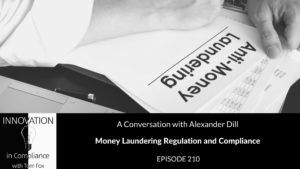
Money Laundering Regulation and Compliance with Alexander Dill


Tom Fox welcomes back Alexander Dill on this week’s episode of the Innovation in Compliance Podcast. Alexander is a lecturer at UCLA, as well as an author and advisor, specializing in financial regulation, risk management, and compliance. Alexander and Tom talk about anti-money laundering and the key problems compliance professionals encounter.


The Importance of Compliance Ratings Compliance Systems
Compliance rating systems were created to measure accuracy and integrity. After the events of Enron and WorldCom, there was a general criticism of credit rating agencies. Moody’s Investors Service, where Alexander spent a considerable amount of time working, got a great deal of that criticism due to the organization’s poor ratings performance and its lack of fraud rating. Moody’s wanted to continue to self-regulate as opposed to being regulated by the global regulators, and so the creation of these compliance systems helped with that. Alexander explains that the initial work that was done with respect to the ratings systems, helped lay the foundation for compliance when it became heavily regulated after the financial crisis of Dodd Frank.
 
The Compliance Regulators
Tom asks Alexander to explain the different types of regulators and what OFAC is. The main regulator for compliance is FinCen, which is the Financial Crimes Enforcement Network. FinCen is the primary rule making authority but delegates supervisory and examination authority to other agencies. Alexander goes on to list the other regulatory agencies. The regulatory agencies overlap, however the conflict that arises is that their objectives often do not align. “Banking agencies are focused on safety and soundness, and the law enforcement authorities spearheaded by FinCen focus on the law enforcement objective, so those don’t always come together in a uniform manner,” Alexander remarks. 
 
The Role of Corporate Governance and Risk Management
The main role of corporate governance in anti-money laundering is to maximize shareholder welfare. Corporate governance systems are designed to protect franchise value. The systems cover all material risks that arise from conflicts of interest within agencies. Risk management is important to anti-money laundering as it is a component of corporate governance. Alexander stresses that the risk management function should fit into the corporate governance framework to be effective.
 
COVID-19 and Beyond
The pandemic has impacted the field of anti-money laundering and compliance in many ways, but perhaps the most notable way is that it enhanced fraudulent schemes. With a great deal of the world’s population migrating online, it opened up the pathway for various cyber attacks and cyber related crimes. COVID-19 unfortunately created various opportunities for people to exploit online platforms. Alexander hoped that in the future the Anti-Money Laundering Act that was introduced last year 2020, will begin to bear fruit and that red tech innovation and machine learning will help to curb these issues. 
 
Resources
Alexander Dill | LinkedIn | Twitter
Check out Professor Dill’s book, Anti-Money Laundering Regulation and Compliance here.


Categories
Compliance Kitchen

AML in Japan


The Kitchen reviews the 2021 report issued by the Financial Action Task Force on AML measures in Japan.

Categories
Looking Back on 9/11

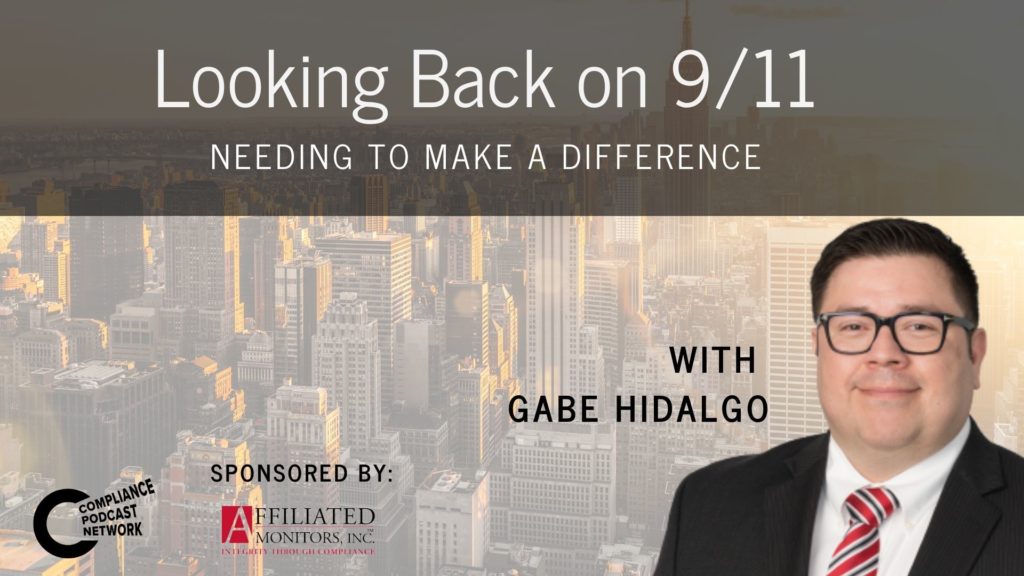
Looking Back at 9/11: Gabe Hidalgo – Needing to Make a Difference


On the 20th anniversary of the 9/11 terrorist attack, Tom Fox and guests look back on the tragic event and what it meant for them personally, as well as how it impacted the world of compliance. Tom’s first guest this week is Gabe Hidalgo, anti money laundering compliance expert, who shares how the events of that fateful day changed the course of his career.
Listen to the Episode Now:

Looking Back
Gabe – who worked as outside counsel for insurance companies at the time – remembers turning on YahooTV as soon as he got to his office on 9/11 and seeing the second plane hit the World Trade Towers. He knew immediately that it was a deliberate attack. “I knew that this was kind of a hallmark moment,” he tells Tom, “that this was not an accident.” He details leaving the office in haste to get to his pregnant wife, and the obstacles and roadblocks he faced on the way. When they finally reunited at home, they were overcome with emotion. He remembers feeling gutted thinking about the unborn children who would grow up never knowing their fathers.
Needing to Do Something
Gabe needed to do something more than just shed tears about 9/11, he tells Tom. He started to think about how he could use his skills as an attorney. “I went down the path of looking in private industry, what I can do, and came across anti money laundering compliance, which I thought was fascinating. And I said to myself, I need a way for me to be able to get into that so that I can start making a difference.” He shares his journey into the field, and that it was exactly the right time and the right fit for him. 9/11 was a wake up call for America, he remarks. It made us realize that we need to do whatever we can to prevent anything similar from happening again.
Evolution of AML Since 9/11
Tom asks Gabe how AML compliance has advanced since 9/11. It’s much more difficult for terrorist financiers to move funds now, he responds. “A lot of institutions have strengthened and hardened their compliance programs to the point where they can monitor individual transactions as they’re moving across the transactional workflow in the United States. They examine each and every transaction that’s coming across from a correspondent banking perspective, which is probably one of the most high-risk channels for money movement.” Gabe and his colleagues have done great work over the past 20 years, which has helped law enforcement stop and apprehend would-be terrorists. However, we can’t be complacent, Gabe says.
Tom asks what 9/11 means for America. The 20th anniversary is a somber one, Gabe replies. 9/11 taught us not to be naive, that we’re not as protected as we think we are. He is proud of the advancements made to keep everyone safe, but the work continues. “It’s a moment of reflection,” he points out. “We need to think about not only the people who have lost their lives, but everyone that was impacted – whether they were directly impacted through a family loss, or they were emotionally impacted by what actually occurred.”
Resources
Gabe Hidalgo on LinkedIn