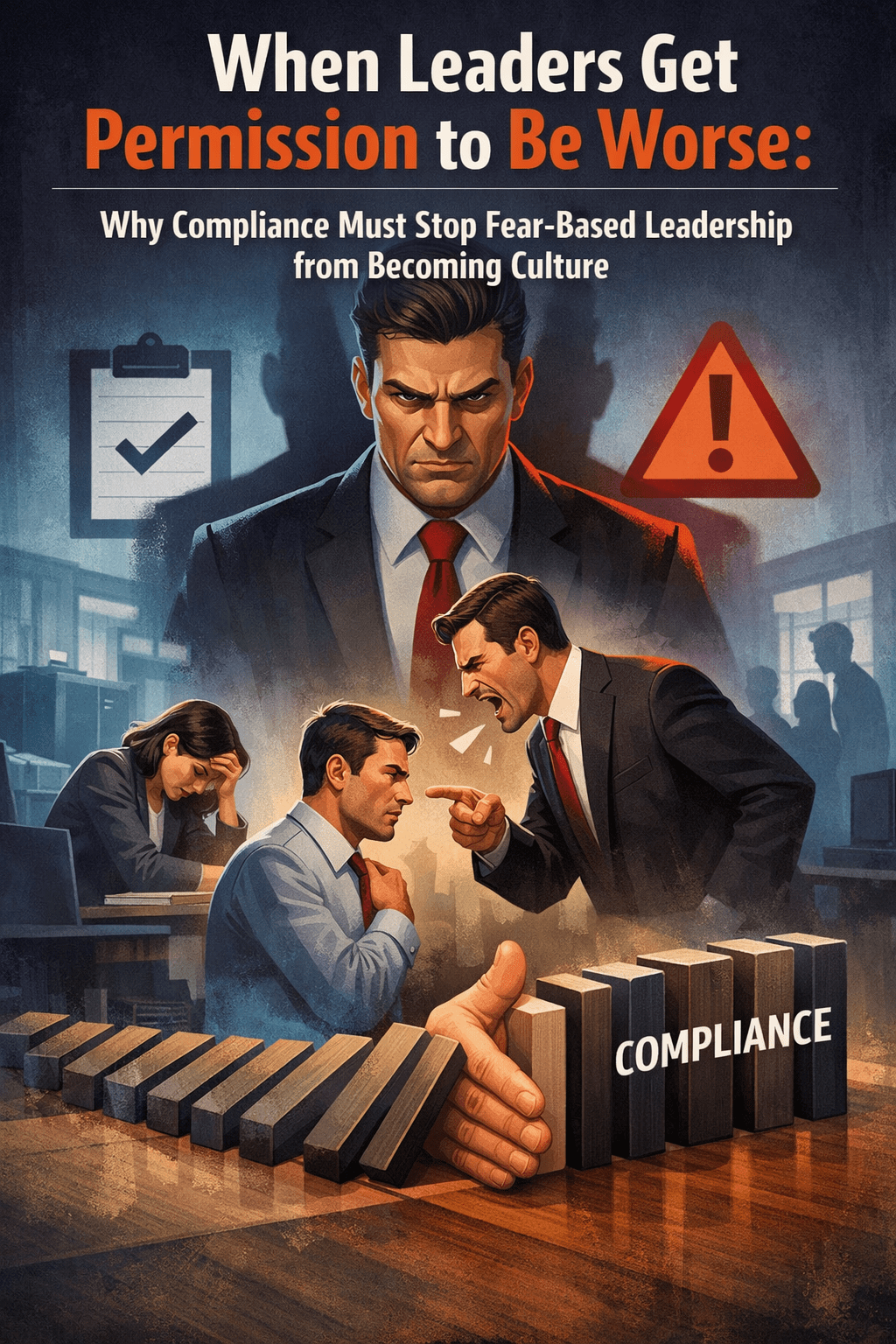
Brené Brown’s blunt warning about toxic leadership is really a compliance warning: when fear, cruelty, and intimidation become normalized management tools, misconduct risk rises, speak-up culture collapses, and the compliance function must move from observer to guardian of organizational integrity.
There are moments when an outside voice captures a problem with more clarity than a stack of internal reports ever could. Brené Brown did exactly that when she warned that some leaders now feel a “sense of relief and permission from the current political climate to be the assholes that they are and have always been”. She paired that with an equally important observation: truly courageous leaders do not need permission from the political climate to be good people. For compliance professionals, that is not simply a leadership critique. It is a flashing red warning light.
Whenever a political or social environment legitimizes bullying, anti-empathy, macho posturing, humiliation, or domination, some corporate leaders will inevitably import that behavior into the workplace. They will call it toughness. They will call it candor. They will call it performance culture. They will call it accountability. But often it is something much simpler and much uglier. It is abuse wrapped in executive language. Compliance needs to be said so clearly.
The central challenge is not that every hard-driving executive is a bully. Some leaders are demanding, exacting, and high-performing without being abusive. They set clear expectations. They make hard calls. They hold people accountable. But they do not create fear as a management system. They do not humiliate subordinates. They do not retaliate against dissent. They do not turn uncertainty into control theater. That is the line compliance must help an organization define.
Brown also offers a useful lens for understanding how toxic leadership takes root. She notes that when people feel vulnerable or afraid, they “put on armor,” and for her, that armor often looks like “micromanagement” and “perfectionism”. That is a profound compliance insight. Toxic leadership is often not random. It is fear operationalized. It is insecurity translated into control. It is anxiety turned outward as cruelty. And once that fear-based conduct gets normalized, the compliance consequences follow quickly.
Employees stop raising concerns. Managers shade facts upward. Internal reporting channels become performative. Investigations lose witnesses because no one wants to be the next target. Small control failures become larger ethical failures because people learn that silence is safer than truth. In that kind of environment, the company does not merely have a culture problem; it has a systemic problem. It has a misconduct incubation problem.
This is where the Department of Justice’s Evaluation of Corporate Compliance Programs (ECCP) becomes highly relevant. The ECCP asks whether compliance is empowered, whether misconduct is investigated, whether reporting mechanisms are trusted, whether middle managers reinforce the right values, and whether the company’s culture actually supports ethical behavior. Those questions are not abstractions. They are designed to uncover exactly this sort of rot. If leadership behavior teaches employees that power matters more than principle, your code of conduct is not your culture. Your leaders are.
Prevention
That is why the compliance function must own this issue as a core mandate for prevention, detection, and response. Compliance should work with HR, internal audit, legal, and business leadership to define abusive leadership conduct in operational terms. Not vague values language. Not posters. Not generic civility commitments. Real examples. Public humiliation. Retaliation against dissent. Weaponized performance reviews—threat-based management. Selective enforcement. Meetings where people are punished for raising risks. Impossible deadlines are designed to force corner-cutting—leaders who demand loyalty over truth.
Just as importantly, compliance should distinguish this from legitimate performance management. Strong leaders can push hard. They can demand rigor. They can insist on deadlines and quality. But they do so transparently, consistently, and without degrading people. That distinction matters because toxic leaders love to hide behind the claim that others are too soft. Compliance must not allow that defense to go unchallenged.
Training is part of the answer, but only if it is targeted. Senior leader and middle manager training should include fear-based leadership scenarios, anti-retaliation obligations, how abusive conduct suppresses reporting, and how a breakdown in culture creates legal and regulatory exposure. This is not “soft skills” programming. Brown herself makes the point that leaders must know themselves, regulate their emotions, and think strategically, rejecting the dismissive label of ‘soft skills’ while linking that work directly to performance and growth. Compliance should embrace that insight. Emotional self-regulation is not cosmetic. It is a control.
Promotion and compensation systems must also be brought into the conversation. Companies create exactly what they reward. If a leader hits numbers while leaving a trail of fear, attrition, broken teams, retaliation complaints, and suppressed escalation, that person is not a high performer. That person is a risk event with a bonus target. So compensation committees, HR, and compliance should align on consequences and incentives. Promotion criteria should include team health, substantiated conduct findings, speak-up metrics, turnover patterns, and responsiveness to internal controls. A toxic rainmaker is still toxic.
Detection
Most companies already have more data on toxic leadership than they think. Hotline reports. Ombuds trends. HR complaints. exit interviews. internal mobility data. regrettable attrition. pulse surveys. investigation outcomes. audit interviews. skip-level feedback. even the language patterns that recur in misconduct reports. The failure is rarely a lack of information. The failure is the refusal to connect the dots when the accused is powerful.
Compliance should build a dashboard to monitor toxic leadership. Not for public circulation, but for disciplined internal review. Which functions have repeated retaliation allegations? Which leaders generate unusual turnover after promotion? Where do substantiated complaints cluster? Which business units show low reporting and high pressure simultaneously? Low hotline volume is not always a sign of health. Sometimes it is a sign that employees have already learned the rules of silence.
Here, the political and social climate matters. Brown describes the current atmosphere as “anti-empathy” and “sinister”. Whether one agrees with every aspect of that characterization is almost beside the point. Compliance professionals should understand that external discourse does seep into internal culture. When public life celebrates cruelty, belittles inclusion, mocks empathy, and treats domination as authenticity, some executives will feel culturally validated in bringing those behaviors to work. The company cannot control the external environment, but it can harden its internal norms to counter it. That means reinforcing that empathy is not weakness, accountability is not abuse, and candor is not humiliation.
Remediation
When a toxic leader crosses the line, the organization has to act in ways employees can see and believe, even if they do not see every fact. This is where many compliance programs fail. They investigate the conduct, document the issues, perhaps quietly coach the leader, and then move on. Employees notice. They conclude that there are two systems: one for everyone else and one for top performers.
The ECCP is skeptical of exactly that sort of inconsistency. Regulators want to know whether discipline is applied fairly across the organization and whether managers are held accountable for misconduct and for supervisory failures. A company that protects abusive executives because they deliver revenue is sending a very loud message about what it truly values.
The response toolkit should include substantiated findings, documented remediation plans, compensation impact, leadership coaching where appropriate, enhanced oversight, demotion when necessary, and termination when warranted. Not every toxic leader needs to be fired. But every confirmed pattern of abusive conduct needs a real consequence. Otherwise, the company is not remediating. It is subsidizing misconduct.
There is another subtle but important point in Brown’s remarks. She warns that emotionally resonant language can be weaponized and that vulnerability does not mean oversharing or abandoning responsibility. Compliance should take that seriously as well. Culture language can be gamed. Toxic leaders are often very good at learning the vocabulary of belonging, authenticity, or purpose without changing their behavior. So the compliance function should evaluate culture not by slogans, but by lived experience. Are people willing to raise concerns? Are bad facts welcome? Can managers be challenged without retaliation? That is the test.
In the end, the compliance function cannot prevent every executive from being a jerk. But it can and must prevent jerk behavior from becoming the unofficial operating system of the company.
That is the real issue. Not bad manners. Not personality conflicts. Not style differences. The real issue is whether fear becomes normalized as a management tool and whether the company, through inaction, grants silent permission for it to continue. When that happens, misconduct is never far behind.
Conclusion
In the final analysis, the compliance function has a duty far beyond policing policies or checking boxes. It must help set the boundaries of acceptable power inside an organization. When leaders use fear, intimidation, humiliation, or retaliation as management tools, they do more than damage morale. They corrode trust, silence speak-up culture, and create the precise conditions in which misconduct can flourish. That is why compliance professionals must be willing to call toxic leadership what it is: a cultural risk, a governance failure, and a business threat.
The larger lesson is straightforward. Culture is not shaped by what an organization says in its values statement. It is shaped by the behavior leaders model, the conduct that gets rewarded, and the misconduct that gets tolerated. If compliance leaders want to prevent corporate executives from turning into bullies with titles, they must insist on accountability before fear becomes normalized. In today’s environment, that is not optional. It is one of the clearest tests of whether a company truly has an effective compliance program.