Categories
The PfBCon Podcast

The PfBCon Podcast: Leveraging Podcasting for Building Personal Brands with Brent Carlson and Mike Huneke

Brent Carlson and Mike Huneke from the Red Flags Rising podcast discuss their journey in building personal brands through podcasting.

Brent, a Principal and Chief Solutions Officer at Red Flags Rising Solutions, LLC, and Mike, a Partner at Morgan, Lewis & Bockius, share insights on using podcasting to create authentic connections, expand professional networks, and address timely industry topics. They emphasize the importance of quality, consistency, and having a genuine passion for your subject matter. The discussion also covers practical tips on choosing the right equipment, the benefits of LinkedIn for promotion, and the value of having a unique style that resonates with your audience. The episode underscores the impact of podcasting on establishing professional credibility and on driving business growth.

Key highlights:

  • The Power of Podcasting for Personal Branding
  • Building Connections and Community
  • Starting the Red Flags Rising Podcast
  • Creating Engaging and Practical Content
  • Promoting Your Podcast Effectively
  • Investing in Quality Equipment
  • Using Podcasts for Business Development

Resources:

Follow Brent and Mike on LinkedIn:

Brent Carlson

Mike Huneke

Follow Red Flags Rising on:

Website

Spotify

RSS. Com

YouTube

Compliance Podcast Network

Apple Podcast

Listen Notes

Categories
Red Flags Rising

Red Flags Rising: S01 E36: How to Prepare for 2026 – The Fraud Diamond Framework (SM) Applied

Mike Huneke and Brent Carlson return for the new year with a refresher on The Fraud Diamond Framework (SM) introduced in Episode 34 and an explanation of how it would apply in practice as trade compliance professionals try to expect the unexpected in 2026. They discuss the importance of designing and implementing “compliance backstops” as geopolitical guardrails (01:47), how Stoic philosophy and the good work of Mo Bunnell (CEO and Founder of Bunnell Idea Group, author of Give to Grow) help build resiliency (03:40), review The Fraud Diamond Framework(SM) (05:57), describe how the framework can help trade compliance personnel to make and defend triage decisions (10:59), the implications of many trade compliance programs reaching a point in their evolution where they need to be able to demonstrate true integrity and effectiveness (13:45), the new 25% tariffs on certain semiconductors (14:38), and notable economic sanctions enforcement decisions related to lawyers’ advice or lawyers themselves (15:56). They conclude with Brent’s first Managing Up of 2026 (21:04).

Resources:

Brent’s email: brent@redflagsrising.com

Mike’s email: michael.huneke@morganlewis.com

Categories
FCPA Compliance Report

FCPA Compliance Report – Navigating Export Control and Trade Sanction Challenges in Venezuela: Insights from Brent Carlson

Welcome to the award-winning FCPA Compliance Report, the longest-running podcast in compliance. In this inaugural episode of 2026, Tom Fox welcomes back Brent Carlson, a specialist in trade and economic sanctions, focusing on compliance issues related to Venezuela.

Tom and Brent discuss the shifting political landscape, potential business opportunities in the energy sector, and the steps compliance professionals need to take to navigate new regulations and restrictions from the export control and trade sanctions perspective. Brent emphasizes the importance of a robust, business-aligned compliance strategy, a non-siloed approach involving all risk disciplines, and proactive dialogue with regulators. They also discuss the heightened enforcement landscape and the need for companies to remain vigilant and adaptable in a rapidly changing global environment.

Key highlights:

  • Focus on Venezuela: Navigating Export Controls and Sanctions
  • Business Opportunities and Risks in Venezuela
  • Importance of Understanding Business Operations
  • Board of Directors: Asking the Right Questions
  • Geopolitical Changes and Risk Management

Resources:

Brent Carlson on LinkedIn

Red Flags Rising website

Tom Fox

Five-Part Blog Post Series on Doing Business in Venezuela on the FCPA Compliance and Ethics Blog

Instagram

Facebook

YouTube

Twitter

LinkedIn

Categories
Blog

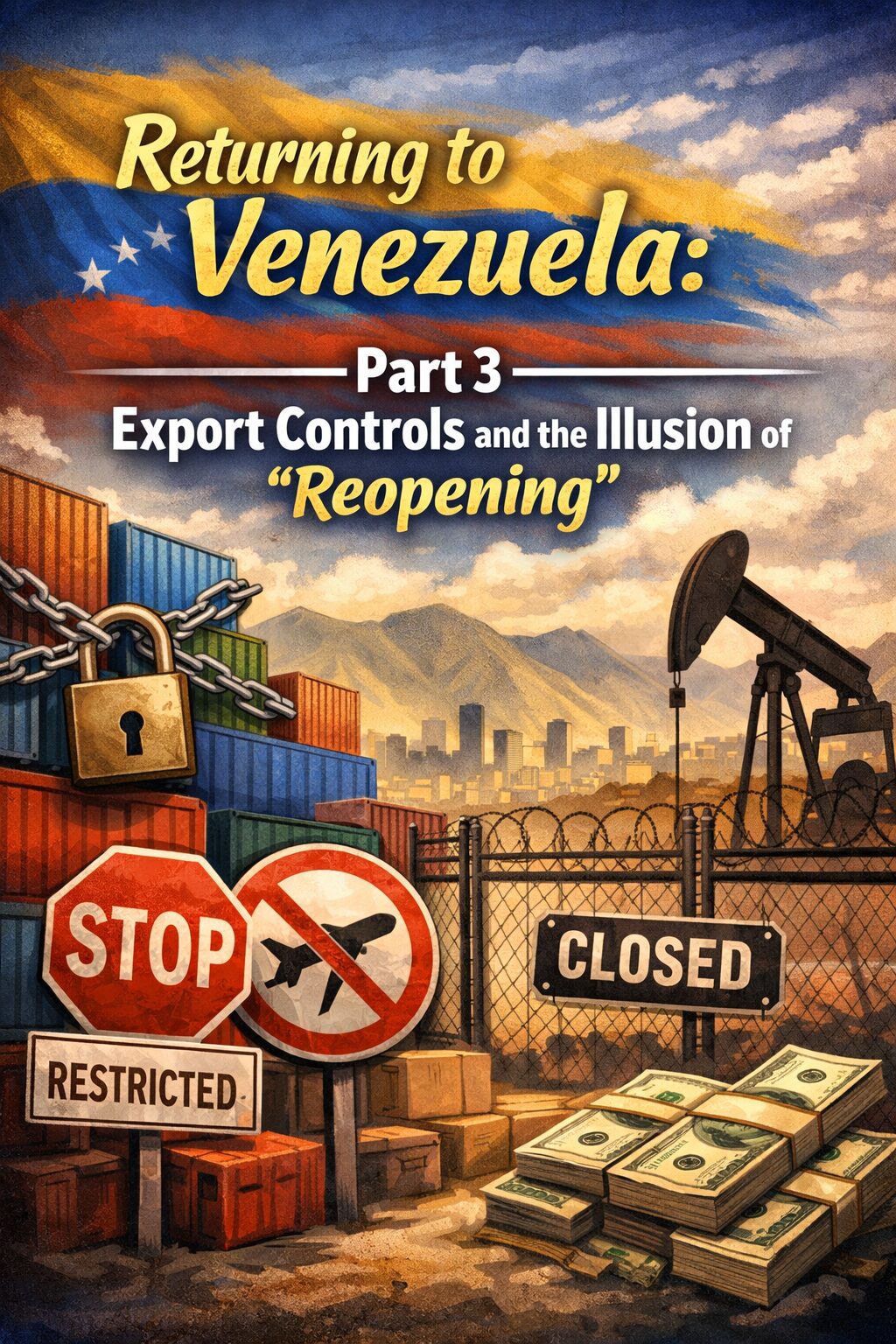
Returning to Venezuela: Part 3 – Export Controls and the Illusion of “Reopening”

We continue to explore what the ‘reopening’ of Venezuela to US energy companies means for the compliance professional. Over the last two days, we considered the corruption issues in Parts One and Two of this blog post series. Today in Part 3, we look at export control and trade sanction issues. I spoke with Brent Carlson, founder of Red Flags Rising Solutions LLC, for his insights.

When the White House announces that U.S. oil companies may be returning to Venezuela, the business press immediately begins talking about opportunities. Compliance professionals should be talking about risk. Not hypothetical risk. Not academic risk. Real, layered, enterprise-threatening risk that sits at the intersection of export controls, sanctions, geopolitics, corruption, security, and board oversight. The conversation I recently had with Carlson makes one thing abundantly clear: Venezuela is not “opening.” It is recalibrating. And compliance programs that treat this moment as a return to business as usual will fail.

Venezuela Remains a High-Risk Jurisdiction by Design

Let us start with first principles. Venezuela remains designated as a D:5 country under the Export Administration Regulations (EAR). That places it in the most restrictive category, alongside jurisdictions such as Iran and North Korea. Even the shipment of EAR99 items can be problematic under the current framework.

That legal reality did not change simply because the President met with U.S. energy executives. Carlson is clear on this point. Whatever policy adjustments may come will be sector-specific, narrowly tailored, and aligned with geopolitical priorities, particularly oil production. There will not be a wholesale rollback of export controls or sanctions. For compliance professionals, this means one thing: the law today is the law as it existed yesterday. Until the Bureau of Industry and Security (BIS) and OFAC issue formal guidance, licenses, or regulatory amendments, nothing has changed.

Regulatory Enforcement Follows Politics, but Law Follows Process

One of the most important compliance insights Carlson offers is that regulatory enforcement follows political drivers, which in turn follow geopolitical drivers. That is undoubtedly true. But it is also where companies get themselves into trouble. Political signaling is not legal authorization. Tweets, speeches, and press briefings do not override the Export Administration Regulations, OFAC sanctions, or anti-money laundering laws. Compliance programs must be built to withstand whiplash, not chase headlines.

This is especially critical in Venezuela, where any meaningful restart of oil production will require billions of dollars, long project timelines, complex infrastructure, and sustained government engagement. These are not quick deals. They are multi-year commitments that must be compliant from day one.

Start With the Business, but Do Not Stop There

Carlson emphasizes that compliance analysis must begin with the business opportunity itself. What is the company actually trying to do? What products or services will be provided? Who will operate them? Where will the equipment go? Who will maintain it? For compliance professionals, this requires operational fluency that goes far beyond policy review. You must understand the business process step by step. Not in the abstract. Literally, transaction by transaction.

This exercise does more than identify export control risks. It exposes corruption, diversion, money laundering, security, and reputational risks. Venezuela is not a jurisdiction where silos survive.

Dual-Use Risk Is Not Theoretical in Venezuela

Any company operating in the energy sector must assume heightened scrutiny around dual-use items. Control systems, industrial machinery, software, and communications technology can all be repurposed. Carlson makes an important point here. Companies that manufacture or deploy these items already know where the risks are. The issue is not ignorance. The problem is prioritization and escalation.

This is where proactive engagement with the BIS becomes essential. Unlike some areas of compliance, export controls encourage dialogue with regulators. Companies can and should engage BIS field offices early to discuss proposed transactions, licensing pathways, and regulatory obstacles. This is not lobbying. It is compliance.

One of the most powerful insights in our discussion is the call for compliance professionals to sit down with business operations and map every operational step. This is not busywork. It is risk triage. Too often, compliance reviews occur after a deal is already emotionally committed. At that point, compliance becomes the obstacle rather than the enabler. Carlson is explicit: sales and operations teams do not want to waste time on deals that will collapse under regulatory scrutiny. When compliance is embedded early, it improves deal quality. It filters out bad opportunities and strengthens good ones. That is value creation.

Siloed Compliance Will Fail in Venezuela

If there is one jurisdiction where compliance silos are fatal, it is Venezuela. Export controls intersect with sanctions. Sanctions intersect with AML. AML intersects with corruption. Corruption intersects with security. Security intersects with human rights and ESG. Carlson cites enforcement actions where companies failed because information did not flow across functions. Finance saw one risk. Operations saw another. Compliance saw a third. No one saw the whole picture.

For Venezuela, companies must adopt a non-siloed, enterprise-wide risk model. Export control specialists must talk to anti-corruption teams. Treasury must talk to security. Legal must talk to operations. This is not optional.

Board Oversight Must Evolve Beyond Periodic Updates

Boards of directors will play a decisive role in whether companies succeed or fail in Venezuela. Carlson is clear that boards must demand updated, transaction-specific risk assessments focused on central compliance risks, not generic program health. This is not about micromanagement. It is about governance. Boards must understand that Venezuela presents a dynamic risk environment where geopolitical shifts can occur overnight. The right board questions are not “Do we have a compliance program? ” They are:

  • What export control risks are central to this opportunity?
  • What sanctions exposure remains?
  • How are we monitoring changes in real time?
  • What is our exit strategy if conditions reverse?

The Case for a Standing Enterprise Risk Committee

Carlson raises a critical governance concept: the need for a standing, cross-functional risk committee empowered to act quickly. Not an ad hoc task force. Not an annual review. A permanent capability. We are no longer in a stable geopolitical environment. Long-trusted partners can become sanctioned entities within weeks. Supply chains built over decades can collapse overnight. For compliance professionals, this reinforces the need for real-time risk sensing, escalation protocols, and decision authority. Venezuela is simply the proving ground.

Enforcement Is Coming, Not Fading

The most sobering warning Carlson offers is about enforcement. The U.S. government has been signaling for some time that export control enforcement will increase. DOJ’s Trade Fraud Task Force, BIS outreach visits, and expanded definitions of “knowledge” under the EAR all point in the same direction. Compliance professionals should recognize the parallel to early FCPA enforcement. Policies alone are not enough. Programs must demonstrate that they identify high-probability risks, escalate them, and act. Testing matters. Documentation matters. Integration matters.

Final Thoughts

The prospect of renewed oil activity in Venezuela is not a green light for compliance. It is a stress test. Companies that approach this moment with discipline, humility, and integrated risk management can create value while protecting themselves. Companies that treat it as a political reopening will find themselves exposed on multiple fronts. For compliance professionals, this is a defining moment. The question is not whether Venezuela is open for business. The question is whether your compliance program is ready for the real world.


Categories
Red Flags Rising

Red Flags Rising: S01 E34: Introducing Brent Carlson’s Fraud Diamond Framework (SM)

Mike & Brent explore the classic “Fraud Triangle” of pressure, opportunity, and rationalization, and discuss Brent’s creation of a new “Fraud Diamond Framework” (SM) to help trade compliance (and other) professionals who are not looking to explain past misconduct but to prevent future misconduct. They discuss recent news and developments in the export controls world (00:55), how seemingly inconsistent headlines are actually consistent with each other (04:05), and how Edward Fishman’s “impossible triad” concept continues to be a useful tool for understanding what’s happening in geopolitics and trade competition (06:22), and then they launch into their discussion of Brent’s Fraud Diamond Framework (SM) (08:05).

Regarding the Fraud Diamond Framework (SM), they discuss the classic fraud triangle and the backward-looking perspective from which it was derived (09:18) and then explain the Fraud Diamond Framework’s four elements of pressure (12:08), opportunity (13:06), something that’s too good to be true that comes at a critical time for the business (14:06), and signs of concealment (15:48). Brent next explains the Fraud Diamond Framework (SM) through a historical case study pulled from his own prior experience helping a client with a compliance commercial fraud dispute involving the acquisition of a business in China (17:35), after which they explain how the Fraud Diamond Framework (SM) can help trade compliance teams today (23:02).

They conclude with another installment of Brent’s always popular “Managing Up” segment (24:43).

Resources:

“Chokepoints: American Power in the Age of Economic Warfare” by Edward Fishman

Brent’s original NYU PCCE post, “When Loopholes Create Liability Pitfalls: A Fresh Look at Export Controls” (Aug. 25, 2023)

Brent’s email: brent@redflagsrising.com

Mike’s email: michael.huneke@morganlewis.com

Categories
All Things Investigations

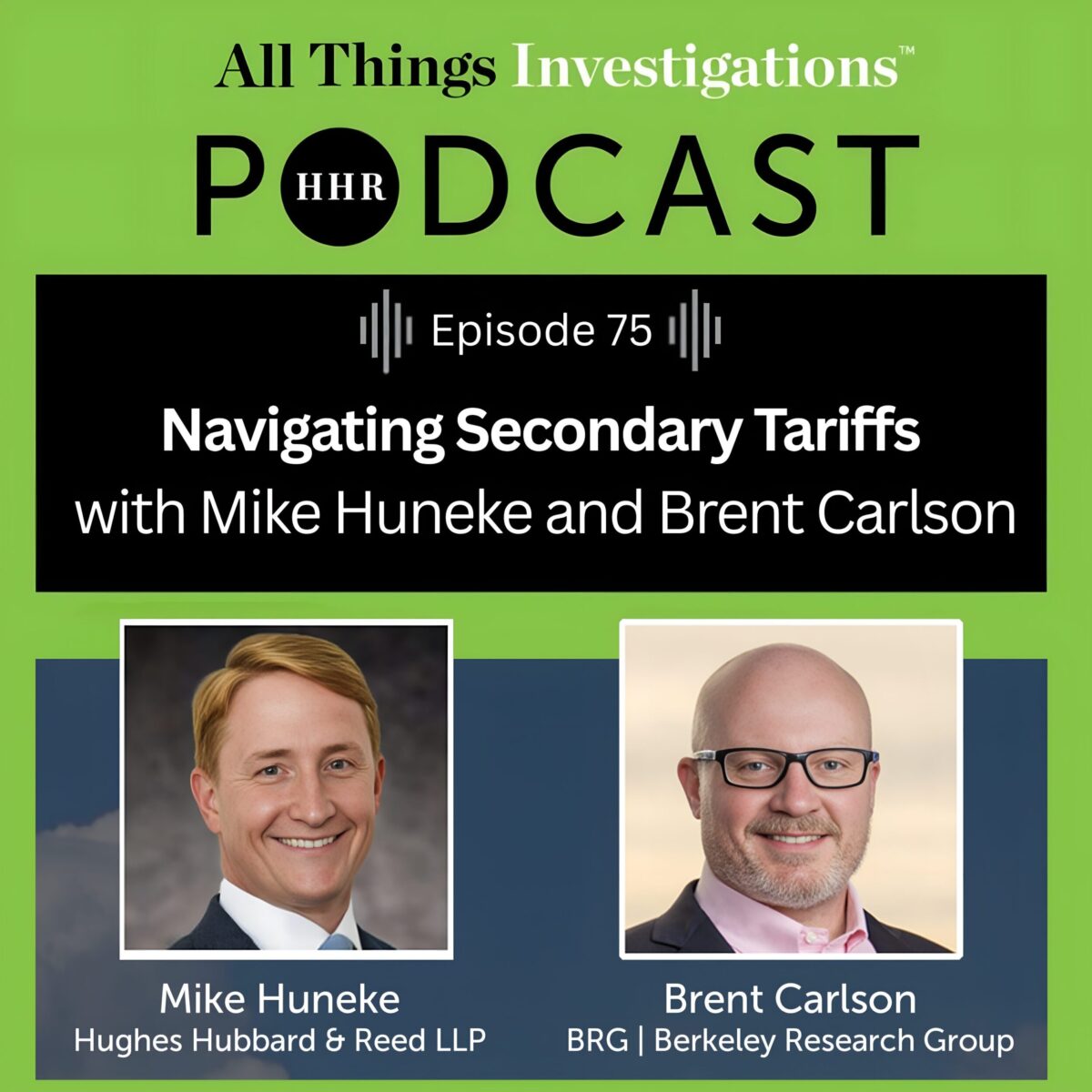
All Things Investigations – Navigating Secondary Tariffs with Mike Huneke and Brent Carlson

Welcome to the Hughes Hubbard Anti-Corruption & Internal Investigations Practice Group’s podcast, All Things Investigation. In this podcast, host Tom Fox is joined by HHR partner Mike Huneke and BRG Director Brent Carlson to discuss secondary tariffs.

Mike Huneke and Brent Carlson are leading experts in trade compliance, with a particular focus on the intricacies and impacts of tariffs and secondary tariffs within the global economic landscape. Huneke emphasizes the existential threats tariffs pose to businesses, stressing the importance of understanding their effects on countries with significant economic ties to Russia, such as China, and advising companies to reassess trade relationships with nations like China, Brazil, Russia, and Iran. Carlson emphasizes the need for trade compliance officers to adapt to the rapidly evolving geopolitical landscape, advising companies to assess their suppliers and consider potential indirect transactions through transshipment countries to navigate imposed tariffs effectively. Both experts emphasize the importance of businesses adopting a dynamic, risk-based approach to compliance, anticipating challenges, and making informed decisions to mitigate financial impacts and maintain shareholder value amid shifting trade patterns and geopolitical tensions.

Key highlights:

  • Geopolitical Impact of Secondary Tariffs
  • Global Trade Dynamics Amid Geopolitical Shifts
  • Trade Compliance Risks: False Claims & Tariff Evasion
  • Resilient Supply Chain Strategy Amid Global Trade Dynamics
  • Negotiating Tactics in Geopolitical Tariff Strategy

Resources:

Mike Huneke

Hughes Hubbard & Reed Website

Brent Carlson

BRG Website

Categories
FCPA Compliance Report

FCPA Compliance Report – The Impact of Secondary Tariffs on Global Trade with Mike Huneke and Brent Carlson

Welcome to the award-winning FCPA Compliance Report, the longest-running podcast in compliance. In this episode, Tom Fox welcomes back Mike Huneke and Brent Carlson, who help us navigate the implications of secondary tariffs, focusing on recent developments following the President’s announcement.

They explore why secondary tariffs could be considered the ‘nuclear bomb’ of trade sanctions, examining their potential impacts on various countries, particularly those doing business with Russia, such as China and India, as well as the broader geopolitical shifts affecting global trade patterns. The conversation emphasizes the need for multinational companies to reassess their supply chains and compliance strategies to mitigate potential risks associated with these tariffs. The episode underscores the importance of companies adapting to a rapidly evolving geopolitical landscape to ensure compliance and maintain their business operations.

Key highlights include:

  • Understanding Secondary Tariffs
  • Implications of Secondary Tariffs on Global Trade
  • Corporate Response to Secondary Tariffs
  • Geopolitical Realities and Trade Compliance
  • False Claims Act and Enforcement Risks

Resources:

Brent Carlson on LinkedIn

Mike Huneke on LinkedIn

Tom Fox

Instagram

Facebook

YouTube

Twitter

LinkedIn

For more information on the use of AI in Compliance programs, my new book, Upping Your Game. You can purchase a copy of the book on Amazon.com

Categories
Red Flags Rising

Red Flags Rising: S01 E17 – Data-Driven Root-Cause Analysis with Erika Trujillo of SEIA

Mike & Brent welcome Erika Trujillo, Managing Director of SEIA (“say-a”), who, with her company, brings advanced data analytics solutions to solving trade compliance problems. Mike and Brent discuss Erika’s background and the services SEIA provides (00:14); how advanced data analytics can help with export controls risk assessments by, among other things, bringing to bear data from across multiple departments (which is particularly important under U.S. law’s collective knowledge doctrine and the “high probability” standard) (02:10); the importance of differentiating between your company’s “internal data” and the “external data” and of identifying and leveraging what internal data might be sitting within reach (05:03); the importance of contextualization, i.e., taking a holistic perspective at potentially interesting data points that only become informative in the context of other data points, for example data suggesting that EAR99 items that otherwise would not require an export license might be exported for prohibited end-uses or to prohibited end-users (06:53); the need for companies to have the courage to engage with their own data, especially since they are making statements to various governments in any case about their trade flows (09:21); how small- and medium-sized companies can start, step-by-step, to get a handle on their internal data (10:53); how to respond to reports or allegations (i.e., “red flags”) of potential export control violations (12:18); common data pitfalls to avoid (13:51); the importance of prioritization not just in terms of data cleanup projects (14:28); why praying to the accounting platform gods and hoping everything is OK is not sufficient (16:00); the full definition of knowledge (including an awareness of a high probability) and what opportunities that presents for risk-based approaches to trade compliance (16:35); how a data-driven approach to trade compliance can help improve relationships with colleagues in sales and operational functions (18:39); how to overcome the fear of what you might find by taking a deeper dive into your company’s data (19:28); and how a data-driven approach can help with c-suites and boards of directors (20:13). We conclude with a surprise twist in the ever-popular segment, Brent Carlson’s “Managing Up,” in exploring Erika’s mission and purpose in co-founding SEIA.

Resources:

More about SEIA

Contact or Book a Demo with SEIA

Contact Erika

Brent LinkedIn

Mike LinkedIn

Mike & Brent’s “Fresh Looks” Series

Categories
Red Flags Rising

Red Flags Rising: S01 E14 – Getting a Grip on U.S. Export Controls Guidance

Mike and Brent unpack the May 13, 2025, due diligence guidance from the U.S. Bureau of Industry & Security. They describe what happened on May 13 (00:00), the guidance from BIS on General Prohibition 10 and Huawei Ascend chips (03:34), the related BIS policy statement (04:13), and then focus on the BIS “Industry Guidance to Prevent Diversion of Advanced Computing Integrated Circuits” (04:47), specifically the underlying U.S. national security concerns (05:50), relevant key takeaways from Episode 13’s special guest Dana W. White (06:51), the significance of the Industry Guidance’s reference to the WMD and military-intelligence catch-all provisions (08:29), the historical pre-1993 “KYC Guidance” cross-referenced by BIS in the new Industry Guidance (11:53), how the historical “KYC Guidance” is often misunderstood through selective quotation devoid of relevant context (13:34), the new “red flags” identified in the May 13, 2025 Industry Guidance (16:10), the key takeaways of the Industry Guidance (17:55), a warning about over-reliance on the Industry Guidance’s statement about existing end-use certificates (18:47), and the practical implications of the Industry Guidance for trade compliance teams (19:36). They then conclude with the next installment of Brent Carlson’s “Managing Up” (21:26).

Resources:

BIS May 15, 2025 Industry Guidance

Brent LinkedIn

Mike LinkedIn

Mike & Brent’s “Fresh Looks” Series

Categories
Red Flags Rising

Red Flags Rising: S01 E13 – Dana W. White on U.S. National Security & Export Controls

Mike and Brent welcome Dana W. White, Managing Partner at the Juno Collective, to share her thoughts and analysis on China and U.S. export controls, drawing on her extensive career in public service, including various national security-related roles. Mike, Brent, and Dana discuss Dana’s national security background (00:49), what happens “behind the scenes” that leads to U.S. agencies determining national security threats exists (02:28), how knowledge-sharing is both the strength and the Achilles’ heel of free societies (06:11), how U.S. businesses and business leaders play an important part in our national security (07:26), the challenge of finding reliable data points from which to infer export controls compliance risks (09:37), what business leaders should understand about how the relationship between the U.S. and China is different today than when China joined the World Trade Organization (11:21), how Dana and the Juno Collective help clients to understand and mitigate risks (13:46), and the common pitfalls companies face when responding to inquiries by the U.S. Congress (18:45). They conclude with yet another segment of Brent Carlson’s “Managing Up” (20:23).

Resources:

More about Dana W. White and the Juno Collective: https://www.juno-collective.com/about

Contact Dana W. White: dana@juno-collective.com

Brent LinkedIn

Mike LinkedIn

Mike & Brent’s “Fresh Looks” Series