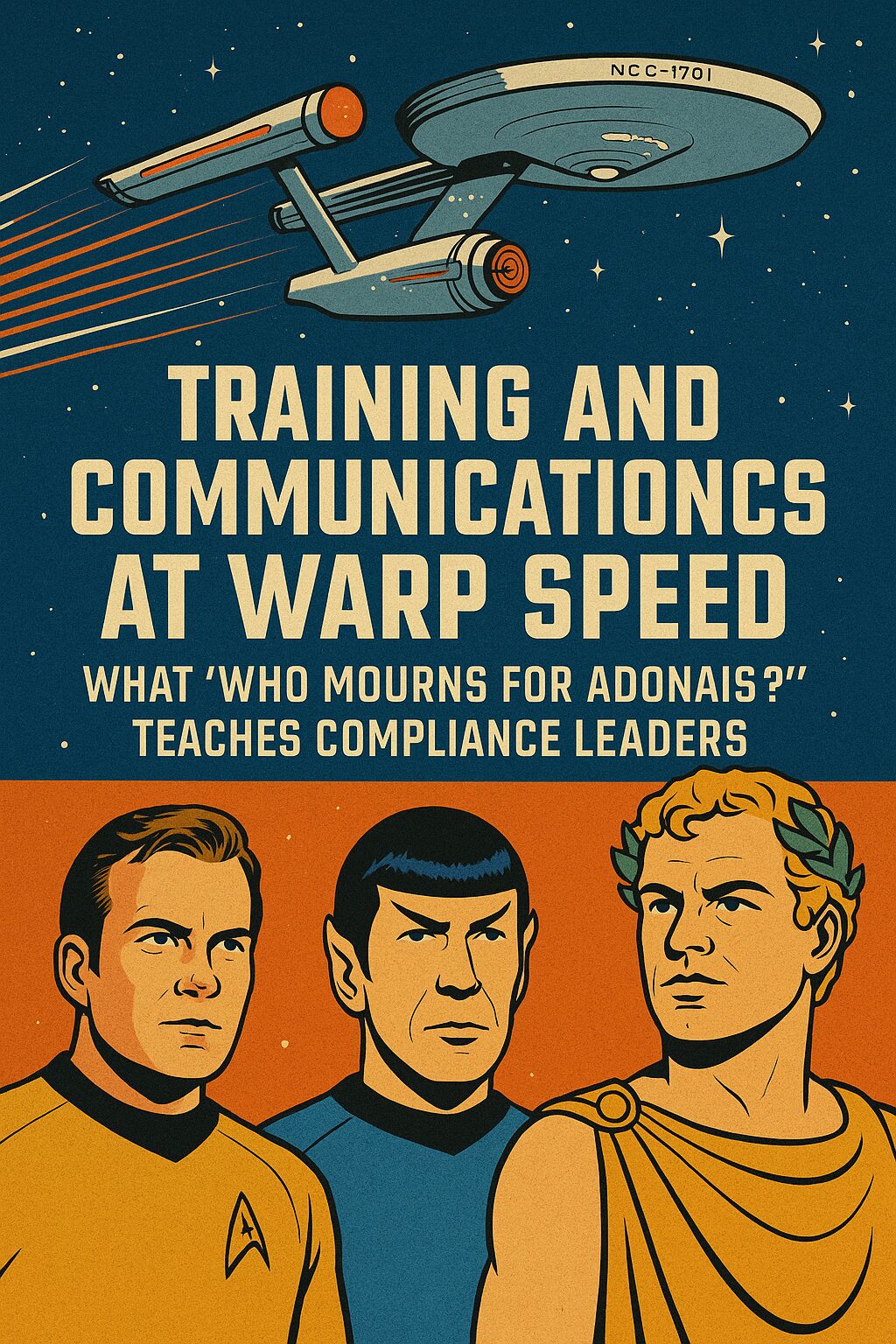
In the vast and often perilous universe of corporate compliance, effective training and communication are the twin guiding stars that help organizations navigate the asteroid fields of regulatory requirements, ethical dilemmas, and cultural complexities safely. Few stories illustrate these challenges as vividly as the classic Star Trek: The Original Series episode “Who Mourns for Adonais? ”This episode presents a rich tableau of human behavior, authority dynamics, and persuasion tactics, all set within the context of an encounter with an all-powerful yet vulnerable being who claims to be the Greek god Apollo (the Adonais of the title).
For today’s compliance leaders, “Who Mourns for Adonais? ” provides invaluable lessons about how communication shapes understanding, the importance of cultural and historical context, and the perils of power imbalances in training environments. Drawing directly from incidents in the episode, here are five key training and communication lessons that compliance professionals should take to heart.
Lesson 1: Know Your Audience and Context—Tailor Communication to Their Needs
Illustrated By: When Apollo appears and asserts his authority, commanding the Enterprise crew to worship him as a god, Captain Kirk and his team respond with rational skepticism rooted in their 23rd-century perspective. Apollo’s attempts to assert dominance fail in part because he misunderstands the crew’s mindset and cultural framework.
Compliance Lesson: Effective training programs begin with a thorough understanding of the target audience. Compliance professionals must design and deliver communications that resonate with the learners’ values, experiences, and knowledge levels. Just as Apollo’s archaic claim to godhood fell flat with a forward-thinking Starfleet crew, compliance messaging that ignores cultural and generational differences risks rejection or misunderstanding.
For example, global companies must adapt compliance training to local cultures, language nuances, and regulatory environments rather than delivering one-size-fits-all modules. Taking the time to “speak their language” makes communication more persuasive and effective.
Lesson 2: Engage in Dialogue, Not Monologue—Foster Two-Way Communication
Illustrated By: Throughout the episode, Apollo attempts to impose his will through proclamations and demands, rarely listening or engaging in genuine dialogue. Kirk, however, insists on questioning Apollo and negotiating, ultimately persuading him to relinquish control by appealing to reason and emotion.
Compliance Lesson: Training and communication programs that function as one-way broadcasts rarely create a lasting impact. Effective compliance leaders foster active dialogue by listening attentively, addressing concerns, and making adjustments based on feedback.
In practical terms, this means facilitating interactive training sessions, town halls, and Q&A forums rather than simply distributing static videos or emails. When employees feel heard and can discuss compliance challenges openly, organizations foster a culture of engagement and shared ownership.
Lesson 3: Balance Authority with Respect—Avoid Coercion in Training Approaches
Illustrated By: Apollo’s attempts to assert absolute control through intimidation backfire, causing resistance and rebellion among the Enterprise crew. The crew’s refusal to submit to blind worship signals that authority imposed without respect for individual autonomy can provoke pushback.
Compliance Lesson: Effective compliance communication should never rely on coercion or fear-mongering. Training must strike a balance between authority and respect, emphasizing the “why” behind rules rather than relying on heavy-handed threats.
Leaders who treat employees as partners in compliance efforts foster trust and willingness to comply voluntarily. This aligns with best practices in adult learning theory, which stresses respect for learners’ autonomy and intrinsic motivation.
Lesson 4: Use Stories and Emotional Appeals to Connect—Facts Alone Are Not Enough
Illustrated By: Kirk’s most effective moment in persuading Apollo to relinquish his power comes when he appeals to Apollo’s loneliness and need for connection. By humanizing the once-godlike figure, Kirk breaks through the barrier of pride and fear.
Compliance Lesson: Compliance training that relies solely on rules, procedures, or penalties often fails to engage learners in a meaningful way. Storytelling that incorporates real-world examples, case studies, or emotional appeals helps learners internalize the importance of compliance and ethical behavior.
For example, sharing stories of whistleblowers who protected the company or lessons learned from enforcement actions personalizes the message and helps bridge the gap between abstract rules and lived experience.
Lesson 5: Prepare for Resistance and Have a Clear, Consistent Message—Persistence Pays Off
Illustrated By: Apollo initially refuses to accept the crew’s rejection of his power, using his energy to disable the Enterprise and control crew members. However, Kirk’s steadfast insistence on autonomy and reason eventually leads Apollo to concede, demonstrating the power of persistence and clarity in communication.
Compliance Lesson: Change, mainly cultural or behavioral change required by compliance programs, often meets resistance. Trainers and communicators must prepare for pushback, maintain a consistent message, and persistently reinforce core values and expectations.
This requires well-planned, repeated communications across multiple channels, combined with leadership modeling and visible enforcement. Over time, consistent messaging chips away at resistance and fosters alignment.
Final ComplianceLog Reflections
“Who Mourns for Adonais? ” is more than just an entertaining sci-fi episode; it’s a masterclass in communication dynamics, authority, and human psychology. For compliance professionals, the episode’s insights remind us that training and communication are not mere formalities or checkboxes; they are essential components of effective risk management. They are the living, breathing elements that animate compliance programs and embed ethical behavior into corporate culture.
From tailoring messages to your audience, fostering dialogue, respecting autonomy, harnessing the power of stories, and anticipating resistance, these five lessons gleaned from the Enterprise crew’s encounter with Apollo provide a robust framework to elevate your compliance training and communication efforts.
In a world where regulations evolve and risks multiply, compliance leadership means more than enforcing rules; it means engaging hearts and minds, inspiring action, and building resilient organizations that boldly go where compliance has never gone before.
Resources:
Excruciatingly Detailed Plot Summary by Eric W. Weisstein
MissionLogPodcast.com
Memory Alpha