Categories
Great Women in Compliance

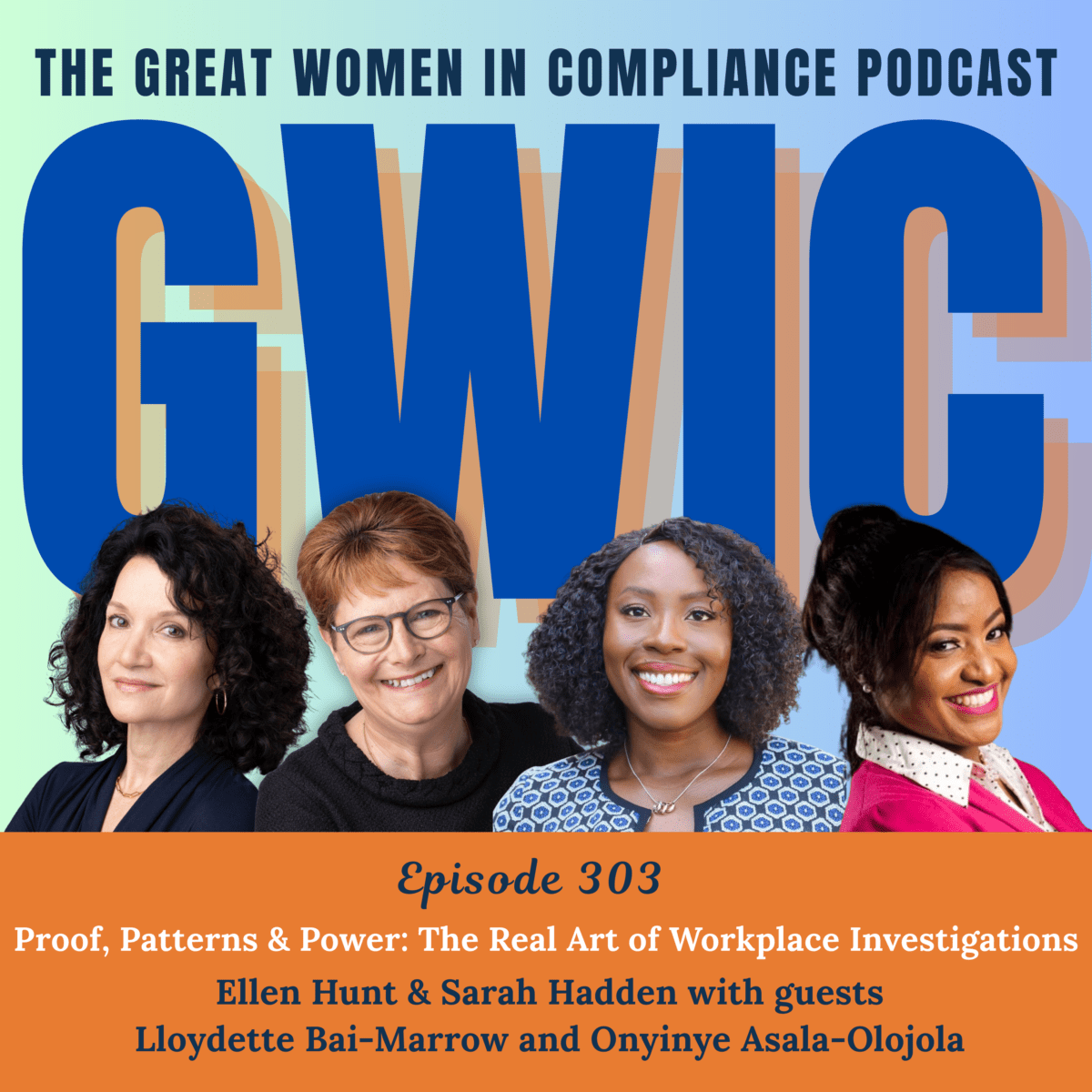
Great Women in Compliance: Proof, Patterns & Power: The Real Art of Workplace Investigations

In this roundtable episode, Sarah Hadden and Ellen M. Hunt explore the real art of workplace investigations with guests Lloydette Bai-Marrow and Onyinye Asala-Olojola through these three lenses:

  • Proof: What evidence do you need to support your finding that not only holds up in a court of law but also withstands scrutiny
  • Patterns: How to connect the dots so that the investigation tells a meaningful story that leads to action
  • Power: How to manage leaders so that the best resolution for the organization is the path forward


If you are looking for expert advice on how to increase the value of workplace investigations to your organization, tune in on your favorite podcast platform, on Corporate Compliance Insights, and the Compliance Podcast Network

#WorkplaceInvestigations #RootCause #CorrectiveMeasures #Retaliation #EthicalLeadership

Categories
Innovation in Compliance

Innovation in Compliance – The Strategic Evolution of Compliance: Insights from Angie McPhail

Innovation comes in many forms, and compliance professionals need not only to be ready for it but also to embrace it. Join Tom Fox, the Voice of Compliance, as he visits with top innovative minds, thinkers, and creators in the award-winning Innovation in Compliance podcast. In this episode, host Tom Fox welcomes Angie McPhail to discuss the transformation of compliance from a regulatory function to a strategic business imperative.

Angie shares her professional background, having led the Integrity and Compliance group for the Americas at Juniper Networks before its acquisition by HPE. Key discussions include the evolving role of compliance as a strategic influencer within organizations, the intersection of ethics and integrity with ESG, and the importance of trust in building effective compliance programs. Angie emphasizes the need for compliance professionals to understand business strategy, leverage technology, and build trust to drive sustainable growth. The talk also covers the future outlook for compliance leaders and provides advice on preparing the next generation of compliance professionals.

Key highlights:

  • Compliance as a Strategic Business Function
  • Influence and Trust in Compliance
  • Compliance as a Driver of Business Success
  • Managing Reputational Risk
  • Future of Compliance Leadership

Resources:

Angie McPhail on LinkedIn

Innovation in Compliance was recently ranked 4th among Risk Management podcasts by 1,000,000 Podcasts.

Categories
Blog

Compliance Leadership Week: Compliance Teams – Cracking the Code for Enhanced Effectiveness

We continue looking at leadership in the compliance function based on a series of recent articles by McKinsey on personal and team leadership. Today, we migrate from individual leadership lessons and issues to issues of compliance team leadership. This is for leadership internal to the corporate compliance function and leadership by the corporate compliance function within the greater organization. We use the article Go, teams: When teams get healthier, the whole organization benefits by authors Aaron De SmetGemma D’Auria,  Maitham Albaharna, and Anaïs Fifer, all with McKinsey, as a starting point for our exploration.

The stakes for effective teamwork have never been higher in the corporate compliance landscape. Teams have become the fundamental drivers of performance and value creation. This rings especially true within compliance departments, where cross-functional and inter-departmental collaboration is desirable and essential for regulatory adherence and ethical excellence. Yet, despite the rise in team autonomy and empowerment, many teams struggle significantly with collaboration and achieving measurable outcomes.

Research supports the harsh reality that three out of every four cross-functional teams fall short of expectations, performing below key metrics. This concerning statistic signals that organizations—and compliance departments in particular—must urgently reassess their approach to building, nurturing, and sustaining high-performing teams.

Debunking the Myths of Team Effectiveness

Two prevalent misconceptions frequently undermine organizational efforts to enhance team performance. First is the myth of the “heroic team leader,” the notion that a talented individual at the helm ensures collective success. Secondly, believing in “team chemistry,” or that teams naturally either click or don’t, fails to provide actionable insights. Both narratives obscure the critical structural and contextual factors shaping team outcomes.

Indeed, leadership skills are crucial. Equipping team leaders with enhanced competencies can yield incremental improvements. Yet, as compliance professionals, we must acknowledge that great leaders alone aren’t enough. Effective compliance teamwork goes beyond individual capabilities and chemistry—it is less art and more a science, demanding strategic consideration of deeper structural elements and systemic behaviors that drive genuine effectiveness.

Team Effectiveness: Moving Beyond Intuition

Compliance leaders often rely on intuition or experience to assemble teams, assuming that stacking teams with top talent automatically ensures optimal outcomes. Yet, this intuitive approach frequently misses the mark. Team effectiveness hinges less on the aggregation of individual “stars” and more on carefully balancing roles, skills, and collective behaviors aligned to the team’s specific purpose.

The U.S. men’s Olympic 4×100-meter relay team is a vivid example of this principle. Despite boasting individual runners of extraordinary speed and skill, repeated baton-passing issues have undermined their overall performance, notably resulting in disqualification at the 2024 Olympics. This illustrates a crucial compliance lesson. Top individual performers cannot guarantee collective success without effective coordination and practiced team collaboration.

Translating this to compliance, consider a team conducting an internal investigation. Staffing this team solely with the organization’s most talented individual specialists may seem sensible. However, without clearly defined roles, purposeful team interaction, and practice collaboration, such a team risks missteps, redundancies, or critical oversight, potentially exacerbating compliance risks.

The Science of Effective Compliance Teams

Recent research has pinpointed specific behaviors that drive team effectiveness, a concept we term “team health drivers.” These drivers represent actionable behaviors that consistently correlate with high-performing teams, which are particularly valuable for compliance professionals navigating intricate regulatory environments.

These health drivers fall under four essential pillars:

  1. Defining clear roles and ensuring diversity of perspectives and skills on the compliance team.
  2. Guaranteeing team clarity and unified commitment to the compliance program’s objectives and regulatory obligations.
  3. Assessing and enhancing how effectively the compliance team executes responsibilities, from risk assessment to enforcement.
  4. Establishing a sustainable work environment that allows compliance teams to maintain effectiveness long-term.

Applying these pillars practically, compliance officers can proactively diagnose and strengthen team effectiveness, resulting in robust regulatory adherence and enhanced organizational integrity.

Context Matters: Compliance Team Archetypes

Not every team requires identical behaviors to achieve effectiveness. Recognizing distinct team archetypes and contexts allows compliance leaders to tailor approaches more precisely. For example, investigative compliance teams may require stringent execution and clearly defined configuration. In contrast, compliance advisory teams interacting closely with business units might prioritize alignment and renewal behaviors to sustain effective long-term partnerships.

Understanding context-specific behaviors empowers compliance leaders to design teams strategically. Rather than generic team-building exercises, focus resources on targeted development areas precisely aligned to specific compliance team functions and organizational goals.

Creating Value Beyond the Top Team

Traditionally, organizations predominantly direct resources toward enhancing senior leadership teams, perceiving them as the greatest value drivers. While top-level alignment is undoubtedly vital, compliance leaders must recognize the indispensable role of middle management and operational compliance teams.

Teams closest to the organization’s front lines, such as customer-facing compliance staff, offer critical real-time insights into emerging risks and operational challenges. Prioritizing these teams can unlock significant value, enhance organizational responsiveness, and empower proactive compliance.

The Imperative for Compliance Leaders

Compliance leaders must embrace evidence-based team effectiveness approaches to navigate today’s fast-evolving regulatory landscape. Debunking myths, adopting scientifically validated team health drivers, and recognizing context-specific nuances position compliance departments for greater strategic impact.

As compliance professionals, the commitment to effective teamwork isn’t merely an administrative detail; it is fundamental to achieving sustained organizational integrity and robust regulatory compliance. The time is now to crack the code on compliance team effectiveness, transforming our teams from collections of talented individuals into cohesive units delivering exceptional collective outcomes.


Categories
Blog

Compliance Leadership in the 2025 and Beyond

All leadership in the 21st century is undergoing a significant transformation. Traditional leadership styles and models are no longer adequate for the complex and rapidly changing world we find ourselves in. In a recent episode of the leadership podcast that Tom Fox hosts, Dan Silberberg, a leadership expert and founder of the Leader Council Program, emphasized this message. This is significant to all chief compliance officers, compliance leaders, and compliance professionals aspiring to the CCO chair.

Silberberg has developed a year-long program designed to enhance the engagement and effectiveness of C-suite executives. The program helps leaders understand their thought patterns and behaviors, providing benefits like promotions and increased visibility within their organizations. It also addresses the need for adaptable leadership styles to cater to different generations in the workplace, emphasizing the importance of understanding what motivates each generation.

One of the significant shifts in leadership is the move from traditional hierarchical business models to ecosystem-based models. This model is essential for the compliance professional as it prioritizes integrity, competence, and value alignment. Instead of top-down command and control structures, self-managed groups are becoming more prevalent. Within these groups, individuals are empowered to make decisions based on integrity, competence, and shared purpose. This approach allows for greater engagement and input from all members, regardless of their generation.

The key for the compliance professional is two-fold. The first is to recognize such groups within your organization and to reach them with communications and ongoing messaging on compliance so that they might cascade this into the group. The second is to recognize this within your compliance function and how, as a CCO, you manage your compliance team going forward.

Another critical area for the CCO and compliance professional is the literal generations of employees across the workspace. Your work environment could include employees from the Greatest Generation, Boomers, GenXers, Millennials, and GenZers. The presence of five generations in the workplace poses a unique challenge for compliance functions and compliance leaders. Each generation has different focuses, buzzwords, ways of communicating, and ways of thinking. The traditional, one-size-fits-all approach to leadership is no longer practical. Instead, leaders need to embrace the diversity of generations and create an environment where everyone’s input is valued. By aligning values, principles, and purpose, leaders can engage all generations and build a sense of meaning and purpose in their work.

Another challenge in leadership development is the transition from technical expertise to middle management roles. Highly technically competent individuals are often promoted to middle management without the necessary leadership skills. This can lead to difficulty in responding to employee concerns and effectively managing teams. To succeed, you must address this gap by providing middle managers with the necessary leadership skills, such as empathy and emotional intelligence. This is of paramount importance around your speak-up culture and internal reporting. Middle managers are most often the first choice for employees to raise concerns, and empathy and emotional intelligence are critical skills for obtaining information from employees who want to speak up and then reporting it up the chain to compliance for evaluation and action.

As a CCO or compliance leader, you will find that leadership development is centered around self-awareness and conscious decision-making. By understanding one’s own thought patterns, behaviors, and emotional reactions, compliance leaders can gain insights into their strengths and areas for improvement. A leadership program where you are exposed to different situations and guided to track back their reactions to their underlying causes process allows for personal growth and new behaviors and outcomes.

Compliance leaders can create positive organizational change and inspire others to do the same by focusing on individual growth and self-improvement. This is important for both your leadership across the organization in compliance and for your compliance team.

Compliance leadership in the 21st century requires shifting from traditional models to more adaptable and inclusive approaches. Understanding the motivations and values of different generations is crucial for engaging all workforce members. Developing middle managers with leadership skills is also essential for effective team management. Leaders can unlock their potential and create positive organizational change by fostering self-awareness and conscious decision-making. As compliance leaders, whether as CCOs or compliance professionals, a comprehensive and transformative approach to leadership development in 2025 and beyond will be a critical skill to garner.