Categories
Blog

AI in Compliance Week: Part 1 – Transforming Risk Management

Compliance professionals face increasing pressures to adapt and innovate in today’s rapidly evolving landscape. On a recent episode of Innovation in Compliance, I visited with Matt Lowe, the Chief Strategy Officer at MasterControl. We discussed how AI is revolutionizing quality management in the life sciences industry. With a background in engineering and extensive experience at MasterControl, Matt offered a unique perspective on integrating AI into compliance processes. We deeply explored how AI is poised to transform the compliance field.

Generative AI is being utilized to create comprehension-based testing automatically. This innovation significantly reduces the time required for compliance-focused training, transforming a process that once took hours into a task completed in minutes. This approach resonates with the broader compliance community, where efficiency and accuracy are paramount. By automating the generation of training materials, AI can help ensure that employees are adequately trained on your internal policies and procedures, helping your organization maintain compliance with regulatory standards.

Perhaps one of AI’s most exciting promises is the shift from reactive to predictive and preventative compliance. Traditionally, risk management has focused on identifying and correcting issues after they occur. However, AI offers the potential to predict and prevent problems before they arise. By analyzing vast amounts of data, AI can identify patterns and anomalies, allowing organizations to address potential issues proactively.

This predictive capability is precious in the life sciences industry, where the stakes are high. Ensuring the highest quality products can directly impact patient safety and regulatory compliance. Leveraging AI to predict and prevent quality issues represents a transformative shift in managing compliance.

When implementing AI in compliance, you should take a risk-based approach. This involves starting with low-risk AI applications to gain confidence in the technology before moving on to more critical areas. For instance, generating training exams is a low-risk application that can still deliver significant benefits. As organizations become more comfortable with AI, they can explore its use in more complex and higher-risk areas.

This cautious approach aligns with the principles of compliance, where assessing and managing risk is a fundamental aspect of the profession. By gradually incorporating AI, organizations can mitigate potential risks while harnessing the technology’s power to enhance compliance processes.

While AI offers tremendous potential, we both stressed the importance of the “Human in the Loop” approach. AI can provide valuable insights and automate processes, but human oversight remains crucial. This is particularly important in life sciences, where the consequences of errors can be severe. Ensuring that humans review and validate AI-generated outputs helps maintain the accuracy and reliability of compliance efforts. This “Human in the Loop” reflects a balanced approach to AI integration. By combining the strengths of AI with human expertise, organizations can achieve a more robust and effective compliance framework.

Lowe shared his vision for the future of AI in compliance. He envisions a world where AI becomes integral to software applications, transforming how professionals interact with technology. Instead of navigating complex interfaces, users will engage with AI-driven chatbots that provide instant answers and guidance. This shift will enable compliance professionals to access the information they need more efficiently and effectively. AI has the potential to identify gaps in compliance frameworks and suggest appropriate controls. This capability can significantly enhance the effectiveness of compliance programs by ensuring that organizations are always prepared for audits and regulatory scrutiny.

As AI continues to evolve, collaboration within the industry will be essential. Lowe mentioned initiatives like the Convention for Healthcare AI, where industry players and regulators discuss the ethical implications and best practices for AI use. Such collaborations are vital to ensure that AI is leveraged responsibly and ethically, particularly in industries like life sciences, where the impact on human health is significant.

AI has transformative potential for compliance. By automating routine tasks, shifting from reactive to predictive compliance, and adopting a risk-based approach, AI can significantly enhance the efficiency and effectiveness of compliance programs. However, the human element remains crucial to ensure accuracy and reliability. As the industry continues to explore and embrace AI, collaboration and ethical considerations will play a vital role in shaping the future of compliance. By harnessing the power of AI, organizations can stay ahead of regulatory requirements, improve product quality, and ultimately protect patient safety. The journey towards AI-driven compliance is just beginning, and the possibilities are exciting and profound.

Categories
Trekking Through Compliance

Trekking Through Compliance: Episode 8 – Risk Management Lessons from Miri

In this episode of Trekking Through Compliance, we consider the episode Miri, which aired on October 27, 1966, with a Star Date of 2713.5.

Episode Summary

A disfigured man attacks a landing party who dies after Kirk strikes him. They discover a preadolescent, Miri, who ran away from them because “grups” kill and maim children before dying. She and her friends are “onlies,” the only ones left. The distress call is traced to an automated signal. The landing party, except for Spock, notices purple lesions on their bodies; Miri tells them that these are the first signs of the disease, and they will soon become like the other adults. When the disease begins, its victims have seven days to live. Although Spock is immune, he considers himself a carrier who could infect the Enterprise if he returns.

Back on the Enterprise, after vaccinating everyone and leaving the children in the care of a medical team, Kirk sends for teachers and advisers to help the children improve their lives.

Commentary

In this episode of Trekking Through Compliance, host Tom Fox explores the Star Trek original series episode ‘Miri.’ Responding to a distress signal, the Enterprise crew discovers a planet that is a duplicate of Earth, inhabited only by children due to a disease that kills anyone who has reached puberty. The episode delves into themes of disaster preparedness, environmental and public health compliance, data governance, supply chain management, and employee welfare. The episode offers crucial compliance and risk management lessons relevant to modern organizations through these themes.

Key Highlights

  • Plot Summary of ‘Miri’
  • Behind the Scenes and Fun Facts
  • Risk Management Lessons from ‘Miri’

Resources

Excruciatingly Detailed Plot Summary by Eric W. Weisstein

Categories
Trekking Through Compliance

Trekking Through Compliance – Episode 5 – Compliance Lessons from The Enemy Within

In this episode of Trekking Through Compliance, we consider The Enemy Within, which aired on October 6, 1966, Star Date 1672.1.

While gathering specimens on planet Alpha 177 (whose night temperature reaches -120 degrees), the transporter malfunctions, stranding the remaining 4-man landing party (including Sulu) on the planet; Kirk beams up. Kirk is split into two alter-egos, the evil one (hostility, lust, violence), which arrives unnoticed a few minutes after the good Kirk (compassion, love, tenderness) after the crew has left the transporter room.

The evil Kirk enters Yeoman Janice Rand’s quarters and lies in wait for her. She scratches him when he attacks her. She fights him off, and soon after that, the good Kirk shows signs of losing both his decisiveness and ability to command. This leads to a gut-wrenching scene where Spock and McCoy interview Rand about the attack.

Spock and Scotty rig the transporter to run off the impulse engines and successfully fix the transporter. He is overpowered when the good Kirk tries to bring the evil Kirk to the transporter. The evil Kirk goes to the bridge and orders the Enterprise to leave orbit, but the good Kirk follows him there. Kirk eventually returns to normal when the transporter is modified and used to fuse his two parts. The landing party is also beamed back up, suffering from frostbite, but nothing worse.

Commentary

This episode explores the duality of Captain Kirk’s personality after a transporter malfunction splits him into two alter egos. The podcast discusses the episode’s themes and their relevance to modern compliance lessons, such as the duality of human nature, the importance of a unified identity, effective leadership in crisis, monitoring and internal controls, addressing ethical dilemmas, and fostering psychological safety. It also touches upon the cultural changes highlighted by the Me Too movement compared to the 1960s portrayal of gender issues. The episode strongly encourages viewers to rewatch with a contemporary lens and apply its lessons to real-world compliance challenges, underlining the importance of this application.

Key Highlights

  • Plot Summary: The Enemy Within
  • Me Too Lessons and Ethical Reflections
  • Compliance Lessons from The Enemy Within

Resources

Excruciatingly Detailed Plot Summary by Eric W. Weisstein

MissionLogPodcast.com

Memory Alpha

Categories
Compliance Tip of the Day

Compliance Tip of the Day: Compliance Lessons from The Gunvor FCPA Enforcement Action

Welcome to “Compliance Tip of the Day,” the podcast where we bring you daily insights and practical advice on navigating the ever-evolving landscape of compliance and regulatory requirements.

Whether you’re a seasoned compliance professional or just starting your journey, our aim is to provide you with bite-sized, actionable tips to help you stay on top of your compliance game.

Join us as we explore the latest industry trends, share best practices, and demystify complex compliance issues to keep your organization on the right side of the law.

Tune in daily for your dose of compliance wisdom, and let’s make compliance a little less daunting, one tip at a time.

In today’s episode, we consider Gunvor FCPA’s enforcement action, which  presents numerous lessons learned. Today we unpack the key compliance takeaways.

For more information on the Ethico ROI Calculator and a free White Paper on the ROI of Compliance, click here.

Categories
The Corruption Files

The Corruption Files: Tyco, Dennis Kozlowski and The Era of Excess

What is stranger than fiction? The stories of worldwide corruption. In this podcast series, co-hosts Tom Fox, the Voice of Compliance and Mike DeBernardis, partner at Hughes Hubbard, discuss some of the most audacious corruption cases in anti-corruption enforcement. More importantly, they will discuss the lessons learned on what your organization can do to prevent running afoul of international anti-bribery laws.

In this episode of Season 2, Tom and Mike take a deep dive into the historical case of Tyco, a quintessential example of dot-com era excess.

Tom and Mike discuss Tyco’s journey from a small semiconductor company to a corporate giant under CEO Dennis Kozlowski. Kozlowski’s aggressive growth strategies and extreme personal expenditures, such as a $6,000 shower curtain, became infamous. The discussion covers fraudulent activities, including unauthorized bonuses and misuse of loan programs, ultimately leading to Kozlowski and CFO Mark Swartz’s convictions.

The episode also examines the implications for corporate governance and the sweeping changes in third-party risk management prompted by the scandal.

Key Highlights:

  • The Rise of Tyco
  • Dennis Kozlowski’s Leadership and Excesses
  • Uncovering the Fraud
  • The Loan Programs and Misconduct
  • The Trial and Conviction
  • Compliance Lessons from Tyco
  • Board Oversight and Final Thoughts

 Resources:

Mike DeBernardis on LinkedIn

HughesHubbardReed

Tom Fox

Instagram

Facebook

YouTube

Twitter

LinkedIn

Mentioned in Podcast

Taking Down the Lion by Catherine Neal

How Compliance Saved Tyco by Joe Mont

Categories
Blog

The Intersection of Creativity and Compliance: Lessons from Improv

In the most recent episode of the Creativity and Compliance podcast, Tom Fox and Ronnie Feldman delved into the fascinating intersection of improvisation and compliance with our special guest, Marla Caceres, an expert in applied improvisation. We explored how the skills and philosophies of improv can significantly enhance communication and leadership within the ethics and compliance community.

Marla introduced improvisation as the theatrical art of making it up on the spot. While it may seem spontaneous, successful improvisation relies heavily on technique, training, and practice. Like a basketball team practices fundamentals to be ready for any game, improvisers hone their skills to perform seamlessly as a team. This ensemble-based approach fosters a collaborative environment where each member supports the other, creating a space where innovation and quick thinking thrive.

Improvisation is not confined to the theater; its principles apply to various business practices, particularly in ethics and compliance. Marla explains that many students are drawn to improv not to pursue comedy but to improve their communication and leadership skills. Improv teaches others-focused communication, essential for building effective teams and fostering a positive organizational culture.

Communication that is others-focused is at the heart of improvisation. This concept involves shifting your focus from your agenda to genuinely listening and responding to others. In an improv scene, success depends on fully accepting and building on your partner’s input. This active listening and validation level creates a supportive environment where creativity and collaboration flourish. Marla highlighted that this approach can transform everyday interactions, making them more productive and meaningful. It also plays directly into the skills needed by a compliance professional.

Psychological safety is paramount for ethics and compliance professionals. Psychological safety refers to an environment where individuals feel safe speaking up without fear of retribution. Improv provides a low-stakes, fun way to practice the skills necessary to foster this environment. By focusing on deep listening and the “Yes” principle, compliance professionals can build trust and encourage open communication.

The “Yes, and” principle is fundamental in improv. It involves accepting your partner’s idea (Yes) and building on it (and). This technique fosters creativity and promotes a nonjudgmental and inclusive atmosphere. For compliance professionals, applying “Yes and” can shift their perception of their role from rule enforcers to supportive advisors. This change in approach can make employees more willing to engage with compliance, seeing it as a collaborative effort rather than a hindrance.

Marla and Ronnie discussed several practical techniques derived from improv that can benefit compliance professionals. One such exercise is the “Should vs. Could” activity. Participants pair up and share a problem, with one offering advice using “You should” statements and then “You could” statements. The difference in reception is profound, with “You could” fostering a more collaborative and empowering dialogue. This simple shift in language can significantly impact how compliance professionals communicate, making their advice feel more supportive and less authoritative.

Improvisation also teaches the importance of building trust and reducing fear in communication. By practicing techniques emphasizing validation and support, compliance professionals can create an environment where employees feel safe to raise concerns and seek guidance. This trust is crucial for effective compliance, as it encourages proactive problem-solving and early reporting of potential issues.

The principles of improv can be applied in various settings within the compliance field. For instance, compliance training sessions can incorporate improv exercises to make learning more engaging and memorable. Additionally, compliance professionals can use these techniques in their day-to-day interactions to build stronger relationships with employees and leadership.

Marla emphasized that organizational culture and communication nuances trickle down from the top. Leaders play a critical role in modeling the behavior and communication styles they want to see throughout the organization. By incorporating improv techniques, leaders can demonstrate openness, active listening, and collaborative problem-solving, setting a positive example for their teams.

Improvisation offers a unique and practical approach to enhancing communication and leadership within the ethics and compliance community. By practicing others-focused communication, fostering psychological safety, and embracing the “Yes, and” principle, compliance professionals can transform their interactions and build a more supportive and proactive organizational culture. If you want to explore how improv can benefit your compliance efforts, consider incorporating these techniques into your training and daily practices. As Marla and Ronnie have shown, a little creativity can go a long way in making compliance a collaborative and engaging endeavor.

Categories
Trekking Through Compliance

Trekking Through Compliance – Episode 4 – Ethical Lessons from The Naked Time

In this episode of Trekking Through Compliance, we consider The Naked Time, which aired on September 29, 1966, Star Date 1704.2.

Story

A landing party from the Enterprise beams aboard Psi 2000, an ancient planet about to break up. They find all six of the station’s crew dead. However, the circumstances are bizarre since the life support systems have been switched off, and everything in the station is frozen solid.

As Psi 2000 shows a shift in a magnetic field (and mass!), the Enterprise begins a close orbit requiring constant vigilance. Meanwhile, Sulu abandons his post for a jaunt at the gym, believing himself to be a rapier-brandishing French cavalier. Riley takes over the engine room and declares himself Captain. He demands ice cream for the entire crew and begins a ship-wide broadcast of his rendition of classic Irish ballads (his favorite being “Kathleen”).

While all this is happening, Nurse Chapel infects Spock and professes to love him. This is extremely difficult for Spock, especially since the infection is causing him to become excessively emotional. Spock then passes the infection on to Kirk, who begins exhibiting paranoia and a loss of ability to command. Bones finds the antidote just in time, and Riley is dislodged before his wrenching ballads permanently damage the audience’s ears.

After mixing matter and antimatter at a colder-than-recommended temperature according to an untested intermix formula, the Enterprise is thrown into a time warp, which causes the chronometer to run backward. This allows the Enterprise to escape the planet’s breakup, returning it 71 hours into the past and, therefore, before any events.

Commentary

In this episode, the focal points are the bizarre events that occur when a landing party from the Enterprise encounters a deadly contagion, leading to erratic behavior among the crew. The analysis draws nine key ethical lessons relevant to the compliance profession: self-control, accountability, transparency, respect for others, moral leadership, decision-making under pressure, understanding human vulnerabilities, the consequences of ethical lapses, and a commitment to ethical standards. The episode highlights how Star Trek can serve as a rich source of moral and compliance insights through vivid descriptions and character evaluations.

Key Highlights

  • Episode Summary: The Naked Time
  • Key Moments and Character Highlights
  • Ethical Lessons from ‘The Naked Time’
  • Conclusion and Final Thoughts

Resources

Excruciatingly Detailed Plot Summary by Eric W. Weisstein

MissionLogPodcast.com

Memory Alpha

Categories
Great Women in Compliance

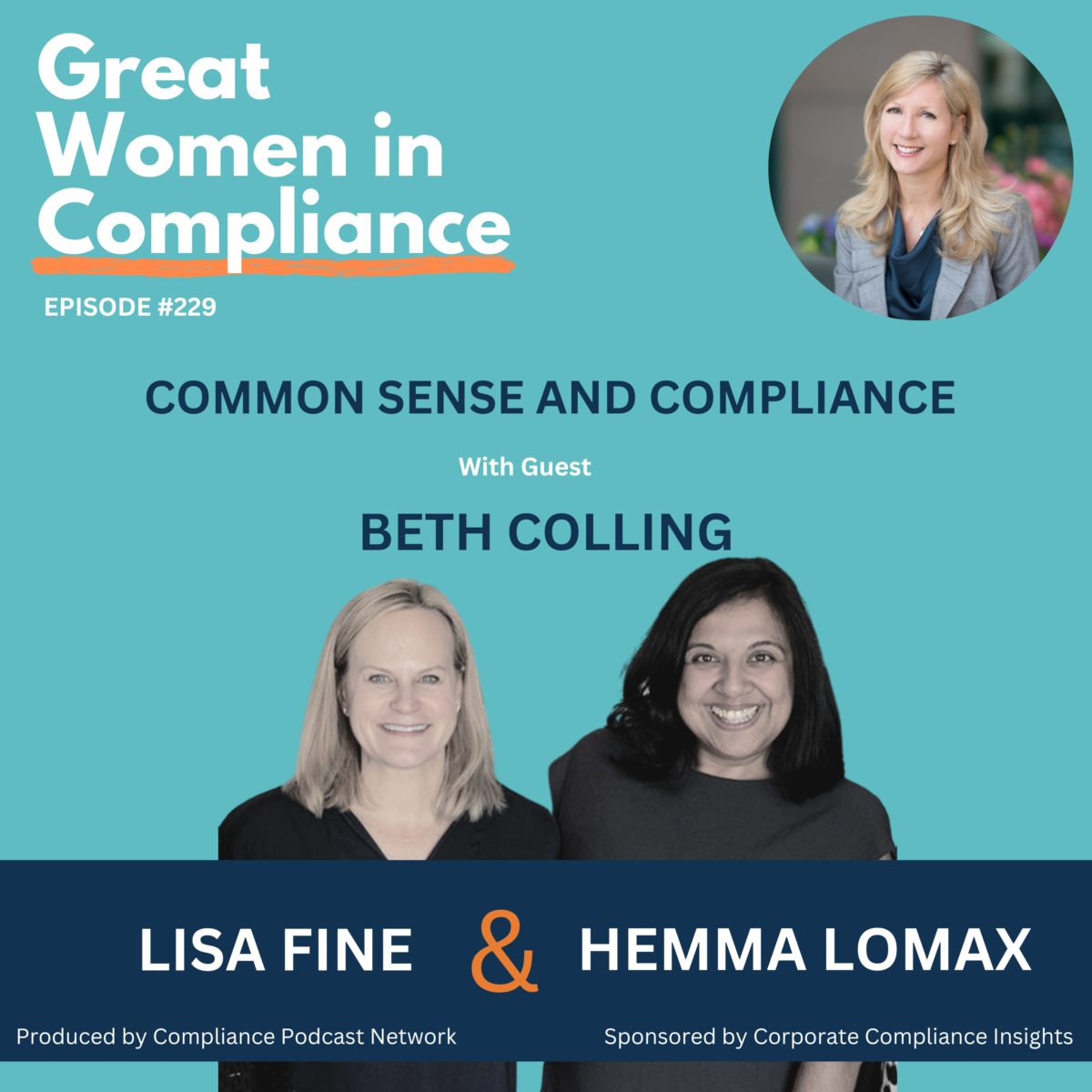
Great Women in Compliance: Beth Colling – Common Sense and Compliance

Welcome to the Great Women in Compliance podcast on the Compliance Podcast Network, sponsored by Corporate Compliance Insights.

In this episode, Lisa speaks with Beth Colling, Senior Vice President and Chief Compliance Officer at CDM Smith. Beth joined organizations after they had to address a significant regulatory change or investigation, and she worked to operationalize and then maintain a compliance program. Lisa and Beth specifically talk about how, as issues inevitably arise, compliance officers will get the resources they need to make and implement changes, but over time, memories fade, and the attention and resources may diminish. Beth provides her insight on this.

Beth uniquely evaluates her work and program by “firing herself” on Friday and re-hiring herself on Monday to examine it with new eyes. After the past several years, with the pandemic and hybrid work, this review became even more relevant. This leads to a discussion of “common sense,” not just within a compliance program but also in terms of personal responsibility and how employees rationalize bad behavior.

One of Beth’s (and Lisa’s) childhood heroes was “Wonder Woman,” and Beth may be Wonder Woman. Outside her work, she coaches young adults to enjoy running, and by the end of 2024, she will have completed 5 of the 6 “World Marathon Majors.”

You can join the LinkedIn podcast community.
Join the Great Women in Compliance podcast community here.

Categories
Compliance Tip of the Day

Compliance Tip of the Day: Compliance Lessons from the Albemarle FCPA Enforcement Action

Welcome to “Compliance Tip of the Day,” the podcast where we bring you daily insights and practical advice on navigating the ever-evolving landscape of compliance and regulatory requirements.

Whether you’re a seasoned compliance professional or just starting your journey, our aim is to provide you with bite-sized, actionable tips to help you stay on top of your compliance game.

Join us as we explore the latest industry trends, share best practices, and demystify complex compliance issues to keep your organization on the right side of the law.

Tune in daily for your dose of compliance wisdom, and let’s make compliance a little less daunting, one tip at a time.

In today’s episode, we review the Albemarle FCPA Enforcement actions and draw out the lessons for compliance professionals.

For more information on the Ethico ROI Calculator and a free White Paper on the ROI of Compliance, click here.

Categories
Adventures in Compliance

Adventures in Compliance: Compliance Lessons from The Second Stain, Part 1

Welcome to a review of all the Sherlock Holmes stories collected in “The Return of Sherlock Holmes.”

This collection comprises thirteen detective stories written by Sir Arthur Conan Doyle, marking the reappearance of the brilliant detective Sherlock Holmes after his apparent death in “The Final Problem.”

The collection spans various intriguing cases and mysteries that Holmes and his loyal friend, Dr. John Watson, tackle.

Today, we conclude our exploration of the third group of short stories found in “The Return of Sherlock Holmes” with the first of a two-part look at the final story in this series, “The Adventure of the Second Stain.”

In this episode, we begin a special two-part look into “The Adventure of the Second Stain,” examining vital compliance lessons such as information security, risk management, ethical conduct, incident response, due diligence, communication, and accountability.

Additionally, we discuss ethical principles like honesty, responsibility, confidentiality, justice, duty, moral courage, empathy, and professional conduct, all through the lens of this classic detective tale.

Key Highlights:

  • Commentary on The Second Stain
  • Compliance Lessons from The Second Stain
  • Ethical Lessons from The Second Stain
  • Conclusion and Invitation to Engage

Resources:

The New Annotated Sherlock Holmes

Sherlock Holmes FAQ

Connect with Tom Fox

Instagram

Facebook

YouTube

Twitter

LinkedIn

For more information on Ethico and a free White Paper on top compliance issues in 2024, click here.