Categories
Trekking Through Compliance

Trekking Through Compliance: Episode 46 – Compliance Across Cultures: Star Trek’s “A Piece of the Action” as a Guide for Global Ethics

Any compliance professional who has ever led a team into a new country, or even a new region, knows that the journey is never as simple as applying the same playbook. Corporate values may be universal, but their application, reception, and risk profile shift dramatically with local context. Cross-cultural compliance isn’t just about checking legal boxes; it’s about building trust, ensuring fairness, and embedding institutional justice in systems often shaped by histories and norms foreign to headquarters. No pop culture episode illustrates this challenge better than Star Trek: The Original Series’ classic, “A Piece of the Action.”

For the compliance professional, this episode serves as a mirror to our modern experience of entering new regulatory territories. It forces us to ask: How do you enforce ethical standards in a place where the “rules of the game” are so different? How do you model institutional justice when even the definitions of “fairness” and “justice” seem up for grabs?

Lesson 1: Don’t Assume Your Ethics Are Universal

Illustrated By: Kirk, Spock, and McCoy are bewildered as they realize the entire Iotian society is based on a book about Earth’s 1920s gangsters.

Compliance Lesson: The first mistake many organizations make is assuming their ethical and compliance frameworks are immediately translatable.

Lesson 2: Institutional Justice Depends on Transparent Processes

Illustrated By: Kirk tries to “play the game,” cutting a deal with mob boss Bela Okmyx for the greater good, but quickly learns that without clear rules, every agreement is subject to double-cross and confusion.

Compliance Lesson: The absence of a transparent and impartial system leads to chaos. Each boss claims to enforce their version of “justice,” but it’s arbitrary and self-serving.

Lesson 3: The Dangers of Imposed Systems and the Need for Adaptation

Illustrated By: Kirk realizes that simply imposing Federation law will not work. The Iotians are not ready for those systems, and the crew’s heavy-handed attempts nearly spark more violence and instability.

Compliance Lesson: When entering new markets, resist the temptation to impose home-country rules without considering the local context.

Lesson 4: Speak the Local Language—Literally and Culturally

Illustrated By: Spock tries to explain Federation rules logically, but it’s Kirk’s willingness to “talk the talk,” even using gangster slang, that opens doors and earns a modicum of respect.

Compliance Lesson: Effective compliance communications must be locally relevant. This is more than translation; it’s cultural adaptation. What resonates in Houston might be meaningless (or counterproductive) in Hanoi.

Lesson 5: Leave a Positive Legacy—Don’t Repeat “Book Mistakes”

Illustrated By: In the final act, McCoy discovers he’s left his communicator behind, prompting a worried Kirk and Spock to realize the Iotians might reverse-engineer the technology and reshape their society once again.

Compliance Takeaway: Every compliance professional leaves a legacy. When you introduce policies, training, or reporting mechanisms, they will be interpreted and possibly misused by future leaders.

Final ComplianceLog Reflections

Cross-cultural compliance is ultimately about humility, adaptability, and respect for institutional justice as it’s lived and experienced on the ground. “A Piece of the Action” teaches us that leadership is not about enforcing rules by fiat, but about fostering a culture where fairness and justice are owned locally, embedded in hearts, not just in handbooks.

Resources:

Excruciatingly Detailed Plot Summary by Eric W. Weisstein

MissionLogPodcast.com

Memory Alpha

Categories
Blog

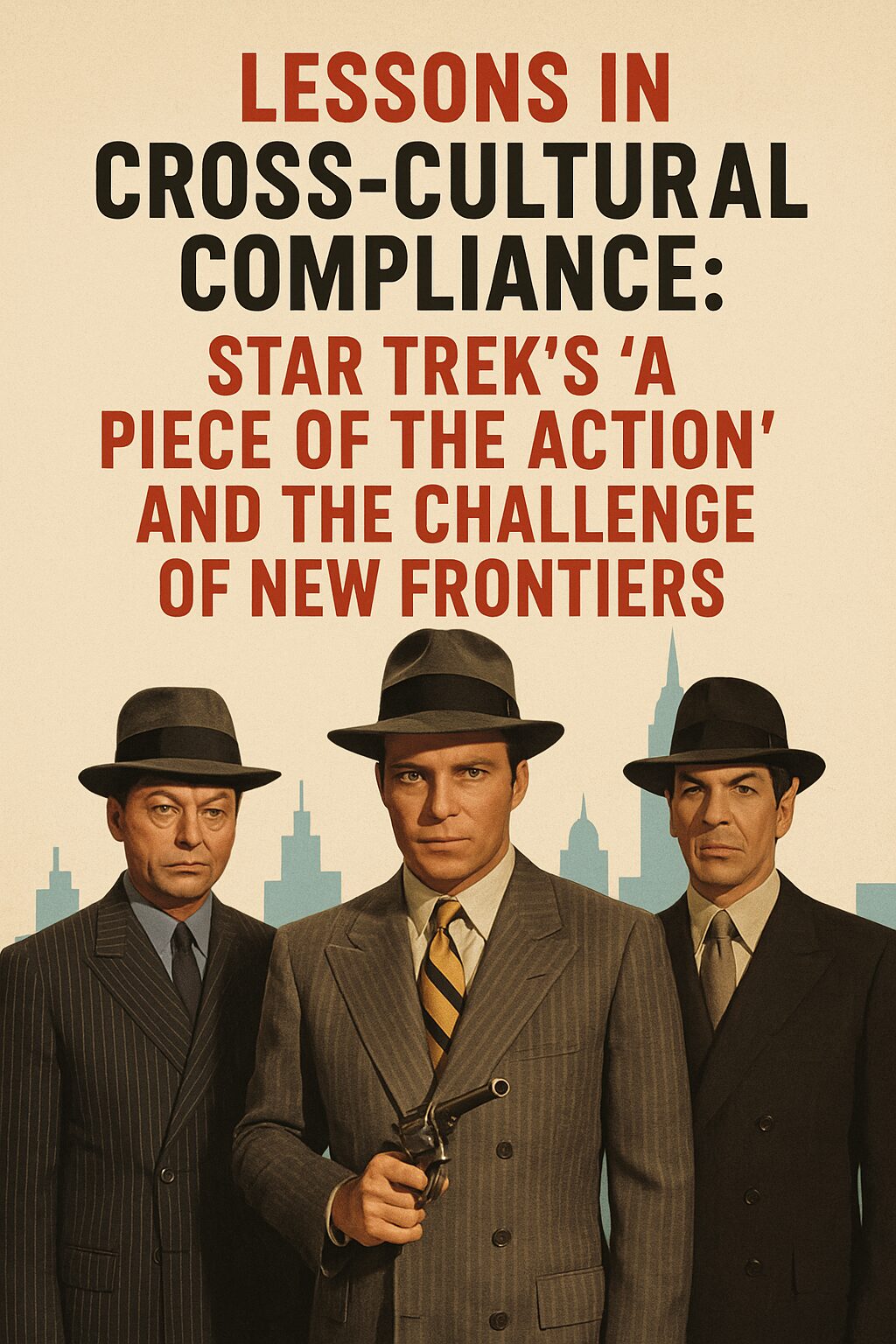
Lessons in Cross-Cultural Compliance: Star Trek’s “A Piece of the Action” and the Challenge of New Frontiers

Any compliance professional who has ever led a team into a new country, or even a new region, knows that the journey is never as simple as applying the same playbook. Corporate values may be universal, but their application, reception, and risk profile shift dramatically with local context. Cross-cultural compliance isn’t just about checking legal boxes; it’s about building trust, ensuring fairness, and embedding institutional justice in systems often shaped by histories and norms foreign to headquarters.

No pop culture episode illustrates this challenge better than Star Trek: The Original Series’ classic, “A Piece of the Action.” In this memorable hour, Captain Kirk and crew beam down to Sigma Iotia II, a planet whose entire society has been shaped by a 1920s Chicago gangster book accidentally left behind by an earlier Earth expedition. The result? A world where the “rules” are alien, an uneasy blend of familiar legality, foreign morality, and institutional chaos.

For the compliance professional, this episode serves as a mirror to our modern experience of entering new regulatory territories. It forces us to ask: How do you enforce ethical standards in a place where the “rules of the game” are so different? How do you model institutional justice when even the definitions of “fairness” and “justice” seem up for grabs?

Today, we boldly go where few compliance professionals have gone before: into the heart of cross-cultural lessons inspired by Kirk, Spock, and McCoy’s misadventures on the planet Vulcan.

Lesson 1: Don’t Assume Your Ethics Are Universal

Illustrated By: Kirk, Spock, and McCoy are bewildered as they realize the entire Iotian society is based on a book about Earth’s 1920s gangsters. What is “normal” here is extortion, double-crossing, and violence.

Compliance Lesson: The first mistake many organizations make is assuming their ethical and compliance frameworks are immediately translatable. On Sigma Iotia II, Kirk’s appeals to law, order, and morality fall flat. Here, the “institutional justice system” is a patchwork of mob bosses, each enforcing their version of fairness.

For Compliance Pros:

  • Start by listening and observing. Before launching training or rolling out policies, invest in local cultural assessments.
  • Engage local stakeholders. They can provide insights into what “justice” and “fairness” mean in practice.
  • Translate—not just language, but values. If your hotline program, reporting mechanisms, or disciplinary systems rely on local trust, learn what earns (or erodes) that trust.

Lesson 2: Institutional Justice Depends on Transparent Processes

Illustrated By: Kirk tries to “play the game,” cutting a deal with mob boss Bela Okmyx for the greater good, but quickly learns that without clear rules, every agreement is subject to double-cross and confusion.

Compliance Lesson: The absence of a transparent and impartial system leads to chaos. Each boss claims to enforce their version of “justice,” but it’s arbitrary and self-serving. For compliance professionals, this is a cautionary tale: if your processes aren’t transparent and predictable, your program risks devolving into selective enforcement or, worse, simply window dressing.

For Compliance Pros:

  • Ensure transparency in policies and procedures. Local teams should understand not only what is expected but also why and what will happen if expectations aren’t met.
  • Communicate the process for raising and resolving concerns. Is there an appeal? Who reviews the case? How are outcomes explained?
  • Build in fairness at every step. Avoid any appearance of “playing favorites” or tailoring decisions to the powerful.

Lesson 3: The Dangers of Imposed Systems and the Need for Adaptation

Illustrated By: Kirk realizes that simply imposing Federation law will not be effective. The Iotians are not ready for those systems, and the crew’s heavy-handed attempts nearly spark more violence and instability.

Compliance Lesson: When entering new markets, resist the temptation to impose home-country rules without considering the local context. This is not just ineffective. It can backfire, causing resentment or noncompliance.

For Compliance Pros:

  • Adapt, don’t transplant. Find ways to harmonize your code of conduct with local customs while upholding core values.
  • Use a risk-based approach. Focus first on the highest-risk behaviors that truly endanger your organization or people.
  • Empower local leaders. Give them ownership over adapting processes and communications so that they are effective and resonate with their audience.

Lesson 4: Speak the Local Language—Literally and Culturally

Illustrated By: Spock tries to explain Federation rules logically, but it’s Kirk’s willingness to “talk the talk,” even using gangster slang, that opens doors and earns a modicum of respect.

Compliance Lesson: Effective compliance communications must be locally relevant. This is more than translation; it’s cultural adaptation. What resonates in Houston might be meaningless (or counterproductive) in Hanoi.

For Compliance Pros:

  • Leverage local stories and examples. Bring policies to life through scenarios that employees recognize.
  • Use local champions. The right messenger can make or break your training or reporting program.
  • Culturally tailor your hotline and reporting mechanisms. In some cultures, direct reporting is perceived as a form of betrayal; consider finding culturally sensitive alternatives (e.g., mediation, ombuds channels).

Lesson 5: Leave a Positive Legacy—Don’t Repeat “Book Mistakes”

Illustrated By: In the final act, McCoy discovers he’s left his communicator behind, prompting a worried Kirk and Spock to realize the Iotians might reverse-engineer the technology and reshape their society once again.

Compliance Takeaway: Every compliance professional leaves a legacy. When you introduce policies, training, or reporting mechanisms, they will be interpreted and possibly misused by future leaders. Are you leaving behind tools for justice or weapons for the next “mob boss” to exploit?

For Compliance Pros:

  • Train for sustainability. Do not just deliver training; build local capacity for ongoing education and oversight.
  • Monitor unintended consequences. Regularly review your program’s impact on local dynamics.
  • Commit to continuous improvement. Don’t just “set it and forget it.” Be prepared to revisit, revise, and reinforce your approach as conditions change.

Final ComplianceLog Reflections

Cross-cultural compliance is ultimately about humility, adaptability, and respect for institutional justice as it’s lived and experienced on the ground. “A Piece of the Action” teaches us that leadership is not about enforcing rules by fiat, but about fostering a culture where fairness and justice are owned locally, embedded in hearts, not just in handbooks.

When we boldly enter new markets, we do so not as conquerors, but as collaborators. Listen, learn, adapt, and, above all, build compliance programs that leave a legacy of justice, fairness, and integrity. Only then will our actions, however small, become a positive piece of the action for years to come.

Resources:

Excruciatingly Detailed Plot Summary by Eric W. Weisstein

MissionLogPodcast.com

Memory Alpha

Categories
Blog

Boldly Going Together: Cross – Cultural Compliance Lessons from Star Trek’s “Journey to Babel”

In the ever-expanding universe of corporate compliance, the question of how to bridge cultural divides is as critical as it is complex. Navigating global operations, integrating diverse teams, and balancing conflicting interests. These challenges would be familiar to Captain Kirk and the crew of the Enterprise, particularly in the Star Trek: The Original Series classic “Journey to Babel.”

In this episode, the Enterprise is tasked with transporting 114 ambassadors from across the Federation to a pivotal diplomatic conference. The plot thickens as old enmities, conflicting interests, and even attempted murder threaten the mission’s success. At the heart of the episode lies a powerful message: cross-cultural competence is not just an HR catchphrase. It is a critical compliance and ethical imperative.

Today, we explore five essential cross-cultural compliance lessons, each grounded in a scene from “Journey to Babel.” These insights are not simply for the Starship Enterprise. Instead, they are vital for every compliance professional in today’s globalized business world.

Lesson 1: Cultural Awareness is the Foundation of Trust

Illustrated By: The Enterprise hosts a diplomatic reception. Ambassadors Sarek (Vulcan) and Gav (Andorian) nearly come to blows over the proposed admission of Coridan to the Federation.

The opening scenes aboard the Enterprise are a masterclass in cultural complexity. The ambassadors, each representing worlds with deep-seated histories and conflicting interests, demonstrate how easily cultural misunderstandings and political baggage can undermine trust.

Compliance Lesson: Cultural awareness is the bedrock of ethical business practice. As compliance professionals, we must recognize that every culture brings its perspectives, values, and sensitivities to the table. Failure to understand these nuances can breed suspicion and derail collaboration, just as the Vulcan and Andorian ambassadors struggle to find common ground.

Prioritize cultural training as part of compliance education. Ensure that codes of conduct are not only translated but also contextually adapted, and that your team is prepared to identify and address cultural gaps before they become compliance risks.

Lesson 2: Personal Bias Must Never Trump Professional Duty

Illustrated By: Kirk discovers that Spock’s parents, Sarek and Amanda, are aboard. Despite personal tensions—especially between Spock and his father—Spock insists on performing his duties during the crisis, even when Sarek’s life is at stake.

This episode famously reveals Spock’s human mother and Vulcan father, bringing family dynamics into the mix. Yet, when Sarek is gravely injured and a heart operation is required, Spock refuses to leave the bridge while the ship is in danger. His professional commitment outweighs personal emotion.

Compliance Lesson: In cross-cultural or high-pressure environments, personal biases and relationships can threaten objective decision-making. Compliance professionals must create policies and foster cultures that prioritize professional integrity above personal interest, even (or especially) when emotions run high.

Implement clear conflict-of-interest policies and foster an environment where recusal and transparency are not just encouraged but expected—train staff to recognize when personal loyalties or cultural allegiances might compromise objective action.

Lesson 3: Open Communication is Critical in Preventing Escalation

Illustrated By: Tensions flare after Ambassador Gav’s murder. Accusations fly, especially toward Sarek, who had argued publicly with Gav just before his death. The crew’s refusal to jump to conclusions, coupled with ongoing dialogue among all parties, helps keep the situation from spiraling.

The murder mystery at the heart of “Journey to Babel” is propelled by suspicion and lack of trust. Yet Kirk, Spock, and Dr. McCoy consistently push for fact-based investigation, communication, and transparency, resisting pressure to act on rumor or assumption.

Compliance Lesson: When dealing with culturally diverse teams or stakeholders, open and transparent communication is your most effective defense against misunderstanding, rumor, and escalation. Silence or closed-door decisions breed mistrust and can quickly escalate a manageable issue into a full-blown crisis.

Establish robust reporting, investigation, and escalation protocols that emphasize transparency and communication. Utilize regular cross-cultural dialogues and forums to identify concerns before they become compliance issues.

Lesson 4: Ethical Leadership Means Making the Hard Call

Illustrated By: Kirk, gravely wounded during an assassination attempt, insists on returning to the bridge rather than receiving treatment so that Spock can perform surgery on Sarek. Both men make personal sacrifices for the greater good and the safety of the mission.

At the height of the crisis, leadership is defined not by rank but by the ethical choices made. Kirk’s and Spock’s willingness to sacrifice for the mission —Kirk risking his life, Spock postponing surgery on his father —demonstrates that ethical leadership means prioritizing the welfare of the collective over personal comfort or interest.

Compliance Lesson: Effective compliance leaders are those who lead by example, making tough decisions that may be unpopular or personally costly, but which uphold the organization’s mission and values. This is especially true in global environments, where decisions often have cross-cultural ripple effects.

Cultivate leadership at all levels that models ethical decision-making. Recognize and reward those who act in the organization’s best interests, even when it is personally inconvenient. Build ethics into leadership development and performance evaluations.

Lesson 5: Unity Through Diversity Drives Mission Success

Illustrated By: Despite assassination attempts, sabotage, and political intrigue, the Enterprise ultimately succeeds in its mission. Thanks in large part to the combined talents and perspectives of its diverse crew and the ambassadors aboard.

In the final act, the ship faces a Romulan attack, and only through the unique expertise of its multicultural crew does the Enterprise survive. The message is clear: unity does not require uniformity. Diversity of culture, thought, and background can be a superpower when harnessed ethically and collaboratively.

Compliance Lesson: In global organizations, diversity is not a problem to be managed, but an asset to be leveraged. Cross-cultural teams, when managed ethically, produce better solutions, more robust risk assessments, and more effective compliance outcomes. But this only works if compliance programs move beyond lip service to real inclusion and empowerment.

Ensure your compliance program explicitly values diversity, not just demographically, but also in terms of ideas and problem-solving approaches. Involve diverse voices in policy creation, risk assessments, and investigations. Use cultural differences as a resource, not a barrier.

Final ComplianceLog Reflections

Journey to Babel” reminds us that successful missions, whether in interstellar diplomacy or global business, depend on more than technical expertise or strategic positioning. They require cultural competence, ethical leadership, and a willingness to prioritize the mission over personal interests.

For the compliance professional, the lessons are clear: invest in cultural awareness, build transparency, foster ethical leadership, and leverage diversity as a driver of success. In today’s interconnected world, the road to Babel is one we all travel. It is your job as a compliance professional to ensure we do so ethically, collaboratively, and boldly.

Resources:

Excruciatingly Detailed Plot Summary by Eric W. Weisstein

MissionLogPodcast.com

Memory Alpha