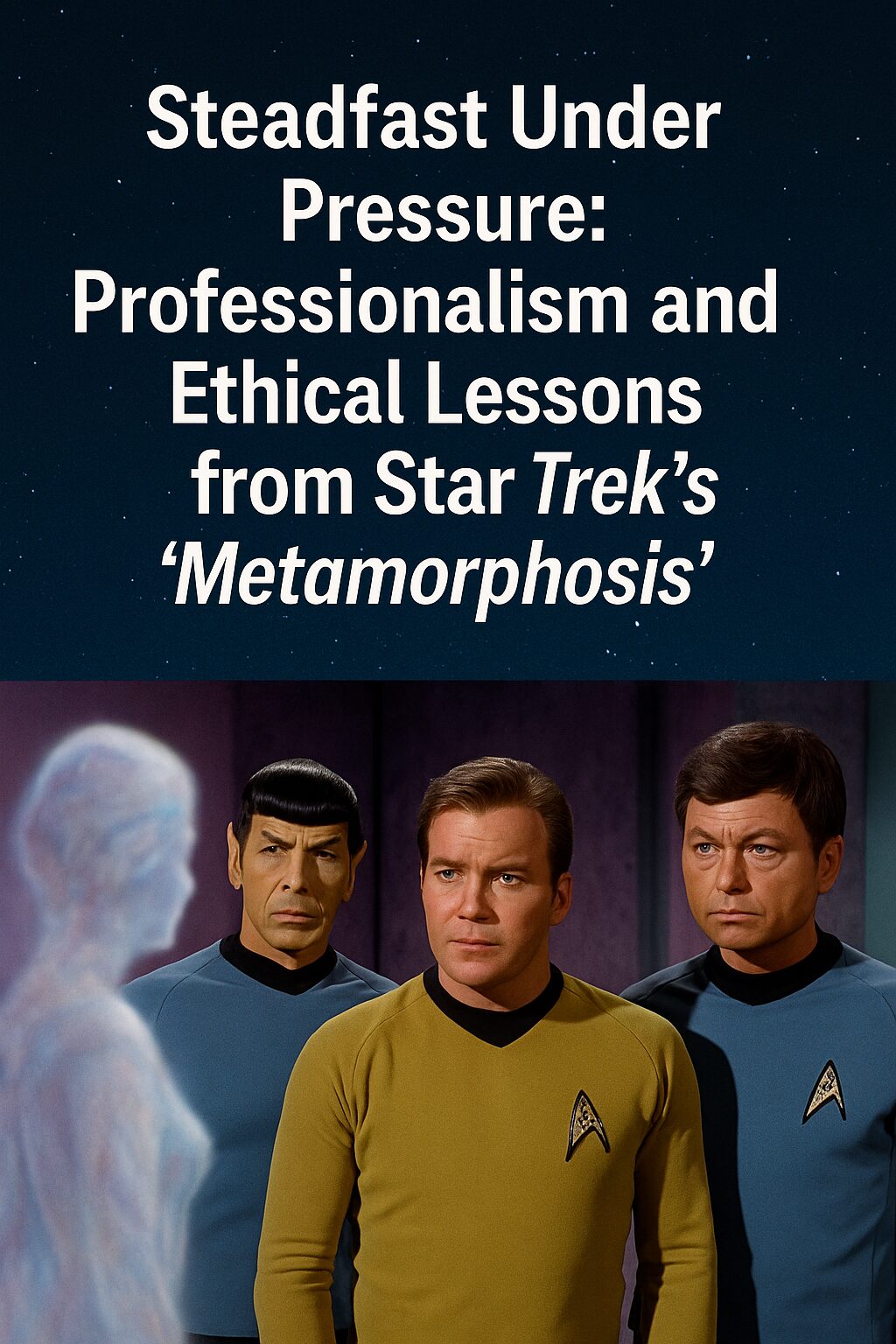
In the universe of corporate compliance, pressure is a constant. Whether facing a sudden investigation, navigating a crisis, or mediating high-stakes negotiations, the capacity to remain professional and ethically grounded is what separates a merely good compliance officer from a great one. Few pop culture references embody this principle more vividly than the classic Star Trek: The Original Series episode, “Metamorphosis.”
Set against the backdrop of a forced landing on a remote asteroid, “Metamorphosis” finds Captain Kirk, Spock, Dr. McCoy, and Commissioner Nancy Hedford stranded by an enigmatic alien entity known as the Companion. Their struggle to survive and mediate a clash of perspectives. It provides a near-perfect parallel to the kinds of professional and ethical challenges compliance professionals routinely face during investigations and stressful situations. Today, we dive into critical lessons for compliance professionals, each illustrated by a pivotal scene from “Metamorphosis.”
Lesson 1: Maintain Calm Objectivity—Even When You’re Under Fire
Illustrated By: Upon realizing that the Companion has hijacked their shuttle and they’re trapped on the planetoid, tensions run high. Commissioner Hedford, suffering from a life-threatening illness and a rapidly fading hope for rescue, becomes increasingly distraught. Yet Kirk and Spock methodically assess their environment and resources, refusing to let panic cloud their decision-making.
Compliance Lesson:
Investigations and crises often produce high-stress, high-stakes environments where anxiety and emotion run rampant. Professionalism in such situations demands composure and objectivity. A compliance officer’s ability to remain unflappable, not just for their own sake, but to reassure and stabilize others, is essential for effective problem-solving and ethical decision-making.
Train teams in stress management and crisis communication. Develop checklists and playbooks for investigative response to minimize decision-making under duress—model calm behavior to set the tone for the entire team.
Lesson 2: Empathy and Respect Are Critical—Even for Those You Don’t Understand
Illustrated By: The crew quickly learns the Companion is an alien being beyond their understanding, communicating in ways that defy their usual protocols. Instead of responding with hostility or frustration, Kirk and Spock seek to understand the Companion’s motives, with Spock even attempting a technological “translation” to bridge the communication gap.
Compliance Lesson: During investigations or stressful encounters, it’s easy to become impatient with those who seem uncooperative or “different,” whether they’re interview subjects, whistleblowers, or business partners from unfamiliar cultures. Professionalism requires empathy, respect, and a genuine effort to understand all perspectives, not just those that align with our own.
Integrate empathy training into your compliance curriculum. Remind investigators and managers that cultural, emotional, and even technological barriers are not obstacles to ignore but invitations to connect.
Lesson 3: Uphold Procedural Fairness—Even When Expediency Tempts You
Illustrated By: Desperate to return Commissioner Hedford to the Enterprise for urgent medical care, Kirk considers using force against the Companion. However, both Spock and McCoy caution against a hasty, confrontational approach. The crew ultimately respects due process, attempting diplomacy and dialogue before resorting to more drastic measures.
Compliance Lesson: Under pressure, shortcuts can seem tempting, such as skipping interviews, overlooking evidence, or rushing conclusions for the sake of expediency. However, professionalism in compliance means adhering to investigative protocols, ensuring fairness for all parties, even if it slows down the process or complicates things.
Institute clear, step-by-step protocols for investigations, and hold teams accountable for following them. Empower compliance personnel to speak up when they see due process being sidestepped.
Lesson 4: Ethical Decision-Making Requires Teamwork and Diverse Perspectives
Illustrated By: When initial attempts to reason with the Companion fail, Kirk doesn’t go it alone. He gathers input from Spock, McCoy, and even Commissioner Hedford, blending logic, medicine, diplomacy, and personal perspective. This collective approach yields a creative solution: merging Hedford’s consciousness with the Companion, which saves her life and resolves the impasse.
Compliance Lesson: Complex investigations rarely have easy answers. Ethical professionalism is reinforced by seeking out diverse viewpoints—legal, operational, cultural, and human—ensuring a comprehensive understanding of the issues at hand. The best compliance outcomes emerge from teams that respect each member’s expertise and encourage candid dialogue.
Promote cross-functional collaboration in every investigation. Debrief as a team after each case, capturing different perspectives and lessons learned for future improvement.
Lesson 5: Never Lose Sight of Humanity—The “Why” Behind Compliance
Illustrated By: As the Companion merges with Commissioner Hedford, she is given a second chance at life but must remain on the planetoid. Kirk and his crew, despite their desire to return to the Enterprise, recognize the profound importance of personal dignity and happiness in their resolution. They leave Hedford/Companion with Cochrane, honoring the choice made for love and fulfillment.
Compliance Lesson: In the rush to resolve crises or complete investigations, it’s easy to focus on policy, rules, and process at the expense of people. But true professionalism and ethical compliance leadership mean never losing sight of the human element. The best compliance professionals serve not just the organization but also the individuals whose lives are impacted by their actions.
Balance every investigative and crisis response protocol with compassion. Regularly revisit the organization’s values and “why” behind the compliance program. Use stories and real-life examples to remind teams of the human cost and benefit of ethical professionalism.
Final ComplianceLog Reflections
“Metamorphosis” stands as one of Star Trek’s most poignant explorations of transformation, not just of an alien being, but of the attitudes and perspectives of everyone involved. For compliance professionals, it serves as a powerful reminder: professionalism is not merely a matter of following procedures but of embodying the best of our values under pressure.
Maintaining objectivity, empathy, fairness, teamwork, and humanity, even in the face of the unknown, are the true hallmarks of ethical leadership in compliance. Every investigation, every high-stress moment, is an opportunity to transform not only the situation but also ourselves and our organizations.
As you lead your team through the next compliance challenge, remember the example set by Kirk, Spock, and McCoy. Stay calm. Seek to understand. Uphold fairness. Embrace teamwork. And above all, never forget the people at the heart of every compliance story.
Resources: