Categories
Trekking Through Compliance

Trekking Through Compliance: Episode 48 – When Compliance Gets Complicated: Navigating the ‘Should We’ Question with Captain Kirk

There comes a time in every compliance professional’s journey when the rules and the regulations alone cannot answer the central ethical question at hand. In the fast-moving, high-stakes world of business, it’s easy to focus on what is permissible and whether we can do something. But the actual test of leadership, integrity, and organizational culture is found in those moments when we pause and ask, “Should we? ”

Today, we journey back to the planet Neural and see what Kirk’s struggle can teach us about the central ethical challenge of our time.

Lesson 1: When External Pressures Push, Ethics Must Anchor Us

Illustrated By: Kirk discovers that the Klingons are arming one side of Neural’s primitive society with flintlock rifles, violating the natural development of the culture.

Compliance Lesson: Business pressures, from competition, regulatory ambiguity, or market demands, often tempt us to respond in kind, rationalizing that “everyone else is doing it.”

Lesson 2: Slippery Slopes Begin with Small Steps

Illustrated By: Despite his misgivings, Kirk ultimately agrees to supply flintlocks to the peaceful villagers so that they can defend themselves.

Compliance Lesson:

Ethical lapses rarely begin with headline-grabbing misconduct. More often, they start with small, “necessary” exceptions just this once, just for now. But these exceptions lay the groundwork for systemic problems. Beware the “just this once” rationale.

Lesson 3: The Limits of Policy—When Rules Don’t Fit the Situation

Illustrated By: The Prime Directive prohibits interference in the natural development of alien societies.

Compliance Lesson: Understand the spirit behind the rule. The Prime Directive’s intent is non-interference, but its strict application could enable greater harm.

Lesson 4: Leaders Bear the Burden of Ethical Choices

Illustrated By: In the episode’s climax, Kirk must make the final call: whether to arm the villagers, risking an escalation he cannot control, or refuse, likely dooming them to subjugation.

Compliance Lesson: Ethical dilemmas often land on the shoulders of compliance leaders, general counsel, or executive management. These moments are defined not by easy answers, but by courage, humility, and accountability.

Lesson 5: Every Ethical Decision Has Ripple Effects

Illustrated By: As Kirk arms the villagers, Dr. McCoy questions the long-term consequences.

Compliance Lesson:

No ethical decision occurs in a vacuum. Actions taken under pressure today set precedents, influence culture, and shape stakeholder expectations for years to come.

Final ComplianceLog Reflections

A Private Little War” reminds us that the most consequential decisions in compliance and ethics aren’t about whether something is allowed but whether it is right. Kirk’s journey is ours: to grapple with ambiguity, resist the seduction of expediency, and own the responsibility for the choices we make.

For today’s compliance professionals, the lesson is clear. The real work begins where the rulebook ends, in those gray areas where business, culture, and humanity intersect. Lead with integrity. Question not just what is possible, but what is just. Because in compliance, as in the universe of Star Trek, our future depends not only on what we can do but on the courage to do what we should do.

Resources:

Excruciatingly Detailed Plot Summary by Eric W. Weisstein

MissionLogPodcast.com

Memory Alpha

Categories
Blog

Beyond “Can We?” – Ethical Lessons for Compliance Professionals from Star Trek’s “A Private Little War”

There comes a time in every compliance professional’s journey when the rules and the regulations alone cannot answer the central ethical question at hand. In the fast-moving, high-stakes world of business, it’s easy to focus on what is permissible and whether we can do something. But the actual test of leadership, integrity, and organizational culture is found in those moments when we pause and ask, “Should we? ”

No episode of Star Trek: The Original Series better dramatizes this ethical crossroads than “A Private Little War.” Here, Captain Kirk is confronted with a situation that blurs the boundaries between what is allowed and what is right, between the technicalities of Federation policy and the broader demands of moral responsibility.

For compliance professionals facing similar dilemmas, whether in the boardroom, emerging markets, or product development, “A Private Little War” offers powerful and relevant lessons. Today, we journey back to the planet Neural and see what Kirk’s struggle can teach us about the central ethical challenge of our time.

Lesson 1: When External Pressures Push, Ethics Must Anchor Us

Illustrated By: Kirk discovers that the Klingons are arming one side of Neural’s primitive society with flintlock rifles, violating the natural development of the culture. Dr. McCoy and Spock debate whether the Enterprise should intervene by arming the opposing side, thus escalating the arms race.

Compliance Lesson: Business pressures, from competition, regulatory ambiguity, or market demands, often tempt us to respond in kind, rationalizing that “everyone else is doing it.” But ethics demand a different calculus. Just because you can match or outdo a competitor’s questionable practice doesn’t mean you should.

Remember to pause before mirroring bad behavior. The fact that a competitor is bending the rules is not justification for lowering your standards. Ethical anchoring, knowing your organization’s “North Star,” matters most when external pressure mounts. Kirk listens to Spock’s cold logic and McCoy’s moral pleas. True compliance leadership means allowing for dissent and critical ethical discussion.

Lesson 2: Slippery Slopes Begin with Small Steps

Illustrated By: Despite his misgivings, Kirk ultimately agrees to supply flintlocks to the peaceful villagers so that they can defend themselves, justifying it as a necessary evil to preserve balance, yet he is visibly haunted by the decision’s potential consequences.

Compliance Lesson:

Ethical lapses rarely begin with headline-grabbing misconduct. More often, they start with small, “necessary” exceptions just this once, just for now. But these exceptions lay the groundwork for systemic problems. Beware the “just this once” rationale. Any deviation from ethical standards needs to be scrutinized, debated, and justified with transparency. Document decisions and rationales. If you must make an exception, create a record that can withstand later review and scrutiny. Finally, assess long-term impact. Kirk’s haunted expression signals what every compliance pro knows: today’s “necessary evil” is tomorrow’s policy norm.

Lesson 3: The Limits of Policy—When Rules Don’t Fit the Situation

Illustrated By: The Prime Directive prohibits interference in the natural development of alien societies. Yet Kirk faces a no-win scenario: intervene and escalate violence or do nothing and watch an entire people be conquered.

Compliance Lesson: Regulations and policies are essential, but they cannot anticipate every situation that may arise. Sometimes, doing the right thing means going beyond the letter of the law, considering the broader impact on people and communities. Understand the spirit behind the rule. The Prime Directive’s intent is non-interference, but its strict application could enable greater harm. Promote a culture of ethical escalation. Encourage employees to seek guidance rather than relying solely on a policy manual. Empower ethical decision-making. Equip teams with frameworks and training to evaluate ambiguous situations, rather than relying exclusively on clear-cut rules.

Lesson 4: Leaders Bear the Burden of Ethical Choices

Illustrated By: In the episode’s climax, Kirk must make the final call: whether to arm the villagers, risking an escalation he cannot control, or refuse, likely dooming them to subjugation. The choice weighs heavily, and Kirk’s solitary decision reflects the isolation that often comes with leadership.

Compliance Lesson: Ethical dilemmas often land on the shoulders of compliance leaders, general counsel, or executive management. These moments are defined not by easy answers, but by courage, humility, and accountability. Acknowledge the weight of ethical decisions. Let your teams see the seriousness with which you consider the “should we” question. Seek collective wisdom but accept ultimate responsibility. Like Kirk, gather perspectives, but be prepared to make a decision. Communicate your reasoning. Explain not just what was decided, but why and what values guided your decision.

Lesson 5: Every Ethical Decision Has Ripple Effects

Illustrated By: As Kirk arms the villagers, Dr. McCoy questions the long-term consequences: “Do you know what you’re doing? ”Kirk can only reply, “No. But if the Klingons give their side even one more gun…” The episode closes with an uneasy truce and the awareness that the future is uncertain.

Compliance Lesson:

No ethical decision occurs in a vacuum. Actions taken under pressure today set precedents, influence culture, and shape stakeholder expectations for years to come. Think beyond the immediate outcome. Consider the secondary and tertiary effects of major ethical choices. Review and revisit as appropriate. Monitor the results of tough calls and be willing to make adjustments as needed. Foster a culture of reflection. Make it safe for your organization to revisit, debate, and learn from past ethical crossroads.

Final ComplianceLog Reflections

“A Private Little War” reminds us that the most consequential decisions in compliance and ethics aren’t about whether something is allowed but whether it is right. Kirk’s journey is ours: to grapple with ambiguity, resist the seduction of expediency, and own the responsibility for the choices we make.

For today’s compliance professionals, the lesson is clear. The real work begins where the rulebook ends, in those gray areas where business, culture, and humanity intersect. Lead with integrity. Question not just what is possible, but what is just. Because in compliance, as in the universe of Star Trek, our future depends not only on what we can do but on the courage to do what we should do.

Resources:

Excruciatingly Detailed Plot Summary by Eric W. Weisstein

MissionLogPodcast.com

Memory Alpha

Categories
FCPA Compliance Report

FCPA Compliance Report – Ethical Challenges in AI, Data Protection, and Sports with André Paris

Welcome to the award-winning FCPA Compliance Report, the longest-running podcast in compliance. Today, Tom Fox welcomes back André Paris for an insightful discussion on various ethical challenges in today’s world. André revisits his role in compliance and ethics and provides updates on his work since the pandemic and delves into the issues of algorithmic bias, transparency, and the ethical ramifications of AI systems, particularly in surveillance and privacy. André also shares his experience as a PhD candidate researching AI’s impact on civil liberties. The episode further explores the ethical challenges in the sports industry, including corruption, doping, and harassment. Lastly, André talks about his book ETHICS & TRANSPARENCY: A Path To Compliance on Amazon and its practical applications in fostering an ethical corporate culture.

Key highlights include:

  • André‘s Role in Compliance and Ethics
  • Ethics and Transparency: André’s Book
  • The Rise of AI and Ethical Challenges
  • AI in Business and Research Applications
  • Data Protection as a Civil Liberty
  • Ethical Challenges in Sports

Resources:

André Paris on LinkedIn

ETHICS & TRANSPARENCY: A Path To Compliance on Amazon

André Paris Website

Tom Fox

Instagram

Facebook

YouTube

Twitter

LinkedIn

For more information on the use of AI in Compliance programs, my new book, Upping Your Game. You can purchase a copy of the book on Amazon.com.

Categories
Blog

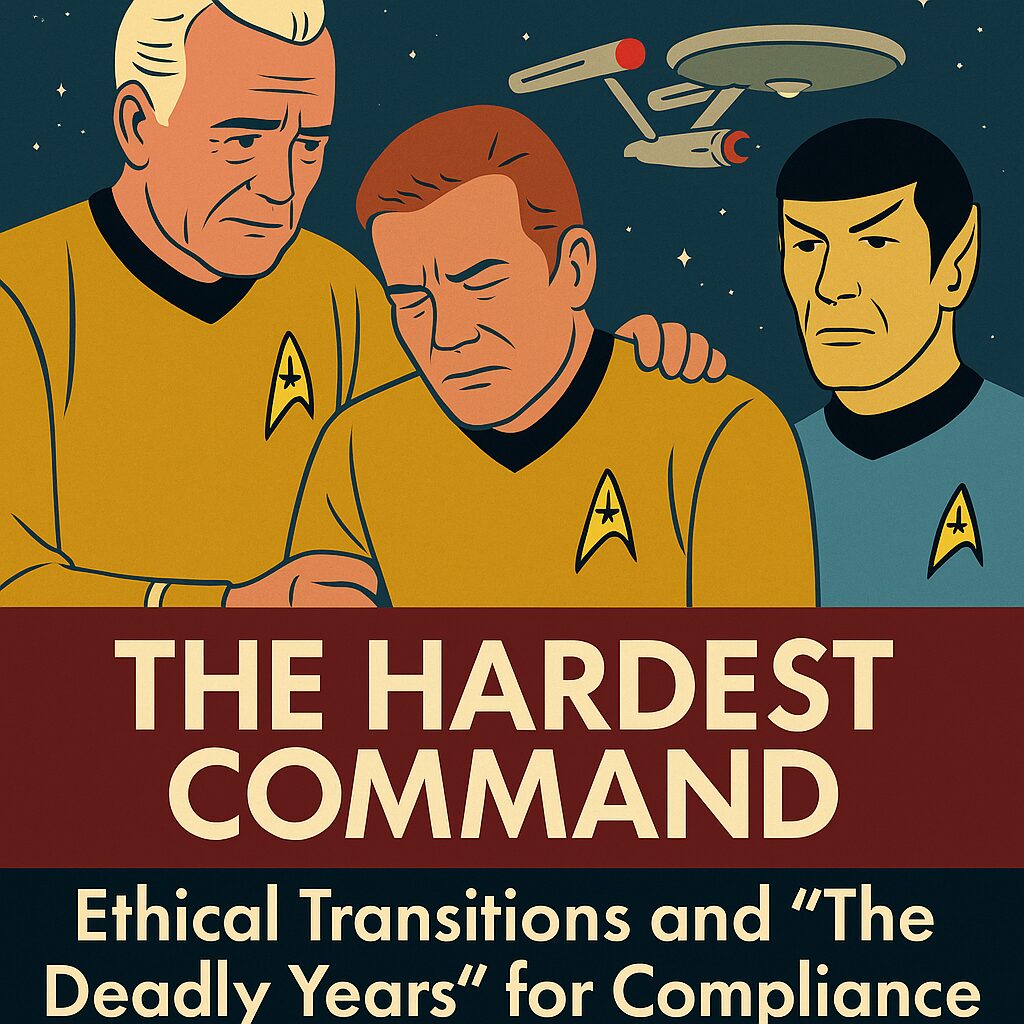
The Hardest Command: Ethical Transitions and “The Deadly Years” for Compliance Professionals

Suppose you have spent any time in leadership, especially in compliance or corporate governance. In that case, you know that one of the most gut-wrenching duties is addressing a colleague who can no longer fulfill their responsibilities. Loyalty, empathy, and organizational needs collide in these moments. Few pop culture stories tackle this theme with more clarity and drama than Star Trek: The Original Series episode “The Deadly Years.” Here, the Enterprise crew confronts rapid aging, physical decline, and, most significantly, the consequences when a leader cannot perform.

Today, we step onto the bridge and examine five ethical lessons for compliance professionals faced with these hard but necessary transitions. Each lesson is illustrated by a specific scene from “The Deadly Years.”

Lesson 1: Recognize the Signs—Objectivity Must Trump Sentiment

Illustrated By:  Early in the episode, the landing party is exposed to a form of radiation that accelerates aging. Captain Kirk, Spock, Scotty, and others quickly show signs of physical and cognitive decline. Kirk, in particular, becomes forgetful and indecisive, missing important details and even failing to recall security procedures.

Compliance Lessons: The first ethical responsibility is to recognize, without sentiment or denial, when a colleague can no longer perform. Whether due to age, health, burnout, or changing business demands, the signs must be identified early, not ignored out of deference to history or personal loyalty.

Implement regular, objective performance reviews and peer assessments. Train managers to look for early indicators of declining performance, especially in high-stress or high-responsibility roles, and provide pathways for safe, supportive reporting.

Lesson 2: Prioritize Mission and Stakeholders—Not Individual Status

Illustrated By:  As Kirk’s abilities deteriorate, the safety of the Enterprise is jeopardized. He hesitates during a Romulan encounter and issues conflicting orders, putting the crew at risk. Spock and Dr. McCoy discuss his decline, acknowledging their concern for their friend but focusing on the danger to the mission.

Compliance Lesson: An organization’s purpose, stakeholders, and people must come before individual egos or career legacies. Ethical leadership means putting the mission first, even when that requires difficult conversations or unpopular actions. This is especially critical in compliance, where risks can have enterprise-wide impacts.

Make mission-driven decision-making a core value in your compliance program. Regularly communicate that the integrity of the enterprise outweighs personal status. Ensure that all leaders, from the C-suite to middle management, understand that their primary obligation is to the organization and its stakeholders.

Lesson 3: Fair, Transparent Processes Protect All Involved

Illustrated By: When the decline in Kirk’s performance can no longer be denied, Spock and Dr. McCoy convene a competency hearing. The tribunal includes multiple voices and follows Starfleet protocol, providing Kirk with a chance to respond and present evidence on his behalf.

Compliance Lesson: No transition or removal, no matter how justified, should be handled arbitrarily or in secret. Transparent, fair, and standardized processes ensure that all parties are treated with dignity and the organization’s decisions are defensible. Above all is dignity. This approach also protects against accusations of favoritism, discrimination, or retaliation.

Document and publish clear protocols for performance-related transitions. Involve impartial parties in any review. Make sure employees understand their rights, the procedures, and the grounds on which decisions are made.

Lesson 4: Compassion Matters—Even When Delivering Hard News

Illustrated By: After the tribunal, Kirk is relieved of command. The process is formal, but the crew treats Kirk with respect and compassion, recognizing his service and the pain of the moment. No one revels in the transition or diminishes Kirk’s contributions.

Compliance Lesson: Delivering tough messages, especially about the need to move on, can be done with empathy and grace. Recognizing the individual’s service, offering support, and helping with a dignified transition isn’t just “nice”; rather, it should be seen as an ethically necessary. How you handle these moments sets the tone for your organization’s values and can even inspire long-term loyalty and goodwill.

Train managers and HR in compassionate communication. Offer support such as career counseling, retirement planning, or mental health resources to those transitioning. Celebrate achievements and acknowledge contributions, even as you move forward.

Lesson 5: The Right Transition Can Save the Mission

Illustrated By:  With Kirk relieved, Commodore Stocker takes command but quickly demonstrates a lack of field experience, putting the ship in further jeopardy. Meanwhile, Dr. McCoy and Spock race against time to find a cure for the aging disease. Once Kirk is restored to health, he returns to command, draws on his experience and instincts, and saves the Enterprise from destruction.

Compliance Lesson: Transitioning a colleague should never be punitive or personal; it’s about restoring the organization to its highest level of functioning. Sometimes, this means moving a leader aside temporarily until they can return or helping someone find a better fit for their abilities. The right person, in the proper role, at the right time, is critical for compliance and organizational health.

Build flexibility into your transition policies. Consider temporary reassignments, sabbaticals, or other options before a final separation. Always keep the focus on what’s best for the mission, the team, and the individual.

Final ComplianceLog Reflections

No compliance professional relishes the moment when a valued colleague must be asked to step aside. But “The Deadly Years” reminds us that the greatest danger lies not in transition, but in denial, sentimentality, or failure to act. As Kirk, Spock, and McCoy demonstrate, the hard path, handled with fairness, transparency, dignity, and compassion, is always the ethical path.

For compliance professionals, this means being vigilant for declining performance, putting mission first, insisting on fair and transparent processes, and consistently delivering hard news with empathy. It also means recognizing that transition is sometimes temporary and, with the proper support, colleagues can return, renewed and ready for new challenges.

As organizations face the “deadly years” of rapid change, new risks, and mounting expectations, may we all steer our ships with courage, wisdom, and integrity, ensuring that the right people are at the helm, for the good of all.

 Resources:

Excruciatingly Detailed Plot Summary by Eric W. Weisstein

MissionLogPodcast.com

Memory Alpha

Categories
Trekking Through Compliance

Trekking Through Compliance: Episode 40 – Prime Directive Decisions: Ethics in Action from Star Trek’s “Friday’s Child”

Star Trek has always been about more than adventure. It is often a mirror for our ethical challenges, especially for those tasked with steering organizations through the tricky space of corporate compliance. The original series episode “Friday’s Child” offers a compelling look at negotiation, trust, and ethics under fire. While set on the distant planet Capella IV, the dilemmas faced by Captain Kirk and his crew echo those in today’s boardrooms and compliance departments. Today, we set our phasers to “learn” and beam down five ethical lessons for compliance professionals, each tied to a defining scene from this classic episode.

Lesson 1: Respect Local Customs—Even When They Conflict With Your Own Values

Illustrated By: Upon arrival on Capella IV, Kirk and his landing party encounter the fiercely traditional Capellan society. The Capellans’ customs, particularly their views on leadership and the role of women, are in stark contrast to those of the Federation. Kirk and Dr. McCoy are forced to tread carefully, knowing that any misstep could lead to violence or destroy negotiations.

Compliance Lesson: Operating globally means working in environments where local laws and customs may clash with your organization’s values or home-country regulations. Compliance professionals must develop cultural intelligence and adapt without compromising core ethical standards. Kirk’s diplomacy demonstrates the importance of engaging with local practices respectfully, seeking understanding before judgment.

Provide training for teams working abroad, focusing on cultural sensitivity and practical ways to address conflicts between local customs and organizational policies. Create protocols for escalating issues when legal or ethical lines are at risk of being crossed.

Lesson 2: Integrity in Negotiation Is Non-Negotiable

Illustrated By: As the Federation seeks mining rights on Capella IV, the Klingons arrive to negotiate with the Capellans, bringing duplicity and manipulation. The Klingon emissary, Kras, offers bribes and deceit, but Kirk insists on transparency—even when it puts the mission at risk.

Compliance Lesson: Negotiations, whether with third parties or regulators, test ethical boundaries. While competitors may take shortcuts or resort to unethical tactics, a compliance-driven organization must prioritize integrity. Kirk’s refusal to engage in deception sets a tone of ethical leadership that earns the grudging respect of the Capellans.

Embed ethics in your negotiation strategy. Establish clear boundaries and a code of conduct for employees and third parties, making it clear that winning at any cost is not acceptable. Regularly audit negotiations for compliance with both law and company values.

Lesson 3: Protect the Vulnerable—Even When It’s Not Easy

Illustrated By: After the assassination of Akaar, the Capellan leader, his pregnant widow, Eleen, becomes the target of violence. Federation protocol would have Kirk and his team withdraw, but McCoy and Kirk insist on protecting Eleen and her unborn child, risking their safety and the mission.

Compliance Lesson: Organizations must safeguard those in vulnerable positions—whether whistleblowers, employees facing retaliation, or communities impacted by business decisions. The true ethical test is what you do when protecting the vulnerable is inconvenient, costly, or unpopular.

Establish robust whistleblower protection programs, anti-retaliation measures, and processes for identifying at-risk individuals or groups. Make it clear that ethical obligations to protect the vulnerable are not optional, but a core part of your compliance mission.

Lesson 4: Ethical Courage Means Making Unpopular Decisions

Illustrated By: When Eleen, following Capellan law, insists that she does not want her child, McCoy faces a stark ethical dilemma. He risks offending her and violating local tradition by insisting on the child’s birth, believing it to be in her and the child’s best interests. Ultimately, his actions save both Eleen and her child, who becomes the new heir.

Compliance Lesson: There are moments when ethical behavior demands standing alone, challenging consensus, or confronting deeply ingrained practices. McCoy’s “tough love” illustrates the courage required to make the right decision, even when it’s not the popular one.

Lesson 5: Transparency and Communication Build Trust in Crisis

Illustrated By: As Kirk, Spock, McCoy, and Eleen flee from the Capellans and Klingons, success depends on clear, honest communication. Kirk keeps his crew and even Eleen informed at every stage, which allows them to adapt quickly and survive the dangers they face together.

Compliance Lesson: During crises, be it a compliance investigation, regulatory challenge, or public scandal, transparency and timely communication are critical. Hiding information, even with good intentions, breeds suspicion and undermines trust. Kirk’s example shows that open communication is not a luxury but a necessity, especially under pressure.

Prepare crisis communication protocols in advance. Train leaders to communicate openly, honestly, and quickly during emergencies. Ensure employees know how, when, and where to report issues, and how updates will be provided as matters evolve.

Final ComplianceLog Reflections

“Friday’s Child” may be set on a planet of warriors, but its ethical lessons are universal. For compliance professionals, the episode is a case study in what it means to lead ethically when stakes are high, the rules are unclear, and the path is fraught with danger.

From respecting local customs to standing up for the vulnerable, even at great personal or professional cost, the crew of the Enterprise demonstrates that ethics is not a luxury, but the core of mission success. The compliance officer’s role is not unlike Kirk’s: to navigate complexity, negotiate with integrity, protect those at risk, summon courage in the face of unpopularity, and build trust through transparency.

In a world where every new market brings new challenges and every crisis tests our character, “Friday’s Child” offers this timeless guidance: set your course by your values, and let ethical leadership be your prime directive.

Resources:

Excruciatingly Detailed Plot Summary by Eric W. Weisstein

MissionLogPodcast.com

Memory Alpha

Categories
Blog

Negotiating Ethics at Warp Speed: Five E&C Lessons from Star Trek’s “Friday’s Child”

Star Trek has always been about more than adventure. It is often a mirror for our ethical challenges, especially for those tasked with steering organizations through the tricky space of corporate compliance. The original series episode “Friday’s Child” offers a compelling look at negotiation, trust, and ethics under fire. While set on the distant planet Capella IV, the dilemmas faced by Captain Kirk and his crew echo those in today’s boardrooms and compliance departments. Today, we set our phasers to “learn” and beam down five ethical lessons for compliance professionals, each tied to a defining scene from this classic episode.

Lesson 1: Respect Local Customs—Even When They Conflict With Your Own Values

Illustrated By: Upon arrival on Capella IV, Kirk and his landing party encounter the fiercely traditional Capellan society. The Capellans’ customs, particularly their views on leadership and the role of women, are in stark contrast to those of the Federation. Kirk and Dr. McCoy are forced to tread carefully, knowing that any misstep could lead to violence or destroy negotiations.

Compliance Lesson: Operating globally means working in environments where local laws and customs may clash with your organization’s values or home-country regulations. Compliance professionals must develop cultural intelligence and adapt without compromising core ethical standards. Kirk’s diplomacy demonstrates the importance of engaging with local practices respectfully, seeking understanding before judgment.

Provide training for teams working abroad, focusing on cultural sensitivity and practical ways to address conflicts between local customs and organizational policies. Create protocols for escalating issues when legal or ethical lines are at risk of being crossed.

Lesson 2: Integrity in Negotiation Is Non-Negotiable

Illustrated By: As the Federation seeks mining rights on Capella IV, the Klingons arrive to negotiate with the Capellans, bringing duplicity and manipulation. The Klingon emissary, Kras, offers bribes and deceit, but Kirk insists on transparency—even when it puts the mission at risk.

Compliance Lesson: Negotiations, whether with third parties or regulators, test ethical boundaries. While competitors may take shortcuts or resort to unethical tactics, a compliance-driven organization must prioritize integrity. Kirk’s refusal to engage in deception sets a tone of ethical leadership that earns the grudging respect of the Capellans.

Embed ethics in your negotiation strategy. Establish clear boundaries and a code of conduct for employees and third parties, making it clear that winning at any cost is not acceptable. Regularly audit negotiations for compliance with both law and company values.

Lesson 3: Protect the Vulnerable—Even When It’s Not Easy

Illustrated By: After the assassination of Akaar, the Capellan leader, his pregnant widow, Eleen, becomes the target of violence. Federation protocol would have Kirk and his team withdraw, but McCoy and Kirk insist on protecting Eleen and her unborn child, risking their safety and the mission.

Compliance Lesson: Organizations must safeguard those in vulnerable positions—whether whistleblowers, employees facing retaliation, or communities impacted by business decisions. The true ethical test is what you do when protecting the vulnerable is inconvenient, costly, or unpopular.

Establish robust whistleblower protection programs, anti-retaliation measures, and processes for identifying at-risk individuals or groups. Make it clear that ethical obligations to protect the vulnerable are not optional, but a core part of your compliance mission.

Lesson 4: Ethical Courage Means Making Unpopular Decisions

Illustrated By: When Eleen, following Capellan law, insists that she does not want her child, McCoy faces a stark ethical dilemma. He risks offending her and violating local tradition by insisting on the child’s birth, believing it to be in her and the child’s best interests. Ultimately, his actions save both Eleen and her child, who becomes the new heir.

Compliance Lesson: There are moments when ethical behavior demands standing alone, challenging consensus, or confronting deeply ingrained practices. McCoy’s “tough love” illustrates the courage required to make the right decision, even when it’s not the popular one.

Lesson 5: Transparency and Communication Build Trust in Crisis

Illustrated By: As Kirk, Spock, McCoy, and Eleen flee from the Capellans and Klingons, success depends on clear, honest communication. Kirk keeps his crew and even Eleen informed at every stage, which allows them to adapt quickly and survive the dangers they face together.

Compliance Lesson: During crises, be it a compliance investigation, regulatory challenge, or public scandal, transparency and timely communication are critical. Hiding information, even with good intentions, breeds suspicion and undermines trust. Kirk’s example shows that open communication is not a luxury but a necessity, especially under pressure.

Prepare crisis communication protocols in advance. Train leaders to communicate openly, honestly, and quickly during emergencies. Ensure employees know how, when, and where to report issues, and how updates will be provided as matters evolve.

Final ComplianceLog Reflections

“Friday’s Child” may be set on a planet of warriors, but its ethical lessons are universal. For compliance professionals, the episode is a case study in what it means to lead ethically when stakes are high, the rules are unclear, and the path is fraught with danger.

From respecting local customs to standing up for the vulnerable, even at great personal or professional cost, the crew of the Enterprise demonstrates that ethics is not a luxury, but the core of mission success. The compliance officer’s role is not unlike Kirk’s: to navigate complexity, negotiate with integrity, protect those at risk, summon courage in the face of unpopularity, and build trust through transparency.

In a world where every new market brings new challenges and every crisis tests our character, “Friday’s Child” offers this timeless guidance: set your course by your values, and let ethical leadership be your prime directive.

Resources:

Excruciatingly Detailed Plot Summary by Eric W. Weisstein

MissionLogPodcast.com

Memory Alpha

Categories
Trekking Through Compliance

Trekking Through Compliance: Episode 38 – Professionalism in the Unknown: Compliance Leadership Lessons from “Metamorphosis”

In the universe of corporate compliance, pressure is a constant. Whether facing a sudden investigation, navigating a crisis, or mediating high-stakes negotiations, the capacity to remain professional and ethically grounded is what separates a merely good compliance officer from a great one. Few pop culture references embody this principle more vividly than the classic Star Trek: The Original Series episode, “Metamorphosis.” Today, we dive into critical lessons for compliance professionals, each illustrated by a pivotal scene from “Metamorphosis.”

Lesson 1: Maintain Calm Objectivity—Even When You’re Under Fire

Illustrated By: Upon realizing that the Companion has hijacked their shuttle and they’re trapped on the planetoid, tensions run high.

Compliance Lesson: Professionalism in such situations demands composure and objectivity. A compliance officer’s ability to remain unflappable, not just for their own sake, but to reassure and stabilize others, is essential for effective problem-solving and ethical decision-making.

Lesson 2: Empathy and Respect Are Critical—Even for Those You Don’t Understand

Illustrated By: The crew quickly learns the Companion is an alien being beyond their understanding, communicating in ways that defy their usual protocols.

Compliance Lesson:

Professionalism requires empathy, respect, and a genuine effort to understand all perspectives, not just those that align with our own.

Lesson 3: Uphold Procedural Fairness—Even When Expediency Tempts You

Illustrated By: Desperate to return Commissioner Hedford to the Enterprise for urgent medical care, Kirk considers using force against the Companion.

Compliance Lesson: Compliance professionalism means adhering to investigative protocols, ensuring fairness for all parties, even if it slows down the process or complicates things.

Lesson 4: Ethical Decision-Making Requires Teamwork and Diverse Perspectives

Illustrated By: When initial attempts to reason with the Companion fail, Kirk doesn’t go it alone. Solution: merging Hedford’s consciousness with the Companion, which saves her life and resolves the impasse.

Compliance Lesson: Compliance professionalism is reinforced by seeking out diverse viewpoints, including legal, operational, cultural, and human.

Lesson 5: Never Lose Sight of Humanity—The “Why” Behind Compliance

Illustrated By: As the Companion merges with Commissioner Hedford, she is given a second chance at life but must remain on the planetoid.

Compliance Lesson: True professionalism and ethical compliance leadership mean never losing sight of the human element. The best compliance professionals serve not just the organization but also the individuals whose lives are impacted by their actions.

Final ComplianceLog Reflections

“Metamorphosis” stands as one of Star Trek’s most poignant explorations of transformation, not just of an alien being, but of the attitudes and perspectives of everyone involved. For compliance professionals, it serves as a powerful reminder: professionalism is not merely a matter of following procedures but of embodying the best of our values under pressure.

Maintaining objectivity, empathy, fairness, teamwork, and humanity, even in the face of the unknown, are the true hallmarks of ethical leadership in compliance. Every investigation, every high-stress moment, is an opportunity to transform not only the situation but also ourselves and our organizations.

Resources:

Excruciatingly Detailed Plot Summary by Eric W. Weisstein

MissionLogPodcast.com

Memory Alpha
Categories
Trekking Through Compliance

Trekking Through Compliance: Episode 34 – Ethical Insights from the “The Apple”

One of the most rewarding experiences for a compliance professional is identifying ethics and integrity lessons in seemingly unrelated fields, especially in unexpected places, such as the far reaches of space, as depicted in the classic “Star Trek: The Original Series” episode “The Apple.” This imaginative story about the crew’s encounter with a seemingly idyllic but oppressive paradise, Vaal, offers powerful ethical lessons highly relevant to corporate compliance professionals today.

Lesson 1: The Dangers of Blind Obedience—Questioning Authority Matters

Illustrated By: The opening scenes of “The Apple” find Captain Kirk and his crew on Gamma Trianguli VI, a world that appears lush, tranquil, and perfect. However, it quickly becomes evident that the inhabitants’ peaceful existence depends entirely upon their blind obedience to the godlike entity Vaal. 

Compliance Lesson. In corporate compliance, this situation mirrors employees blindly following directives without exercising independent judgment or ethical scrutiny. 

Lesson 2: The Illusion of Benevolent Dictatorship—Long-term Harm from Short-term Convenience

Illustrated by Vaal, the natives are provided for, ensuring they never have to struggle or face uncertainty. While seemingly kind and protective, this arrangement ultimately stifles growth, curiosity, and development. 

Compliance Lesson. For organizations, relying on a centralized, overly controlling compliance or management structure can similarly produce unintended negative consequences. 

Lesson 3: Transparency and Communication Are Crucial—The Pitfalls of Hidden Controls

Illustrated By: A critical ethical issue in “The Apple” is the hidden mechanism of control maintained by Vaal. 

Compliance Lesson. Transparency and open communication are equally essential in a compliance context. A company that hides critical facts or maintains opaque operational practices places itself at considerable risk of ethical failures. 

Lesson 4: Cultivating Ethical Independence—Empowering Employees to Make Ethical Choices

Illustrated by: In one particularly illuminating scene, Kirk and Spock realize the villagers have no concept of making personal decisions. They have never had to confront moral or ethical dilemmas because Vaal dictates every aspect of their lives. 

Compliance Lesson. Corporations that over-regulate or excessively constrain ethical discretion similarly create a workforce that is incapable of making independent ethical decisions. 

Lesson 5: Consequences of Disrupting Status Quo—Planning for Ethical and Cultural Change

Illustrated By: At the episode’s conclusion, Kirk disables Vaal, freeing the planet’s inhabitants. This sudden transition underscores a critical compliance insight: ethical and cultural shifts demand thorough preparation and intentional transition management.

Compliance Lesson. Corporate compliance programs often face the need to introduce significant changes in organizational behavior or ethical expectations, whether due to new regulatory mandates, cultural realignment initiatives, or remedial compliance actions following an incident. 

Final ComplianceLog Reflections

In conclusion, the Star Trek TOS episode “The Apple” provides profound insights into the ethical obligations of compliance officers and their corporate counterparts. Through powerful metaphor and storytelling, it highlights critical issues such as the necessity of fostering independent thinking, the perils of opaque governance structures, the value of transparency, the vital importance of cultivating ethical independence, and the thoughtful management of cultural change. These enduring lessons from the Final Frontier underscore the universal truths essential for maintaining an effective, sustainable, and ethically sound compliance culture.

Resources:

Excruciatingly Detailed Plot Summary by Eric W. Weisstein

MissionLogPodcast.com 

Memory Alpha
Categories
Blog

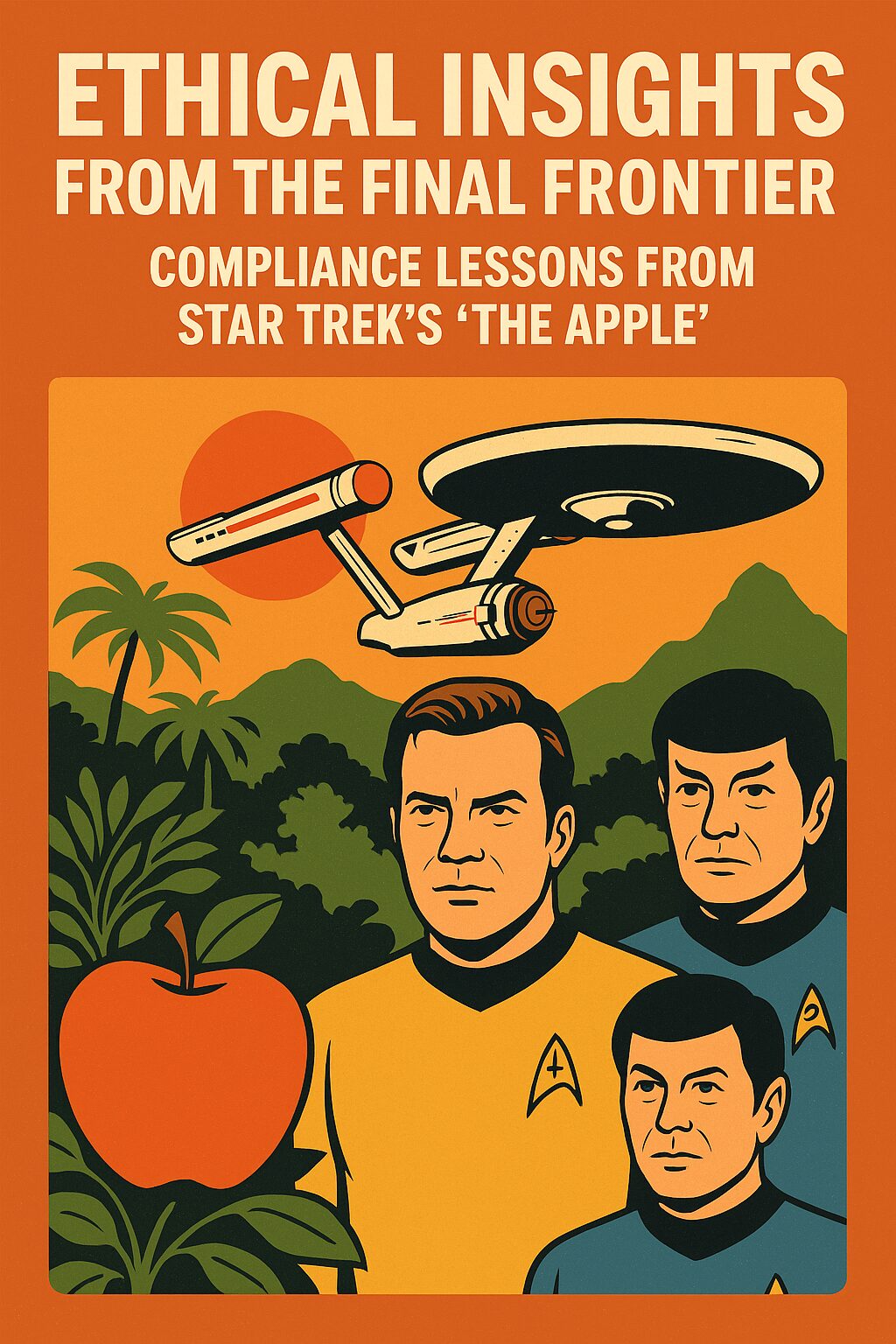
Ethical Insights from the Final Frontier: Compliance Lessons from Star Trek’s “The Apple”

One of the most rewarding experiences for a compliance professional is identifying ethics and integrity lessons in seemingly unrelated fields, especially in unexpected places, such as the far reaches of space, as depicted in the classic “Star Trek: The Original Series” episode “The Apple.” This imaginative story about the crew’s encounter with a seemingly idyllic but oppressive paradise, Vaal, offers powerful ethical lessons highly relevant to corporate compliance professionals today.

Lesson 1: The Dangers of Blind Obedience—Questioning Authority Matters

Illustrated By: The opening scenes of “The Apple” find Captain Kirk and his crew on Gamma Trianguli VI, a world that appears lush, tranquil, and perfect. However, it quickly becomes evident that the inhabitants’ peaceful existence depends entirely upon their blind obedience to the godlike entity Vaal. The residents never question their way of life, adhering unquestioningly to traditions and rituals even when those customs directly threaten outsiders or themselves.

Compliance Lesson. In corporate compliance, this situation mirrors employees blindly following directives without exercising independent judgment or ethical scrutiny. Compliance professionals must foster a corporate culture that encourages questions, promotes dialogue, and rewards ethical skepticism. The ability to question potentially problematic directives or cultural norms is critical to preventing unethical or non-compliant behaviors. Just as Kirk urges the natives to think independently, compliance leaders must empower their teams to challenge assumptions and raise concerns without fear of retaliation.

Lesson 2: The Illusion of Benevolent Dictatorship—Long-term Harm from Short-term Convenience

Illustrated by Vaal, the natives are provided for, ensuring they never have to struggle or face uncertainty. While seemingly kind and protective, this arrangement ultimately stifles growth, curiosity, and development. In reality, Vaal is a benevolent dictator, maintaining control at the expense of progress, individual autonomy, and ethical independence.

Compliance Lesson. For organizations, relying on a centralized, overly controlling compliance or management structure can similarly produce unintended negative consequences. Although micromanagement might seem efficient in the short term, it prevents employees from developing the essential skills of ethical discernment and independent decision-making. Compliance officers must resist the temptation to overly centralize ethical decision-making. Instead, they must facilitate an environment that equips employees with robust training, clear ethical frameworks, and genuine empowerment, encouraging responsible autonomy rather than dictating every ethical choice.

Lesson 3: Transparency and Communication Are Crucial—The Pitfalls of Hidden Controls

Illustrated By: A critical ethical issue in “The Apple” is the hidden mechanism of control maintained by Vaal. The inhabitants live unaware of how their lives are controlled and limited. They lack transparency regarding their actual condition and the forces that shape their decisions and lives.

Compliance Lesson. Transparency and open communication are equally essential in a compliance context. A company that hides critical facts or maintains opaque operational practices places itself at considerable risk of ethical failures. To foster an ethical corporate culture, transparency must become a bedrock principle. Employees should clearly understand why rules exist, how compliance standards support business and moral objectives, and precisely what practices are unacceptable. Transparent policies help ensure organizational alignment and strengthen ethical resilience. Compliance officers must consistently commit to communicating openly and honestly with all stakeholders.

Lesson 4: Cultivating Ethical Independence—Empowering Employees to Make Ethical Choices

Illustrated by: In one particularly illuminating scene, Kirk and Spock realize the villagers have no concept of making personal decisions. They have never had to confront moral or ethical dilemmas because Vaal dictates every aspect of their lives. As a result, when faced with unfamiliar choices, the villagers are paralyzed by indecision and fear.

Compliance Lesson. Corporations that overregulate or excessively constrain ethical discretion similarly create a workforce that is incapable of making independent ethical decisions. Ethical independence, an individual’s confidence and competence in making morally sound choices, is not merely desirable but vital for corporate health. Compliance professionals must support this by providing ample training, role-modeling good ethical behavior, and creating environments where employees can safely test their ethical reasoning without undue fear of mistakes or punishment. Like Kirk guiding the villagers toward a new sense of self-governance, compliance leaders must equip employees to face real-world ethical challenges confidently.

Lesson 5: Consequences of Disrupting Status Quo—Planning for Ethical and Cultural Change

Illustrated By: At the episode’s conclusion, Kirk disables Vaal, freeing the planet’s inhabitants. While intended positively, this disruption places new responsibilities and challenges upon the natives, obliging them to create and adhere to new ethical norms and societal structures. This sudden transition underscores a critical compliance insight: ethical and cultural shifts demand thorough preparation and intentional transition management.

Compliance Lesson. Corporate compliance programs often face the need to introduce significant changes in organizational behavior or ethical expectations, whether due to new regulatory mandates, cultural realignment initiatives, or remedial compliance actions following an incident. Like the villagers confronting their newly won freedom, employees faced with sudden ethical or cultural changes may feel overwhelmed. Compliance professionals must, therefore, carefully plan and execute transitions, communicating clearly about what has changed, why the change was necessary, and what behaviors are expected going forward. Successful ethical transformations require preparation, communication, reinforcement, and ongoing support.

Final ComplianceLog Reflections

In conclusion, the Star Trek TOS episode “The Apple” provides profound insights into the ethical obligations of compliance officers and their corporate counterparts. Through powerful metaphor and storytelling, it highlights critical issues such as the necessity of fostering independent thinking, the perils of opaque governance structures, the value of transparency, the vital importance of cultivating ethical independence, and the thoughtful management of cultural change. These enduring lessons from the Final Frontier underscore the universal truths essential for maintaining an effective, sustainable, and ethically sound compliance culture.

Compliance professionals, much like Captain Kirk and his crew, must navigate the complexities of ethical leadership daily. By internalizing and applying these principles, compliance officers can not only safeguard their organizations but also nurture cultures where ethics and integrity thrive. As we boldly step into the complexities of tomorrow, lessons from today—and unexpected corners of popular culture—remain among our strongest guides.

Resources:

Excruciatingly Detailed Plot Summary by Eric W. Weisstein

MissionLogPodcast.com 

Memory Alpha
Categories
Blog

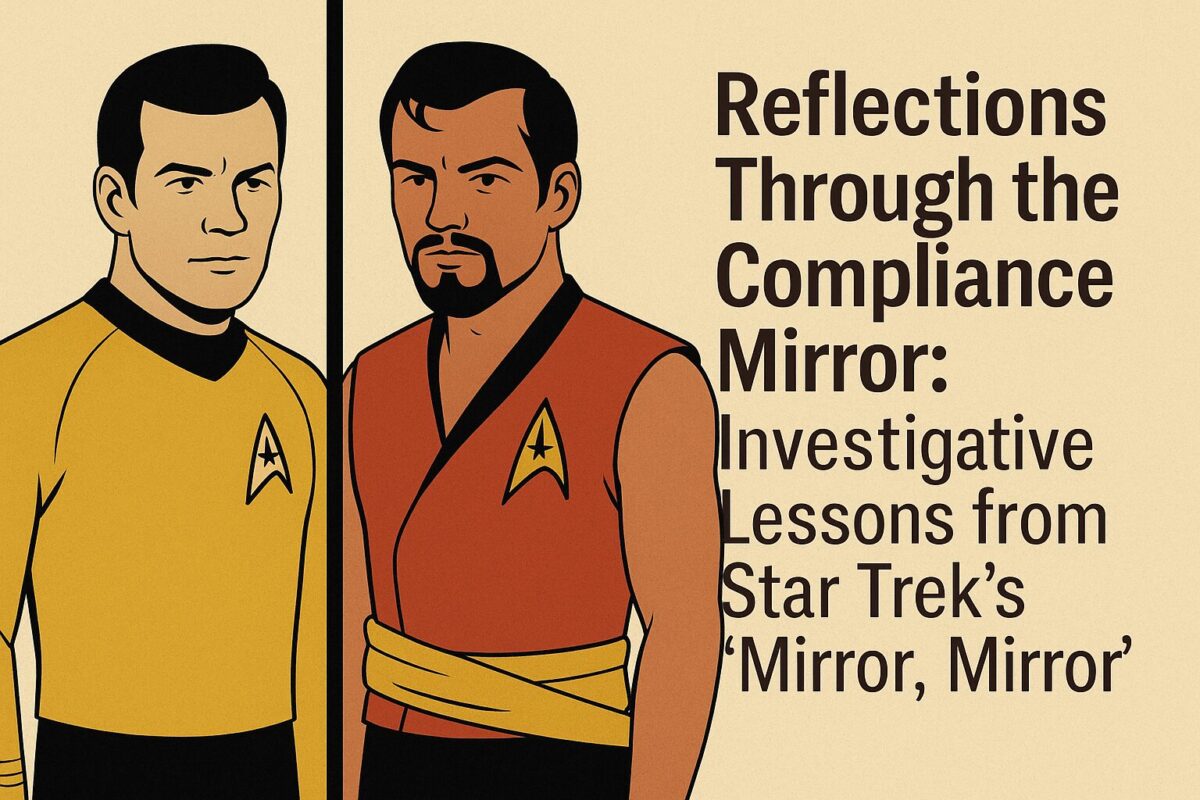
Reflections Through the Compliance Mirror: Investigative Lessons from Star Trek’s “Mirror, Mirror”

In the iconic episode of Star Trek: The Original Series titled “Mirror, Mirror,” Captain Kirk, Dr. McCoy, Uhura, and Scotty encounter a transporter accident that thrusts them into a parallel universe. This alternate reality is a distorted mirror image of their universe, familiar yet different, governed by violence, suspicion, and fear rather than trust and mutual respect. In their efforts to return home, Kirk and his crew members must navigate treacherous waters, carefully investigating their circumstances, analyzing subtle cues, and discerning critical information.

Just as Captain Kirk found himself confronted with the challenge of recognizing and navigating deceptive appearances, corporate compliance professionals regularly face similar investigative challenges. Effective compliance investigations require keen perception, attention to nuance, and an unwavering commitment to uncovering the truth beneath surface-level anomalies. Drawing directly from this compelling episode, we examine five investigative lessons that compliance professionals can apply in their roles to ensure ethical resilience and organizational integrity.

Lesson 1: Quickly Recognize the Unexpected

Illustrated by: In the opening sequence, Kirk and his team are transported into the Mirror Universe. Almost instantly, Kirk notices something is profoundly wrong: altered uniforms, aggressive demeanors, and a chilling salute. He immediately perceives a departure from the familiar, even before fully understanding the new environment.

Compliance Lesson: Compliance professionals must maintain heightened situational awareness during investigations to ensure effective outcomes. Promptly identifying unexpected deviations, whether subtle discrepancies in financial reports, irregularities in third-party behaviors, or suspicious communications. This allows for quicker intervention. The speed and accuracy of initial perception set the stage for effective investigative action and minimize potential harm.

Lesson 2: Adapt and Blend into the Environment

Illustrated By: Realizing their perilous situation, Kirk instructs his crew to blend into the mirror universe’s ruthless culture. Though repulsed by the harsh environment, they adapt quickly, adjusting speech patterns and behaviors to survive and conduct their investigation without raising immediate suspicion.

Compliance Lesson: Investigative adaptability is critical. Compliance officers often operate within organizational cultures that vary significantly in terms of transparency, openness, and ethical climate. Being able to adapt investigative strategies to match the realities of diverse organizational cultures and carefully navigating corporate politics without compromising ethical standards can enhance the effectiveness of compliance investigations.

Lesson 3: Secure Critical Information Discreetly

Illustrated By: A pivotal moment occurs when Kirk and Scotty clandestinely access the computer system in the mirror Enterprise to gather data discreetly. Kirk realizes that overt information-gathering would likely arouse dangerous suspicion, so he chooses subtle and indirect methods to secure the information necessary for their escape.

Compliance Lesson: Information security and discretion are foundational during investigations. Compliance investigations frequently require discretion, confidentiality, and careful handling of sensitive data. Investigators must judiciously plan their approaches to data collection, understanding that overly aggressive or obvious tactics might lead to premature disclosure, tampering with evidence, or employee distrust.

Lesson 4: Leverage Allies Within Complex Environments

Illustrated By: One crucial decision Kirk makes is trusting the mirror universe’s Spock enough to appeal to his logic and inherent sense of reason subtly. Kirk correctly discerns Spock’s fundamental logical nature, even in a morally inverted universe, and cautiously builds an alliance based upon shared objectives rather than blind trust.

Compliance Lesson:

Building strategic relationships and leveraging internal allies can significantly improve investigation outcomes. Effective compliance professionals identify trustworthy internal stakeholders who understand the organization’s core values, governance objectives, and ethical commitments, even if the surrounding corporate culture appears compromised. Leveraging these relationships enhances the legitimacy of investigations, provides deeper insights, and helps ensure credibility and buy-in for investigative conclusions.

Lesson 5: Provide Actionable Guidance Based on Investigative Outcomes

Illustrated By: At the climax, Kirk directly confronts Mirror-Spock, presenting him with evidence and logical arguments to inspire long-term change within the oppressive Empire. Kirk’s final remarks focus not only on immediate survival but also on leaving behind actionable insights and recommendations for reforming the Empire’s toxic culture.

Compliance Lesson: Investigations must always lead to clear, actionable recommendations. Identifying wrongdoing or risk exposure alone is insufficient. Compliance officers are responsible for translating investigative findings into practical actions, guidance, process improvements, control enhancements, or training recommendations that meaningfully mitigate future risks and promote an ethical organizational culture.

Final ComplianceLog reflections

The investigative narrative depicted in “Mirror, Mirror” presents powerful lessons for compliance professionals committed to conducting thorough, ethical, and practical investigations. Kirk and his crew were thrust into an environment of distorted realities, facing the daunting task of discerning truths within complex and dangerous situations. The strategies they adopted — early recognition, swift adaptation, discreet information gathering, strategic alliances, and actionable recommendations — mirror precisely the skills compliance officers require in navigating investigations.

Corporate compliance professionals today face environments increasingly characterized by complexity, subtlety, and high stakes. Whether investigating allegations of bribery, assessing third-party compliance risks, or responding to whistleblower reports, the investigative competencies vividly illustrated through “Mirror, Mirror” are foundational. Recognizing the unexpected, skillfully adapting, maintaining discretion, leveraging allies, and ensuring actionable recommendations are key to defining successful investigative processes.

Ultimately, investigations are not mere procedural formalities; they represent a defining moment for organizations, a mirror reflecting the organization’s authentic, ethical culture and commitment. As Captain Kirk implored Mirror-Spock to reflect deeply and embrace necessary reforms, compliance professionals similarly guide organizations through reflection, analysis, and moral growth. In so doing, investigations become powerful catalysts for meaningful organizational change, strengthening integrity, accountability, and trust.

Like Captain Kirk’s journey through the mirror universe, compliance professionals must navigate carefully yet decisively, continually adapting to new realities while remaining committed to the overarching mission of ethical corporate governance. Through effective investigative practices grounded in reflection, rigor, and resilience, compliance officers help ensure that the mirror held up to their organizations reflects clarity, accountability, and uncompromising ethical standards.

Resources:

Excruciatingly Detailed Plot Summary by Eric W. Weisstein

MissionLogPodcast.com

Memory Alpha