At a conference, the 2025 Agora Award for Excellence in Podcasting is formally presented to Regulatory Ramblings, recognizing its role in clarifying complex global financial regulation through expert, long-form dialogue and its contribution to transparency, accountability, and informed public discourse. Host Ajay Shamdasani (a veteran financial and legal journalist and senior research fellow at the University of Hong Kong) discusses the show’s origins—modeled on the idea of telling “the story of money” through the interconnections of law, regulation, finance, and capital—and how its scope has evolved to include ESG, sustainability, inclusion, and geopolitical risk alongside topics like money laundering, sanctions, fraud, crypto/Web3, cybercrime, anti-corruption, and human trafficking.
Ajay outlines the production team and roles (Professor Douglas Arner as team leader with editorial freedom; producer Prospero Laput as the technical backbone; admin support from Neo; research support, including Ying Man Chan) and explains a format change, adding a short topical segment before a longer interview to accommodate audience attention spans while keeping conversations authentic. The discussion also covers the podcast’s growing global reach through the Compliance Podcast Network, increased inbound guest and collaboration requests, listener feedback on episodes about U.S. regulatory shifts (including the FCPA, AML enforcement, and the GENIUS Act), and how the show anchors global issues back to Hong Kong and Asia-Pacific. Ajay reflects on the emotional impact of the human trafficking episode with Matt Friedman and comments on Hong Kong’s regulatory and fintech landscape versus Singapore and Dubai, the role and reputation of HKU Law, and broader themes of shifting global power centers, sanctions, and managed globalization. The episode closes with Ajay’s view that podcasting can be a public service that spreads ideas, builds awareness of institutions and research, and creates opportunities for collaboration.
Key highlights:
Agora Award Announcement: 2025 Excellence in Podcasting
Why They Won: “We’re Still Here” and Hong Kong’s Global Role
Origin Story & Mission: Telling the Story of Money (and Everything Connected)
Behind the Mic: Who Does What on the Show
Format Evolution: Spotlight Segments, Audience Attention, and Editorial Choices
Toughest Topics: Human Trafficking Episode and the Emotional Toll
HKU’s Role: Hong Kong’s Legal Education Powerhouse
Hong Kong Finance Today: FinTech, Crypto Rules, and Traditional Banking Reality
Growing the Audience: Compliance Podcast Network, Brand Awareness, and Listener Impact
Covering a Region (and the World): Balancing Local Hong Kong Anchors with Global News
US–China Thaw? Decoupling, Trade Realities, and What Comes Next
Why Professionals Should Podcast: Influence, Public Service, and Collaboration
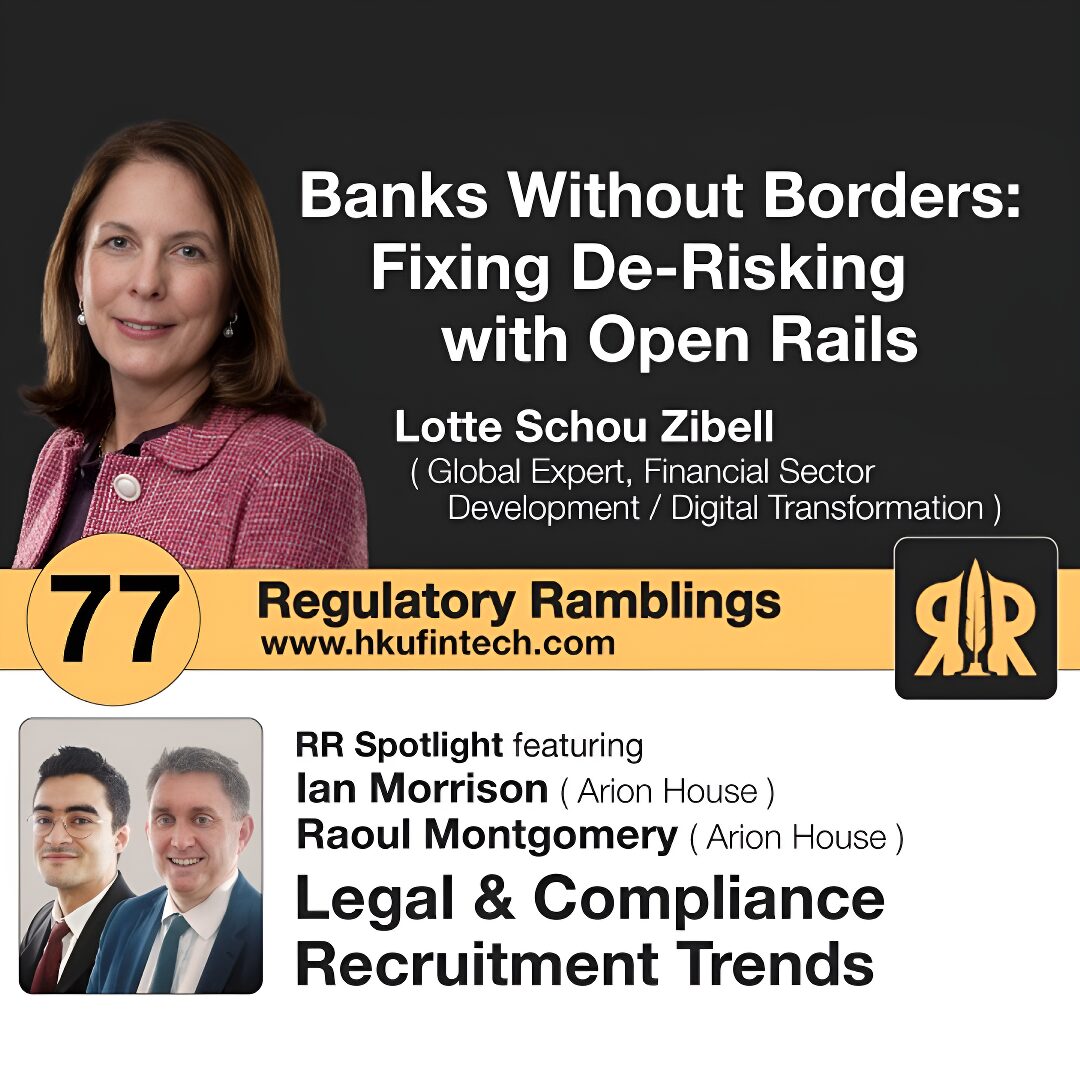
In the initial spotlight segment of this episode, we speak with London-based Ian Morrison of search and recruitment firm Arion House, and his Hong Kong colleague Raoul Montgomery to get a broader perspective on hiring trends in the legal and compliance space for the remainder of this year and into 2026 – with an eye towards global hubs such as London, Hong Kong, and Singapore.
Following that, we chat with Lotte Schou Zibell, formerly of the Asian Development Bank (ADB), to discuss the importance of financial inclusion and sustainability – including her thoughts on how something as seemingly mundane as the bamboo plant can be part of the solution.
Ian Morrison has over 18 years of experience in executive search and market intelligence, spanning Europe and Asia. Having placed legal, compliance, and financial crime professionals at the vice president, managing director, and partner levels globally, he has worked with many of the world’s leading investment banks, asset managers, hedge funds, law firms, and corporate clients.
Before establishing Arion House, Ian spent three years running the Asia Pacific business for Leathwaite International. He holds a degree in history from the University of Newcastle.
Raoul Montgomery joined as a research consultant in September 2019, with a focus on the APAC markets. He joined the University of Hong Kong, where he graduated with a Bachelor of Arts degree in History, Politics, and Public Administration. Having worked with numerous non-governmental organizations (NGOs), he is currently pursuing a JD degree in law at HKU. He is also fluent in English, Hindi, and Spanish.
Lotte Schou Zibell is a veteran international expert on sustainable finance, digital financial innovation, and financial inclusion. Lotte has played a key role in shaping policies and leading initiatives addressing emerging challenges in capital markets and financial systems.
For 19 years, she held various leadership positions at the Asian Development Bank, including serving as an advisor in the Finance Sector Office, as regional director for the Bank’s Pacific Liaison and Coordination Office, and as its chief of finance.
Before joining the ADB, she served as Director for International Economic Policy at the Swedish Ministry of Finance. She held positions at the Swedish Financial Supervisory Authority and the Swedish Central Bank. She has also worked as a consultant for the International Monetary Fund (IMF).
Lotte holds a master’s degree in economics from Lund University and a bachelor’s degree in international relations from George Mason University in the US state of Virginia. Her career reflects a deep commitment to strengthening financial systems and fostering economic resilience on a global scale.
Discussion:
With recruitment budgets for compliance and legal hires already set for the remainder of this year and into 2026, Ian and Raoul begin the conversation by discussing their observations on hiring trends in London, Hong Kong, and Singapore. As Ian tells Regulatory Ramblings host Ajay Shamdasani, hiring appears most robust in the insurance sector relative to other parts of the financial world.
A common refrain is that even with compliance, many organizations want to keep headcounts lean. Many employers seem willing to hire at the very senior levels, yet for middle management to junior hires, they are in retention mode. Simply put: if someone leaves, they are generally not replaced.
Worse still, stories of layoffs and hiring freezes at banking and financial institutions, as well as multinational corporations (MNCs), abound. For example, HSBC’s recent decision to shut its regional geopolitical risk unit caused quite a stir.
The spotlight chat concludes with a discussion of what knowledge and soft skills, other than being savvy in legal and regulatory matters, in-house counsel, and compliance, should possess. Ian noted that a greater awareness of political and economic risk was now firmly part of the remit of many in-house lawyers and compliance professionals at financial institutions and other multinational corporations.
We then proceed to our discussion with Lotte, who shares her experiences growing up in Sweden and spending time abroad in the US due to her father’s postings. She discusses what drew her to work for the IMF and ADB, as well as her commitment to developmental economics.
Having run Bank’s financial sector development projects for the past 20 years, Lotte comments on her achievements and how awed she is by the developments in fintech that she has seen during her tenure.
Acknowledging her current status as a consultant with the ADB, she discusses how it is to still work with her former colleagues, albeit in a less formal capacity, outside of the organization’s official hierarchy. As Lotte notes, being a consultant enables her to devote time to other interests.
She also elaborates on a post she authored for the ADB website, entitled “Five Ways Bamboo Can Revolutionize Finance, Housing, and Sustainability.” She noted that: “Bamboo’s fast growth and carbon capture abilities offer a sustainable solution to financial inclusion, housing affordability, and economic resilience in developing countries. Integrating modern technologies with bamboo cultivation can drive economic development while mitigating environmental impacts.”
The chat then drifted to another one of her posts entitled “Banks Without Borders: How AI, IDs, and Innovation Are Changing the Game.” Lotte wrote: “Rising compliance costs, regulatory fragmentation, and de-risking are limiting cross-border banking access, but technology-driven solutions offer a path to restore connectivity and resilience.”
Regulators often advise banks to adopt a risk-weighted approach to compliance and refrain from engaging in wholesale derisking. Yet, correspondent banking and related AML/KYC issues for certain sectors are a perennial issue, Lotte admits.
Acknowledging the problem’s entrenched nature, the sad truth is that derisking occurs when the compliance costs for banks maintaining particular correspondent banking relationships are too great. This can be due to the meager profit from serving them, resulting from small business volumes, or to the enhanced risk associated with serving a particular client or category of clients.
Lotte noted that there is often a lack of basic infrastructure in many emerging markets and that the developed world needs to provide those nations without capital, technology, and know-how the means to catch up.
Sadly, biometric safeguards are often not there in the developing world, she said. Many do not have identity cards or smartphones. In that regard, she thinks India’s Aadhaar card initiative is a triumph.
Their chat concludes with a reflection on a more recent ADB website post by Lotte entitled “Strengthen Compliance to Safeguard Pacific Banking Access.” She said: “Addressing gaps in financial compliance, upgrading digital infrastructure, and improving regulatory capacity can help Pacific countries build economic resilience and protect vital financial links.”
She added, however, that the resources required for compliance and risk management invariably affect a banking or financial institution’s bottom line.
Regulatory Ramblings podcasts is brought to you by The University of Hong Kong – Reg/Tech Lab, HKU-SCF Fintech Academy, Asia Global Institute, and HKU-edX Professional Certificate in Fintech, with support from the HKU Faculty of Law.