Categories
Blog

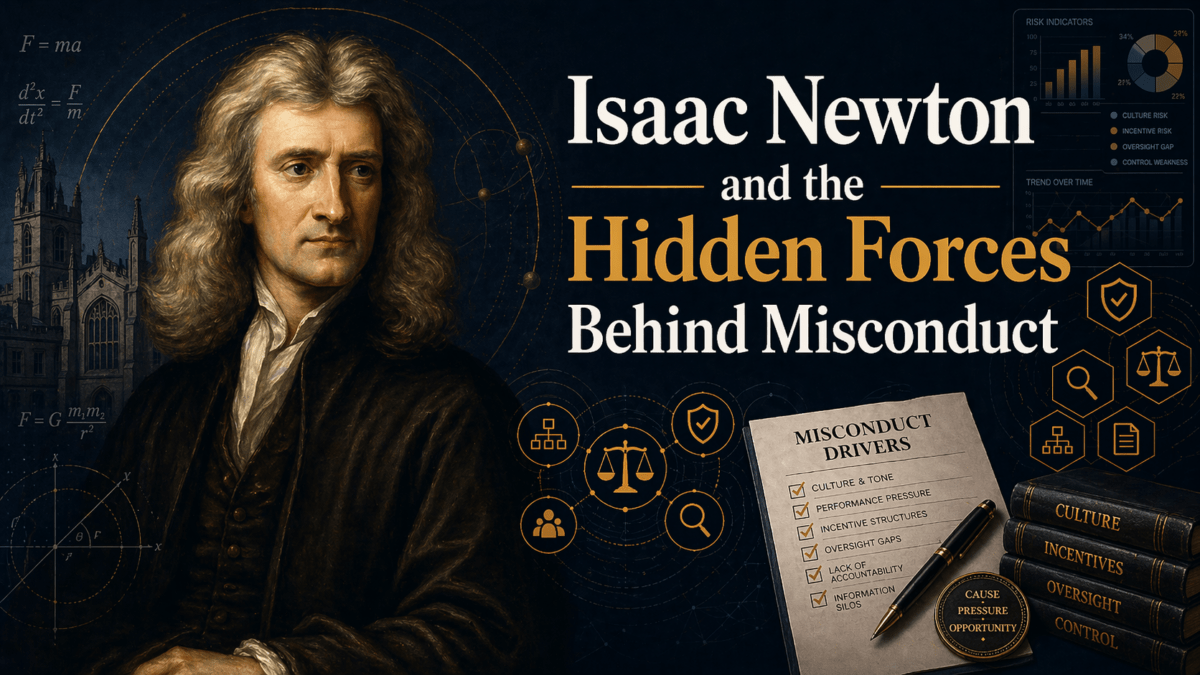
Isaac Newton and the Hidden Forces Behind Misconduct

Today, we conclude our exploration of Enlightenment Thinkers to see their influence on modern compliance programs. This week’s category is broader than philosophers, as many of these men excelled in numerous fields, including science, mathematics, calculus, and medicine. However, each contributed a key component that relates directly to our modern compliance regimes. In this concluding post, we consider Isaac Newton’s theorem that misconduct is rarely random.

If Francis Bacon taught us that a compliance program must be grounded in evidence, René Descartes taught us that evidence must be examined with rigor, John Locke taught us that the system must be legitimate, and Thomas Hobbes taught us that institutions need order, Isaac Newton brings this series to its final and perhaps most powerful insight: misconduct is rarely random. Forces drive it. Pressures. Incentives. Structural weaknesses. Repeated patterns. Hidden relationships. The most mature compliance programs understand that reality and act on it.

Newton is remembered as the great scientist of motion, force, and causation. He gave the world a way to understand that observable events are often the result of underlying principles that can be identified, studied, and predicted. His work was not simply about describing what happened. It was about explaining why it happened and how the same forces might operate again. For the compliance professional, that is a profoundly useful way to think. A hotline complaint, a bribery incident, a books-and-records failure, a retaliation claim, or a control breakdown should never be seen as a one-off event. The real question is Newtonian: what forces produced this result? In a best practices compliance program, that question is the bridge from reaction to prevention.

Why Newton Matters to Compliance

Newton helps compliance professionals move beyond event-based thinking. Too often, organizations respond to misconduct by focusing only on the visible incident. Someone violated policy. Someone approved a bad payment. Someone ignored a red flag. Someone retaliated against a whistleblower. Those facts matter, of course, but they are usually only the surface expression of deeper conditions. Newton would urge us to ask what was acting beneath the surface.

Was the employee under intense sales pressure? Were performance incentives designed in a way that rewarded output but ignored process? Was a business unit growing so quickly that controls were bypassed in the name of speed? Did management tolerate workarounds because the local market was too important to slow down? Was the company relying on outdated monitoring tools in a rapidly changing business model? Were risk signals present but scattered across functions with no one connecting them?

That is Newton’s great gift to compliance. He reminds us that forces shape behavior, and if you want to reduce misconduct, you must understand and address the forces that make misconduct more likely.

The DOJ Expects Companies to Understand Causes, Not Just Outcomes

The Department of Justice’s Evaluation of Corporate Compliance Programs (ECCP) reflects this Newtonian logic with remarkable consistency. The ECCP asks whether a company performs root cause analysis, adapts its program based on lessons learned, uses data to identify patterns, aligns incentives with ethical conduct, and can demonstrate that controls are responsive to emerging risks. These are not narrow enforcement questions. There are questions about causation.

The ECCP is not satisfied when a company says it found the bad actor and imposed discipline. Regulators want to know what the company learned. Why did the misconduct happen? Were there prior warning signs? Was the conduct enabled by poor oversight, flawed incentives, weak middle management, insufficient resources, or ineffective controls? Did the company identify those drivers and change the system? That is exactly the sort of inquiry Newton would have appreciated.

Root Cause Analysis Is Newton in Practice

If there is one place where Newton’s influence should be front and center, it is root cause analysis. In compliance, root cause analysis is the discipline of looking beyond the immediate violation to identify the pressures, structures, incentives, and system weaknesses that created the conditions for failure. This is where many companies still fall short.

A company uncovers improper payments and concludes that an employee acted dishonestly. Perhaps that is true. But Newton would ask what else was in motion. Was there a compensation model that encouraged aggressive behavior without corresponding control discipline? Were finance and compliance understaffed relative to expansion? Did business leadership send signals that revenue mattered more than process? Had similar concerns surfaced in audit findings or prior investigations? Was a third-party oversight process designed for a smaller and less risky operating model? A true root cause analysis keeps asking until the organization understands the forces at work.

Incentives Are Among the Strongest Forces in Any Organization

Newton’s framework is especially valuable when thinking about incentives. Every organization generates motion through what it rewards, measures, and celebrates. If those incentives are poorly designed, they can push employees and managers toward decisions that undermine the compliance program even when the formal policy language is sound. This is one of the most underappreciated truths in compliance.

A company may say all the right things about integrity, but if promotions, bonuses, and recognition go disproportionately to people who hit aggressive numbers regardless of how they achieved them, employees receive a different message. If managers are evaluated on speed and volume but not on control discipline, they will often treat process as friction. If local market leaders are given extraordinary flexibility without matching oversight, the organization may create precisely the pressures and blind spots that breed misconduct.

The ECCP has increasingly focused on compensation structures, clawbacks, and incentive alignment for precisely this reason. Regulators understand that culture is shaped not only by leadership’s words, but also by tangible rewards that guide daily conduct. Newton helps compliance professionals explain why this matters. Incentives are not background conditions. They are active forces inside the corporate system.

Analytics Help the Company See What the Eye Misses

A Newtonian compliance program also leverages analytics more effectively. Newton’s work showed that patterns in motion could be identified through disciplined observation and analysis. Modern compliance can do something similar. Data analytics, trend reviews, and integrated monitoring allow a company to detect patterns that an isolated human review might miss. That does not mean technology replaces judgment. It means technology can help reveal the forces and relationships that judgment must then interpret.

Consider a multinational company reviewing third-party spend, travel, and entertainment data, hotline trends, and investigation outcomes. Each data set alone may show only limited information. But when viewed together, patterns may emerge. A particular region may show above-average use of high-risk intermediaries, greater discounting, delayed documentation, and increased employee complaints about management pressure. No single data point proves misconduct. But together they may reveal a system under strain.

This is where Newton connects back to Bacon. Bacon tells us to gather evidence. Newton tells us to study how patterns and causes operate across the system. Together, they produce a compliance function that is empirical, analytical, and forward-looking.

Misconduct Is Often a Systems Failure, Not Merely an Individual Failure

One of the most valuable lessons Newton offers the compliance profession is that misconduct is frequently systemic. This does not excuse individual wrongdoing. Personal accountability remains essential. But if a company stops with personal accountability, it may miss the broader organizational truth.

An employee may make an improper payment, but the surrounding system may have made that outcome easier, more predictable, or more likely. A senior manager may retaliate against a reporter, but the broader culture may have conditioned leaders to treat bad news as disloyalty. A financial control breakdown may involve one approving official, but the deeper problem may be a long-standing tolerance for informal overrides. In each case, the misconduct event should prompt a systems review.

This is particularly important in fast-changing environments. Growth, acquisitions, digital transformation, remote work, AI deployment, and market stress all alter the forces acting on the organization. Controls designed for one operating model may not be sufficient for the next. A Newtonian compliance officer understands that governance must evolve as the system changes. The question is never just whether the policy still exists. The question is whether the underlying forces have shifted in ways the compliance program has not yet caught up to.

Newton and the Future of Compliance

Newton is particularly relevant today because the modern compliance landscape is increasingly defined by complexity. Third-party ecosystems are larger. Data flows are faster. Business models shift more quickly. AI and automated decision-making create new risks that can change over time through drift, scale, and changing use cases. In that world, static compliance is not enough. A company needs to understand how moving systems work.

This is where frameworks like NIST and ISO/IEC 42001 become useful companions to Newtonian thinking. They emphasize lifecycle governance, ongoing monitoring, documented accountability, testing, and adaptation. In the AI context, especially, the lesson is clear: a control that works on day one may not be enough on day two. Risks evolve—inputs change. Vendors change. User behavior changes. Governance must therefore be dynamic, evidence-based, and attentive to emerging forces.

The same is true across compliance more broadly. Companies cannot assume that yesterday’s control environment will manage tomorrow’s pressures. Newton teaches that motion continues unless acted upon, and in the corporate setting, that means risk patterns will continue to develop unless governance actively intervenes.

The Compliance Officer as Interpreter of Organizational Forces

If Bacon casts the compliance officer as an institutional scientist, Descartes as a guardian of clear thinking, Locke as a steward of legitimacy, and Hobbes as an architect of order, Newton casts the compliance officer as an interpreter of organizational forces. That is a sophisticated and necessary role.

The compliance officer must ask what is really driving conduct across the enterprise. Which incentives are shaping decisions? Which processes are creating blind spots? Which managers are transmitting pressure? Which data trends suggest a deeper problem? Which repeated “isolated incidents” are no longer isolated at all? Which changes in the business model have altered the risk environment without corresponding updates to governance?

Those are not merely compliance questions. They are strategic governance questions. That is why Newton is such a fitting conclusion to this series. He pulls together all that came before. Evidence matters. Rigor matters. Legitimacy matters. Order matters. But ultimately, the mature compliance program does something more. It understands how these elements interact inside a living system. It seems that misconduct does not fall from the sky. It emerges from forces that can be studied, anticipated, and changed. Isaac Newton would have understood that a well-governed institution learns to read its own motion.

Five Lessons Learned for the Modern Compliance Professional

First, misconduct is rarely random. It is usually the product of identifiable pressures, incentives, weaknesses, and structural conditions.

Second, root cause analysis must go beyond the visible event. The goal is to understand the forces that made the event more likely.

Third, incentives are among the strongest drivers of conduct. A company must align compensation, promotion, and recognition systems with ethical and compliant behavior.

Fourth, analytics and trend analysis are essential tools for seeing patterns across the system. They help the company detect pressure points before they become crises.

Fifth, the most mature compliance programs are systemic and preventive. They do not simply respond to incidents. They study the organization well enough to reduce the conditions that produce misconduct.

Closing It Out

This five-part journey through Bacon, Descartes, Locke, Hobbes, and Newton shows that the architecture of a modern compliance program is not merely legal or procedural. It is intellectual. Bacon teaches us to demand evidence. Descartes teaches us to examine it with discipline. Locke teaches us that the system must be legitimate. Hobbes teaches us that institutions require order. Newton teaches us to understand the forces that shape outcomes.

Together, they offer a powerful framework for the compliance professional, the board, internal audit, legal, and business leadership. A best practices compliance program is not simply a collection of policies. It is a way to see the organization clearly, govern it credibly, and continuously improve it. That is as true now as it would have been revolutionary in their own time.

 

Categories
Compliance Tip of the Day

Compliance Tip of the Day: Encouraging and Incentivizing Reporting

Welcome to “Compliance Tip of the Day,” the podcast where we bring you daily insights and practical advice on navigating the ever-evolving landscape of compliance and regulatory requirements.

Whether you’re a seasoned compliance professional or just starting your journey, our aim is to provide you with bite-sized, actionable tips to help you stay on top of your compliance game.

Join us as we explore the latest industry trends, share best practices, and demystify complex compliance issues to keep your organization on the right side of the law.

Tune in daily for your dose of compliance wisdom, and let’s make compliance a little less daunting, one tip at a time.

A reporting mechanism is only as effective as the culture that surrounds it. Compliance professionals must work to foster an environment where reporting is encouraged and valued.

Categories
Compliance Tip of the Day

Compliance Tip of the Day: The Importance of Having a Hotline

Welcome to “Compliance Tip of the Day,” the podcast where we bring you daily insights and practical advice on navigating the ever-evolving landscape of compliance and regulatory requirements.

Whether you’re a seasoned compliance professional or just starting your journey, our aim is to provide you with bite-sized, actionable tips to help you stay on top of your compliance game.

Join us as we explore the latest industry trends, share best practices, and demystify complex compliance issues to keep your organization on the right side of the law.

Tune in daily for your dose of compliance wisdom, and let’s make compliance a little less daunting, one tip at a time.

Today, we consider the importance of an organization creating a hotline from the legal and regulatory perspectives.

Categories
Compliance Tip of the Day

Compliance Tip of the Day: Tenets of a Successful Hotline

Welcome to “Compliance Tip of the Day,” the podcast where we bring you daily insights and practical advice on navigating the ever-evolving landscape of compliance and regulatory requirements.

Whether you’re a seasoned compliance professional or just starting your journey, our aim is to provide you with bite-sized, actionable tips to help you stay on top of your compliance game.

Join us as we explore the latest industry trends, share best practices, and demystify complex compliance issues to keep your organization on the right side of the law. Tune in daily for your dose of compliance wisdom, and let’s make compliance a little less daunting, one tip at a time.

In this episode, I discuss the basic tenets of a successful hotline and how this can foster engagement across your organization.

For more information on the Ethico ROI Calculator and a free White Paper on the ROI of Compliance, click here.

Categories
Principled Podcast

Principled Podcast – S9 E13 – Is Your Hotline Running Cold? How To Get Meaningful Data from Internal Reporting.

What you’ll learn on this podcast episode

Do hotlines really work? According to the 2019 Global Business Survey conducted by the Ethics and Compliance Initiative, only 6% of E&C complaints went to hotlines, compared to 51% to direct supervisors and the remainder to higher management or human resources. So why are so many E&C programs—not to mention boards of directors—relying principally on hotline data to assess company culture and compliance? In this episode of LRN’s Principled Podcast, Susan Divers talks about reimagining hotlines with Scott Sullivan, the chief integrity and compliance officer at Newmont Corporation. Listen in as Scott shares how his team reinvented Newmont’s hotline channel and reporting process to separate the wheat from the chaff and gain meaningful information.

Guest: Scott Sullivan

Headshot_Scott_S7E18

Scott Sullivan is the Chief Integrity & Compliance Officer of Newmont Corporation, the world’s leading gold company. Newmont has approximately 15,000 employees and 15,000 contractors and has 12 operating mines and 2 non-operated JVs in 9 countries. Mr. Sullivan oversees, develops, implements, and manages Newmont’s integrity and compliance program including ethics, anti-bribery, corporate investigations, and global trade compliance. Previously, Mr. Sullivan was the Chief Ethics & Compliance Officer of a global manufacturer of fluid motion and control products with approximately 17,000 employees operating in 55 countries. Mr. Sullivan has written and contributed numerous articles on compliance programs, anti-bribery/FCPA, export controls, economic sanctions, and other ethics and compliance topics to a variety of publications. Mr. Sullivan is also a frequent local, national, and international speaker, moderator, and conference organizer on compliance, anti-bribery/FCPA, export controls, and economic sanctions.

Host: Susan Divers

Headshot_Susan_Divers_S7E18_Principled_Podcast

Susan Divers is a senior advisor with LRN Corporation. In that capacity, Ms. Divers brings her 30+ years’ accomplishments and experience in the ethics and compliance area to LRN partners and colleagues. This expertise includes building state-of-the-art compliance programs infused with values, designing user-friendly means of engaging and informing employees, fostering an embedded culture of compliance and substantial subject matter expertise in anti-corruption, export controls, sanctions, and other key areas of compliance.

Prior to joining LRN, Mrs. Divers served as AECOM’s Assistant General for Global Ethics & Compliance and Chief Ethics & Compliance Officer. Under her leadership, AECOM’s ethics and compliance program garnered six external awards in recognition of its effectiveness and Mrs. Divers’ thought leadership in the ethics field. In 2011, Mrs. Divers received the AECOM CEO Award of Excellence, which recognized her work in advancing the company’s ethics and compliance program.

Mrs. Divers’ background includes more than thirty years’ experience practicing law in these areas. Before joining AECOM, she worked at SAIC and Lockheed Martin in the international compliance area. Prior to that, she was a partner with the DC office of Sonnenschein, Nath & Rosenthal. She also spent four years in London and is qualified as a Solicitor to the High Court of England and Wales, practicing in the international arena with the law firms of Theodore Goddard & Co. and Herbert Smith & Co. She also served as an attorney in the Office of the Legal Advisor at the Department of State and was a member of the U.S. delegation to the UN working on the first anti-corruption multilateral treaty initiative.

Mrs. Divers is a member of the DC Bar and a graduate of Trinity College, Washington D.C. and of the National Law Center of George Washington University. In 2011, 2012, 2013 and 2014 Ethisphere Magazine listed her as one the “Attorneys Who Matter” in the ethics & compliance area. She is a member of the Advisory Boards of the Rutgers University Center for Ethical Behavior and served as a member of the Board of Directors for the Institute for Practical Training from 2005-2008.

She resides in Northern Virginia and is a frequent speaker, writer and commentator on ethics and compliance topics. Mrs. Divers’ most recent publication is “Balancing Best Practices and Reality in Compliance,” published by Compliance Week in February 2015. In her spare time, she mentors veteran and university students and enjoys outdoor activities.

Categories
Compliance Into the Weeds

Suicide Prevention Hotline and a Speak Up Culture

Compliance into the Weeds is the only weekly podcast that takes a deep dive into a compliance-related topic, literally going into the weeds to more fully explore a subject. In this episode, we look at the implementation of a national suicide prevention hotline, 988, and consider what it might teach compliance professionals. Highlights and questions posed include:

·      What is the new national Suicide Prevention hotline?

·      How does it inform your corporate hotline and speak up culture?

·      How do you teach the trait of listening?

·      Engaged employees are more effective employees.

·      How easy are the mechanics of your hotline to navigate?

Resources

Matt in Radical Compliance

Categories
Blog

Practicing Compliance

As usual during the Oscar season, Richard Lummis, my co-host on the podcast series 12 O’Clock High, a podcast on business leadership, and I do a special 4-part podcast series on Best Picture winning Oscar movies. We mine them for leadership lessons for the compliance and business leader in the 2020’s. It is also a great way to watch some fabulous old movies or even some which are not so old. Some movies are very intuitive on leadership lessons. Movies like Patton, Lawrence of Arabia or The Bridge on the River Kwai are clearly about leadership as well as multiple other themes.
This Oscar season we have a lineup of Schindler’s List, Gladiator, A Man for All Seasons and Platoon. The series premiers on Thursday, February 10, and runs for four consecutive weeks. I hope you will check it out. It is great to sit down with a movie, that you may not have seen in years and watch it with an eye towards leadership lessons. Equally enjoyable is reading the commentary on the movie, both film critique and more business and leadership focused commentary.
Next week’s offering will be Gladiator and one of the leadership lessons I garnered from the movie is the need to not only design your compliance strategy but practice it. Practicing is not often talked about in compliance. There is plenty of ink and commentary on designing a compliance program but almost none on practicing it after you design, create and implement it into a best practices compliance program.
One person who does talk about practicing compliance is Jonathan Marks. In a blog post entitled Crisis Management – Lights, Camera, Action! he wrote, “Even the best-prepared organizations will experience a crisis—and there’s rarely a perfect response. The ability to avoid disaster and avoid mismanagement of the situation—will largely be determined by the effectiveness of the organization’s crisis prevention efforts, crisis response plan, proper training of the crisis team, and leadership to manage the crisis effectively.” What is the solution to this imbroglio? Marks answers, “Practice, practice, practice…regularly conduct disaster rehearsal exercises or crisis management simulations that are impactful and help reveal blind spots that can be remediated and ultimately prepare you and your team for not if, but when something ugly happens.”
But you do not have to wait for a crisis to practice. You can do it on a regular basis and on a variety of areas in your compliance program. An obvious place to practice is around your internal reporting system. Can an internationally based employee reach the hotline to report a claim? Have you ever tested that proposition? Does your hotline work in each country where you have employees? In the local language of the employees?
However, being able to pick up the phone and make a hotline compliant is only the starting point. Do you have a triage protocol? Have you tested it? If you are a Chief Compliance Officer (CCO) have you sat down with your compliance team and run through some examples of reports that might come in to see where your team would send them and what advice they would provide at that point? Now think about the cost of performing such a ‘practice’ session. That is right it would be zero dollars. Always remember as a CCO or compliance professional you are only limited by your imagination and in this case, you can imagine many scenarios and use that imagination to practice your compliance team.
What about practicing formal internal and external audits? To do so you can employ a practice  audit. In the practice audit, the team will go through the factors which will be reviewed in a formal audit at your organization. The practice audit is a mechanism by which a compliance team can go into a location or business unit and not only try to determine what might need remediation but, equally importantly, help the employees move towards greater compliance. The team members who perform these practice audits need not always be compliance personnel. This allows you to train as you practice. These practice audits help to uncover gaps that need closing before any of the regulatory mandated audits by external audit teams. Obviously, the entire experience can be a powerful training tool as well as a practice exercise.
In the movie Gladiator, the character Maximus survives several gladiatorial bouts in the Coliseum by practicing. While not often considered in compliance, think about practicing your compliance program to see if it works, determine what can be improved but also train as you are practicing. As I noted above, the cost be can very low even if you bring a seasoned compliance professional to lead the practice session.
Finally, I hope you will check out the podcast series Lummis and I have put together for this year’s Oscar season. We had a ton of fun re-watching the movies, researching the lessons and then recording the podcasts. I know you will both get a lot of leadership and ethical lessons out of these podcasts but also find them quite enjoyable. Happy Oscar Season.

Categories
Compliance Into the Weeds Daily Compliance News

Compliance into the Weeds: Episode 118-Hotline Metrics

Compliance into the Weeds is the only weekly podcast which takes a deep dive into a compliance related topic, literally going into the weeds to more fully explore a subject. In this episode, Matt Kelly (the coolest guy in compliance) and I take a deep dive into recently released NAVEX Global 2019 Ethics & Compliance Hotline Benchmark Report. We consider the details from the report and ask the following question “are you using all the right intake channels to capture a true sense of misconduct and corporate culture at your organization?” Some of the highlights include:

Some of the highlights include:

  • What are the intake channels available to your organization?
  • If you are only tracking complaints through a formal system, you may well be missing a wider variety and rich source of information.
  • Moving your intake past simply what the law requires will give you a much better accounting of your organization’s culture.
  • How can you improve your intake?
  • Has closure time for reported increase or decrease?
  • What has been the continued impact of #MeToo?

For more reading check out Matt’s blog post “Hotline Metrics-are you missing any?”
To read the full NAVEX Global 2019 Ethics & Compliance Hotline Benchmark Report, click here.