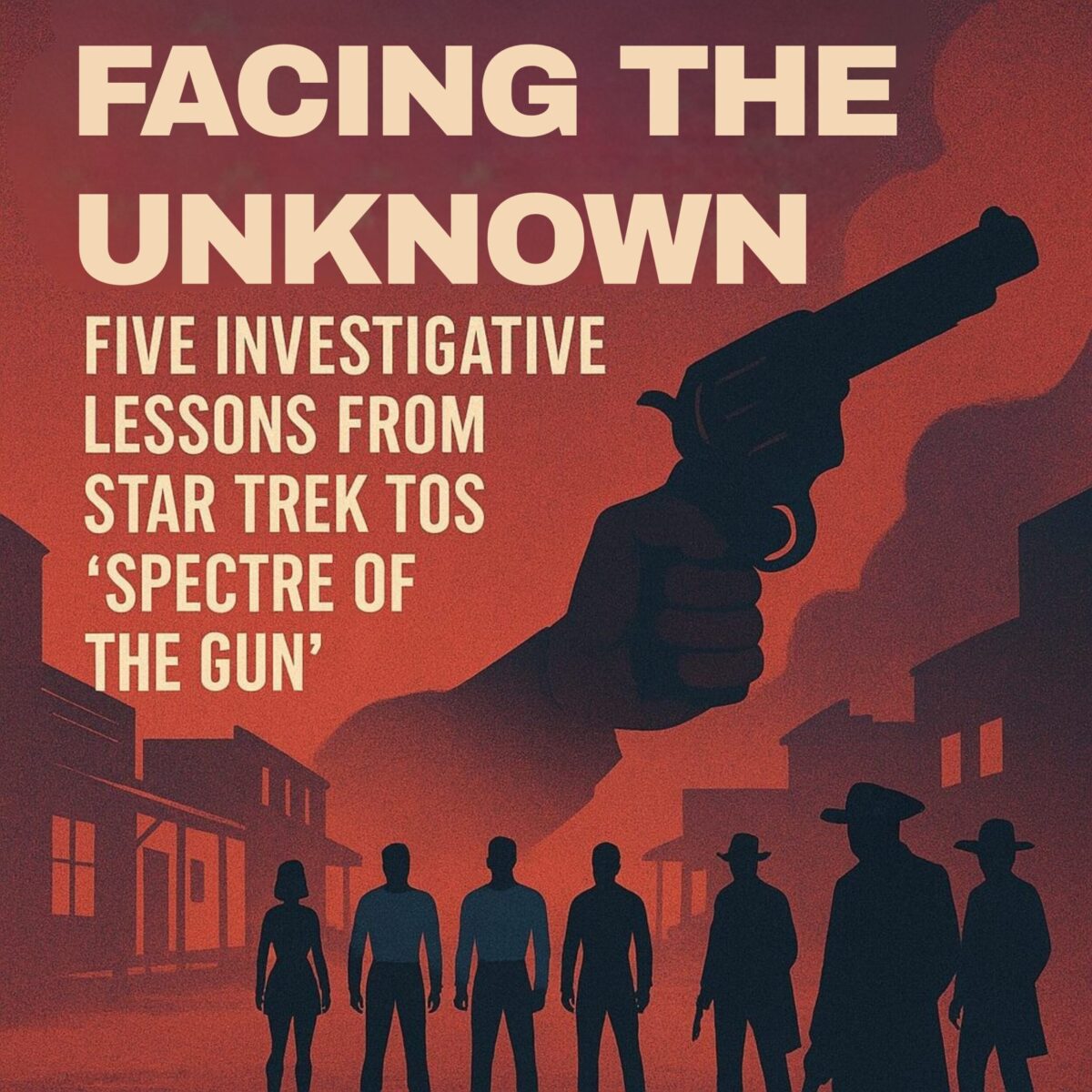
One of the most fascinating aspects of compliance investigations is navigating the unknown—those ambiguous, often illogical circumstances where instinct and method must work together. Few television episodes dramatize this challenge as vividly as the Star Trek: The Original Series (TOS) episode, “Spectre of the Gun.”
In this third-season episode, Captain Kirk and his landing party beam down to a planet of the reclusive and telepathic Melkotians, only to be punished for trespassing. Their punishment? Being cast into a surreal, incomplete recreation of the 1881 Gunfight at the O.K. Corral, destined to play the losing side against the Earps and Doc Holliday. As the Enterprise crew quickly learns, logic, memory, and even physical law are unreliable. Their investigation into their predicament and their survival depends on teamwork, analysis, and the willingness to question what’s real.
The compliance world may not often resemble the Wild West, but the best compliance investigators know that the strange and surreal are not always fiction. Misunderstandings, missing evidence, and “unwritten rules” can make the truth as elusive as any Melkotian illusion. “Spectre of the Gun” provides a powerful lens through which to examine the investigative process.
Today, we saddle up and explore five essential investigative lessons for compliance professionals from Tombstone in the Arizona Territory, as featured in this classic episode.
1. Never Assume Reality Is What It Seems
Illustrated By: From the moment Kirk and his team arrive, things are… off. The town is half-finished, with buildings lacking walls and only a few facades standing. There are missing objects and inexplicable absences. Despite this, the crew initially tries to follow the “script” of Tombstone’s history, assuming their actions will play out as expected.
Compliance Lesson. In a compliance investigation, assumptions are your enemy. Initial appearances can deceive, especially when dealing with incomplete data, manipulated records, or the subtle influence of organizational culture. Like the Enterprise crew, investigators often find themselves in environments that “look” right but don’t quite add up.
A skilled investigator asks:
- What’s missing from this picture?
- Are there gaps or inconsistencies in the documentation?
- Do witness accounts align, or are they conspicuously similar as if rehearsed?
Always challenge the first layer of evidence. Probe for context. Cross-check data sources and resist the urge to “solve” the case too quickly.
Takeaway:
If your compliance investigation feels too neat, step back and re-examine. The truth often lies in the gaps, not the obvious.
2. Stay Calm in the Face of Escalating Pressure
Illustrated By: As the clock ticks toward 5:00, the hour of the gunfight, the tension mounts. The Earps are aggressive, and the townsfolk are hostile or unhelpful. The crew experiences mounting psychological stress, but Kirk repeatedly counsels his team to stay calm and focused, even as the “inevitable” doom approaches.
Compliance Lesson. Investigations often bring high-pressure moments: interviewees who become confrontational, business leaders who want quick resolutions, or whistleblowers who fear retaliation. In these moments, emotions can cloud judgment and cause missteps.
“Spectre of the Gun” shows that, when panic rises, clear-headed leadership and methodical process are essential. Kirk’s calm enables the team to think creatively and challenge assumptions, ultimately saving their lives.
In compliance investigations:
- Set clear ground rules for interviews.
- Create a calm environment, even when accusations are severe.
- Support your team and witnesses, especially when the stakes are high.
What should you do now? Under pressure, composure and methodical thinking separate successful investigators from those who react.
3. Leverage Diverse Perspectives and Skills
Illustrated By: Each member of the landing party brings a unique skill to the puzzle. Spock applies logic to interpret the unreality of their situation. McCoy’s medical knowledge helps craft “anti-venom” to counter the gas used by Doc Holliday. Scotty and Chekov offer technical and tactical ideas, while Kirk analyzes motivations and strategy.
Compliance Lesson. No single investigator has all the answers. The best compliance investigations are team efforts, drawing on legal, HR, IT, and business expertise. This diversity helps spot blind spots and ensures that all avenues are explored.
In the episode, Spock recognizes that their environment is illusory, and the group’s willingness to trust his logic unlocks their escape. In your investigations:
- Gather a multidisciplinary team.
- Encourage open debate and the airing of alternate theories.
- Leverage outside expertise when needed, such as forensic accountants or language specialists.
What should you do now? Diversity is not just about backgrounds; it is about thinking styles and problem-solving approaches. Use every tool at your disposal.
4. Test Hypotheses—Don’t Just Accept Stories
Illustrated By: When McCoy attempts to make “real” tranquilizer gas to stop the Earps, it fails, as the gas has no effect, because nothing in their environment is truly real. Spock theorizes that their minds are the only reality that matters. The crew realizes they must test each new hypothesis about their environment, ultimately concluding that belief itself will determine the outcome of the gunfight.
Compliance Lesson. Compliance investigators must go beyond the “story” provided by policy manuals or initial interviews. Every theory, whether about a missing document, a suspicious transaction, or a timeline inconsistency, should be tested.
This may mean:
- Reconstructing timelines.
- Running technical or forensic tests.
- Seeking out independent corroboration for claims.
In the episode, only by testing (and failing) do Kirk and his team realize what’s going on. Similarly, failed hypotheses in your investigation are not a waste; they point you closer to the truth.
What should you do now? Test your investigative theories actively. Do not accept stories at face value; experiment, reconstruct, and challenge.
5. Mindset Shapes Outcomes—Don’t Underestimate the Power of Belief
Illustrated By: As the showdown approaches, Spock deduces that their survival depends on their conviction that the Earps’ bullets cannot harm them. He leads the crew in a Vulcan mind meld, focusing their thoughts on total certainty in their safety. When the bullets fly, they are unharmed—because they believe they cannot be hurt.
Compliance Lesson. While compliance investigators don’t need Vulcan mind melds, the principle is clear: the mindset you bring to your investigation—open-mindedness, integrity, and thoroughness—shapes the outcome. Cynicism, bias, or defeatism can close your eyes to the real issues.
Additionally, the mindset of the organization matters. If employees believe investigations are futile or predetermined, they won’t participate honestly. If they believe in the integrity of the process, you’ll get better results.
Set the tone by:
- Demonstrating impartiality.
- Communicating the importance of the investigative process.
- Encouraging a “speak-up” culture where all feel heard.
What should you do now? The beliefs and values you bring to an investigation shape its success. Foster a culture of open-mindedness, curiosity, and fairness.
Final ComplianceLog Reflections
“Spectre of the Gun” is more than a surreal Star Trek adventure; rather, it is a case study in the art and science of investigation. As compliance professionals, we may not face ghostly gunfights at sundown, but we do face situations where logic, courage, and creative teamwork are our only tools against the unknown.
So, as you saddle up for your next compliance investigation, remember the lessons of the Enterprise crew in Tombstone. The truth is out there, sometimes behind the facade, hiding in plain sight.
Resources:
Excruciatingly Detailed Plot Summary by Eric W. Weisstein
MissionLogPodcast.com
Memory Alpha