Corporate compliance is not just about rules, regulations, and policy manuals. At its core, compliance is about people—their perceptions, blind spots, willingness to communicate, and, above all, their ability to learn from each other in the face of risk and ambiguity. No franchise has dramatized the struggles of understanding, ethics, and communication better than Star Trek: The Original Series (TOS). And no episode is more apt for compliance professionals seeking to elevate their training and communications program than the third season gem, “Is There in Truth No Beauty?”
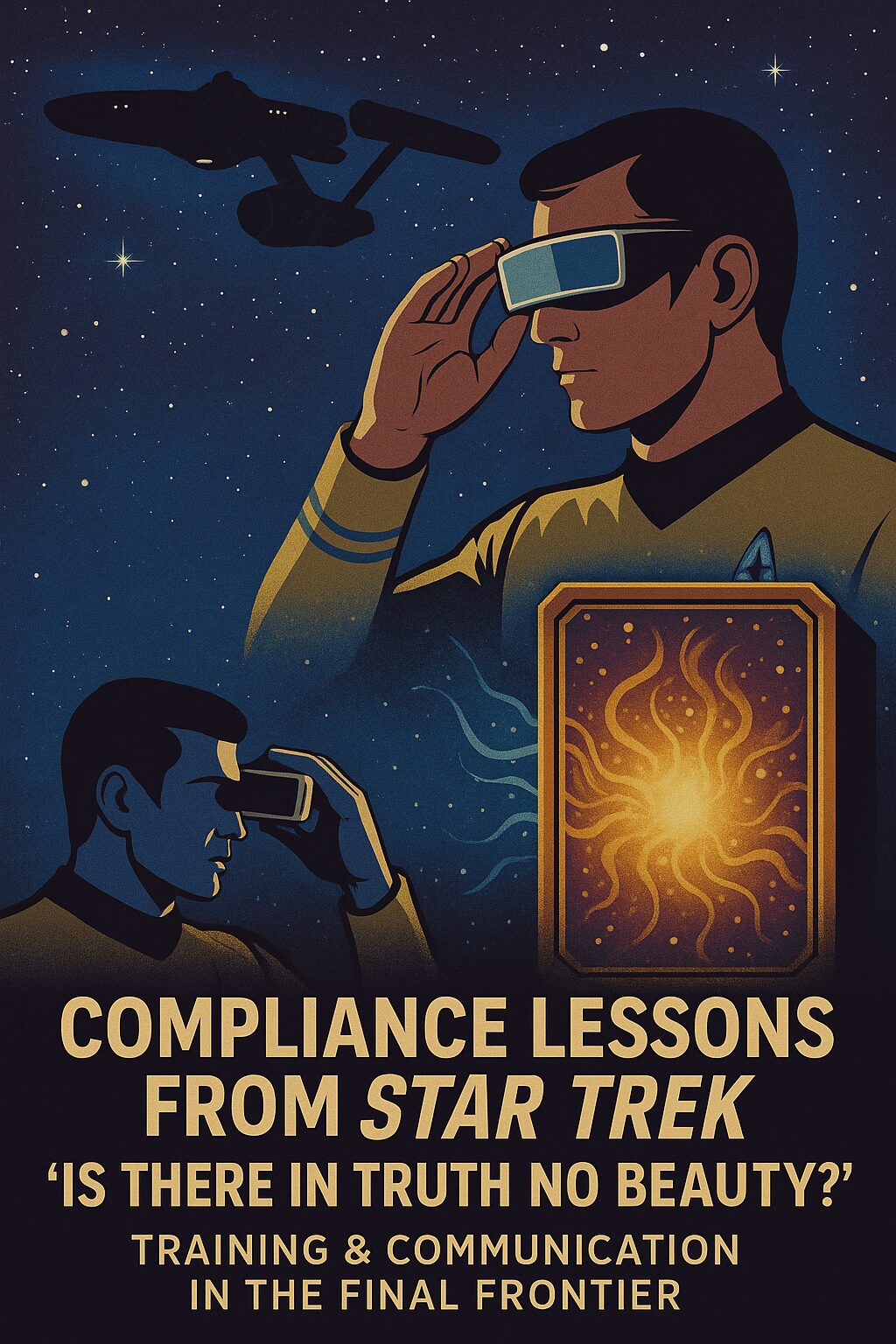
Set aboard the USS Enterprise, the episode revolves around the arrival of Dr. Miranda Jones and the enigmatic Medusan ambassador, Kollos. The Medusans are a race of beings whose appearance is so alien that to gaze upon them causes madness. It’s a parable about the dangers and necessity of confronting the unknown, understanding difference, and building bridges across divides.
As compliance professionals, we can mine “Is There in Truth No Beauty?” for powerful lessons on how to build a culture of effective training and communications that prepares our teams for the uncharted territory of tomorrow’s risks. Today, we set our phasers to “inspire” and explore five key compliance training and communications lessons from this classic Trek tale.
1. Embrace the Limits of Human (and Organizational) Perception
Illustrated By: The crew’s first briefing about the Medusan ambassador is laden with warnings: “No one may look upon a Medusan with the naked eye.” To the Medusan, human forms are equally incomprehensible, but they have developed technology, a protective visor, that allows safe interaction. Dr. Miranda Jones, specially trained and equipped, serves as a living bridge between the two species.
Compliance Lesson. Every organization has its own “Medusans” risks, regulations, and even people whose perspectives are so different they can seem incomprehensible. Too often, compliance training assumes everyone shares the same baseline understanding and comfort level. That is a dangerous assumption.
Your training must recognize the limits of perception, both cognitive and cultural. Not everyone will see risk the same way; not everyone will feel empowered to ask questions or speak up. Just as Dr. Jones brings specialized knowledge and equipment to the table, your compliance communications should equip employees with tools to recognize their blind spots and to bridge those gaps. This can mean scenario-based learning, peer-led discussions, or visual tools that help explain complex risks from multiple perspectives.
What should you do now? Acknowledge and proactively address the limits of human perception. Empower your team with adaptive tools and diverse viewpoints to “see” risk.
2. Communicate Expectations—Don’t Assume Understanding
Illustrated By: Early in the episode, Captain Kirk assembles his crew for a detailed briefing. He explicitly warns, “You must not look upon the Medusan ambassador.” Spock and Dr. Jones reinforce the message, and the procedures for safe interaction are laid out.
Compliance Lesson. How many compliance failures begin with, “Well, I thought I understood what was required…”? In Star Trek, lives depend on explicit, repeated communication of expectations. In your organization, regulatory and reputational survival depends on it as well.
Effective compliance training requires more than a one-time email or a paragraph in the handbook. Clear, repeated, scenario-based communication is essential. Explain the “why” as well as the “what.” Don’t just say “do not do X,” but explain the risk, the rationale, and the real-world consequences. Use multiple formats, including live, digital, visual, and narrative, to reinforce the message.
What should you do now? Never assume understanding. Communicate expectations explicitly and often, and use stories, scenarios, and repetition to anchor key messages.
3. Build Trust and Psychological Safety Before the Crisis
Illustrated By: The relationship between Dr. Jones and the crew is initially fraught. She is a telepath, guarded and secretive. Her sense of isolation is palpable. Yet as the episode progresses, Kirk and Spock earn her trust by inviting her into their confidence and acknowledging her unique expertise. This trust proves critical when disaster strikes.
Compliance Lesson. Effective communication is built on trust and psychological safety. If employees feel isolated, mistrusted, or afraid to speak up, no amount of “mandatory training” will make your compliance program effective. The Medusan can only safely interact through a trusted intermediary—just as employees will only engage with compliance if they feel respected and included.
Foster a compliance culture where people feel safe to voice concerns, ask questions, and share mistakes without fear of retaliation. Encourage managers to model vulnerability and openness. Use anonymous Q&A, “ask me anything” sessions, and real stories to build an environment of trust.
What should you do now? Trust is the engine of communication. Build psychological safety into your compliance training so that employees feel empowered to participate, especially when the stakes are high.
4. Prepare for the Unexpected—And Practice the Protocols
Illustrated By: When Kollos’s container is accidentally opened, crew member Larry Marvick is exposed to the Medusan and descends into madness, nearly destroying the Enterprise. The emergency procedures are put to the test, and Spock’s preparation (and his use of the protective visor) is the difference between disaster and survival.
Compliance Lesson. Crises never unfold according to plan, but they reveal the effectiveness of your training and protocols. Star Trek demonstrates that it’s not enough to have a policy in the binder; you must train, rehearse, and test those protocols until they are second nature.
Use tabletop exercises, drills, and “what if” scenarios in your compliance training. Walk teams through incident response steps—Debrief after near-misses or actual compliance failures. Emphasize not just the letter of the protocol, but the spirit, why each step matters, and how it protects the organization and its people.
What should you do now? Prepare, practice, and stress-test your compliance protocols. When the unthinkable happens, your team must be ready to act, not just recite policy, but live it.
5. Embrace Diversity—and the Value of the Outsider’s View
Illustrated By: The Medusan, Kollos, is physically incomprehensible to humans, yet he is also a being of great intelligence and empathy. Spock, uniquely Vulcan and human, can serve as a bridge—merging with Kollos to save the ship. In the process, both gain insight from the other’s perspective.
Compliance Lesson:
Homogeneity is a hidden compliance risk. Diverse teams bring broader perspectives, challenge assumptions, and spot blind spots that a monoculture would miss. In Star Trek, survival depends on learning from the outsider; in compliance, innovation, and vigilance depend on the same principle.
Include voices from across your organization and beyond in your compliance training and communications. Seek out the “outsiders” who can question the status quo. Value the contributions of people from different backgrounds, departments, and experiences. Remember: your “Medusan” might hold the key to your next compliance breakthrough.
What should you do now? Diversity is your compliance superpower. Embrace the outsider’s perspective and make inclusion a pillar of your training and communications.
Final ComplianceLog Reflections
“Is There in Truth No Beauty?” is a meditation on the limits of perception, the power of communication, and the necessity of embracing difference. For compliance professionals, it offers a road map for building training and communications programs that are clear, inclusive, practical, and resilient.
As you chart the course for your compliance initiatives, ask yourself:
- Are we equipping our people to see risk from every angle?
- Do we communicate expectations, repeatedly, and meaningfully?
- Is trust the foundation of our compliance culture?
- Are we truly ready for the unexpected?
- Are we harnessing the power of diverse perspectives?
The universe of compliance is ever-expanding. Let’s train and communicate so our teams are ready to boldly go where no one has gone before.
Resources:
Excruciatingly Detailed Plot Summary by Eric W. Weisstein