Categories
Innovation in Compliance

Innovation in Compliance – Constructive Conversations: Insights with Nina Sunday

Innovation comes in many areas, and compliance professionals need to be ready for it and embrace it. Join Tom Fox, the Voice of Compliance, as he visits with top innovative minds, thinkers, and creators in the award-winning Innovation in Compliance podcast. In this episode, host Tom Fox is joined by Nina Sunday, a podcaster, author, and speaker, to discuss the nuances of difficult conversations and leadership.

Nina shares her experiences and insights from her podcast ‘Manage Self, Lead Others,’ which has been running for six years. She elaborates on her career transition from teaching and film production to training and self-employment. Nina also introduces her new book based on her podcast and discusses effective conversation techniques, including using non-threatening language openings. She advocates for a learning culture within organizations and speaks about the importance of middle managers in fostering a productive and innovative work environment. The episode concludes with information on how to connect with Nina and access her various works.

Key highlights:

  • Nina Sunday’s Podcast Journey
  • Exploring Difficult Conversations
  • Nina’s Professional Background
  • Middle Management Challenges
  • Effective Communication Techniques
  • The Role of Vulnerability in Leadership
  • Developing Future Leaders
  • Utilizing Podcasts for Business Growth

Resources:

Visit Nina Sunday’s Website

Brain Power Training

Substack

New Book: Manage Self, Lead Others: Constructive Conversations, True Self Leadership and Culture You Can’t Fake on Amazon

Follow Nina Sunday on:

Facebook

LinkedIn

C-Suite Radio

C-Suite TV

Grab Nina Sunday’s book on Amazon

Tom Fox

Instagram

Facebook

YouTube

Twitter

LinkedIn

Categories
Trekking Through Compliance

Trekking Through Compliance: Episode 66 – The Human Element in Compliance: CCO Takeaways from ‘The Empath’

Today we set a course for one of Star Trek: The Original Series’ most underrated yet profound episodes: “The Empath.” As compliance professionals, we know that the heart of any effective compliance program is its leadership. The Hallmarks of an Effective Compliance Program, from the FCPA Resource Guide, 2nd edition, require that the CCO possess the “appropriate expertise” to do the job. But what does that mean, and how does a leader’s expertise transcend mere technical skill to encompass the human, ethical, and cultural challenges inherent to the compliance function?

As we explore five critical lessons for compliance officers from “The Empath,” you will observe that true expertise for a CCO is not simply about credentials or technical know-how; rather, it is about the deeper qualities that empower a leader to guide organizations through pain, ambiguity, and risk.

1. Beyond the Resume: The CCO as Empathic Leader

Illustrated By: Gem learns not through technical means, but by direct connection and deep feeling.

Compliance Lesson. Expertise is more than certifications, legal degrees, or audit experience. The most effective CCOs bring an “empathic intelligence” to their work, a capacity to understand the pressures, fears, and motivations of employees at all levels.

2. Courage Under Pressure: The CCO Must Withstand the Ultimate Test

Illustrated By: The episode asks, who dares to stand up, even when it hurts?

Compliance Lesson. CCO expertise is proven under fire. This means the ability to stand firm when pressured by powerful business leaders, to deliver hard truths to the Board, and to make unpopular recommendations in the face of potential personal or professional blowback.

3. Interdisciplinary Skillset: Bridging Science and Compassion

Illustrated By: The Enterprise officers combine analytical thinking with compassion, helping Gem grow by demonstrating both logic and heart.

Compliance Lesson. A truly effective CCO integrates hard skills with the “soft skills” of persuasion, relationship-building, and cultural sensitivity.

4. The Power of Sacrifice: Prioritizing the Mission Over Personal Gain

Illustrated By: McCoy’s selflessness teaches Gem that true empathy means accepting risk for the sake of others’ well-being.

Compliance Lesson. The CCO role demands a willingness to prioritize the organization’s long-term health, even when it may come at the cost of short-term popularity or personal advancement.

5. Teaching and Transforming: The CCO as Culture Carrier

Illustrated By: By the episode’s conclusion, Gem is transformed by the example set by the Enterprise crew. She learns to act, not just to feel, demonstrating that real change comes from both internalizing values and taking decisive action.

Compliance Lesson. A CCO’s expertise is measured not only in what they know but also in how effectively they teach, mentor, and shape the organization’s culture—the enterprise.

Final ComplianceLog Reflections

The Empath” reminds us that leadership in compliance, like leadership in the Enterprise, requires more than technical skill. It requires empathy, courage, interdisciplinary knowledge, sacrifice, and the ability to teach and inspire. The DOJ’s Hallmarks of an Effective Compliance Program make it clear: a CCO must have the appropriate expertise to do the job, and that expertise is as much about the heart as the head.

In evaluating, supporting, or stepping into the CCO role, remember Gem’s journey. The greatest expertise lies not only in knowing the rules but in living them and in helping others do the same, especially when the path is hard. Empathic leadership is not a luxury; it is a requirement for building compliance programs that endure.

Resources:

⁠⁠Excruciatingly Detailed Plot Summary by Eric W. Weisstein⁠⁠

⁠⁠MissionLogPodcast.com⁠⁠

⁠⁠Memory Alpha

Categories
Trekking Through Compliance

Trekking Through Compliance: Episode 57 – Leadership & Tone from the Top Lessons from “The Paradise Syndrome”

Few Star Trek episodes put Captain Kirk in as vulnerable or as revealing a position as “The Paradise Syndrome.” What begins as a routine mission to deflect an asteroid from a primitive planet spirals down into an exploration of leadership, identity, and the power of influence from the very top. For corporate compliance professionals, this story is a masterclass in how tone from the top and authentic leadership can either protect or imperil an entire organization.

Join me as we step through the wormhole and extract five vital leadership lessons for the modern compliance officer, each illustrated by scenes from this unforgettable episode.

1. Leadership Presence Is the First Line of Defense

Illustrated By:  As soon as Kirk disappears, Spock and McCoy sense something is amiss. The crew is uneasy, decision-making becomes muddled, and a lack of clear command amplifies the mission’s urgency.

Compliance Lesson: The tone set by leadership isn’t just about lofty statements or annual memos. It’s a daily, lived presence.

2. Values Must Be Internalized, Not Just Announced

Illustrated By: Despite not knowing who he is, Kirk’s instincts for fairness, curiosity, and protection shine through. He becomes a leader not by decree, but by action.

Compliance Lesson: True leadership is more than titles and speeches; it’s about internalized values that guide decisions, even under stress or uncertainty. Kirk’s ethical compass survives amnesia because it’s part of who he is.

3. Crisis Reveals the True Tone from the Top

Illustrated By: Spock makes tough, sometimes unpopular decisions, including pushing the engines to dangerous limits.

Compliance Lesson: In a crisis, all eyes turn to leadership. How leaders act or fail to act under stress defines the tone from the top far more than any code of conduct. Spock’s resolve and willingness to make hard choices keep the crew focused on their mission, even as doubt and tension rise.

4. Empathy and Communication Sustain Compliance

Illustrated By: While among the villagers, Kirk forms relationships based on empathy and service.

Compliance Lesson: Leadership is not just about command; it is about connection. In compliance, the ability to listen, understand, and respond to concerns is just as important as issuing directives. Empathy builds credibility and encourages a culture of speaking up, especially during times of change.

5. Sustainable Culture Requires Both Structure and Spirit

Illustrated By: When Kirk finally regains his memory and identity, he is torn between his love for Miramanee and his duty to the Enterprise.

Compliance Lesson: Tone from the top is sustained not just by systems and controls, but by the personal commitment of leaders to do what’s right, even when it’s difficult. The spirit of compliance must be aligned with the structure of compliance; one without the other is incomplete.

Final ComplianceLog Reflections

The Paradise Syndrome” is a cautionary tale and an inspiration. When leadership vanishes, even temporarily, an organization’s values, direction, and resilience are put to the test. Kirk’s journey reminds us that leadership is not just about the title on the door but about daily actions, internalized values, and the ability to connect authentically with those you lead.

Resources:

⁠⁠Excruciatingly Detailed Plot Summary by Eric W. Weisstein⁠⁠

⁠⁠MissionLogPodcast.com⁠⁠

⁠⁠Memory Alpha

Categories
Blog

Lost Among the Stars: Leadership & Tone from the Top Lessons from Star Trek’s “The Paradise Syndrome”

Few Star Trek episodes put Captain Kirk in as vulnerable or as revealing a position as “The Paradise Syndrome.” What begins as a routine mission to deflect an asteroid from a primitive planet spirals down into an exploration of leadership, identity, and the power of influence from the very top. For corporate compliance professionals, this story is a masterclass in how tone from the top and authentic leadership can either protect or imperil an entire organization.

In “The Paradise Syndrome,” the Enterprise crew is faced not only with a ticking clock but also with the absence of their leader. As Kirk loses his memory and is separated from his command, Spock, McCoy, and the rest must navigate the crisis without the guiding presence that usually sets the tone. What unfolds is a powerful lesson in why leadership and the values it projects matter more than any written policy or technology.

With Kirk’s leadership removed at the most critical moment, we see the cascading impact on the crew, on the planet, and on Kirk himself. This scenario, while fantastical, is a perfect metaphor for what happens in organizations when the tone from the top is unclear, inconsistent, or simply absent.

Join me as we step through the wormhole and extract five vital leadership lessons for the modern compliance officer, each illustrated by scenes from this unforgettable episode.

Leadership Presence Is the First Line of Defense

Illustrated By: As soon as Kirk disappears, Spock and McCoy sense something is amiss. The crew is uneasy, decision-making becomes muddled, and a lack of clear command amplifies the mission’s urgency.

Compliance Lesson: The tone set by leadership isn’t just about lofty statements or annual memos. It’s a daily, lived presence. When leadership is visible, engaged, and available, the organization operates with clarity and confidence. When it is absent, even for a short time, uncertainty fills the vacuum, and risk increases.

What should I do? For compliance professionals, this means that leadership must be front and center, not just when things go wrong, but in the rhythms of daily business. Leaders should participate in training, be present in investigations, and visibly support the compliance function. A leader’s consistent presence sends the strongest possible message: compliance matters here.

Values Must Be Internalized, Not Just Announced

Illustrated By: Stripped of his memory, Kirk (as “Kirok”) is taken in by the planet’s people. Despite not knowing who he is, his instincts for fairness, curiosity, and protection shine through. He becomes a leader not by decree, but by action.

Compliance Lesson: True leadership is more than titles and speeches; it’s about internalized values that guide decisions, even under stress or uncertainty. Kirk’s ethical compass survives amnesia because it’s part of who he is.

What should I do? Corporate values, particularly those related to ethics and compliance, must be deeply ingrained in the organization. Training and messaging must move beyond checklists to foster genuine understanding and belief. When faced with unexpected challenges or moral dilemmas, employees should be able to act based on these internalized values, even if the “playbook” is missing. Compliance professionals should focus on culture-building, rather than just disseminating policies.

Crisis Reveals the True Tone from the Top

Illustrated By: Spock, now in command, faces a daunting technical challenge with limited time and resources. He makes tough, sometimes unpopular decisions, including pushing the engines to dangerous limits. McCoy protests, but Spock remains steadfast, demonstrating calm under pressure.

Compliance Lesson: In a crisis, all eyes turn to leadership. How leaders act or fail to act under stress defines the tone from the top far more than any code of conduct. Spock’s resolve and willingness to make hard choices keep the crew focused on their mission, even as doubt and tension rise.

What should I do? Compliance leaders should prepare for the inevitable crisis by building trust, communicating transparently, and showing willingness to take responsibility. When employees see leadership confronting difficulties head-on, they are more likely to follow suit. Tabletop exercises and crisis simulations should always include a tone-from-the-top component. How will leadership communicate? How will they reinforce values under pressure?

Empathy and Communication Sustain Compliance

Illustrated By: While among the villagers, Kirk forms relationships based on empathy and service. He marries Miramanee, helps heal a sick child, and supports his new community. Even without his identity, he inspires trust because of the way he listens and responds to those around him.

Compliance Lesson: Leadership is not just about command; it is about connection. In compliance, the ability to listen, understand, and respond to concerns is just as important as issuing directives. Empathy fosters credibility and promotes a culture of speaking up, particularly during times of change.

What should I do? Compliance officers should foster open-door environments where employees feel comfortable sharing concerns and asking questions. Leaders should model humility and emotional intelligence, admitting when they don’t have all the answers. In the modern workplace, psychological safety is an essential component of tone from the top.

Sustainable Culture Requires Both Structure and Spirit

Illustrated By: When Kirk finally regains his memory and identity, he is torn between his love for Miramanee and his duty to the Enterprise. The heartbreak of leaving behind his new life underscores that authentic leadership often requires personal sacrifice for the greater good.

Compliance Lesson: Tone from the top is sustained not just by systems and controls, but by the personal commitment of leaders to do what’s right, even when it’s difficult. The spirit of compliance must be aligned with the structure of compliance; one without the other is incomplete.

What should I do? Senior leaders and compliance professionals must demonstrate their commitment through both words and deeds. This may involve making tough decisions, investing resources, or prioritizing compliance over short-term gains. By modeling this balance, leadership sets the foundation for a culture that endures, regardless of who is at the helm.

Final ComplianceLog Reflections

“The Paradise Syndrome” is a cautionary tale and an inspiration. When leadership vanishes, even temporarily, an organization’s values, direction, and resilience are put to the test. Kirk’s journey reminds us that leadership is not just about the title on the door but about daily actions, internalized values, and the ability to connect authentically with those you lead. By embracing these lessons, compliance officers and business leaders alike can build organizations that thrive not just in paradise but in any storm the universe throws their way.

Resources:

⁠⁠Excruciatingly Detailed Plot Summary by Eric W. Weisstein⁠⁠

⁠⁠MissionLogPodcast.com⁠⁠

⁠⁠Memory Alpha

Categories
Trekking Through Compliance

Trekking Through Compliance: Episode 42 – Objectivity Under Fire: What “Obsession” Teaches Compliance Leaders

In the world of corporate compliance, the most challenging issues are often not the ones found in policies and procedures but the ones that hit close to home. When an investigation, a potential violation, or a risk becomes personal, even the most seasoned compliance professionals can struggle to maintain objectivity, leadership, and ethical clarity.

No episode of Star Trek: The Original Series captures this dilemma more powerfully than “Obsession.” Today, we have five key leadership lessons for compliance professionals, each illustrated by a scene from this classic episode.

Lesson 1: The Danger of Letting Past Failures Drive Present Decisions

Illustrated By:  Early in “Obsession,” Captain Kirk becomes fixated on the mysterious cloud-creature, which he encountered as a young officer. He blames himself for not destroying it years ago, feeling responsible for the deaths of his former crewmates. This guilt clouds his judgment and causes him to pursue the creature at the expense of his current mission and crew.

Compliance Lesson: It is natural for past failures or unresolved issues to haunt compliance professionals, whether it is a missed red flag, a mishandled investigation, or a colleague’s misconduct that slipped through the cracks. However, leadership means acknowledging these feelings without letting them dictate current actions. Fixating on the past can compromise your objectivity, impair decision-making, and erode team trust.

Create a structured debrief process after investigations and audits, encouraging candid discussions of lessons learned—but draw a clear line between healthy reflection and self-blame. If you notice yourself or a colleague ruminating on a past failure, seek outside perspective from a mentor or coach.

Lesson 2: Beware of Conflicts Between Personal Motivations and Organizational Mission

Illustrated By: The pursuit of the creature leads him to override the advice of Spock and McCoy, risking a critical rendezvous with the USS Yorktown, which is carrying vital medical supplies. His vendetta threatens to derail the Enterprise’s primary mission and put others at risk.

Compliance Lesson: Personal motivations, even those rooted in a sense of justice or accountability, can create conflicts with the organization’s broader mission. For compliance leaders, it’s essential to recognize when personal feelings, loyalties, or ambitions are at odds with what’s best for the company, stakeholders, or compliance program as a whole.

Regularly revisit your program’s core mission and values. Before making significant decisions, pause to ask: “Am I doing this for the right reasons? Is this truly about compliance and ethics, or is my agenda creeping in?” Encourage a culture of peer challenge, where team members can safely question each other’s motivations in high-stakes situations.

Lesson 3: Listen to Your Team—Even When You Disagree

Illustrated By: Throughout the episode, Spock, McCoy, and other crew members challenge Kirk’s judgment, pointing out the risks of his obsession. Kirk initially rebuffs their advice, convinced that only he understands the threat. It is only when he finally listens to his officers that he can devise an effective plan to confront the creature.

Compliance Lesson: Leadership in compliance is not about always being right; rather, it is about fostering a culture where diverse perspectives are welcomed, especially when an issue becomes personal. Leaders must actively seek and value dissenting opinions and be open to changing course based on credible advice, even if it stings.

During high-stress or personal cases, explicitly ask your team for feedback and alternative viewpoints. Consider creating “devil’s advocate” roles in investigations and setting ground rules that ensure even junior team members can raise concerns without fear of reprisal.

Lesson 4: Maintain Professional Distance—Don’t Let Emotions Overwhelm Ethics

Illustrated By: Kirk’s obsession nearly leads him to take unnecessary risks, endangering himself and his crew. His emotional investment clouds his judgment, and he pushes past reasonable boundaries in pursuit of what he believes is justice. Only when he regains his professional composure does he successfully lead his crew to resolve the crisis.

Compliance Lesson: When issues become personal, whether due to relationships, past failures, or high stakes, it is easy for emotions to override ethics and professionalism. Compliance leaders must learn to recognize when they are too close to a situation and take deliberate steps to regain perspective.

Build time for reflection into your workflow, especially during emotionally charged investigations. When possible, delegate or recuse yourself from cases where you cannot maintain impartiality. Seek support from trusted colleagues or external advisors to help you keep perspective and objectivity.

Lesson 5: The Power of Accountability—Owning Up to Mistakes and Moving Forward

Illustrated By: At the episode’s conclusion, Kirk reflects on his actions with McCoy, admitting that his personal feelings clouded his judgment and nearly led to disaster. He doesn’t make excuses but owns up to his mistakes and takes the lessons to heart, recommitting himself to his duty as captain.

Compliance Lesson: True leadership is not about perfection, but about accountability. When personal issues intrude and mistakes are made, the best compliance leaders acknowledge their errors, communicate them transparently, and model a commitment to continuous improvement. This builds credibility, trust, and resilience within the team and across the organization.

Foster a culture of accountability at all levels. After challenging cases, hold post-mortems to identify both successes and failures, and publicly recognize leaders and team members who model accountability. Use mistakes as learning opportunities, not sources of shame.

Final ComplianceLog Reflections

“Obsession” stands as a reminder that even the best leaders are vulnerable when the stakes become personal. But it also shows the power of self-awareness, teamwork, and accountability to bring us back to our best selves. For compliance professionals, the message is clear: We must learn to recognize when our history, emotions, or motivations are shaping our decisions; then pause, reflect, and act by our values and mission.

By encouraging diverse viewpoints, maintaining professional boundaries, and owning our mistakes, we can transform moments of personal challenge into opportunities for growth and organizational strength. That is the essence of ethical leadership in compliance.

So, as you navigate your next difficult investigation or compliance challenge, especially the one that hits close to home, remember Kirk’s journey. Do not shy away from what is personal. Embrace it, learn from it, and lead with courage, humility, and integrity.

  Resources:

Excruciatingly Detailed Plot Summary by Eric W. Weisstein

MissionLogPodcast.com

Memory Alpha

Categories
Blog

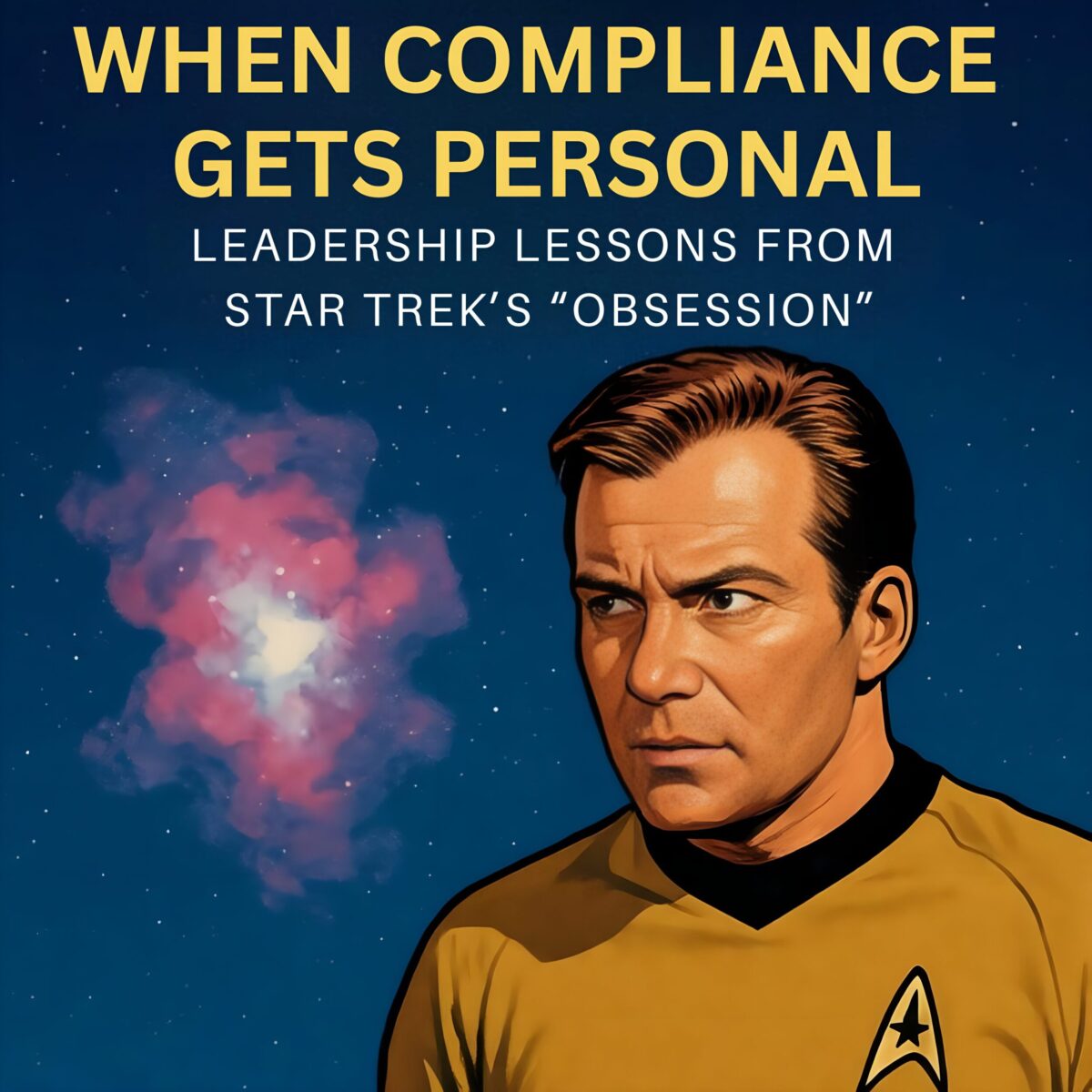
When Compliance Gets Personal: Leadership Lessons from Star Trek’s “Obsession”

In the world of corporate compliance, the most challenging issues are often not the ones found in policies and procedures but the ones that hit close to home. When an investigation, a potential violation, or a risk becomes personal, even the most seasoned compliance professionals can struggle to maintain objectivity, leadership, and ethical clarity.

No episode of Star Trek: The Original Series captures this dilemma more powerfully than “Obsession.” Captain Kirk finds himself battling a deadly cloud-like creature that once decimated his former crew. His pursuit becomes a personal vendetta, blurring the lines between duty and obsession. For compliance professionals, “Obsession” offers a vivid cautionary tale about the dangers and the growth opportunities when leadership gets personal.

Here are five key leadership lessons for compliance professionals, each illustrated by a scene from this classic episode.

Lesson 1: The Danger of Letting Past Failures Drive Present Decisions

Illustrated By:  Early in “Obsession,” Captain Kirk becomes fixated on the mysterious cloud-creature, which he encountered as a young officer. He blames himself for not destroying it years ago, feeling responsible for the deaths of his former crewmates. This guilt clouds his judgment and causes him to pursue the creature at the expense of his current mission and crew.

Compliance Lesson: It is natural for past failures or unresolved issues to haunt compliance professionals, whether it is a missed red flag, a mishandled investigation, or a colleague’s misconduct that slipped through the cracks. However, leadership means acknowledging these feelings without letting them dictate current actions. Fixating on the past can compromise your objectivity, impair decision-making, and erode team trust.

Create a structured debrief process after investigations and audits, encouraging candid discussions of lessons learned—but draw a clear line between healthy reflection and self-blame. If you notice yourself or a colleague ruminating on a past failure, seek outside perspective from a mentor or coach.

Lesson 2: Beware of Conflicts Between Personal Motivations and Organizational Mission

Illustrated By: The pursuit of the creature leads him to override the advice of Spock and McCoy, risking a critical rendezvous with the USS Yorktown, which is carrying vital medical supplies. His vendetta threatens to derail the Enterprise’s primary mission and put others at risk.

Compliance Lesson: Personal motivations, even those rooted in a sense of justice or accountability, can create conflicts with the organization’s broader mission. For compliance leaders, it’s essential to recognize when personal feelings, loyalties, or ambitions are at odds with what’s best for the company, stakeholders, or compliance program as a whole.

Regularly revisit your program’s core mission and values. Before making significant decisions, pause to ask: “Am I doing this for the right reasons? Is this truly about compliance and ethics, or is my agenda creeping in?” Encourage a culture of peer challenge, where team members can safely question each other’s motivations in high-stakes situations.

Lesson 3: Listen to Your Team—Even When You Disagree

Illustrated By: Throughout the episode, Spock, McCoy, and other crew members challenge Kirk’s judgment, pointing out the risks of his obsession. Kirk initially rebuffs their advice, convinced that only he understands the threat. It is only when he finally listens to his officers that he can devise an effective plan to confront the creature.

Compliance Lesson: Leadership in compliance is not about always being right; rather, it is about fostering a culture where diverse perspectives are welcomed, especially when an issue becomes personal. Leaders must actively seek and value dissenting opinions and be open to changing course based on credible advice, even if it stings.

During high-stress or personal cases, explicitly ask your team for feedback and alternative viewpoints. Consider creating “devil’s advocate” roles in investigations and setting ground rules that ensure even junior team members can raise concerns without fear of reprisal.

Lesson 4: Maintain Professional Distance—Don’t Let Emotions Overwhelm Ethics

Illustrated By: Kirk’s obsession nearly leads him to take unnecessary risks, endangering himself and his crew. His emotional investment clouds his judgment, and he pushes past reasonable boundaries in pursuit of what he believes is justice. Only when he regains his professional composure does he successfully lead his crew to resolve the crisis.

Compliance Lesson: When issues become personal, whether due to relationships, past failures, or high stakes, it is easy for emotions to override ethics and professionalism. Compliance leaders must learn to recognize when they are too close to a situation and take deliberate steps to regain perspective.

Build time for reflection into your workflow, especially during emotionally charged investigations. When possible, delegate or recuse yourself from cases where you cannot maintain impartiality. Seek support from trusted colleagues or external advisors to help you keep perspective and objectivity.

Lesson 5: The Power of Accountability—Owning Up to Mistakes and Moving Forward

Illustrated By: At the episode’s conclusion, Kirk reflects on his actions with McCoy, admitting that his personal feelings clouded his judgment and nearly led to disaster. He doesn’t make excuses but owns up to his mistakes and takes the lessons to heart, recommitting himself to his duty as captain.

Compliance Lesson: True leadership is not about perfection, but about accountability. When personal issues intrude and mistakes are made, the best compliance leaders acknowledge their errors, communicate them transparently, and model a commitment to continuous improvement. This builds credibility, trust, and resilience within the team and across the organization.

Foster a culture of accountability at all levels. After challenging cases, hold post-mortems to identify both successes and failures, and publicly recognize leaders and team members who model accountability. Use mistakes as learning opportunities, not sources of shame.

Final ComplianceLog Reflections

“Obsession” stands as a reminder that even the best leaders are vulnerable when the stakes become personal. But it also shows the power of self-awareness, teamwork, and accountability to bring us back to our best selves. For compliance professionals, the message is clear: We must learn to recognize when our history, emotions, or motivations are shaping our decisions; then pause, reflect, and act by our values and mission.

By encouraging diverse viewpoints, maintaining professional boundaries, and owning our mistakes, we can transform moments of personal challenge into opportunities for growth and organizational strength. That is the essence of ethical leadership in compliance.

So, as you navigate your next difficult investigation or compliance challenge, especially the one that hits close to home, remember Kirk’s journey. Do not shy away from what is personal. Embrace it, learn from it, and lead with courage, humility, and integrity.

  Resources:

Excruciatingly Detailed Plot Summary by Eric W. Weisstein

MissionLogPodcast.com

Memory Alpha

Categories
Trekking Through Compliance

Trekking Through Compliance – Episode 41 – Duty Over Ego: Leadership Change in “The Deadly Years”

If you have spent any time in leadership, especially in compliance or corporate governance, you know that one of the most gut-wrenching duties is addressing a colleague who can no longer fulfill their responsibilities. Today, we step onto the bridge and examine five ethical lessons for compliance professionals faced with these hard but necessary transitions. Each lesson is illustrated by a specific scene from “The Deadly Years.”

Lesson 1: Recognize the Signs—Objectivity Must Trump Sentiment

Illustrated By:  Early in the episode, the landing party is exposed to a form of radiation that accelerates aging. Captain Kirk, Spock, Scotty, and others quickly show signs of physical and cognitive decline. Kirk, in particular, becomes forgetful and indecisive, missing important details and even failing to recall security procedures.

Compliance Lessons: The first ethical responsibility is to recognize, without sentiment or denial, when a colleague can no longer perform. Whether due to age, health, burnout, or changing business demands, the signs must be identified early, not ignored out of deference to history or personal loyalty.

Implement regular, objective performance reviews and peer assessments. Train managers to look for early indicators of declining performance, especially in high-stress or high-responsibility roles, and provide pathways for safe, supportive reporting.

Lesson 2: Prioritize Mission and Stakeholders—Not Individual Status

Illustrated By:  As Kirk’s abilities deteriorate, the safety of the Enterprise is jeopardized. He hesitates during a Romulan encounter and issues conflicting orders, putting the crew at risk. Spock and Dr. McCoy discuss his decline, acknowledging their concern for their friend but focusing on the danger to the mission.

Compliance Lesson: An organization’s purpose, stakeholders, and people must come before individual egos or career legacies. Ethical leadership means putting the mission first, even when that requires difficult conversations or unpopular actions. This is especially critical in compliance, where risks can have enterprise-wide impacts.

Make mission-driven decision-making a core value in your compliance program. Regularly communicate that the integrity of the enterprise outweighs personal status. Ensure that all leaders, from the C-suite to middle management, understand that their primary obligation is to the organization and its stakeholders.

Lesson 3: Fair, Transparent Processes Protect All Involved

Illustrated By: When the decline in Kirk’s performance can no longer be denied, Spock and Dr. McCoy convene a competency hearing. The tribunal includes multiple voices and follows Starfleet protocol, providing Kirk with a chance to respond and present evidence on his behalf.

Compliance Lesson: No transition or removal, no matter how justified, should be handled arbitrarily or in secret. Transparent, fair, and standardized processes ensure that all parties are treated with dignity and the organization’s decisions are defensible. Above all is dignity. This approach also protects against accusations of favoritism, discrimination, or retaliation.

Document and publish clear protocols for performance-related transitions. Involve impartial parties in any review. Make sure employees understand their rights, the procedures, and the grounds on which decisions are made.

Lesson 4: Compassion Matters—Even When Delivering Hard News

Illustrated By: After the tribunal, Kirk is relieved of command. The process is formal, but the crew treats Kirk with respect and compassion, recognizing his service and the pain of the moment. No one revels in the transition or diminishes Kirk’s contributions.

Compliance Lesson: Delivering tough messages, especially about the need to move on, can be done with empathy and grace. Recognizing the individual’s service, offering support, and helping with a dignified transition isn’t just “nice”; rather, it should be seen as an ethically necessary. How you handle these moments sets the tone for your organization’s values and can even inspire long-term loyalty and goodwill.

Train managers and HR in compassionate communication. Offer support such as career counseling, retirement planning, or mental health resources to those transitioning. Celebrate achievements and acknowledge contributions, even as you move forward.

Lesson 5: The Right Transition Can Save the Mission

Illustrated By:  With Kirk relieved, Commodore Stocker takes command but quickly demonstrates a lack of field experience, putting the ship in further jeopardy. Meanwhile, Dr. McCoy and Spock race against time to find a cure for the aging disease. Once Kirk is restored to health, he returns to command, draws on his experience and instincts, and saves the Enterprise from destruction.

Compliance Lesson: Transitioning a colleague should never be punitive or personal; it’s about restoring the organization to its highest level of functioning. Sometimes, this means moving a leader aside temporarily until they can return or helping someone find a better fit for their abilities. The right person, in the proper role, at the right time, is critical for compliance and organizational health.

Build flexibility into your transition policies. Consider temporary reassignments, sabbaticals, or other options before a final separation. Always keep the focus on what’s best for the mission, the team, and the individual.

Final ComplianceLog Reflections

No compliance professional relishes the moment when a valued colleague must be asked to step aside. But “The Deadly Years” reminds us that the greatest danger lies not in transition, but in denial, sentimentality, or failure to act. As Kirk, Spock, and McCoy demonstrate, the hard path, handled with fairness, transparency, dignity, and compassion, is always the ethical path.

For compliance professionals, this means being vigilant for declining performance, putting mission first, insisting on fair and transparent processes, and consistently delivering hard news with empathy. It also means recognizing that transition is sometimes temporary and, with the proper support, colleagues can return, renewed and ready for new challenges.

As organizations face the “deadly years” of rapid change, new risks, and mounting expectations, may we all steer our ships with courage, wisdom, and integrity, ensuring that the right people are at the helm, for the good of all.

 Resources:

Excruciatingly Detailed Plot Summary by Eric W. Weisstein

MissionLogPodcast.com

Memory Alpha

Categories
Hill Country Hustlers

Hill Country Hustlers: From Oaxaca to Hill Country: Jorge Salinas’ Journey in Youth Soccer Coaching

In this episode of the Hill Country Hustlers podcast, host Zachary Green interviews Jorge Salinas, an entrepreneur and youth soccer coach. Originally from Oaxaca, Mexico, Jorge shares his journey from immigrating to the United States with his mother to settling in the Hill Country and eventually thriving as a soccer coach. Despite numerous challenges and setbacks, Jorge highlights the importance of perseverance, community support, and staying true to one’s passion. He discusses the development of Vida Es Futbol, his soccer training program, and the significance of indoor soccer in youth development. The conversation emphasizes the importance of honesty, effective communication, and their impact on children’s lives as key elements of success.

Key highlights:

  • Inspirational Journey Highlights
  • Coaching & Leadership Impact
  • Family, Faith & Values
  • Community Building & Legacy
  • Overcoming Odds & Taking Initiative

Resources:

Zach Green on LinkedIn

Jorge Salinas on LinkedIn

Categories
Innovation in Compliance

Innovation in Compliance: Maximizing LinkedIn for Personal and Professional Branding with Carol Kaemmerer

Innovation is present in many areas, and compliance professionals must not only be prepared for it but also actively embrace it. Join Tom Fox, the Voice of Compliance, as he visits with top innovative minds, thinkers, and creators in the award-winning Innovation in Compliance podcast. In this episode, host Tom Fox visits with Carol Kaemmerer, a renowned executive branding expert and author of ‘LinkedIn for the Savvy Executive.’

Carol shares her professional journey, from marketing communications expert to LinkedIn branding specialist. They discuss the significance of LinkedIn in today’s digital landscape, focusing on its role in establishing a professional brand, the importance of a deliberate and cohesive personal brand, and effective strategies for leveraging LinkedIn’s digital presence. Carol also elaborates on her five-point LinkedIn Brilliance Framework and the ‘rule of three’ to enhance clarity and retention of personal branding messages. This insightful conversation highlights how professionals, particularly young graduates and executives, can utilize LinkedIn to improve their careers and individual brands.

Key highlights:

  • The Power of LinkedIn for Branding
  • Personal Branding for Young Professionals
  • LinkedIn as a Professional Storefront
  • The Rule of Three for Effective Messaging
  • Maximizing LinkedIn’s Digital Real Estate
  • The LinkedIn Brilliance Framework

Resources:

Carol Kaemmerer on  LinkedIn

Carol Kaemmerer Website

 Tom Fox

Instagram

Facebook

YouTube

Twitter

LinkedIn

Categories
Trekking Through Compliance

Trekking Through Compliance: Episode 34 – Ethical Insights from the “The Apple”

One of the most rewarding experiences for a compliance professional is identifying ethics and integrity lessons in seemingly unrelated fields, especially in unexpected places, such as the far reaches of space, as depicted in the classic “Star Trek: The Original Series” episode “The Apple.” This imaginative story about the crew’s encounter with a seemingly idyllic but oppressive paradise, Vaal, offers powerful ethical lessons highly relevant to corporate compliance professionals today.

Lesson 1: The Dangers of Blind Obedience—Questioning Authority Matters

Illustrated By: The opening scenes of “The Apple” find Captain Kirk and his crew on Gamma Trianguli VI, a world that appears lush, tranquil, and perfect. However, it quickly becomes evident that the inhabitants’ peaceful existence depends entirely upon their blind obedience to the godlike entity Vaal. 

Compliance Lesson. In corporate compliance, this situation mirrors employees blindly following directives without exercising independent judgment or ethical scrutiny. 

Lesson 2: The Illusion of Benevolent Dictatorship—Long-term Harm from Short-term Convenience

Illustrated by Vaal, the natives are provided for, ensuring they never have to struggle or face uncertainty. While seemingly kind and protective, this arrangement ultimately stifles growth, curiosity, and development. 

Compliance Lesson. For organizations, relying on a centralized, overly controlling compliance or management structure can similarly produce unintended negative consequences. 

Lesson 3: Transparency and Communication Are Crucial—The Pitfalls of Hidden Controls

Illustrated By: A critical ethical issue in “The Apple” is the hidden mechanism of control maintained by Vaal. 

Compliance Lesson. Transparency and open communication are equally essential in a compliance context. A company that hides critical facts or maintains opaque operational practices places itself at considerable risk of ethical failures. 

Lesson 4: Cultivating Ethical Independence—Empowering Employees to Make Ethical Choices

Illustrated by: In one particularly illuminating scene, Kirk and Spock realize the villagers have no concept of making personal decisions. They have never had to confront moral or ethical dilemmas because Vaal dictates every aspect of their lives. 

Compliance Lesson. Corporations that over-regulate or excessively constrain ethical discretion similarly create a workforce that is incapable of making independent ethical decisions. 

Lesson 5: Consequences of Disrupting Status Quo—Planning for Ethical and Cultural Change

Illustrated By: At the episode’s conclusion, Kirk disables Vaal, freeing the planet’s inhabitants. This sudden transition underscores a critical compliance insight: ethical and cultural shifts demand thorough preparation and intentional transition management.

Compliance Lesson. Corporate compliance programs often face the need to introduce significant changes in organizational behavior or ethical expectations, whether due to new regulatory mandates, cultural realignment initiatives, or remedial compliance actions following an incident. 

Final ComplianceLog Reflections

In conclusion, the Star Trek TOS episode “The Apple” provides profound insights into the ethical obligations of compliance officers and their corporate counterparts. Through powerful metaphor and storytelling, it highlights critical issues such as the necessity of fostering independent thinking, the perils of opaque governance structures, the value of transparency, the vital importance of cultivating ethical independence, and the thoughtful management of cultural change. These enduring lessons from the Final Frontier underscore the universal truths essential for maintaining an effective, sustainable, and ethically sound compliance culture.

Resources:

Excruciatingly Detailed Plot Summary by Eric W. Weisstein

MissionLogPodcast.com 

Memory Alpha