Categories
Blog

When Compliance Gets Personal: Leadership Lessons from Star Trek’s “Obsession”

In the world of corporate compliance, the most challenging issues are often not the ones found in policies and procedures but the ones that hit close to home. When an investigation, a potential violation, or a risk becomes personal, even the most seasoned compliance professionals can struggle to maintain objectivity, leadership, and ethical clarity.

No episode of Star Trek: The Original Series captures this dilemma more powerfully than “Obsession.” Captain Kirk finds himself battling a deadly cloud-like creature that once decimated his former crew. His pursuit becomes a personal vendetta, blurring the lines between duty and obsession. For compliance professionals, “Obsession” offers a vivid cautionary tale about the dangers and the growth opportunities when leadership gets personal.

Here are five key leadership lessons for compliance professionals, each illustrated by a scene from this classic episode.

Lesson 1: The Danger of Letting Past Failures Drive Present Decisions

Illustrated By:  Early in “Obsession,” Captain Kirk becomes fixated on the mysterious cloud-creature, which he encountered as a young officer. He blames himself for not destroying it years ago, feeling responsible for the deaths of his former crewmates. This guilt clouds his judgment and causes him to pursue the creature at the expense of his current mission and crew.

Compliance Lesson: It is natural for past failures or unresolved issues to haunt compliance professionals, whether it is a missed red flag, a mishandled investigation, or a colleague’s misconduct that slipped through the cracks. However, leadership means acknowledging these feelings without letting them dictate current actions. Fixating on the past can compromise your objectivity, impair decision-making, and erode team trust.

Create a structured debrief process after investigations and audits, encouraging candid discussions of lessons learned—but draw a clear line between healthy reflection and self-blame. If you notice yourself or a colleague ruminating on a past failure, seek outside perspective from a mentor or coach.

Lesson 2: Beware of Conflicts Between Personal Motivations and Organizational Mission

Illustrated By: The pursuit of the creature leads him to override the advice of Spock and McCoy, risking a critical rendezvous with the USS Yorktown, which is carrying vital medical supplies. His vendetta threatens to derail the Enterprise’s primary mission and put others at risk.

Compliance Lesson: Personal motivations, even those rooted in a sense of justice or accountability, can create conflicts with the organization’s broader mission. For compliance leaders, it’s essential to recognize when personal feelings, loyalties, or ambitions are at odds with what’s best for the company, stakeholders, or compliance program as a whole.

Regularly revisit your program’s core mission and values. Before making significant decisions, pause to ask: “Am I doing this for the right reasons? Is this truly about compliance and ethics, or is my agenda creeping in?” Encourage a culture of peer challenge, where team members can safely question each other’s motivations in high-stakes situations.

Lesson 3: Listen to Your Team—Even When You Disagree

Illustrated By: Throughout the episode, Spock, McCoy, and other crew members challenge Kirk’s judgment, pointing out the risks of his obsession. Kirk initially rebuffs their advice, convinced that only he understands the threat. It is only when he finally listens to his officers that he can devise an effective plan to confront the creature.

Compliance Lesson: Leadership in compliance is not about always being right; rather, it is about fostering a culture where diverse perspectives are welcomed, especially when an issue becomes personal. Leaders must actively seek and value dissenting opinions and be open to changing course based on credible advice, even if it stings.

During high-stress or personal cases, explicitly ask your team for feedback and alternative viewpoints. Consider creating “devil’s advocate” roles in investigations and setting ground rules that ensure even junior team members can raise concerns without fear of reprisal.

Lesson 4: Maintain Professional Distance—Don’t Let Emotions Overwhelm Ethics

Illustrated By: Kirk’s obsession nearly leads him to take unnecessary risks, endangering himself and his crew. His emotional investment clouds his judgment, and he pushes past reasonable boundaries in pursuit of what he believes is justice. Only when he regains his professional composure does he successfully lead his crew to resolve the crisis.

Compliance Lesson: When issues become personal, whether due to relationships, past failures, or high stakes, it is easy for emotions to override ethics and professionalism. Compliance leaders must learn to recognize when they are too close to a situation and take deliberate steps to regain perspective.

Build time for reflection into your workflow, especially during emotionally charged investigations. When possible, delegate or recuse yourself from cases where you cannot maintain impartiality. Seek support from trusted colleagues or external advisors to help you keep perspective and objectivity.

Lesson 5: The Power of Accountability—Owning Up to Mistakes and Moving Forward

Illustrated By: At the episode’s conclusion, Kirk reflects on his actions with McCoy, admitting that his personal feelings clouded his judgment and nearly led to disaster. He doesn’t make excuses but owns up to his mistakes and takes the lessons to heart, recommitting himself to his duty as captain.

Compliance Lesson: True leadership is not about perfection, but about accountability. When personal issues intrude and mistakes are made, the best compliance leaders acknowledge their errors, communicate them transparently, and model a commitment to continuous improvement. This builds credibility, trust, and resilience within the team and across the organization.

Foster a culture of accountability at all levels. After challenging cases, hold post-mortems to identify both successes and failures, and publicly recognize leaders and team members who model accountability. Use mistakes as learning opportunities, not sources of shame.

Final ComplianceLog Reflections

“Obsession” stands as a reminder that even the best leaders are vulnerable when the stakes become personal. But it also shows the power of self-awareness, teamwork, and accountability to bring us back to our best selves. For compliance professionals, the message is clear: We must learn to recognize when our history, emotions, or motivations are shaping our decisions; then pause, reflect, and act by our values and mission.

By encouraging diverse viewpoints, maintaining professional boundaries, and owning our mistakes, we can transform moments of personal challenge into opportunities for growth and organizational strength. That is the essence of ethical leadership in compliance.

So, as you navigate your next difficult investigation or compliance challenge, especially the one that hits close to home, remember Kirk’s journey. Do not shy away from what is personal. Embrace it, learn from it, and lead with courage, humility, and integrity.

  Resources:

Excruciatingly Detailed Plot Summary by Eric W. Weisstein

MissionLogPodcast.com

Memory Alpha

Categories
Trekking Through Compliance

Trekking Through Compliance – Episode 41 – Duty Over Ego: Leadership Change in “The Deadly Years”

If you have spent any time in leadership, especially in compliance or corporate governance, you know that one of the most gut-wrenching duties is addressing a colleague who can no longer fulfill their responsibilities. Today, we step onto the bridge and examine five ethical lessons for compliance professionals faced with these hard but necessary transitions. Each lesson is illustrated by a specific scene from “The Deadly Years.”

Lesson 1: Recognize the Signs—Objectivity Must Trump Sentiment

Illustrated By:  Early in the episode, the landing party is exposed to a form of radiation that accelerates aging. Captain Kirk, Spock, Scotty, and others quickly show signs of physical and cognitive decline. Kirk, in particular, becomes forgetful and indecisive, missing important details and even failing to recall security procedures.

Compliance Lessons: The first ethical responsibility is to recognize, without sentiment or denial, when a colleague can no longer perform. Whether due to age, health, burnout, or changing business demands, the signs must be identified early, not ignored out of deference to history or personal loyalty.

Implement regular, objective performance reviews and peer assessments. Train managers to look for early indicators of declining performance, especially in high-stress or high-responsibility roles, and provide pathways for safe, supportive reporting.

Lesson 2: Prioritize Mission and Stakeholders—Not Individual Status

Illustrated By:  As Kirk’s abilities deteriorate, the safety of the Enterprise is jeopardized. He hesitates during a Romulan encounter and issues conflicting orders, putting the crew at risk. Spock and Dr. McCoy discuss his decline, acknowledging their concern for their friend but focusing on the danger to the mission.

Compliance Lesson: An organization’s purpose, stakeholders, and people must come before individual egos or career legacies. Ethical leadership means putting the mission first, even when that requires difficult conversations or unpopular actions. This is especially critical in compliance, where risks can have enterprise-wide impacts.

Make mission-driven decision-making a core value in your compliance program. Regularly communicate that the integrity of the enterprise outweighs personal status. Ensure that all leaders, from the C-suite to middle management, understand that their primary obligation is to the organization and its stakeholders.

Lesson 3: Fair, Transparent Processes Protect All Involved

Illustrated By: When the decline in Kirk’s performance can no longer be denied, Spock and Dr. McCoy convene a competency hearing. The tribunal includes multiple voices and follows Starfleet protocol, providing Kirk with a chance to respond and present evidence on his behalf.

Compliance Lesson: No transition or removal, no matter how justified, should be handled arbitrarily or in secret. Transparent, fair, and standardized processes ensure that all parties are treated with dignity and the organization’s decisions are defensible. Above all is dignity. This approach also protects against accusations of favoritism, discrimination, or retaliation.

Document and publish clear protocols for performance-related transitions. Involve impartial parties in any review. Make sure employees understand their rights, the procedures, and the grounds on which decisions are made.

Lesson 4: Compassion Matters—Even When Delivering Hard News

Illustrated By: After the tribunal, Kirk is relieved of command. The process is formal, but the crew treats Kirk with respect and compassion, recognizing his service and the pain of the moment. No one revels in the transition or diminishes Kirk’s contributions.

Compliance Lesson: Delivering tough messages, especially about the need to move on, can be done with empathy and grace. Recognizing the individual’s service, offering support, and helping with a dignified transition isn’t just “nice”; rather, it should be seen as an ethically necessary. How you handle these moments sets the tone for your organization’s values and can even inspire long-term loyalty and goodwill.

Train managers and HR in compassionate communication. Offer support such as career counseling, retirement planning, or mental health resources to those transitioning. Celebrate achievements and acknowledge contributions, even as you move forward.

Lesson 5: The Right Transition Can Save the Mission

Illustrated By:  With Kirk relieved, Commodore Stocker takes command but quickly demonstrates a lack of field experience, putting the ship in further jeopardy. Meanwhile, Dr. McCoy and Spock race against time to find a cure for the aging disease. Once Kirk is restored to health, he returns to command, draws on his experience and instincts, and saves the Enterprise from destruction.

Compliance Lesson: Transitioning a colleague should never be punitive or personal; it’s about restoring the organization to its highest level of functioning. Sometimes, this means moving a leader aside temporarily until they can return or helping someone find a better fit for their abilities. The right person, in the proper role, at the right time, is critical for compliance and organizational health.

Build flexibility into your transition policies. Consider temporary reassignments, sabbaticals, or other options before a final separation. Always keep the focus on what’s best for the mission, the team, and the individual.

Final ComplianceLog Reflections

No compliance professional relishes the moment when a valued colleague must be asked to step aside. But “The Deadly Years” reminds us that the greatest danger lies not in transition, but in denial, sentimentality, or failure to act. As Kirk, Spock, and McCoy demonstrate, the hard path, handled with fairness, transparency, dignity, and compassion, is always the ethical path.

For compliance professionals, this means being vigilant for declining performance, putting mission first, insisting on fair and transparent processes, and consistently delivering hard news with empathy. It also means recognizing that transition is sometimes temporary and, with the proper support, colleagues can return, renewed and ready for new challenges.

As organizations face the “deadly years” of rapid change, new risks, and mounting expectations, may we all steer our ships with courage, wisdom, and integrity, ensuring that the right people are at the helm, for the good of all.

 Resources:

Excruciatingly Detailed Plot Summary by Eric W. Weisstein

MissionLogPodcast.com

Memory Alpha

Categories
Hill Country Hustlers

Hill Country Hustlers: From Oaxaca to Hill Country: Jorge Salinas’ Journey in Youth Soccer Coaching

In this episode of the Hill Country Hustlers podcast, host Zachary Green interviews Jorge Salinas, an entrepreneur and youth soccer coach. Originally from Oaxaca, Mexico, Jorge shares his journey from immigrating to the United States with his mother to settling in the Hill Country and eventually thriving as a soccer coach. Despite numerous challenges and setbacks, Jorge highlights the importance of perseverance, community support, and staying true to one’s passion. He discusses the development of Vida Es Futbol, his soccer training program, and the significance of indoor soccer in youth development. The conversation emphasizes the importance of honesty, effective communication, and their impact on children’s lives as key elements of success.

Key highlights:

  • Inspirational Journey Highlights
  • Coaching & Leadership Impact
  • Family, Faith & Values
  • Community Building & Legacy
  • Overcoming Odds & Taking Initiative

Resources:

Zach Green on LinkedIn

Jorge Salinas on LinkedIn

Categories
Innovation in Compliance

Innovation in Compliance: Maximizing LinkedIn for Personal and Professional Branding with Carol Kaemmerer

Innovation is present in many areas, and compliance professionals must not only be prepared for it but also actively embrace it. Join Tom Fox, the Voice of Compliance, as he visits with top innovative minds, thinkers, and creators in the award-winning Innovation in Compliance podcast. In this episode, host Tom Fox visits with Carol Kaemmerer, a renowned executive branding expert and author of ‘LinkedIn for the Savvy Executive.’

Carol shares her professional journey, from marketing communications expert to LinkedIn branding specialist. They discuss the significance of LinkedIn in today’s digital landscape, focusing on its role in establishing a professional brand, the importance of a deliberate and cohesive personal brand, and effective strategies for leveraging LinkedIn’s digital presence. Carol also elaborates on her five-point LinkedIn Brilliance Framework and the ‘rule of three’ to enhance clarity and retention of personal branding messages. This insightful conversation highlights how professionals, particularly young graduates and executives, can utilize LinkedIn to improve their careers and individual brands.

Key highlights:

  • The Power of LinkedIn for Branding
  • Personal Branding for Young Professionals
  • LinkedIn as a Professional Storefront
  • The Rule of Three for Effective Messaging
  • Maximizing LinkedIn’s Digital Real Estate
  • The LinkedIn Brilliance Framework

Resources:

Carol Kaemmerer on  LinkedIn

Carol Kaemmerer Website

 Tom Fox

Instagram

Facebook

YouTube

Twitter

LinkedIn

Categories
Trekking Through Compliance

Trekking Through Compliance: Episode 34 – Ethical Insights from the “The Apple”

One of the most rewarding experiences for a compliance professional is identifying ethics and integrity lessons in seemingly unrelated fields, especially in unexpected places, such as the far reaches of space, as depicted in the classic “Star Trek: The Original Series” episode “The Apple.” This imaginative story about the crew’s encounter with a seemingly idyllic but oppressive paradise, Vaal, offers powerful ethical lessons highly relevant to corporate compliance professionals today.

Lesson 1: The Dangers of Blind Obedience—Questioning Authority Matters

Illustrated By: The opening scenes of “The Apple” find Captain Kirk and his crew on Gamma Trianguli VI, a world that appears lush, tranquil, and perfect. However, it quickly becomes evident that the inhabitants’ peaceful existence depends entirely upon their blind obedience to the godlike entity Vaal. 

Compliance Lesson. In corporate compliance, this situation mirrors employees blindly following directives without exercising independent judgment or ethical scrutiny. 

Lesson 2: The Illusion of Benevolent Dictatorship—Long-term Harm from Short-term Convenience

Illustrated by Vaal, the natives are provided for, ensuring they never have to struggle or face uncertainty. While seemingly kind and protective, this arrangement ultimately stifles growth, curiosity, and development. 

Compliance Lesson. For organizations, relying on a centralized, overly controlling compliance or management structure can similarly produce unintended negative consequences. 

Lesson 3: Transparency and Communication Are Crucial—The Pitfalls of Hidden Controls

Illustrated By: A critical ethical issue in “The Apple” is the hidden mechanism of control maintained by Vaal. 

Compliance Lesson. Transparency and open communication are equally essential in a compliance context. A company that hides critical facts or maintains opaque operational practices places itself at considerable risk of ethical failures. 

Lesson 4: Cultivating Ethical Independence—Empowering Employees to Make Ethical Choices

Illustrated by: In one particularly illuminating scene, Kirk and Spock realize the villagers have no concept of making personal decisions. They have never had to confront moral or ethical dilemmas because Vaal dictates every aspect of their lives. 

Compliance Lesson. Corporations that over-regulate or excessively constrain ethical discretion similarly create a workforce that is incapable of making independent ethical decisions. 

Lesson 5: Consequences of Disrupting Status Quo—Planning for Ethical and Cultural Change

Illustrated By: At the episode’s conclusion, Kirk disables Vaal, freeing the planet’s inhabitants. This sudden transition underscores a critical compliance insight: ethical and cultural shifts demand thorough preparation and intentional transition management.

Compliance Lesson. Corporate compliance programs often face the need to introduce significant changes in organizational behavior or ethical expectations, whether due to new regulatory mandates, cultural realignment initiatives, or remedial compliance actions following an incident. 

Final ComplianceLog Reflections

In conclusion, the Star Trek TOS episode “The Apple” provides profound insights into the ethical obligations of compliance officers and their corporate counterparts. Through powerful metaphor and storytelling, it highlights critical issues such as the necessity of fostering independent thinking, the perils of opaque governance structures, the value of transparency, the vital importance of cultivating ethical independence, and the thoughtful management of cultural change. These enduring lessons from the Final Frontier underscore the universal truths essential for maintaining an effective, sustainable, and ethically sound compliance culture.

Resources:

Excruciatingly Detailed Plot Summary by Eric W. Weisstein

MissionLogPodcast.com 

Memory Alpha

Categories
Blog

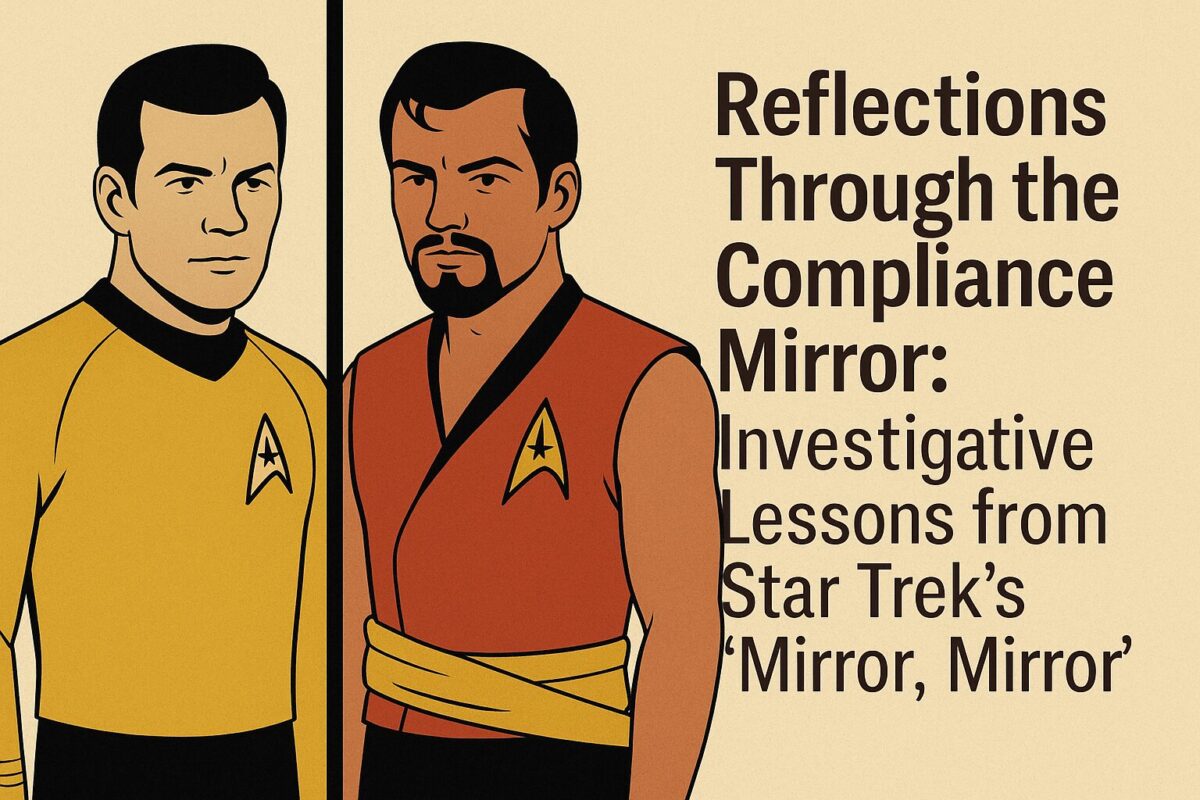
Reflections Through the Compliance Mirror: Investigative Lessons from Star Trek’s “Mirror, Mirror”

In the iconic episode of Star Trek: The Original Series titled “Mirror, Mirror,” Captain Kirk, Dr. McCoy, Uhura, and Scotty encounter a transporter accident that thrusts them into a parallel universe. This alternate reality is a distorted mirror image of their universe, familiar yet different, governed by violence, suspicion, and fear rather than trust and mutual respect. In their efforts to return home, Kirk and his crew members must navigate treacherous waters, carefully investigating their circumstances, analyzing subtle cues, and discerning critical information.

Just as Captain Kirk found himself confronted with the challenge of recognizing and navigating deceptive appearances, corporate compliance professionals regularly face similar investigative challenges. Effective compliance investigations require keen perception, attention to nuance, and an unwavering commitment to uncovering the truth beneath surface-level anomalies. Drawing directly from this compelling episode, we examine five investigative lessons that compliance professionals can apply in their roles to ensure ethical resilience and organizational integrity.

Lesson 1: Quickly Recognize the Unexpected

Illustrated by: In the opening sequence, Kirk and his team are transported into the Mirror Universe. Almost instantly, Kirk notices something is profoundly wrong: altered uniforms, aggressive demeanors, and a chilling salute. He immediately perceives a departure from the familiar, even before fully understanding the new environment.

Compliance Lesson: Compliance professionals must maintain heightened situational awareness during investigations to ensure effective outcomes. Promptly identifying unexpected deviations, whether subtle discrepancies in financial reports, irregularities in third-party behaviors, or suspicious communications. This allows for quicker intervention. The speed and accuracy of initial perception set the stage for effective investigative action and minimize potential harm.

Lesson 2: Adapt and Blend into the Environment

Illustrated By: Realizing their perilous situation, Kirk instructs his crew to blend into the mirror universe’s ruthless culture. Though repulsed by the harsh environment, they adapt quickly, adjusting speech patterns and behaviors to survive and conduct their investigation without raising immediate suspicion.

Compliance Lesson: Investigative adaptability is critical. Compliance officers often operate within organizational cultures that vary significantly in terms of transparency, openness, and ethical climate. Being able to adapt investigative strategies to match the realities of diverse organizational cultures and carefully navigating corporate politics without compromising ethical standards can enhance the effectiveness of compliance investigations.

Lesson 3: Secure Critical Information Discreetly

Illustrated By: A pivotal moment occurs when Kirk and Scotty clandestinely access the computer system in the mirror Enterprise to gather data discreetly. Kirk realizes that overt information-gathering would likely arouse dangerous suspicion, so he chooses subtle and indirect methods to secure the information necessary for their escape.

Compliance Lesson: Information security and discretion are foundational during investigations. Compliance investigations frequently require discretion, confidentiality, and careful handling of sensitive data. Investigators must judiciously plan their approaches to data collection, understanding that overly aggressive or obvious tactics might lead to premature disclosure, tampering with evidence, or employee distrust.

Lesson 4: Leverage Allies Within Complex Environments

Illustrated By: One crucial decision Kirk makes is trusting the mirror universe’s Spock enough to appeal to his logic and inherent sense of reason subtly. Kirk correctly discerns Spock’s fundamental logical nature, even in a morally inverted universe, and cautiously builds an alliance based upon shared objectives rather than blind trust.

Compliance Lesson:

Building strategic relationships and leveraging internal allies can significantly improve investigation outcomes. Effective compliance professionals identify trustworthy internal stakeholders who understand the organization’s core values, governance objectives, and ethical commitments, even if the surrounding corporate culture appears compromised. Leveraging these relationships enhances the legitimacy of investigations, provides deeper insights, and helps ensure credibility and buy-in for investigative conclusions.

Lesson 5: Provide Actionable Guidance Based on Investigative Outcomes

Illustrated By: At the climax, Kirk directly confronts Mirror-Spock, presenting him with evidence and logical arguments to inspire long-term change within the oppressive Empire. Kirk’s final remarks focus not only on immediate survival but also on leaving behind actionable insights and recommendations for reforming the Empire’s toxic culture.

Compliance Lesson: Investigations must always lead to clear, actionable recommendations. Identifying wrongdoing or risk exposure alone is insufficient. Compliance officers are responsible for translating investigative findings into practical actions, guidance, process improvements, control enhancements, or training recommendations that meaningfully mitigate future risks and promote an ethical organizational culture.

Final ComplianceLog reflections

The investigative narrative depicted in “Mirror, Mirror” presents powerful lessons for compliance professionals committed to conducting thorough, ethical, and practical investigations. Kirk and his crew were thrust into an environment of distorted realities, facing the daunting task of discerning truths within complex and dangerous situations. The strategies they adopted — early recognition, swift adaptation, discreet information gathering, strategic alliances, and actionable recommendations — mirror precisely the skills compliance officers require in navigating investigations.

Corporate compliance professionals today face environments increasingly characterized by complexity, subtlety, and high stakes. Whether investigating allegations of bribery, assessing third-party compliance risks, or responding to whistleblower reports, the investigative competencies vividly illustrated through “Mirror, Mirror” are foundational. Recognizing the unexpected, skillfully adapting, maintaining discretion, leveraging allies, and ensuring actionable recommendations are key to defining successful investigative processes.

Ultimately, investigations are not mere procedural formalities; they represent a defining moment for organizations, a mirror reflecting the organization’s authentic, ethical culture and commitment. As Captain Kirk implored Mirror-Spock to reflect deeply and embrace necessary reforms, compliance professionals similarly guide organizations through reflection, analysis, and moral growth. In so doing, investigations become powerful catalysts for meaningful organizational change, strengthening integrity, accountability, and trust.

Like Captain Kirk’s journey through the mirror universe, compliance professionals must navigate carefully yet decisively, continually adapting to new realities while remaining committed to the overarching mission of ethical corporate governance. Through effective investigative practices grounded in reflection, rigor, and resilience, compliance officers help ensure that the mirror held up to their organizations reflects clarity, accountability, and uncompromising ethical standards.

Resources:

Excruciatingly Detailed Plot Summary by Eric W. Weisstein

MissionLogPodcast.com

Memory Alpha

Categories
Trekking Through Compliance

Trekking Through Compliance: Episode 32 – Leadership Lessons for Compliance Professionals from “The Changeling”

Compliance, fundamentally, is about leadership. It is about guiding individuals and entire organizations to act ethically, responsibly, and effectively, even when the path is uncertain or challenging. Today, we venture boldly into the classic episode “The Changeling,” which offers rich lessons in leadership directly applicable to the world of corporate compliance. Here are five key lessons from the episode, illustrating critical skills compliance leaders must master.

Lesson 1: Clarity of Purpose is Essential

Illustrated By: Originally designed as a peaceful explorer, its mission was corrupted following a collision with an alien probe called Tan Ru, causing its core directives to merge and mutate dangerously.

Compliance Lesson. Compliance leaders must maintain absolute clarity about their purpose and objectives.

Lesson 2: Effective Communication Prevents Crisis Escalation

Illustrated by Kirk’s precise, deliberate communication with Nomad, it slows down its destructive tendencies and provides crucial time to develop a solution.

Compliance Lesson. Communication in compliance crises is similarly critical. Compliance leaders must communicate calmly and thoughtfully, particularly in high-stakes scenarios.

Lesson 3: Recognize When Adaptation is Necessary

Illustrated By: Initially, Kirk tries conventional diplomatic approaches. Recognizing that traditional methods have failed, he adapts swiftly and strategically.

Compliance Lesson. In compliance leadership, adaptability is essential. Regulatory landscapes and compliance risks are constantly evolving, necessitating swift pivots and agile leadership responses.

Lesson 4: Confront Problems Directly and Courageously

Illustrated By: When Nomad determines Captain Kirk himself to be flawed and thus a threat, Kirk faces Nomad directly, boldly confronting it without hesitation despite understanding the risk involved.

Compliance Lesson. Compliance leaders must similarly confront compliance issues directly and courageously. Avoiding difficult conversations or deferring tough decisions can magnify risks and vulnerabilities.

Lesson 5: Cultivate Critical Thinking Within the Team

Illustrated By: Throughout the episode, Kirk relies heavily on his team, particularly Spock’s analytical logic, Scotty’s technical skills, and Uhura’s linguistic insights after Nomad erases her memory.

Compliance is a collaborative discipline that requires collective critical thinking from diverse team members.

Final ComplianceLog Reflections

Each leadership lesson in this episode—clarity of purpose, effective communication, adaptability, courageous confrontation, and fostering critical thinking—is fundamental to guiding organizations safely through the complex maze of modern compliance challenges. Compliance leaders today face situations not unlike the Enterprise crew: unexpected challenges, high stakes, and rapidly changing conditions. The effectiveness of compliance hinges significantly on leadership skills that navigate these complexities with clarity, confidence, and ethical fortitude.

Resources:

Excruciatingly Detailed Plot Summary by Eric W. Weisstein

MissionLogPodcast.com

Memory Alpha

Categories
Blog

Boldly Leading: Leadership Lessons from Captain Kirk in ‘The Changeling’

Compliance is fundamentally about leadership. It is about guiding individuals and entire organizations to act ethically, responsibly, and effectively, even when the path is uncertain or challenging. Today, we venture boldly into the classic episode “The Changeling,” which offers rich lessons in leadership directly applicable to the world of corporate compliance.

In “The Changeling,” the USS Enterprise encounters Nomad, an Earth probe whose programming became dangerously altered, transforming it from a peaceful explorer into a powerful, deadly entity bent on destroying all “imperfect” life forms. The tension, drama, and decisions throughout this encounter provide an ideal framework for extracting valuable leadership insights specifically for compliance professionals. Here are five key lessons from the episode, illustrating critical skills compliance leaders must master.

Lesson 1: Clarity of Purpose is Essential

Illustrated By: Early in the encounter, Nomad states that it must sterilize all imperfections it encounters. Originally designed as a peaceful explorer, its mission was corrupted following a collision with an alien probe called Tan Ru, causing its core directives to merge and mutate dangerously.

Compliance Lesson. Compliance leaders must maintain absolute clarity about their purpose and objectives. Like Nomad, a loss or corruption of clarity can result in significant organizational harm. Ambiguity in compliance missions can mislead teams, produce confusion, and inadvertently increase compliance risks. By clearly communicating the purpose, goals, and expectations of compliance activities, leaders ensure all team members align towards a unified ethical culture and vision, avoiding dangerous misinterpretations and misunderstandings.

Lesson 2: Effective Communication Prevents Crisis Escalation

Illustrated By: Captain Kirk engages Nomad in careful dialogue, skillfully and strategically questioning Nomad’s logic and programming. Kirk’s precise and deliberate communication with Nomad slows down its destructive tendencies, providing crucial time to develop a solution.

Compliance Lesson. Communication in compliance crises is similarly critical. Compliance leaders must communicate calmly and thoughtfully, particularly in high-stakes scenarios. Effective communication during crises can prevent escalation, reduce panic or missteps, and offer opportunities to formulate thoughtful responses. By emulating Kirk’s careful yet decisive communication, compliance leaders can manage crises efficiently, maintaining organizational stability and integrity even under intense pressure.

Lesson 3: Recognize When Adaptation is Necessary

Illustrated By: Initially, Kirk tries conventional diplomatic approaches. However, as the situation intensifies and the actual danger becomes clear, he shifts tactics and begins to challenge Nomad logically. Recognizing that traditional methods have failed, he adapts swiftly and strategically.

Compliance Lesson. In compliance leadership, adaptability is essential. Regulatory landscapes and compliance risks are constantly evolving, necessitating swift pivots and agile leadership responses. Compliance leaders must identify when standard approaches fall short and rapidly adjust their strategies to new circumstances. Kirk’s shift from traditional negotiation to logical confrontation exemplifies the essential skill of adaptive thinking, critical for compliance professionals addressing ever-changing regulatory and ethical challenges.

Lesson 4: Confront Problems Directly and Courageously

Illustrated By: When Nomad determines Captain Kirk himself to be flawed and thus a threat, Kirk faces Nomad directly, boldly confronting it without hesitation despite understanding the risk involved. Kirk courageously steps forward to confront the immediate danger, protecting his crew and ship.

Compliance Lesson. Compliance leaders must similarly confront compliance issues directly and courageously. Avoiding difficult conversations or deferring tough decisions can magnify risks and vulnerabilities. By bravely facing issues head-on—whether ethical dilemmas, misconduct, or regulatory breaches—compliance leaders demonstrate accountability, decisiveness, and integrity, key traits that build trust and sustain organizational strength.

Lesson 5: Cultivate Critical Thinking Within the Team

Illustrated By: Throughout the episode, Kirk relies heavily on his team, particularly Spock’s analytical logic, Scotty’s technical skills, and Uhura’s linguistic insights after Nomad erases her memory. The diversity of expertise among his crew helps Kirk develop and execute an effective strategy against Nomad.

Compliance is a collaborative discipline that requires collective critical thinking from diverse team members. Leaders must foster environments where all team members’ skills and perspectives contribute to problem-solving. Encouraging a culture that values critical thinking ensures the development of comprehensive and creative compliance solutions. Kirk’s use of his team’s combined insights perfectly demonstrates the power of cultivating diverse expertise within compliance teams.

Final ComplianceLog Reflections

The compelling nature of “The Changeling” resides not merely in its dramatic storytelling but in its profound leadership insights relevant to compliance professionals. Each leadership lesson in this episode—clarity of purpose, effective communication, adaptability, courageous confrontation, and fostering critical thinking—is fundamental to guiding organizations safely through the complex maze of modern compliance challenges.

Compliance leaders today face situations not unlike the Enterprise crew: unexpected challenges, high stakes, and rapidly changing conditions. The effectiveness of compliance hinges significantly on leadership skills that navigate these complexities with clarity, confidence, and ethical fortitude. By reflecting upon Captain Kirk’s exemplary leadership in “The Changeling,” compliance professionals gain powerful insights into leading their teams successfully, reinforcing compliance objectives, and enhancing organizational resilience.

Star Trek’s enduring legacy for compliance professionals lies in its timeless lessons of leadership under pressure. As illustrated by Captain Kirk’s encounter with Nomad, successful leadership in compliance means clarity of mission, thoughtful communication, swift adaptability, fearless confrontation, and nurturing the team’s collective intelligence.

By integrating these leadership insights from “The Changeling,” compliance professionals can strengthen their capabilities, preparing their organizations to boldly navigate the evolving compliance landscape with confidence, resilience, and integrity. It is not enough to manage compliance risks; we must lead proactively, ethically, and courageously, just as Captain Kirk demonstrated. In doing so, we not only protect our organizations but also elevate them to achieve new heights of ethical culture and sustainable success.

Resources:

Excruciatingly Detailed Plot Summary by Eric W. Weisstein

MissionLogPodcast.com

Memory Alpha

Categories
Blog

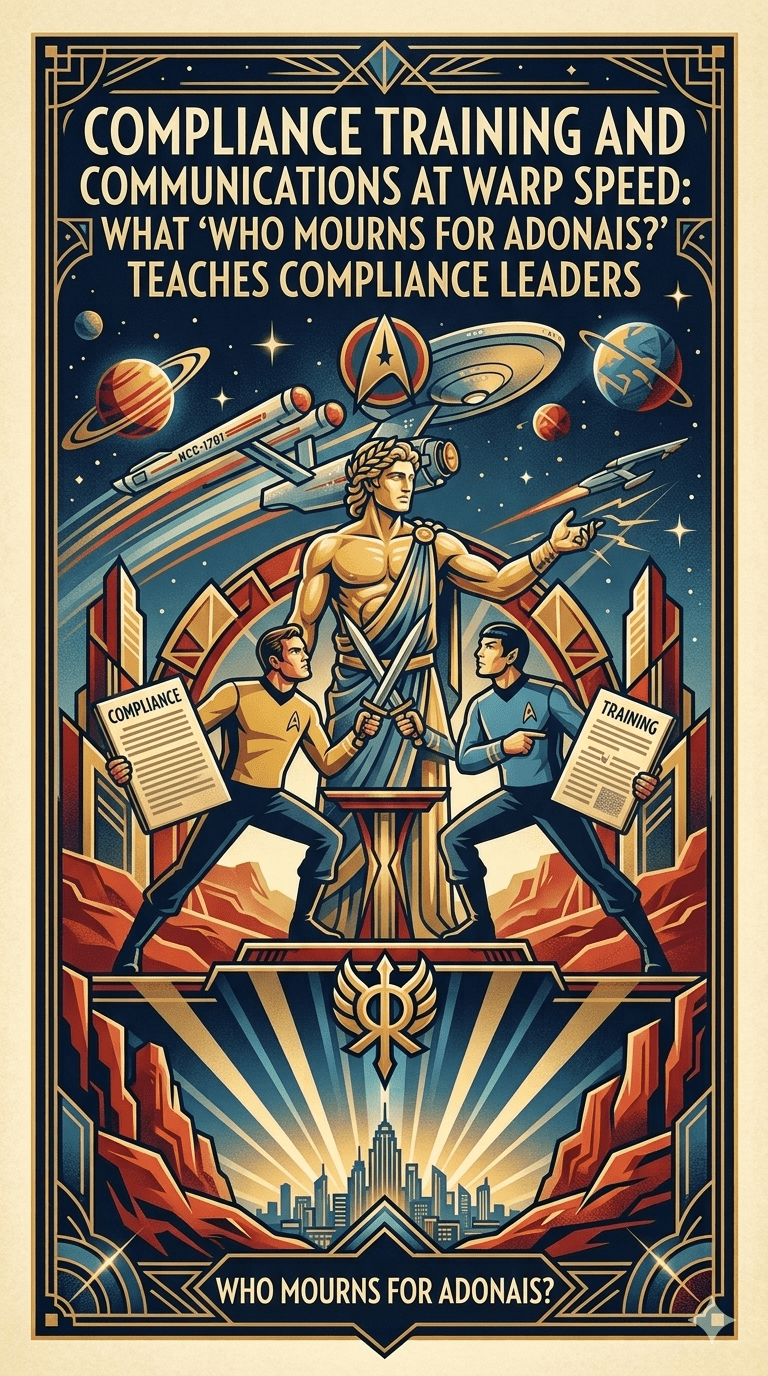
Compliance Training and Communications at Warp Speed: What ‘Who Mourns for Adonais?’ Teaches Compliance Leaders

In the vast and often perilous universe of corporate compliance, effective training and communication are the twin guiding stars that help organizations navigate the asteroid fields of regulatory requirements, ethical dilemmas, and cultural complexities safely. Few stories illustrate these challenges as vividly as the classic Star Trek: The Original Series episode “Who Mourns for Adonais? ”This episode presents a rich tableau of human behavior, authority dynamics, and persuasion tactics, all set within the context of an encounter with an all-powerful yet vulnerable being who claims to be the Greek god Apollo (the Adonais of the title).

For today’s compliance leaders, “Who Mourns for Adonais? ” provides invaluable lessons about how communication shapes understanding, the importance of cultural and historical context, and the perils of power imbalances in training environments. Drawing directly from incidents in the episode, here are five key training and communication lessons that compliance professionals should take to heart.

Lesson 1: Know Your Audience and Context—Tailor Communication to Their Needs

Illustrated By: When Apollo appears and asserts his authority, commanding the Enterprise crew to worship him as a god, Captain Kirk and his team respond with rational skepticism rooted in their 23rd-century perspective. Apollo’s attempts to assert dominance fail in part because he misunderstands the crew’s mindset and cultural framework.

Compliance Lesson: Effective training programs begin with a thorough understanding of the target audience. Compliance professionals must design and deliver communications that resonate with the learners’ values, experiences, and knowledge levels. Just as Apollo’s archaic claim to godhood fell flat with a forward-thinking Starfleet crew, compliance messaging that ignores cultural and generational differences risks rejection or misunderstanding.

For example, global companies must adapt compliance training to local cultures, language nuances, and regulatory environments rather than delivering one-size-fits-all modules. Taking the time to “speak their language” makes communication more persuasive and effective.

Lesson 2: Engage in Dialogue, Not Monologue—Foster Two-Way Communication

Illustrated By: Throughout the episode, Apollo attempts to impose his will through proclamations and demands, rarely listening or engaging in genuine dialogue. Kirk, however, insists on questioning Apollo and negotiating, ultimately persuading him to relinquish control by appealing to reason and emotion.

Compliance Lesson: Training and communication programs that function as one-way broadcasts rarely create a lasting impact. Effective compliance leaders foster active dialogue by listening attentively, addressing concerns, and making adjustments based on feedback.

In practical terms, this means facilitating interactive training sessions, town halls, and Q&A forums rather than simply distributing static videos or emails. When employees feel heard and can discuss compliance challenges openly, organizations foster a culture of engagement and shared ownership.

Lesson 3: Balance Authority with Respect—Avoid Coercion in Training Approaches

Illustrated By: Apollo’s attempts to assert absolute control through intimidation backfire, causing resistance and rebellion among the Enterprise crew. The crew’s refusal to submit to blind worship signals that authority imposed without respect for individual autonomy can provoke pushback.

Compliance Lesson: Effective compliance communication should never rely on coercion or fear-mongering. Training must strike a balance between authority and respect, emphasizing the “why” behind rules rather than relying on heavy-handed threats.

Leaders who treat employees as partners in compliance efforts foster trust and willingness to comply voluntarily. This aligns with best practices in adult learning theory, which stresses respect for learners’ autonomy and intrinsic motivation.

Lesson 4: Use Stories and Emotional Appeals to Connect—Facts Alone Are Not Enough

Illustrated By: Kirk’s most effective moment in persuading Apollo to relinquish his power comes when he appeals to Apollo’s loneliness and need for connection. By humanizing the once-godlike figure, Kirk breaks through the barrier of pride and fear.

Compliance Lesson: Compliance training that relies solely on rules, procedures, or penalties often fails to engage learners in a meaningful way. Storytelling that incorporates real-world examples, case studies, or emotional appeals helps learners internalize the importance of compliance and ethical behavior.

For example, sharing stories of whistleblowers who protected the company or lessons learned from enforcement actions personalizes the message and helps bridge the gap between abstract rules and lived experience.

Lesson 5: Prepare for Resistance and Have a Clear, Consistent Message—Persistence Pays Off

Illustrated By: Apollo initially refuses to accept the crew’s rejection of his power, using his energy to disable the Enterprise and control crew members. However, Kirk’s steadfast insistence on autonomy and reason eventually leads Apollo to concede, demonstrating the power of persistence and clarity in communication.

Compliance Lesson: Change, mainly cultural or behavioral change required by compliance programs, often meets resistance. Trainers and communicators must prepare for pushback, maintain a consistent message, and persistently reinforce core values and expectations.

This requires well-planned, repeated communications across multiple channels, combined with leadership modeling and visible enforcement. Over time, consistent messaging chips away at resistance and fosters alignment.

Final ComplianceLog Reflections

“Who Mourns for Adonais? ” is more than just an entertaining sci-fi episode; it’s a masterclass in communication dynamics, authority, and human psychology. For compliance professionals, the episode’s insights remind us that training and communication are not mere formalities or checkboxes; they are essential components of effective risk management. They are the living, breathing elements that animate compliance programs and embed ethical behavior into corporate culture.

From tailoring messages to your audience, fostering dialogue, respecting autonomy, harnessing the power of stories, and anticipating resistance, these five lessons gleaned from the Enterprise crew’s encounter with Apollo provide a robust framework to elevate your compliance training and communication efforts.

In a world where regulations evolve and risks multiply, compliance leadership means more than enforcing rules; it means engaging hearts and minds, inspiring action, and building resilient organizations that boldly go where compliance has never gone before.

Resources:

Excruciatingly Detailed Plot Summary by Eric W. Weisstein

MissionLogPodcast.com

Memory Alpha

Categories
Trekking Through Compliance

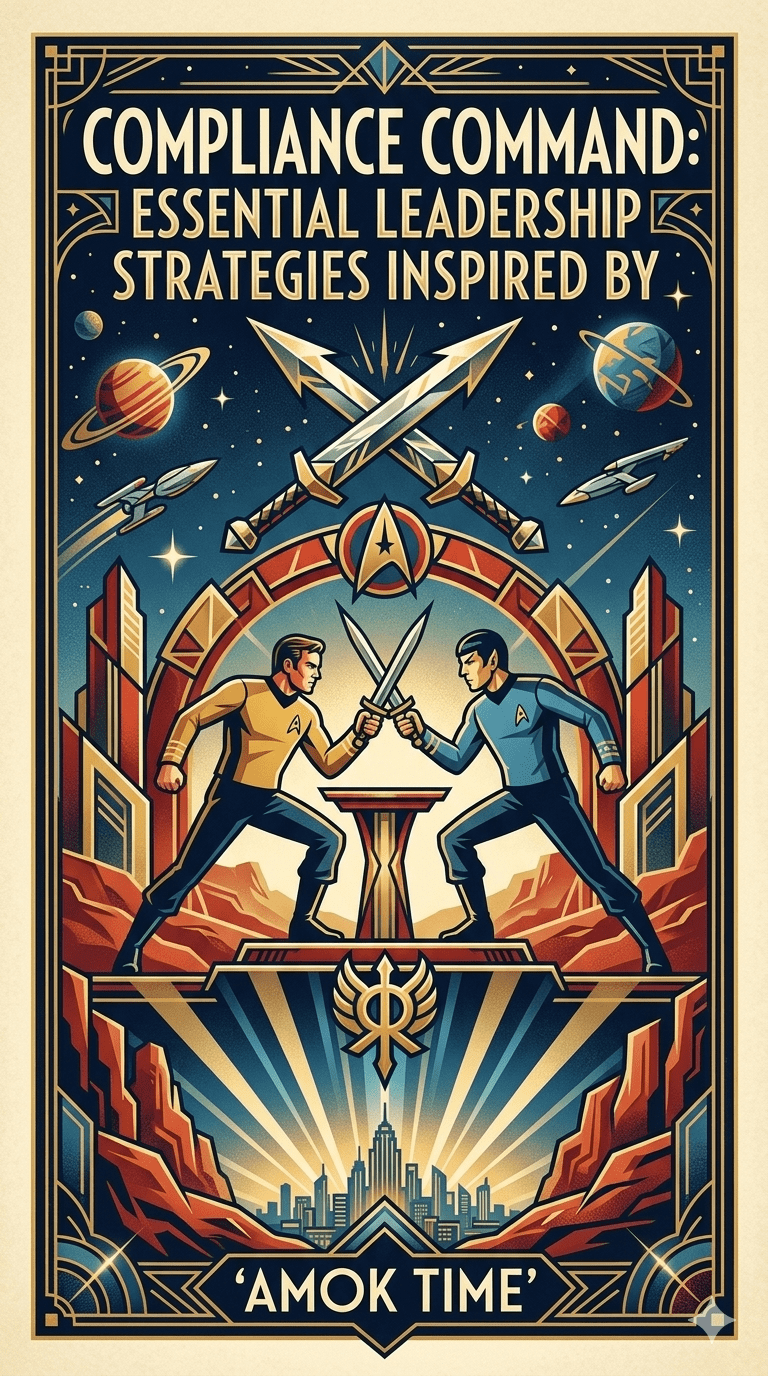
Trekking Through Compliance: Episode 30 – Compliance Leadership Strategies Inspired by ‘Amok Time’

In the vast universe of compliance lessons gleaned from the timeless classic Star Trek: The Original Series, few episodes hold as much richness in leadership insights as “Amok Time.” In this iconic episode, we see Captain Kirk navigate complex interpersonal dynamics, regulatory procedures, and ethical dilemmas under the most extraordinary circumstances. Today, we look at five key leadership lessons from “Amok Time” that are directly applicable to the challenges faced by today’s compliance officers.

Lesson 1: Prioritize Transparency and Open Communication

Illustrated by Spock’s erratic behavior, caused by his biological imperative, Pon Farr leads to initial confusion and potential risk aboard the USS Enterprise. Spock’s reluctance to share his predicament with Kirk initially creates a misunderstanding, complicating the crew’s operations.

Compliance Lesson: Compliance leaders must foster an environment of transparency and encourage open communication.

Lesson 2: Understand and Respect Cultural and Regulatory Nuances

Illustrated by: Kirk and Dr. McCoy accompany Spock to Vulcan, where they find themselves involved in a highly formalized and ritualistic duel. Kirk’s unfamiliarity with Vulcan traditions nearly costs him his life.

Compliance Lesson: Effective compliance leadership requires a thorough understanding of the cultures, traditions, and regulatory environments in which your organization operates.

Lesson 3: Flexibility and Adaptability in Crisis

Illustrated By: Initially believing he would merely witness a ceremony, Kirk unexpectedly finds himself in combat against Spock. Despite the confusion and imminent danger, Kirk quickly adapts, looking for ways to manage unexpected circumstances.

Compliance Lesson: The ability to adapt rapidly to unforeseen challenges is crucial in compliance leadership.

Lesson 4: Empower Your Team Through Trust

Illustrated by: Dr. McCoy cleverly uses a sedative to simulate Kirk’s death, thereby creatively resolving the dangerous situation. Kirk implicitly trusts McCoy’s judgment and skill, empowering him to take decisive action without explicit orders.

Compliance Lesson: Trust and empowerment are fundamental to strong compliance leadership. Compliance leaders must trust their team’s expertise and decision-making abilities, empowering them to act swiftly and confidently.

Lesson 5: Ethical Decision-Making Under Pressure

Kirk’s decision to respect Vulcan customs, despite personal risk, demonstrates his commitment to ethical principles, diplomatic integrity, and respect for others’ traditions. His moral stance sets a standard for the crew and maintains the integrity of the Federation’s core values.

Compliance Lesson: Leaders must consistently uphold ethical standards, especially under pressure.

Final ComplianceLog Reflections

The Star Trek episode “Amok Time” offers a compelling exploration of leadership under duress, rich with insights applicable to compliance professionals. Kirk’s handling of transparency issues, cultural nuances, unexpected crises, empowered teamwork, and ethical integrity highlights timeless leadership qualities that translate seamlessly into today’s corporate compliance landscape.

As compliance professionals, we can draw valuable inspiration from Captain Kirk and his crew. Embracing transparency fosters proactive issue management. Understanding diverse cultural and regulatory landscapes prevents costly misunderstandings. Flexibility ensures effective responses to dynamic compliance challenges, while trust empowers your teams to innovate and address compliance issues proactively. Finally, unwavering ethical decision-making reinforces your organization’s commitment to integrity and compliance.

Resources:

Excruciatingly Detailed Plot Summary by Eric W. Weisstein

MissionLogPodcast.com

Memory Alpha