Show Summary
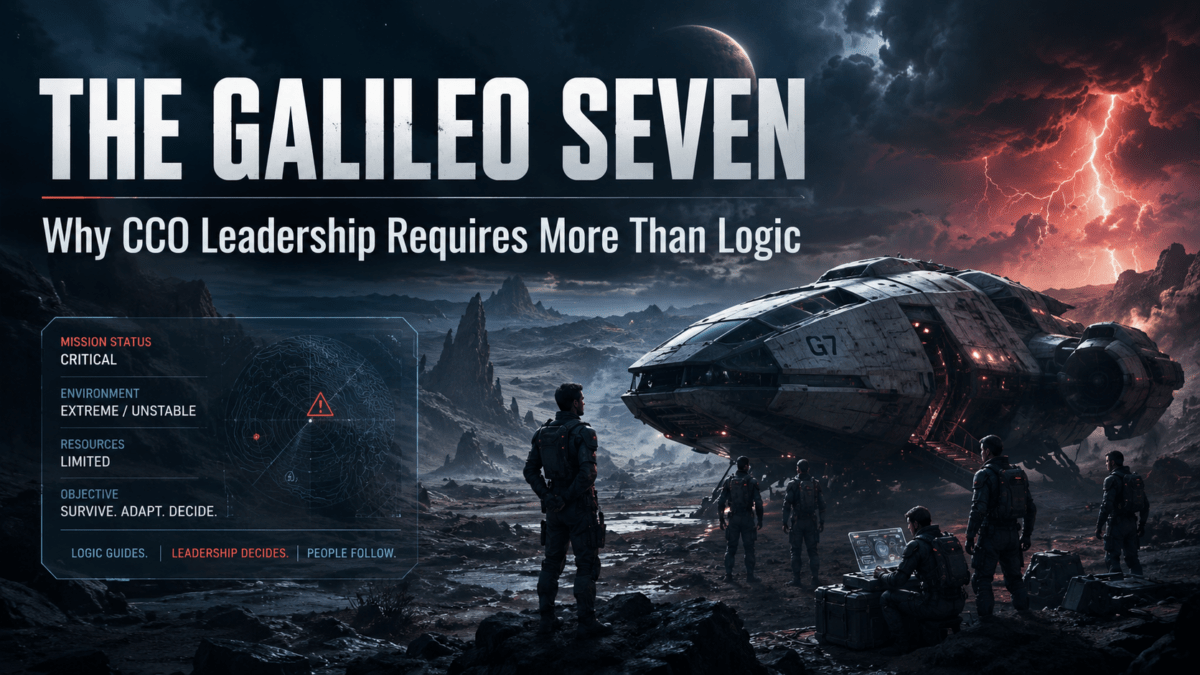
In the rich tapestry of leadership parables woven by Star Trek: The Original Series, the episode “The Galileo Seven” offers an extraordinary case study in adaptive leadership for compliance professionals.
Captain Kirk dispatches the shuttlecraft Galileo, commanded by Mr. Spock, to investigate a mysterious spatial phenomenon known as the Murasaki 312 quasar-like formation. Things quickly escalate when Galileo crash-lands on Taurus II, a hostile and primitive planet. Faced with limited resources, dwindling time, and escalating internal conflicts among the shuttlecraft crew, Spock must navigate his first significant command crisis without the immediate guidance of Captain Kirk.
Drawing parallels from “The Galileo Seven,” we explore critical leadership lessons and their practical implications for compliance professionals.
1. Logic vs. Emotional Intelligence—Know When to Adjust
Illustrated by: Spock’s initial adherence strictly to logic, which causes friction among his crew.
Initially, Spock applies logic rigidly, prioritizing scientific analysis and efficiency above all else. However, his lack of emotional awareness and inability to adapt to crew concerns cause resentment and weaken morale. For compliance officers, this highlights the importance of emotional intelligence in leadership. Successful compliance leaders understand that emotions, fears, and motivations drive people.
2. Collaborative Decision-Making—Recognize the Power of the Team
Illustrated by: Spock’s initial refusal to accept team input, followed by his eventual realization of its value.
Initially, Spock resisted his team’s input, confident that his logic alone would lead them to safety. However, after multiple setbacks, including the loss of crew members and mounting internal pressure, Spock recognizes the need for collaborative input. In compliance, unilateral decision-making can often lead to resistance or compliance failures. Encouraging team participation fosters diverse perspectives, enriches problem-solving, and enhances implementation success.
3. Adaptive Communication—Tailor Your Message
Illustrated by: Spock learning to communicate more effectively under crisis conditions.
Initially, Spock’s communication style was overly technical, direct, and unemotional. This approach alienates crew members who need reassurance, context, and encouragement. For compliance professionals, transparent, adaptable communication is paramount. Compliance officers regularly interact with diverse audiences, and each group requires a tailored approach to communication. Employees need practical, understandable instructions; senior executives seek strategic implications and bottom-line impacts; regulators require precise, factual responses.
4. Strategic Flexibility—Be Prepared to Shift Tactics
Illustrated by: Spock’s decision to jettison shuttle fuel as a distress signal.
Spock makes an unconventional decision to ignite Galileo’s remaining fuel to create a distress signal. This act is a decisive departure from his logic-based strategy, demonstrating Spock’s ability to pivot rapidly under pressure. Compliance leadership requires similar strategic flexibility. Regulations evolve, new risks emerge, and organizational dynamics shift quickly. Compliance officers must be agile, ready to abandon approaches that are not working and to pivot to new strategies that address a changing landscape.
5. Crisis Leadership—Maintain Composure and Provide Clarity
Illustrated by: Spock’s calm demeanor under extreme pressure.
Throughout the escalating crisis, Spock maintains remarkable composure, never allowing panic or emotional strain to overtly influence his behavior. Employees and executives alike look to compliance professionals for clear-headed leadership during turmoil.
6. Continuous Learning—Grow Through Experience
Illustrated by: Spock’s reflection on the mission’s challenges and outcomes.
By the end of the episode, Spock demonstrates meaningful growth as a leader, reflecting on the lessons learned from the crisis and acknowledging his initial shortcomings. Compliance officers should adopt this same mindset of continuous learning. Rather than viewing mistakes as purely negative, compliance professionals can treat them as opportunities to refine their approach, enhance their strategic perspective, and improve compliance practices.
Final ComplianceLog Reflections
“The Galileo Seven” is not just a thrilling adventure; it is a masterclass in adaptive leadership that compliance professionals can emulate. Spock’s journey from rigid logic to adaptive, compassionate leadership underscores that effective compliance officers must be dynamic, empathetic, collaborative, flexible, composed, and continuously learning.
Resources:
Excruciatingly Detailed Plot Summary by Eric W. Weisstein