Categories
Blog

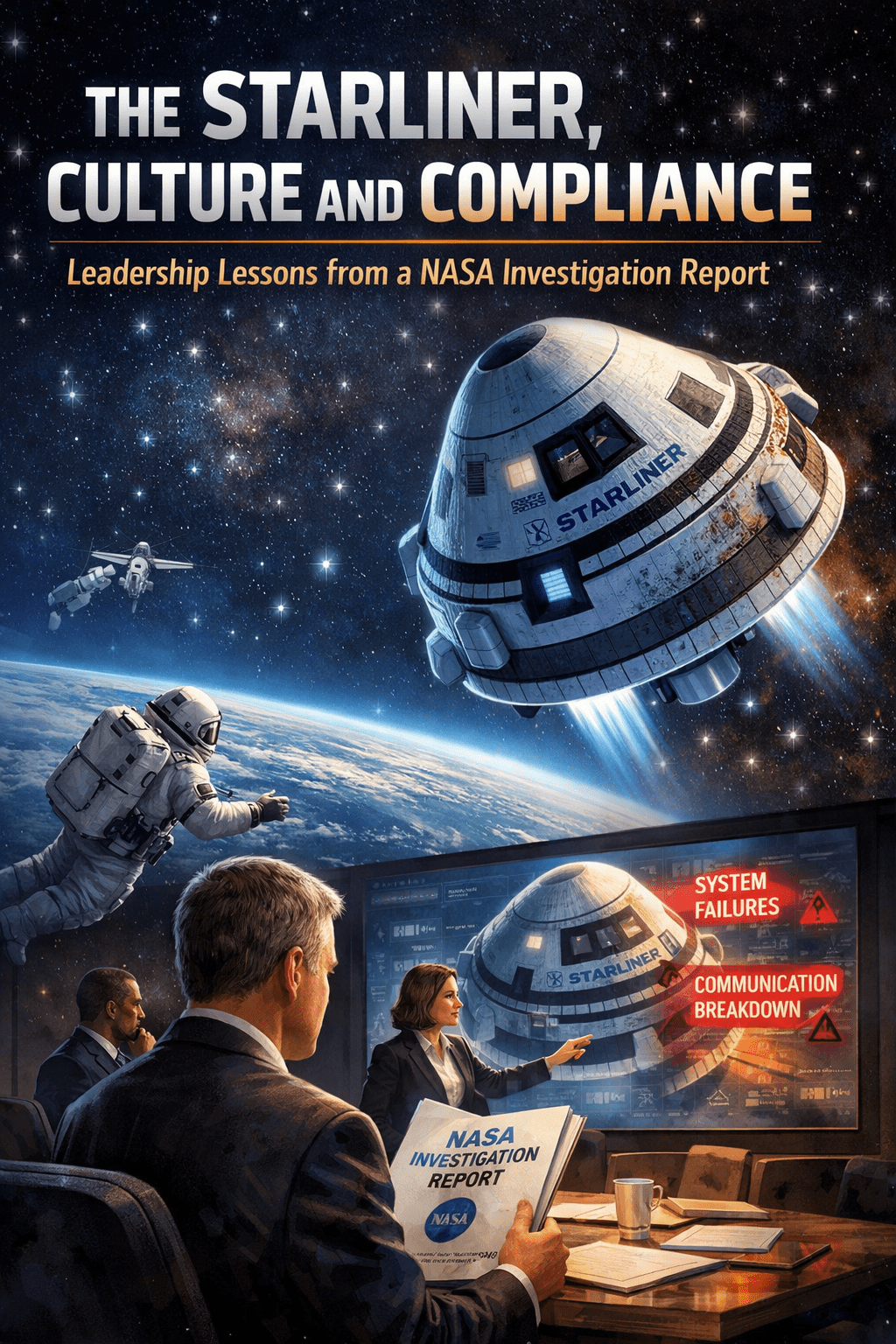
The Starliner, Culture and Compliance: Leadership Lessons from a NASA Investigation Report

Corporate compliance professionals spend a lot of time talking about controls, training, third parties, and investigations. Yet the hard truth is that the most important control environment sits above all of that: leadership behavior and the culture it creates. That is why this NASA investigation report on the Boeing CST-100 Starliner Crewed Flight Test (CFT) is such a useful case study. It is a technical report, to be sure. But it is also a cultural, leadership, and governance report. NASA’s bottom line is unambiguous: technical excellence and safety require transparent communication and clear roles and responsibilities, not as slogans, but as operating requirements that must be institutionalized so safety is never compromised in pursuit of schedule or cost.

If you are a Chief Compliance Officer, General Counsel, or business leader, you should read this report the way you read an enforcement action. Not to gawk. Not to assign blame. But to harvest lessons for your own organization before you have your own high-visibility close call.

The incident(s) that led to the report

The CFT mission launched June 5, 2024, as a pivotal step toward certifying Starliner to transport astronauts to the International Space Station. It was planned as an 8-to-14-day mission but was extended to 93 days after significant propulsion system anomalies emerged. Ultimately, the Starliner capsule returned uncrewed, while astronauts Barry “Butch” Wilmore and Sunita “Suni” Williams returned aboard SpaceX’s Crew-9 Dragon in March 2025. In February 2025, NASA chartered a Program Investigation Team (PIT) to examine the technical, organizational, and cultural factors contributing to the anomalies.

The report describes four major hardware anomaly areas, including Service Module RCS thruster fail-offs that temporarily caused a loss of 6 Degrees of Freedom control during ISS rendezvous and required in-situ troubleshooting to recover enough capability to dock, a Crew Module thruster failure during descent that reduced fault tolerance, and helium manifold leaks where seven of eight Service Module helium manifolds leaked during the mission. The PIT further determined that the 6DOF loss during rendezvous met criteria for a Type A mishap (or at least a high-visibility close call), underscoring how close the program came to a very different ending.

That is the “what.” For compliance professionals, the “so what” is that NASA did not treat this as a purely engineering problem. It treated it as an integrated system failure, in which culture and leadership either reduce risk or magnify it.

Lesson 1: Decision authority is culture, not paperwork

One of the report’s clearest threads is that fragmented roles and responsibilities delayed decision-making and eroded confidence. In the compliance world, unclear decision rights become the breeding ground for “informal governance”: private conversations, end-runs around committees, and decisions that are never fully documented. Over time, that becomes a shadow-control environment that your policies cannot touch.

Compliance action steps

  • Define decision rights for the riskiest calls (high-risk third parties, market entry, major remediation, critical incidents).
  • Require a short, written record of: facts reviewed, options considered, dissent captured, decision made, and owner accountable.
  • Separate “recommendation authority” from “approval authority” so everyone knows where they sit.

Lesson 2: Transparency is a control, and selective data sharing destroys trust

The report explicitly flags that the lack of data access fueled concerns about selective information sharing. Interviewees described frustration that information could be filtered, selectively chosen, or sanitized, which eroded confidence in the process and people. It also notes reports of questions being labeled “too detailed” or “out of scope” without mechanisms to ensure concerns were addressed. That is the compliance danger zone. When teams believe the narrative matters more than the data, they stop escalating early. They start documenting defensively. They seek safety in silence.

Compliance action steps

  • Build “open data” expectations into your incident response and investigative protocols.
  • Create a defined pathway for technical or subject-matter dissent to be logged, reviewed, and dispositioned.
  • Treat meeting notes and decisions as governed records, not optional artifacts.

Lesson 3: Risk acceptance without rigor becomes “unexplained anomaly tolerance”

NASA calls out “anomaly resolution discipline” and warns that repeated acceptance of unexplained anomalies without root cause can lead to recurrence. That single lesson belongs on a poster in every compliance office. In corporate terms, “unexplained anomalies” are recurring control exceptions, repeat hotline themes, repeated third-party red flags, and audit findings that are “managed” rather than fixed. If leadership normalizes that pattern, it teaches the organization that closure is more important than correction.

Compliance action steps

  • Require root cause analysis for repeat issues, not just incident closure.
  • Set escalation thresholds for “repeat with no root cause” findings.
  • Audit remediation quality, not only remediation completion.

Lesson 4: Partnerships fail when “shared accountability” is not operationalized

The report emphasizes that shared accountability in the commercial model was inconsistently understood and applied. It also notes that historical relationships and private conversations outside formal forums created perceptions of blurred boundaries, favoritism, and lack of objectivity, whether or not those perceptions were accurate. Compliance teams have seen this movie. Think distributors, joint ventures, outsourced compliance support, and major technology partners. If accountability is shared in theory but siloed in practice, something will fall through the cracks. Usually, it falls right into your lap when regulators arrive.

Compliance action steps

  • Define “shared accountability” in contracts, governance charters, and escalation protocols.
  • Ensure independence and objectivity are protected by design, not by personality.
  • Create joint forums where data is shared broadly, dissent is recorded, and decisions are made openly.

Lesson 5: Burnout is a risk factor, and meeting chaos is a governance failure

The report’s recommendations recognize the operational reality: high-pressure environments can degrade decision quality. It calls for “pulse checks,” rotation of high-pressure responsibilities, contingency staffing, and time protection for deep work to proactively address burnout and improve decision-making under mission conditions. Compliance professionals should take that to heart. Crisis cadence is sometimes unavoidable. Permanent crisis cadence is a leadership choice. And it carries predictable consequences: shortcuts, missed details, weakened documentation, and poor judgment.

Compliance action steps

  • Build surge staffing plans for investigations and incident response.
  • Rotate incident commander roles when events extend beyond days.
  • Protect time for analysis, not just meetings and status updates.

Lesson 6: Accountability must be visible, not performative

NASA does not bury the human dimension. The report contains leadership recommendations to speak openly with the joint team about leadership accountability, including concurrence with the report and reclassification as a mishap, and to hold a leadership-led stand-down day focused on reflection, accountability concerns, and rebuilding trust. For corporate leaders, this is where trust is won or lost after a crisis. Employees can tolerate a hard outcome. They struggle to tolerate spin. If your organization communicates externally with confidence but internally with vagueness, your culture learns the wrong lesson: optics first, truth second.

Compliance action steps

  • After a major incident, publish an internal accountability and remediation plan with owners and timelines.
  • Provide regular updates on what has been completed, what is delayed, and why.
  • Make it safe for the workforce to ask questions in interactive forums, as NASA recommends.

Lesson 7: Trust repair requires a plan, not a pep talk

One of the most useful artifacts in the report is a sample Organizational Trust Plan. It sets a goal to rebuild trust by establishing clear expectations, open accountability, and shared commitment to safety and mission success. It includes objectives around transparent communication, acknowledging past challenges, reinforcing shared values, and structured engagement. It then lays out action steps: leadership engagement, facilitated sessions, outward expressions of accountability, teamwide rollout, training and coaching, and communication through a written plan and regular updates.

That is exactly the kind of operational discipline compliance leaders should bring to culture work. Culture does not change because someone gives a speech. Culture changes when the organization changes how it makes decisions, treats dissent, and follows through.

Five key takeaways for the compliance professional

  1. Clarify decision rights before the crisis. Ambiguity becomes politics under pressure.
  2. Make transparency non-negotiable. Perceived filtering of data destroys credibility.
  3. Do not normalize unexplained anomalies. Repeat issues without a root cause are future failures.
  4. Operationalize shared accountability with partners. Otherwise, it is a slogan.
  5. Rebuild trust with a written plan and visible accountability. Trust repair is a managed process.

In the end, the Starliner lesson for compliance is simple: controls matter, but culture decides whether controls work when it counts. If leadership cannot run disagreements well, cannot share data broadly, and cannot demonstrate accountability after the fact, the best-written compliance program in the world will fail the moment the pressure rises.

Categories
2 Gurus Talk Compliance

2 Gurus Talk Compliance – Episode 67 – Our Favorite Stories Edition

What happens when two top compliance commentators get together? They talk compliance, of course. In this episode, Kristy Grant-Hart and Tom Fox delve into their top ten most compelling compliance stories from 2025. The discussion includes controversial presidential pardons, the impact of the Trump administration on the American justice system, and shifts in the EU’s regulatory landscape. They also explore the complexities of managing a multigenerational workforce, the implications of AI as a potential whistleblower, and reflections on the importance of maintaining trust in safety protocols at organizations like NASA. The episode wraps up with an amusingly bizarre ‘Florida Man’ story. Tune in for a blend of compliance insights and entertaining anecdotes.

Our Favorite Stories:

  • Top Story: Presidential Pardons and Their Impact
  • Geopolitical Turmoil and Business Risks
  • Trump as CEO: Implications for US Corporations
  • Shifts in EU Legislation and Regulation
  • Generational Differences in the Workplace
  • AI in Compliance: Risks and Ethical Considerations
  • Engagement Surveys and Corporate Culture
  • NASA Safety Concerns and Compliance
  • Florida Man: The Best Story of 2025

Resources:

Kristy Grant-Hart on LinkedIn

Prove Your Worth

Tom

Instagram

Facebook

YouTube

Twitter

LinkedIn

Categories
Hill Country Authors

Hill Country Authors Podcast – The Barber, The Astronaut, and The Golf Ball: Untold NASA Stories with Barbara Radnofsky and Ed Supkis

Welcome to a new season of the award-winning Hill Country Authors Podcast, sponsored by Stoney Creek Publishing. In this podcast, Hill Country resident Tom Fox visits with authors who live in and write up the Texas Hill Country. In this episode, Tom visits with Barbara Radnofsky and her co-author husband, Ed Supkis, on their book, The Barber, The Astronaut, and The Golf Ball: An Exploration of Untold NASA Stories.

Barbara, a former lawyer and mediator turned author, and Ed, a cardiovascular anesthesiologist turned aviation medicine expert, share their journey from documentary filmmakers to authors. The book delves into the intriguing relationships between Carlos Villagomez, a barber with a Navy history, and the iconic astronaut Alan Shepard, focusing on the mysterious golf ball hit on the moon. Ed and Barbara grew up as ‘NASA Brats’ as their fathers worked in the space program. They provide an insider’s perspective on NASA’s behind-the-scenes heroes, emphasizing the collaborative spirit that fueled the space program. The episode closes with reflections on the importance of preserving legacies and storytelling for future generations and how listeners can access their books and documentaries.

Key highlights:

  • Carlos Villagomez: The Barber
  • Carlos’s Relationship with Alan Shepard
  • Alan Shepard: The Astronaut and the Man
  • NASA’s Support System
  • Growing Up as NASA Brats
  • The Importance of Preserving Legacies

Resources:

Barbara Radnofsky on LinkedIn

The Barber, the Astronaut and the Golf Ball on Amazon.com

The Barber, the Astronaut and the Golf Ball on Bibliotica.com

Stoney Creek Publishing

Nancy Huffman Fine Art

Tom Fox

Instagram

Facebook

YouTube

Twitter

LinkedIn

Categories
Everything Compliance - Shout Outs and Rants

Shout Outs and Rants from Episode 104

Welcome to theShout Outs and Rants from the Everything Compliance gang. In this episode, we have the quintet of Jonathan Marks, Jay Rosen, Tom Fox, Jonathan Armstrong, and Matt Kelly on a variety of shoutouts.

1. Jay Rosen shouts out to the firm Moxie, who is trying to create Oxygen from CO2 so that life can exist on Mars.

2. Matt Kelly shouts out to NASA engineers who scrubbed the space shuttle launch due to safety concerns.

3. Jonathan Marks shouts out the 30th anniversary of the US Sentencing Guidelines.

4. Tom Fox shouts out the American League-leading Houston Astros.

5. Jonathan Armstrong shouts out to the British television show “Have I Got News” for skewering Boris Johnson with his own words.

The members of Everything Compliance are:

•       Jay Rosen– Jay is Vice President, Business Development Corporate Monitoring at Affiliated Monitors. Rosen can be reached at JRosen@affiliatedmonitors.com

•       Karen Woody – One of the top academic experts on the SEC. Woody can be reached at kwoody@wlu.edu

•       Matt Kelly – Founder and CEO of Radical Compliance. Kelly can be reached at mkelly@radicalcompliance.com

•       Jonathan Armstrong –is our UK colleague who is an experienced data privacy/data protection lawyer with Cordery in London. Armstrong can be reached at jonathan.armstrong@corderycompliance.com

•       Jonathan Marks is Partner, Firm Practice Leader – Global Forensic, Compliance & Integrity Services at Baker Tilly. Marks can be reached at jonathan.marks@bakertilly.com

The host and producer of Everything Compliance is Tom Fox, the Voice of Compliance. He can be reached at tfox@tfoxlaw.com. Everything Compliance is a part of the Compliance Podcast Network.

Categories
Blog

Farewell to Lt. Uhura

The Star Trek world and family lost one of its dearest members on Sunday with the passing of Nichelle Nichols, Lt. Nyota Uhura. George Takei spoke for many of us when he wrote on Twitter, “For today, my heart is heavy, my eyes shining like the stars you now rest among, my dearest friend.” The role of Lt. Uhuru was truly ground-breaking for television in the 1960s; a black woman was an officer of a naval ship (well OK combined services); manning a key role on the executive leadership team of the Starship Enterprise. For a television show which premiered only a couple of years after the landmark Civil Rights Act of 1964, her role was almost revolutionary.

Indeed, as noted by Jake Tapper on Twitter, perhaps her biggest fan was Dr. Martin Luther King. After the first season of the show, she was considering leaving but reconsidered after meeting Dr. King at an NAACP fundraiser. She said he introduced himself as a fan and grew visibly horrified when she explained her desire to abandon her role, one of the few non-servile parts for Blacks on television. Nichols told Entertainment Tonight, “Because of Martin, I looked at work differently. There was something more than just a job.” As reported in The Hollywood Reporter, “He told me that Star Trek was one of the only shows that his wife Coretta and he would allow their little children to stay up and watch,” she recalled. “I thanked him and I told him I was leaving the show. All the smile came off his face and he said, ‘You can’t do that. Don’t you understand, for the first time, we’re seen as we should be seen? You don’t have a Black role. You have an equal role.’ “I went back to work on Monday morning and went to Gene’s office and told him what had happened over the weekend. And he said, ‘Welcome home. We have a lot of work to do.’ Said Roddenberry in the documentary, “I was pleased that in those days, when you couldn’t even get Blacks on television, that I not only had a Black but a Black woman and a Black officer.””

Adam Bernstein, writing in the Washington Post, said, “Nichelle Nichols, an actress whose role as the communications chief Uhura in the original “Star Trek” franchise in the 1960s helped break ground on TV by showing a Black woman in a position of authority and who shared with co-star William Shatner one of the first interracial kisses on American prime-time television.” He went on to say, “On the bridge of the starship Enterprise, in a red minidress that permitted her to flaunt her dancer’s legs, Ms. Nichols stood out among the otherwise all-male officers. Uhura was presented matter-of-factly as fourth in command, exemplifying hopeful future when Blacks would enjoy full equality.”

On the subject of that kiss, the first inter-racial kiss went to Sammy Davis, Jr. and Nancy Sinatra but was simply a “peck on the cheeks.” Her kiss with Shatner was anything but a peck on the cheek. Bernstein wrote, “Her most prominent “Star Trek” moment came in a 1968 episode, “Plato’s Stepchildren,” about a group of “superior” beings who use mind control to make the visiting Enterprise crew submit to their will. They force Kirk and Uhura, platonic colleagues, to kiss passionately.” But if you watch the episode, I as recently did for its upcoming treatment on my podcast series Trekking Through Compliance, you will see that it is something very different than a passionate kiss, as it was forced onto the characters of Kirk and Uhura by beings who controlled their minds. In rewatching the entire episode, it is a troubling episode with this kiss perhaps the most troubling seen.

The Hollywood Reporter said of that kiss, “When NBC execs learned about the kiss during production, they feared stations in the Southern states would not air the episode, so they ordered that another version of the scene be filmed. But Nichols and Shatner purposely screwed up every additional take. Finally, the guys in charge relented: ‘To hell with it. Let’s go with the kiss,” Nichols wrote in her 1994 book, Beyond Uhura: Star Trek and Other Memories. “I guess they figured we were going to be canceled in a few months anyway. And so the kiss stayed.”

Even though Star Trek, the Original Series went off the air in 1969, “Nichols’s continued association with Uhura at Trekkie conventions led to a NASA contract in 1977 to help recruit women and minorities to the nascent space shuttle astronaut corps.” Nichols said of that recruiting effort, “I went everywhere. I went to universities that had strong science and engineering programs. I was a guest at NORAD [the North American Aerospace Defense Command], where no civilian had gone before. “At the end of the recruitment, NASA had so many highly qualified people. They took six women, they took three African-American men … it was a very fulfilling accomplishment for me.”

In many ways, the fight for equality that Nichols participated in is still ongoing. Diversity, Equity and Inclusion (DEI) is under attack in many states across the nation, with states such as Florida and Texas considering legislation which prevents companies from DEI initiatives such as those by pioneers such as Nichols.

Sunday, we lost another pioneer in the fight for DEI and social justice but from a very different world from Nichols. That pioneer was Bill Russell, and his world was sports. Please join me tomorrow when I pay tribute to Russell.

Categories
Daily Compliance News

Daily Compliance News: June 16, 2019-the Sunday Book Review edition

Books reviewed in today’s edition of Daily Compliance News:

  • One Giant Leap: The Impossible Mission that Flew Us to the Moon-Charles Fishman
  • Apollo 11: The Inside Story-David Whitehouse
  • The Moon: A History for the Future
Categories
Daily Compliance News

Daily Compliance News: June 8, 2019-the thrown under the bus edition

In today’s edition of Daily Compliance News:

  • FIFA VP detained for questioning by French Police.(NYT)
  • In the UK, expect fines to increase under GDPR. (Compliance Week)
  • Want to go the ISS? NASA has a ticket for you (limited leg room in coach) (NYT)
  • What happens when new CEO throws old CEO ‘under the bus’? Meg Whitman explains. (FT)