In corporate life, ethical decision-making is not only a question of right and wrong. It is also a test of leadership, trust, and long-term vision. Missteps in ethics erode corporate culture, destroy reputations, and invite regulatory and shareholder scrutiny.
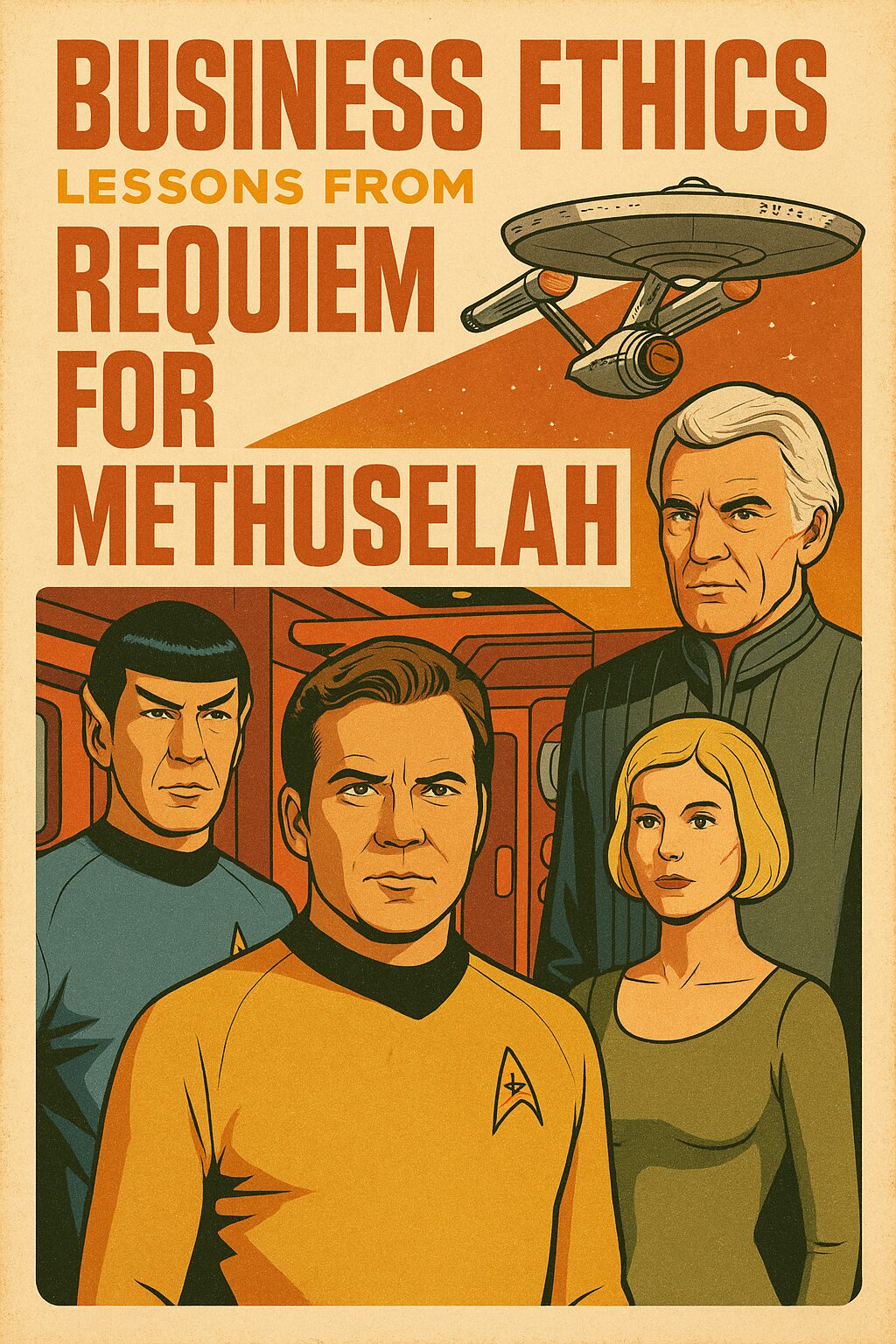
Few Star Trek episodes present an ethical crucible as layered as Requiem for Methuselah. In this episode, the Enterprise crew, seeking an urgently needed medical cure for a deadly illness sweeping the ship, beams down to a remote, seemingly uninhabited planet. There, they meet the enigmatic Flint, a man who turns out to be immortal, having lived for over 6,000 years under various identities, from Methuselah to Da Vinci. Flint lives with Rayna, a beautiful, brilliant young woman who, as the crew later learns, is not human but an android he has created.
The story unfolds into a complex web of secrecy, autonomy, manipulation, and unintended consequences, a rich territory for ethical reflection. From this episode, we can draw five business ethics lessons directly applicable to today’s corporate compliance environment.
Lesson 1: Transparency Is Essential to Trust
Illustrated By: Flint initially hides critical facts from Kirk, Spock, and McCoy: his true identity, the fact that Rayna is an android, and the location of the life-saving mineral ryetalyn they came to obtain. His secrecy stems from a desire to control the situation, but it breeds mistrust and escalating tension.
Ethics Lesson. In business, withholding material information, even with ostensibly good intentions, undermines trust—stakeholders, whether employees, customers, or regulators, expect honesty. Concealing facts creates suspicion, damages credibility, and can lead to decisions made on false assumptions. A compliance culture grounded in transparency prevents misunderstandings and reinforces stakeholder confidence.
What should you do?
- Communicate openly about relevant facts, especially those impacting health, safety, or financial stability.
- Establish disclosure protocols for potential conflicts of interest.
- Recognize that partial truths can be as damaging as outright falsehoods.
Lesson 2: Autonomy Must Be Respected, Even with Good Intentions
Illustrated by Flint, Rayna was designed to be his companion, controlling her environment and limiting her exposure to the outside world. He claims to be protecting her, but in doing so, denies her agency. When she begins to form independent thoughts and feelings, particularly toward Kirk, Flint’s inability to let go leads to tragedy.
Ethics Lesson. Corporations sometimes restrict employee autonomy under the guise of protection, micromanaging, withholding career opportunities, or blocking external engagement. Even if the motive is to “protect” the employee or company, the result can stifle growth and foster resentment. Ethical leadership means equipping people to act responsibly, not controlling every move they make.
What should you do?
- Empower individuals to make informed choices within ethical boundaries.
- Provide access to opportunities and resources without paternalistic gatekeeping.
- Respect the right of employees to voice concerns and explore options.
Lesson 3: Ends Do Not Justify the Means
Illustrated By: Flint’s primary objective, immortality, has allowed him to amass vast knowledge and wealth. Yet to achieve his goals in this episode, he manipulates the Enterprise crew, withholds the cure they need until his conditions are met, and engineers circumstances to force emotional outcomes for Rayna.
Ethics Lesson. In business, leaders may justify cutting corners or bending rules to achieve short-term results, winning a contract, securing market share, or hitting quarterly targets. But compromising ethics for results can cause long-term damage far outweighing the immediate gain. A sustainable corporate culture is built on the principle that ethical processes matter as much as business goals.
What should you do?
- Evaluate not just what you achieve, but how you achieve it.
- Build decision-making frameworks that weigh both outcomes and methods.
- Reinforce that compliance and ethics are integral to success, not obstacles to it.
Lesson 4: Emotional Intelligence Is Critical in Ethical Decision-Making
Illustrated By: Kirk’s growing attachment to Rayna closes his eyes to the urgency of his mission. McCoy warns him about becoming too emotionally involved, but Kirk underestimates the impact on his judgment. Flint, likewise, fails to foresee that forcing Rayna to choose between him and Kirk will overwhelm her, leading to her breakdown.
Ethics Lesson. In corporate environments, emotions, whether loyalty, rivalry, or fear, can cloud ethical judgment. Leaders may overlook red flags, delay action, or make decisions based on personal feelings rather than principles. Ethical clarity often requires stepping back and separating personal attachment from professional responsibility.
What should you do?
- Train leaders to recognize when emotions may be influencing decisions.
- Encourage second opinions and peer review in high-stakes decisions.
- Create safe spaces for voicing concerns about potential bias.
Lesson 5: Ethical Leadership Includes Considering Long-Term Impact
Illustrated By: Flint’s immortality has given him a unique long view of history, but in this episode, he fails to account for the long-term consequences of his actions toward Rayna and the Enterprise crew. His choices have immediate, tragic outcomes and lasting emotional scars.
Ethics Lesson. Businesses that focus solely on short-term gains, without assessing long-term impacts, risk harming their reputation, eroding stakeholder trust, and creating systemic problems. Ethical leaders anticipate not just the next quarter, but the next decade. Considering long-term consequences ensures ethical decisions hold up under the scrutiny of time.
What should you do?
- Incorporate long-term risk and ethical impact into strategic planning.
- Assess how today’s decisions will be perceived by future employees, customers, and regulators.
- Prioritize sustainability, both in environmental and cultural terms.
Why “Requiem for Methuselah” Matters for Business Ethics
The drama in Requiem for Methuselah is driven not by alien threats or galactic battles, but by human (and android) ethical dilemmas: secrecy, autonomy, manipulation, emotional entanglement, and shortsightedness. These are the same challenges corporate leaders face when navigating business ethics in the modern era.
An ethical corporate culture:
- Practices transparency to build trust.
- Respects the autonomy of individuals.
- Rejects “ends justify the means” thinking.
- Recognizes and manages the role of emotions in decision-making.
- Considers the long-term legacy of choices made today.
The compliance department is not just a rules enforcer. According to the DOJ, it is the ethics steward of the organization, ensuring that decisions at every level meet both legal and moral standards.
Final ComplianceLog Reflections
Requiem for Methuselah is ultimately a cautionary tale about the cost of ethical missteps, even for someone with the wisdom of centuries. Flint’s intellect and resources could not compensate for a failure to act with transparency, respect, and foresight.
For today’s corporate leaders, the lesson is simple: ethical decision-making is not a luxury—it is the foundation of sustainable success. The compliance function’s role is to embed these values so deeply into the corporate DNA that they guide every choice, from the boardroom to the front line.
Resources:
Excruciatingly Detailed Plot Summary by Eric W. Weisstein
MissionLogPodcast.com
Memory Alpha