


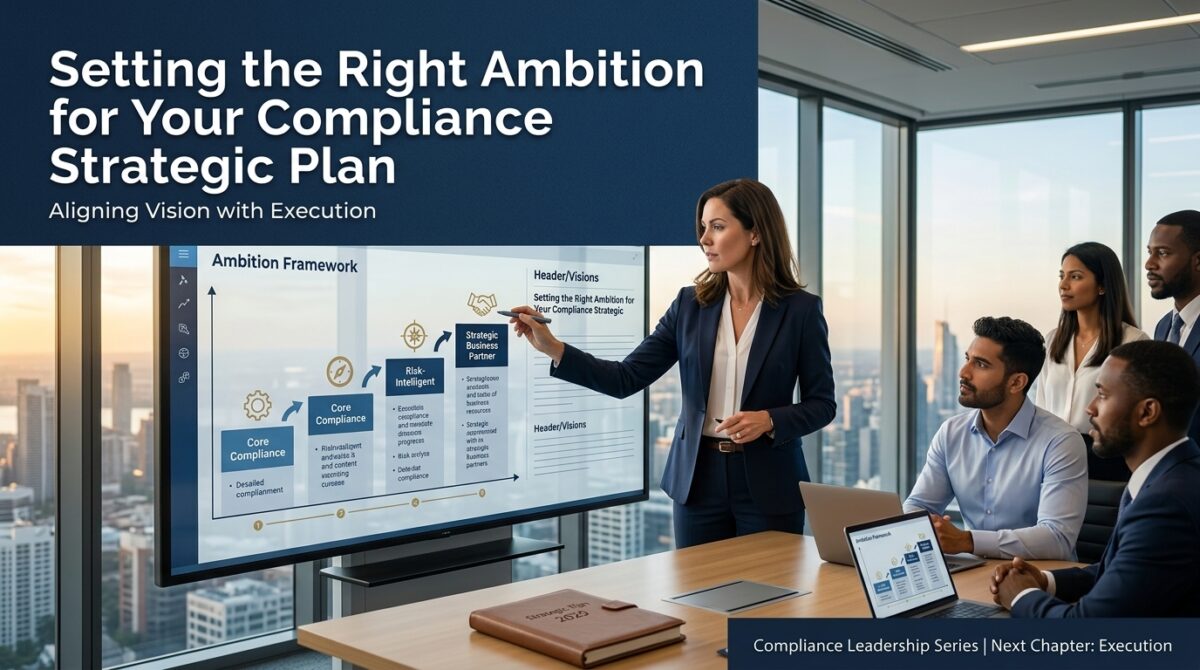
A compliance strategic plan should explain how the function will build the capabilities the business needs to manage its risks. That requires choices about priorities, resources, authority, and execution. A plan can fall short by asking the organization for too little. It can also promise more than the company is prepared to support.
Consider a CCO preparing a three-year plan while the company expands through acquisitions and new distribution channels. The proposed compliance plan calls for refreshed policies, additional training, and a new monitoring platform. Each initiative may be useful. But does the plan address the integration gaps and third-party decisions that expansion will create? And has anyone committed the people, data, and funding needed to deliver it?
Rebecca Knight explores the calibration of strategic ambition in “Is Your Strategic Plan Too Ambitious? Or Not Ambitious Enough? In the Harvard Business Review. Her article draws on insights from Columbia Business School’s Sheena Iyengar and MIT Sloan School of Management’s Donald Sull. Their discussion provides a useful foundation for examining the compliance function’s strategy. The compliance applications below build on that discussion.
Define the Problem Before Setting the Target
Knight begins with Iyengar’s advice to identify the problem a strategy must solve before debating the ambition of its targets. For CCOs, this discipline matters because familiar deliverables can substitute for a clear diagnosis. Take a goal to increase training hours. What problem requires that increase? Employees may misunderstand an approval requirement. They may understand it perfectly but lack a workable way to obtain approval before a commercial deadline. Those conditions require different responses.
The strategic plan should connect each major initiative to an identified weakness or emerging business need. If acquisitions repeatedly leave the company with incomplete third-party records, define the intended capability: an integration process that establishes ownership, identifies missing information, and escalates unresolved risks within a specified period. This gives management a concrete outcome to fund and the board a meaningful basis for oversight.
Develop Alternatives Before Committing Resources
Knight reports Iyengar’s recommendation to consider several distinct approaches so leaders can see their trade-offs. A CCO can apply this by requiring alternatives for the plan’s largest investments. Suppose the objective is better third-party monitoring. One option might strengthen existing reviews and accountability. Another might integrate procurement and payment data. A broader approach might redesign the third-party lifecycle, including who can engage an intermediary and what evidence permits renewal.
Compare the options against the actual problem, implementation demands, and expected improvement. A technology purchase may be appropriate, but its value depends on the process and information supporting it. This exercise also exposes insufficient ambition. If every option preserves the same fragmented ownership that created the problem, the CCO has reason to question whether the proposed change goes far enough. A major redesign also needs stronger justification than an attractive vision of a fully integrated program.
Make Resource Commitments Explicit
Sull’s resource argument, as Knight presents it, is that substantial strategic change can require moving money and talent away from existing commitments. That has direct implications for compliance planning. CCOs often describe new responsibilities without specifying which existing activities will change. A team already handling investigations, advice, training, and monitoring cannot absorb unlimited transformation work simply because the strategic plan assigns it a deadline.
For each major initiative, identify the required budget, expertise, business participation, and implementation time. Explain what can be simplified or discontinued and what must remain protected. Required controls and essential response capacity need explicit provision during the transition.
Dependencies deserve the same attention as the compliance budget. If success requires information technology support, procurement process changes, or finance data, obtain named owners and documented commitments. Where a critical commitment is missing, describe the resulting limitation in the proposal presented to leadership. Your board should be able to see the relationship between the approved ambition and the resources management has committed.
Build Capability Around the Business Strategy
Knight’s discussion of staffing emphasizes the expertise needed to execute a bold plan. Applied to compliance, the question extends beyond headcount to the capabilities the company’s direction requires. Acquisition-led growth may require stronger integration management. Expansion through distributors may require regional knowledge and commercial experience. A monitoring initiative may require data analysis, systems access, and people who understand how transactions occur.
Map the company’s major strategic moves to their compliance implications, then identify the skills and authority needed to respond. This helps the CCO explain why the function needs particular capabilities and when those capabilities must be available. Business alignment also requires independence of judgment. The plan should enable informed decisions about growth while preserving the CCO’s ability to challenge unsupported assumptions, escalate concerns, and identify conditions that should be met before proceeding. Management owns the commercial strategy; compliance must be equipped to assess and address its implications.
Use Pilots With Clear Decision Rules
Knight describes experimentation as a way to pursue ambitious goals while learning through smaller steps. A compliance plan can use that approach to improve processes and build new capabilities. For example, a proposed monitoring method could begin in one business unit. Before launch, define the information required, the existing controls that remain in place, the people responsible for reviewing results, and the conditions for expansion or revision.
The pilot should answer a specific question. Does the method identify relevant exceptions? Can the business resolve them? Are the results dependable enough to support decisions? A successful software demonstration alone does not answer those questions. Set a review date and a decision owner. Without those commitments, a pilot can continue indefinitely, consuming resources while providing little clarity about whether the broader strategic objective is achievable.
Measure Progress Toward a Working Capability
Knight connects a longer strategic horizon with measurable interim progress. This is particularly useful for compliance improvements that require changes across functions and systems. A multi-year goal to improve acquisition integration could include quarterly milestones for establishing ownership, validating acquired third-party records, addressing priority exceptions, and testing whether the revised process works on a subsequent acquisition.
Select measures that reveal both implementation and performance. Completing a procedure establishes that something was produced. Evidence that business teams use it, resolve exceptions, and escalate overdue actions helps show whether the capability is functioning.
Establish a baseline before claiming improvement. Faster review times need context about review quality. Fewer exceptions need context about detection coverage. Report limitations alongside results so management and directors can distinguish progress from incomplete information. The strategic plan should also specify when it will revisit assumptions. A major acquisition, a new business model, or a material change in available resources may require revised priorities and sequencing.
Give the Board Decisions It Can Assess
Board oversight becomes more useful when the CCO presents the choices behind the plan. Directors need to understand the priority problems, the proposed response, the resource commitments, and the consequences of delay.
A practical strategy discussion should explain what the function expects to accomplish, what depends on other executives, and what remains outside the funded scope. Where alternatives exist, show their implications for timing and capability. This gives the board a basis to challenge both overpromises and underinvestment. It also establishes what management should report back as the plan proceeds.
Action Steps for the CCO
Use the next planning review to test whether ambition and execution are aligned:
- Define the priority problems. State the business risk or capability gap behind each major initiative and the evidence supporting its priority.
- Compare credible alternatives. Examine different ways to achieve the intended outcome, including their costs, dependencies, and implementation demands.
- Secure resource commitments. Identify accountable business partners, required expertise, funding, and the activities that must change to make room for execution.
- Set milestones and decision points. Establish baselines, measures, pilot criteria, and dates for reassessing assumptions.
- Present the choices to the board. Explain the funded scope, unresolved dependencies, and consequences of deferring priority capabilities.
A sound compliance strategy makes a demanding but supportable commitment to improving how the company manages risk. The CCO’s responsibility is to make that commitment specific enough to execute, measure, and oversee.