Categories
Adventures in Compliance

Adventures in Compliance: The Novels – The Valley of Fear, Root Cause Analysis: Uncovering Deep-Seated Issues in Corporate Compliance

In this new season of Adventures in Compliance, host Tom Fox takes a deep dive into the Sherlock Holmes novels. Over this season, Tom will take a deep dive into each novel over a four-part series. The four novels we will consider from the ethics and compliance perspective are A Study in Scarlet, The Sign of Four, The Hound of the Baskervilles, and The Valley of Fear. For the month of August, we conclude this Season with a deep dive into the least well-known of the Sherlock Holmes novels, The Valley of Fear. 

Timothy and Fiona return to explore how Sherlock Holmes’ methods in ‘The Valley of Fear’ can be applied to modern corporate compliance. By examining five key lessons from Holmes’ approach, distinguishing symptoms from causes, expanding the scope of investigation, tracing the chain of causation, evaluating the role of fear and culture, and ensuring remediation aligns with root causes. Timothy and Fiona provide invaluable insights for anyone dealing with complex problems. This episode is essential for compliance professionals and anyone looking to delve deeper into systemic failures and long-lasting solutions.

Key highlights:

  • Lesson 1: Distinguishing Symptom from Cause
  • Lesson 2: Look Beyond the Obvious Suspects
  • Lesson 3: Trace the Chain of Causation
  • Lesson 4: Consider the Role of Fear and Culture
  • Lesson 5: Ensure Remediation Aligns with the Root Cause

 Resources:

The New Annotated Sherlock Holmes

Sherlock Holmes FAQ by Dave Thompson

Connect with Tom Fox

Instagram

Facebook

YouTube

Twitter

LinkedIn

Categories
Adventures in Compliance

Adventures in Compliance: The Novels – The Valley of Fear, Whistleblowers and Corporate Compliance

In this new season of Adventures in Compliance, host Tom Fox takes a deep dive into the Sherlock Holmes novels. Over this season, Tom will take a deep dive into each novel over a four-part series. The four novels we will consider from the ethics and compliance perspective are A Study in Scarlet, The Sign of Four, The Hound of the Baskervilles, and The Valley of Fear. For August, we conclude this Season with a deep dive into the least well-known of the Sherlock Holmes novels, The Valley of Fear.


Timothy and Fiona return in Part 3 of our series on Sir Arthur Conan Doyle’s novel ‘The Valley of Fear’ to draw parallels with contemporary corporate challenges. Their discussion highlights how the novel’s depiction of fear, secrecy, and intimidation in a terror-ruled society resembles modern-day corporate environments where employees hesitate to speak up about issues due to fear of retaliation. Some of the key points they debate include the importance of anonymity, protection from retaliation, continuous communication with whistleblowers, and building a speak-up culture. These elements are identified as vital for effective compliance programs and fostering an environment of trust and integrity.

Key highlights:

  • Connecting Fiction to Modern Corporate Challenges
  • The Role of Whistleblowers in Corporate Compliance
  • The Importance of Anonymity
  • Protection from Retaliation
  • Building a Speak-Up Culture

Resources:

The New Annotated Sherlock Holmes

Sherlock Holmes FAQ by Dave Thompson

Connect with Tom Fox

Instagram

Facebook

YouTube

Twitter

LinkedIn

Categories
Adventures in Compliance

Adventures in Compliance: The Novels – The Valley of Fear, Sherlock Holmes’ Investigative Techniques for Today’s Challenges

In this new season of Adventures in Compliance, host Tom Fox takes a deep dive into the Sherlock Holmes novels. Over this season, Tom will take a deep dive into each novel over a four-part series. The four novels we will consider from the ethics and compliance perspective are A Study in Scarlet, The Sign of Four, The Hound of the Baskervilles, and The Valley of Fear. For the month of August, we conclude this Season with a deep dive into the least well-known of the Sherlock Holmes novels, The Valley of Fear.

In Part 2, Timothy and Fiona return to continue our exploration of The Valley of Fear, where we delve into five key investigative lessons from Sherlock Holmes. Discover how Holmes’ methods of questioning initial facts, emphasizing collaborative efforts, maintaining patience, keeping a big-picture perspective, and communicating findings effectively can be applied to modern corporate and personal challenges. Learn to approach information gathering with meticulous scrutiny and uncover bigger truths hidden in the details.

Key highlights:

  • Sherlock Holmes’ Relevance Today
  • Lesson 1: Question Everything
  • Lesson 2: Investigative Cooperation
  • Lesson 3: Patience and Persistence
  • Lesson 4: Big Picture Perspective
  • Lesson 5: Effective Communication

Resources:

The New Annotated Sherlock Holmes

Sherlock Holmes FAQ by Dave Thompson

Connect with Tom Fox

Instagram

Facebook

YouTube

Twitter

LinkedIn

Categories
Blog

Sherlock Holmes and Compliance: Investigative Insights from “The Valley of Fear”

Here’s a detailed, insightful article in the style of Tom Fox for a corporate compliance audience, highlighting investigative lessons from the Sherlock Holmes novel, “The Valley of Fear.”

For compliance professionals, investigations are the bedrock of effective compliance programs. Whether it’s tracking down evidence of bribery, uncovering fraud schemes, or rooting out systemic misconduct, the investigative methods you deploy can significantly impact your organization’s integrity, reputation, and bottom line.

“The Valley of Fear” offers a wealth of investigative wisdom. Its narrative of deception, undercover operations, secret societies, and surprising plot twists provides vivid lessons highly relevant to today’s corporate compliance landscape. Let’s unpack five key investigative lessons, each illustrated with memorable scenes from this timeless detective classic.

Lesson 1: Do Not Take Facts at Face Value

Illustrated By: Detailed Analysis of the Crime Scene. Upon arrival at Birlstone Manor, Holmes carefully examines the room where Douglas’s body was discovered, noting inconsistencies like the placement of furniture, window access, and unusual blood patterns.

The central narrative of “The Valley of Fear” revolves around the apparent murder of John Douglas at his Manor House in Birlstone. Initially, the crime scene appears straightforward: Douglas has seemingly been shot at close range, and the crime scene implicates an intruder. Yet Holmes immediately suspects deeper layers beneath the obvious evidence. His meticulous examination of the scene, blood patterns, room layout, and oddities like misplaced items reveals inconsistencies that others missed.

For compliance professionals, the lesson is clear: avoid jumping to conclusions based solely on initial evidence. It is tempting and human to embrace straightforward narratives quickly. But like Holmes, investigators must resist that impulse, digging deeper, questioning assumptions, and rigorously testing evidence for hidden contradictions or overlooked facts. By refusing to accept surface-level interpretations, compliance teams protect organizations from premature and potentially misguided conclusions.

Compliance Takeaway: Always scrutinize initial evidence meticulously and objectively. Never accept evidence without question or assume that initial appearances represent complete facts.

Lesson 2: Investigative Cooperation is Essential

Illustrated By: Collaboration between Holmes and MacDonald. Holmes and Inspector MacDonald openly discuss theories, evidence, and ideas, working cooperatively rather than competitively. Holmes shares insights freely, establishing mutual trust and respect that propel the investigation forward. 

Throughout the novel, Holmes collaborates closely with Scotland Yard’s Inspector MacDonald, who initially struggles to make sense of the complex scenario. Rather than competing, Holmes works cooperatively with MacDonald, openly sharing insights, theories, and information. Their mutual respect, dialogue, and professional cooperation ultimately contribute to solving the intricate puzzle.

Corporate compliance investigations similarly require effective internal and external cooperation. Compliance departments must partner seamlessly with Legal, HR, Audit, and IT functions, as well as outside counsel or forensic experts when necessary. Effective cooperation and collaboration across departments ensure thoroughness and objectivity, minimize blind spots, and enhance investigative outcomes. Holmes demonstrates that strong investigative results rely on teamwork rather than isolation or internal competition.

Compliance Takeaway: Foster collaborative relationships across organizational functions, aligning investigative efforts with Legal, HR, IT, and other stakeholders to produce effective outcomes.

Lesson 3: Patience and Persistence Yield Results

Illustrated By: Patient Uncovering of Douglas’s Background. Holmes painstakingly reconstructs Douglas’s past life in America, gradually identifying him as a Pinkerton detective who infiltrated the Scowrers. This meticulous work takes time, patience, and sustained investigative discipline.

Holmes painstakingly pieces together the clues surrounding John Douglas, ultimately revealing Douglas’s true identity as Birdy Edwards, a former Pinkerton detective who infiltrated a dangerous criminal organization, the Scowrers, in the United States. This revelation is not instantaneous; Holmes’ success comes from persistence, incremental discovery, and careful analysis of evidence collected over time.

In corporate compliance investigations, patience and persistence are equally critical. Compliance officers must frequently manage complex, multi-faceted investigations spanning weeks, months, or even years. Instant resolutions are rare; critical information often emerges slowly and incrementally. Holmes’s deliberate and patient approach to unraveling Douglas’s identity highlights the importance of tenacity, emphasizing that thoroughness and sustained attention invariably produce the clearest investigative outcomes.

Compliance Takeaway: Recognize and embrace that thorough investigative efforts are often incremental, requiring sustained attention and patience to understand complex compliance issues fully.

Lesson 4: Maintain a Big-Picture Perspective

Illustrated By: Contextual Awareness of Moriarty’s Influence. Holmes keeps Moriarty’s potential involvement clearly in mind throughout, maintaining awareness that individual incidents might connect to larger criminal patterns.

In the novel, Holmes repeatedly emphasizes that the apparent Birlstone murder is merely one small part of a larger, sinister picture orchestrated by the infamous Professor Moriarty. Though Moriarty never physically appears, his influence permeates the narrative, connecting seemingly unrelated events and adding deeper context to the investigation. Holmes maintains a sharp awareness of this broader context throughout, ensuring he does not lose sight of underlying motivations and interconnected plots.

This lesson resonates powerfully for compliance professionals. Frequently, investigations initially perceived as isolated incidents reveal systemic compliance or ethical weaknesses within an organization. Investigators must always remain cognizant of the broader organizational, cultural, or regulatory contexts influencing misconduct. By keeping this “big picture” perspective, compliance teams ensure investigations are holistic, not narrowly focused, enabling effective systemic remediation rather than piecemeal solutions.

Compliance Takeaway: Maintain holistic awareness in compliance investigations, ensuring isolated incidents are analyzed within broader organizational, regulatory, or ethical contexts to uncover deeper systemic issues.

Lesson 5: Effective Communication is Crucial 

Illustrated By: Contextual Awareness of Moriarty’s Influence. Holmes keeps Moriarty’s potential involvement clearly in mind throughout, maintaining awareness that individual incidents might connect to larger criminal patterns.

At key points throughout the novel, Holmes carefully explains his deductions, processes, and conclusions to Inspector MacDonald, Dr. Watson, and other key players. His ability to clearly articulate reasoning and insights, especially when conclusions appear counterintuitive or complex, is essential to maintaining credibility, building consensus, and driving effective outcomes.

Corporate compliance investigators must also master clear, effective communication. It’s insufficient merely to uncover misconduct; the true skill lies in effectively communicating findings to stakeholders, management, regulators, and even potentially implicated employees. Holmes shows us that investigative brilliance must be matched by communicative clarity. In corporate settings, investigative reports must clearly explain methodology, facts, assumptions, and conclusions, ensuring decisions based on investigations are informed, justified, and actionable.

Compliance Takeaway: Maintain holistic awareness in compliance investigations, ensuring isolated incidents are analyzed within broader organizational, regulatory, or ethical contexts to uncover deeper systemic issues.

Sherlock Holmes as Compliance Inspiration

Sherlock Holmes remains an enduring inspiration to corporate compliance professionals precisely because effective investigations are foundational to compliance success. Holmes’s methods, including detailed scrutiny of evidence, a collaborative approach, patient and persistent inquiry, a holistic perspective, and clear communication, are not merely fictional flourishes; they represent essential best practices.

“The Valley of Fear” offers compliance officers vivid, relatable insights, underscoring that successful investigations require disciplined methodology, sustained inquiry, careful analysis, cross-functional cooperation, and effective stakeholder communication. As Sherlock Holmes memorably states, “It is, of course, a trifle, but there is nothing so important as trifles.” For compliance professionals today, Holmes’s wisdom is more relevant than ever, reminding us that attention to detail, disciplined process, and communicative clarity are never trivial.

By embracing Holmes’s investigative rigor and lessons from this classic novel, compliance professionals equip themselves and their organizations to meet today’s complex challenges effectively. After all, just like Holmes himself, the compliance investigator’s role is fundamentally about uncovering truth; patiently, methodically, and tirelessly ensuring organizational integrity and ethical clarity amidst a complex corporate landscape.


Categories
Adventures in Compliance

Adventures in Compliance: The Novels – The Valley of Fear, Introduction and Compliance Lessons Learned

In this new season of Adventures in Compliance, host Tom Fox takes a deep dive into the Sherlock Holmes novels. Over this season, I will take a deep dive into each novel over a four-part series. The four novels we will consider from the ethics and compliance perspective are A Study in Scarlet, The Sign of Four, The Hound of the Baskervilles, and The Valley of Fear. For the month of August, we conclude this season with a deep dive into the least well-known of the Sherlock Holmes novels, The Valley of Fear.

In this episode, Timothy and Fiona explore unconventional wisdom for modern corporate compliance by examining Sir Arthur Conan Doyle’s classic detective novel, The Valley of Fear. They discuss how Sherlock Holmes’ investigative strategies, like proactive scenario analysis, understanding complex interconnections, and creating robust internal controls, can enhance compliance practices. The episode emphasizes the importance of continuous monitoring, protecting whistleblowers, upholding ethical leadership, and embracing a culture of continuous improvement, drawing parallels between Holmes’ methods and practical compliance management.


Key highlights:

  • Introduction and the Story
  • Sherlock Holmes and Corporate Compliance
  • Holmes’ Proactive Scenario Analysis
  • Continuous Monitoring and Vigilance
  • Ethical Leadership and Corporate Governance

Resources:

The New Annotated Sherlock Holmes

Sherlock Holmes FAQ by Dave Thompson

Connect with Tom Fox

Instagram

Facebook

YouTube

Twitter

LinkedIn

Categories
Adventures in Compliance

Adventures in Compliance: The Novels – The Hound of the Baskervilles: Uncovering M&A Compliance Lessons

In this new season of Adventures in Compliance, host Tom Fox takes a deep dive into the Sherlock Holmes novels. Over the course of this season, Tom Fox will take a deep dive into each novel in a four-part series. The four novels we will consider from the ethics and compliance perspective are A Study in Scarlet, The Sign of Four, The Hound of the Baskervilles, and The Valley of Fear. For the month of July, we are considering lessons from The Hound of the Baskervilles. Today, Timothy and Fiona are back to consider the pre- and post-acquisition M&A lessons from the novel.

This episode explores the fascinating parallels between Sir Arthur Conan Doyle’s ‘The Hound of the Baskervilles‘ and modern corporate compliance. By examining Sherlock Holmes’ meticulous investigative methods, we gain critical insights into due diligence, compliance integration, and forensic investigations. Discover how to apply Sherlockian principles to proactively prevent corruption, foster an ethical corporate environment, and transform potential liabilities into assets. We break down these ideas into three stages: pre-acquisition due diligence, post-acquisition training and integration, and the handling of forensic investigations when issues arise.

Highlights include:

  • Pre-Acquisition Due Diligence: The Sherlockian Approach
  • Post-Acquisition Integration: Building a Baskerville Hall of Compliance
  • Forensic Investigations: Swift and Evidence-Based Responses
  • Conclusion: Applying Sherlockian Insights to Modern Compliance

Resources:

The New Annotated Sherlock Holmes

Sherlock Holmes FAQ by Dave Thompson

Sherlock Holmes, The Novels with an introduction by Michael Dirda

Connect with Tom Fox

Instagram

Facebook

YouTube

Twitter

LinkedIn

Categories
Blog

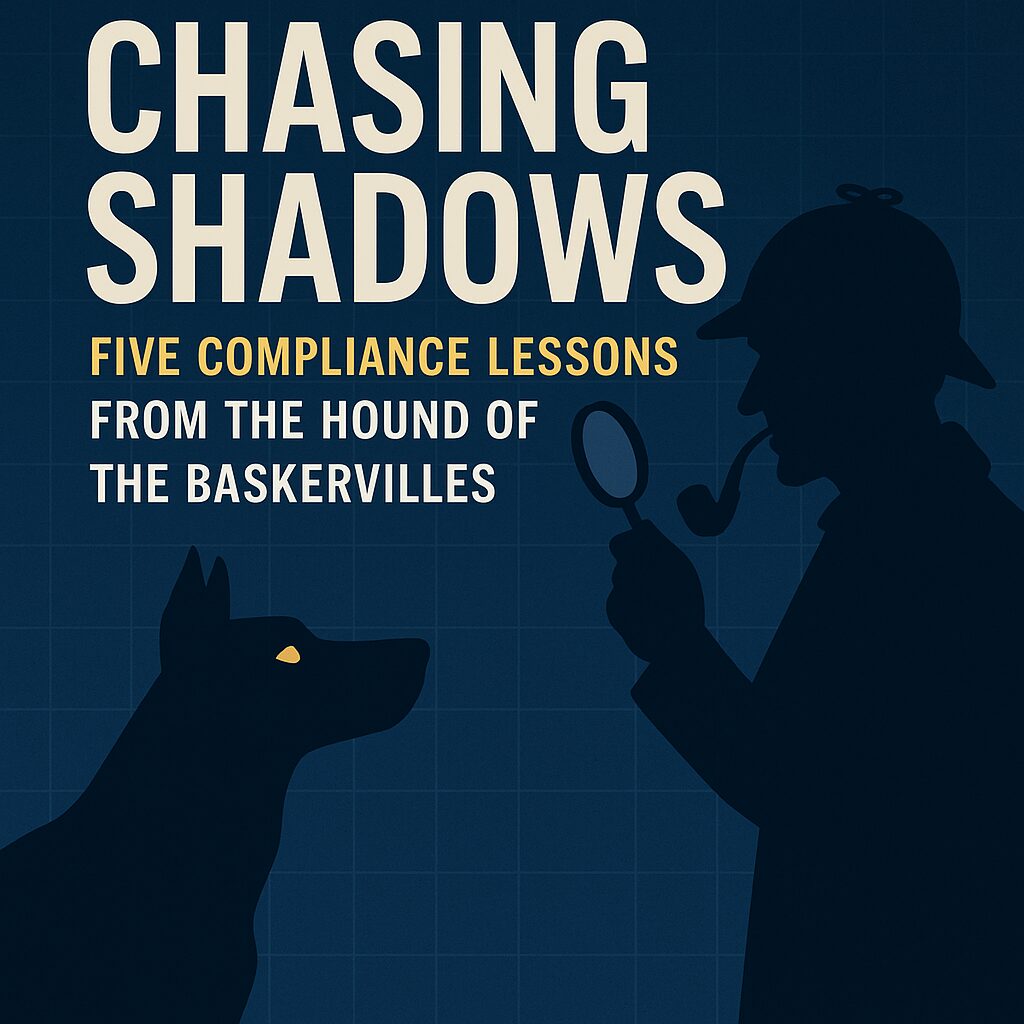
Chasing Shadows: Five Compliance Lessons from the Hound of the Baskervilles

The Hound of the Baskervilles,” penned by Sir Arthur Conan Doyle, is not only the most famous Sherlock Holmes story and a riveting detective tale but also presents timeless lessons in compliance applicable to corporate governance and risk management. Through its intricate plot and detailed character portrayals, the novel underscores several critical principles that every compliance professional should heed.

The story itself blends mystery, suspense, and supernatural elements. Sherlock Holmes and Dr. Watson investigate Sir Charles Baskerville’s mysterious death on the eerie Devonshire moors, connected to a legendary demonic hound curse. Holmes sends Watson with his heir, Sir Henry Baskerville, to the estate, where suspicious servants, an escaped convict, and peculiar neighbors—the Stapletons—heighten tensions. Watson’s observations reveal Jack Stapleton’s instability and jealousy over Sir Henry’s attention to Beryl Stapleton. Secretly investigating, Holmes identifies Stapleton as a Baskerville relative plotting Sir Henry’s death to claim the inheritance. Stapleton’s deception includes staging supernatural events to exploit local superstition. In the climax, Stapleton releases a phosphorus-painted hound to kill Sir Henry, but Holmes and Watson intervene, killing the beast. Stapleton flees, presumed dead in the Grimpen Mire. Holmes’s rational deductions triumph, dismissing supernatural fears and reinforcing logic and reason. Watson’s meticulous work is instrumental, showcasing his courage and skill. The novel concludes by affirming reason over superstition, demonstrating the dangers of irrational fear.

Here are five key compliance lessons derived from specific events within this classic tale.

Lesson 1: Avoiding Complacency in Risk Assessment

The initial approach to the mystery of Sir Charles Baskerville’s death illustrates a critical lesson in risk assessment: the importance of maintaining vigilance. Dr. Mortimer initially attributes the death to supernatural causes, influenced by local legends of a family curse. Sherlock Holmes immediately challenges this complacency, emphasizing the need for rational investigation over reliance on myths or unexamined assumptions. Holmes insists on examining evidence logically rather than accepting straightforward, sensational explanations.

Compliance professionals must similarly avoid complacency. It is easy for an organization to rely on historical assumptions or superficial risk assessments. However, genuine vigilance requires continuous questioning and reevaluation of all potential threats. By regularly revisiting risk assessments and remaining skeptical of conventional wisdom, compliance teams can better anticipate, mitigate, and respond to potential compliance failures before they escalate into significant issues.

Lesson 2: Effective Use of Data and Evidence

Throughout “The Hound of the Baskervilles,” Holmes’s meticulous use of evidence exemplifies the necessity of thorough documentation and analysis in achieving effective compliance outcomes. One key example is Holmes’s careful examination of Sir Henry Baskerville’s stolen boots. Holmes correctly deduces that the shoes were stolen to provide the hound with Sir Henry’s scent. This attention to minute detail and systematic analysis underscores the importance of robust documentation and record-keeping.

Compliance professionals should similarly prioritize precise data collection, rigorous documentation, and evidence-based decision-making. Proper documentation provides transparency, facilitates effective audits, and ensures clarity when addressing compliance issues or regulatory inquiries. By fostering a culture where data-driven decision-making is standard practice, organizations can strengthen their compliance programs and more effectively prevent violations.

Lesson 3: Maintaining Independence and Objectivity

A pivotal moment in the novel occurs when Holmes secretly arrives on the moor, independent of Watson’s investigation. Holmes understands the importance of maintaining independence to gather unbiased information. By conducting a parallel investigation that is free from local biases and personal relationships, Holmes preserves objectivity and ultimately identifies the true culprit, Jack Stapleton.

For compliance professionals, maintaining independence and objectivity is equally vital. Conflicts of interest can obscure judgment and compromise investigations. Compliance officers must be empowered to act independently, free from undue influence, to ensure the integrity of their findings and recommendations. Establishing clear reporting structures and supporting unbiased investigative procedures can significantly enhance an organization’s overall compliance effectiveness.

Lesson 4: Transparent Communication and Reporting

Transparency is repeatedly highlighted as essential throughout Conan Doyle’s narrative. Watson’s regular and detailed correspondence with Holmes exemplifies clear, transparent reporting. Watson meticulously records his observations, suspicions, and interactions, ensuring Holmes remains informed of developments in real time. This ongoing communication proves instrumental in Holmes’s eventual successful intervention.

In the realm of corporate compliance, transparent communication and reporting are equally critical. Employees must feel encouraged and supported in reporting suspicious activities or compliance concerns without fear of retaliation or retribution. Implementing precise and accessible reporting mechanisms, while ensuring open lines of communication, fosters a culture that is compliant-friendly. This transparency enables compliance teams to detect and address issues promptly, thereby reducing organizational exposure to risk and promoting an ethical business environment.

Lesson 5: Importance of Culture and Ethics

The actions and eventual downfall of Jack Stapleton underscore a profound lesson in compliance regarding organizational culture and ethics. Stapleton manipulates local fears and exploits the legend of the supernatural hound to facilitate his criminal plans. His unethical behavior, driven by greed and a disregard for human life, ultimately led to his ruin.

Organizations must prioritize building and maintaining a strong ethical culture. Leadership should exemplify ethical behavior, clearly communicate expectations, and swiftly address unethical actions. Regular training and communication regarding ethical standards reinforce an organization’s values and expectations. By cultivating a robust ethical culture, organizations not only reduce the likelihood of compliance violations but also enhance their reputation and long-term sustainability.

The Hound of the Baskervilles” offers rich insights for compliance professionals. Avoiding complacency, emphasizing evidence-based decision-making, maintaining independence, ensuring transparent communication, and fostering a robust ethical culture are foundational principles that are vividly highlighted throughout Conan Doyle’s timeless narrative. These lessons, illustrated through specific events and character decisions within the story, remain deeply relevant in guiding modern corporate compliance practices.

Categories
Adventures in Compliance

Adventures in Compliance: The Novels – The Hound of the Baskervilles: Uncovering Compliance – Lessons from The Hound of the Baskervilles

In this new season of Adventures in Compliance, host Tom Fox takes a deep dive into the Sherlock Holmes novels. Over this season Tom will take a deep dive into each novel over a four part series. The four novels we will consider from the ethics and compliance perspective are A Study in Scarlet, The Sign of Four, The Hound of the Baskervilles and The Valley of Fear. For the month of July we are considering lessons from The Hound of the Baskervilles.

Fiona and Timothy are back to extract five key compliance lessons from the story, including combating complacency, effective data use, maintaining objectivity, transparent communication, and ethical culture. These principles, drawn from a Victorian mystery, prove profoundly relevant for modern corporate compliance.

Highlights include:

  • Overview of Compliance Lessons from Sherlock Holmes
  • Lesson 1: Avoiding Complacency
  • Lesson 2: Power of Effective Data and Evidence
  • Lesson 3: Independence and Objectivity
  • Lesson 4: Transparent Communication and Reporting
  • Lesson 5: Importance of Culture and Ethics

Resources:

The New Annotated Sherlock Holmes

Sherlock Holmes FAQ by Dave Thompson

Sherlock Holmes, The Novels, with an introduction by Michael Dirda

Connect with Tom Fox

Instagram

Facebook

YouTube

Twitter

LinkedIn

Categories
Adventures in Compliance

Adventures in Compliance: The Novels – The Hound of the Baskervilles, Introduction and Compliance Lessons Learned

In this new season of Adventures in Compliance, host Tom Fox takes a deep dive into the Sherlock Holmes novels. Throughout this season, Tom will delve into each novel in a four-part series. The four novels we will consider from the ethics and compliance perspective are A Study in Scarlet, The Sign of Four, The Hound of the Baskervilles, and The Valley of Fear.

In this episode (and for the entire month of July), we focus on the most famous Holmes novel, ‘The Hound of the Baskervilles.’ Timothy and Fiona are back to explore the key elements of the novel, connecting them with compliance themes and investigative techniques. They dissect the storyline, reveal insights, and discuss timeless lessons in rational thinking, the perils of unquestioned beliefs, and the power of meticulous observation and teamwork. Additionally, Tom invites listeners to provide feedback on the use of AI voices and offers to help those interested in starting their podcasts.

Highlights include:

  • Deep Dive into The Hound of the Baskervilles
  • The Mysterious Case Unfolds
  • Holmes’ Investigation and Revelations
  • Lessons from The Hound of the Baskervilles

Resources:

The New Annotated Sherlock Holmes

Sherlock Holmes FAQ by Dave Thompson

Sherlock Holmes, The Novels, with an introduction by Michael Dirda

Connect with Tom Fox

Instagram

Facebook

YouTube

Twitter

LinkedIn

Categories
Adventures in Compliance

Adventures in Compliance: The Sign of Four – Holmes Revealed: Communication and Training Insights

In this new season of Adventures in Compliance, we take a deep dive into the Sherlock Holmes novels. Today, we conclude our four-part exploration of the novel The Sign of Four with a deep dive into communication and training lessons for the compliance professional. Timothy and Fiona dissect Holmes’ meticulous methods of deduction, uncovering essential strategies for clear, effective, and engaging communication. Key topics include forensic clarity, varied reinforcement, tailored messaging, the importance of transparency, setting clear expectations, interactive training techniques, and crisis communication preparedness. Learn how these principles can enhance your professional interactions and build a more resilient, informed culture within your organization.

Highlights include:

  • Exploring Sherlock Holmes’ Communication Lessons
  • Forensic Clarity in Communication
  • The Power of Repetition and Reinforcement
  • Tailoring Messages for Different Audiences
  • Building Trust Through Transparency
  • Setting Clear Expectations

Resources:

The New Annotated Sherlock Holmes

Sherlock Holmes FAQ by Dave Thompson

Connect with Tom Fox

Instagram

Facebook

YouTube

Twitter

LinkedIn