


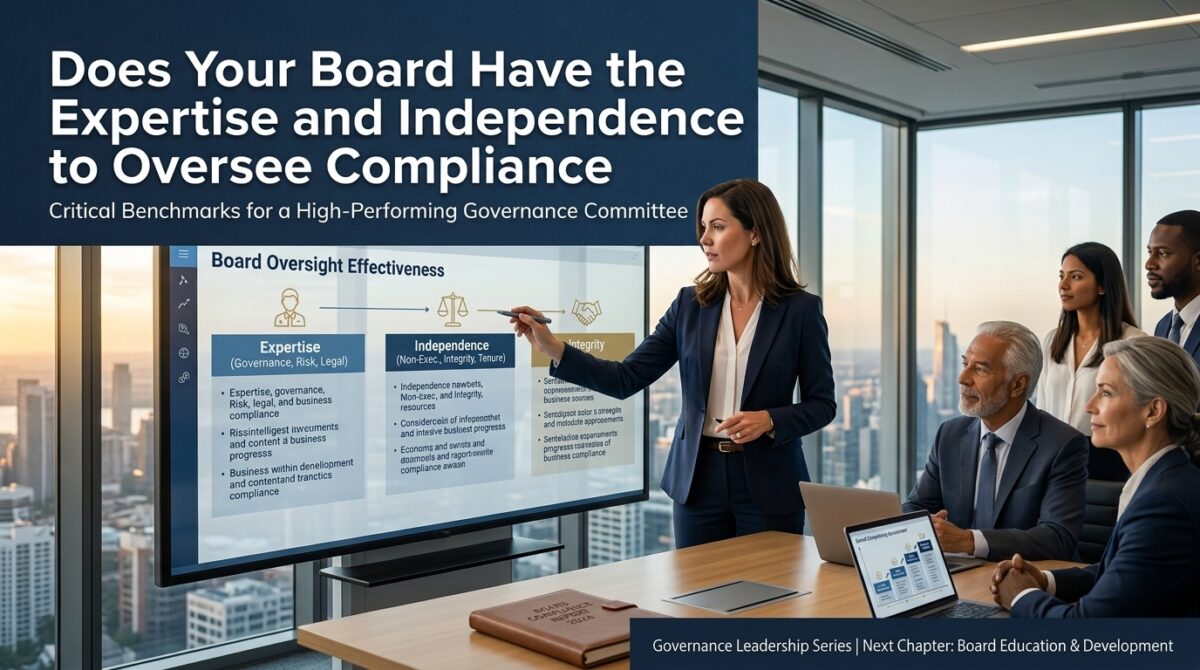
A board can have impressive credentials and still lack the experience needed to challenge management on the company’s most significant compliance risks. Directors may understand finance, strategy, and operations in broad terms while struggling to recognize how misconduct could arise within a particular business model. Effective oversight requires relevant knowledge and the willingness to use it when the answers become uncomfortable.
For the chief compliance officer, that makes board capability a practical program issue. The quality of oversight influences the questions management must answer, the resources compliance receives, and what happens when a concern conflicts with a commercial priority. Today we examine board composition in the article Measuring Board Fit — Evidence from Elliott’s Campaign at Norwegian Cruise Line, from the Harvard Law School Forum on Corporate Governance. Their analysis uses AI to compare directors’ professional backgrounds with company strategy and with one another. It offers a starting point for a broader compliance question: Does this board have the expertise and independent judgment to oversee the risks this company actually faces?
Look Beyond the Skills Matrix
DesJardine and Mertens argue that conventional skills matrices can conceal meaningful differences in experience. Two directors may receive the same designation for operations or risk management while bringing very different capabilities to the boardroom.
The compliance application is straightforward. A risk management designation should prompt further inquiry into the nature, relevance, and recency of that experience. Has the director overseen a business using intermediaries in difficult markets? Has the director managed the integration of acquired companies? Examined an investigation involving senior leadership? Challenged a compensation structure that encouraged questionable conduct? No director needs to possess every capability. The board and its committees do need an informed basis for questioning management across the company’s priority risks.
The CCO can help define that basis. Translate the risk assessment into the experience and understanding needed for oversight. Where third-party conduct creates substantial exposure, explain the commercial relationships, payment practices, and escalation decisions directors need to understand. This gives the nominating and governance committee a more useful description than a generic request for compliance expertise.
Read the Norwegian Findings Carefully
The authors apply their method to Norwegian Cruise Line Holdings before and after Elliott Investment Management’s campaign, comparing its board with those of three cruise industry peers. They report that the company’s board-to-company similarity score increased from 0.382 to 0.396 following the changes. Average director-to-board similarity declined from 0.729 to 0.701, which they interpret as more distinct professional perspectives.
Those results describe changes in the authors’ measures of professional alignment and overlap. They do not establish that the reconstituted board became more effective at compliance oversight, that individual directors exercised greater independence, or that misconduct risk declined. That distinction matters for CCOs. An assessment can identify questions about composition without answering how directors perform. A board with relevant backgrounds still needs reliable information, sufficient time, and the resolve to follow an issue through. The practical response is to combine an examination of credentials with evidence of the board’s oversight process.
Examine Independence Through the Oversight Process
The authors acknowledge that their method cannot assess integrity, interpersonal skills, or willingness to challenge a chief executive. Those limitations point directly to the independent judgment compliance oversight requires. Consider a hypothetical board discussion about a distributor generating substantial revenue while repeatedly failing to provide requested ownership information. Management recommends extending the relationship during further review. A director with relevant experience may recognize how significant the missing information is. The next question is whether the board presses management to explain the proposed safeguards, decision authority, and consequences of continued delay.
The CCO should help create the conditions for that discussion. Present the facts, uncertainties, available options, and recommendation clearly. Identify who owns the decision and what would trigger escalation. Provide access to the underlying analysis where needed.
Direct access to the responsible committee and opportunities for discussion without management present can support candid oversight. Follow-up is equally important. An unresolved concern should return with updated evidence and a clear account of management’s actions. A difficult question has value when the governance process ensures it receives an adequate answer.
Make Expertise Usable Through Better Information
Even an experienced director can struggle with reports that emphasize activity while obscuring unresolved risk. Assess board capability and reporting quality together. A presentation may show that due diligence reviews are complete without explaining the exceptions approved. Investigation statistics may omit repeated issues within one business unit. Remediation updates may describe actions as finished without showing whether the revised controls work.
A CCO should organize reporting around decisions and consequences. Explain the issue, the evidence, management’s response, and what remains unresolved. When a commercial objective conflicts with a compliance recommendation, make that tension clear. Directors can then apply their experience to a concrete problem. Does the proposed response address the cause? Is the responsible executive accountable for delivery? What evidence will show that the correction is working? These questions help convert professional knowledge into oversight of program effectiveness.
Preserve Perspectives That Challenge Assumptions
The authors examine both alignment with company strategy and similarity among directors. That combination highlights a tension: a board needs relevant experience while retaining perspectives that question the organization’s assumptions. For compliance, industry familiarity can help a director spot questionable practices. It can also leave accepted business conventions insufficiently examined. Experience from another sector may expose weaknesses in customer treatment, escalation, or control ownership that insiders have normalized.
A CCO should therefore avoid equating a closely matched background with superior judgment. Ask what the board needs to understand and where a different perspective could improve its questions. Director education can help close specific knowledge gaps. Sessions built around the company’s actual processes, anonymized matters, and emerging business changes can give directors a better foundation for challenge. Persistent gaps may also warrant discussion of committee expertise or board recruitment, with those decisions remaining with the appropriate governance bodies.
Use AI Assessment as a Diagnostic Input
DesJardine and Mertens use contextualized word embeddings, a technique that turns text into numerical representations, to compare professional and company profiles. The approach can surface similarities that broad categories miss. For a board considering such analysis, the CCO and governance team should ask what information supports each profile and what the resulting score actually measures. Public biographies and media coverage provide an incomplete record of a director’s contributions. The volume and character of available material may differ substantially between candidates.
Company disclosures also describe the organization through a particular lens. Similarity to that description does not necessarily establish the expertise needed to address an overlooked risk or challenge an unsuccessful strategy. Use the output to inform interviews, reference discussions, and committee deliberations. Ask how sensitive the result is to source selection and whether the underlying evidence supports the interpretation. Record significant limitations. A numerical score should help the board investigate a capability question; appointment and evaluation decisions require accountable human judgment.
Action Steps for the CCO
Bring a practical assessment of oversight capability to the next discussion with the committee chair:
- Map priority risks to oversight knowledge. Identify what directors need to understand about the company’s business practices, controls, and escalation decisions.
- Provide evidence of capability gaps. Work with the corporate secretary and general counsel to inform education and composition discussions, using specific examples rather than broad labels.
- Strengthen the conditions for independent challenge. Establish clear access, candid reporting, and follow-up arrangements for unresolved concerns, including matters involving senior management.
- Test the usefulness of board reporting. Ensure directors can see material exceptions, recurring issues, remediation evidence, and decisions requiring their attention.
- Apply scrutiny to AI assessments. Examine source quality, missing information, and the limits of similarity measures before incorporating results into governance decisions.
Effective compliance oversight depends on directors who understand the company’s risks and are prepared to question how management addresses them. The CCO can strengthen that oversight by making capability needs explicit and ensuring the board receives the evidence needed to exercise its judgment.