Categories
Trekking Through Compliance

Trekking Through Compliance: Episode 60 – Gunsmoke and Gaps: How ‘Spectre of the Gun’ Informs Modern Compliance Investigations

The compliance world may not often resemble the Wild West, but the best compliance investigators know that the strange and surreal are not always fiction. Misunderstandings, missing evidence, and “unwritten rules” can make the truth as elusive as any Melkotian illusion. “Spectre of the Gun” provides a powerful lens through which to examine the investigative process. Today, we saddle up and explore five essential investigative lessons for compliance professionals from Tombstone in the Arizona Territory, as featured in this classic episode.

1. Never Assume Reality Is What It Seems

Illustrated By: From the moment Kirk and his team arrive, things are… off.

Compliance Lesson. In a compliance investigation, assumptions are your enemy. Initial appearances can deceive, especially when dealing with incomplete data, manipulated records, or the subtle influence of organizational culture.

2. Stay Calm in the Face of Escalating Pressure

Illustrated By: As the clock ticks toward 5:00, the hour of the gunfight, the crew experiences mounting psychological stress, but Kirk repeatedly counsels his team to stay calm and focused, even as the “inevitable” doom approaches.

3. Leverage Diverse Perspectives and Skills

Illustrated By: Each member of the landing party brings a unique skill to the puzzle.

Compliance Lesson. No single investigator has all the answers. The best compliance investigations are team efforts, drawing on legal, HR, IT, and business expertise. This diversity helps spot blind spots and ensures that all avenues are explored.

4. Test Hypotheses—Don’t Just Accept Stories

Illustrated By: Spock theorizes that their minds are the only reality that matters. The crew realizes they must test each new hypothesis about their environment, ultimately concluding that belief itself will determine the outcome of the gunfight.

Compliance Lesson. Compliance investigators must go beyond the “story” provided by policy manuals or initial interviews. Every theory, whether about a missing document, a suspicious transaction, or a timeline inconsistency, should be tested.

5. Mindset Shapes Outcomes—Don’t Underestimate the Power of Belief

Illustrated By: As the showdown approaches, Spock deduces that their survival depends on their conviction that the Earps’ bullets cannot harm them. He leads the crew in a Vulcan mind meld, focusing their thoughts on total certainty in their safety.

Compliance Lesson. While compliance investigators don’t need Vulcan mind melds, the principle is clear: the mindset you bring to your investigation—open-mindedness, integrity, and thoroughness—shapes the outcome. Cynicism, bias, or defeatism can close your eyes to the real issues.

Final ComplianceLog Reflections

Spectre of the Gun” is more than a surreal Star Trek adventure; rather, it is a case study in the art and science of investigation. As compliance professionals, we may not face ghostly gunfights at sundown, but we do face situations where logic, courage, and creative teamwork are our only tools against the unknown.

So, as you saddle up for your next compliance investigation, remember the lessons of the Enterprise crew in Tombstone. The truth is out there sometimes behind the facade, sometimes hiding in plain sight.

Resources:

⁠⁠Excruciatingly Detailed Plot Summary by Eric W. Weisstein⁠⁠

⁠⁠MissionLogPodcast.com⁠⁠

⁠⁠Memory Alpha


Categories
Blog

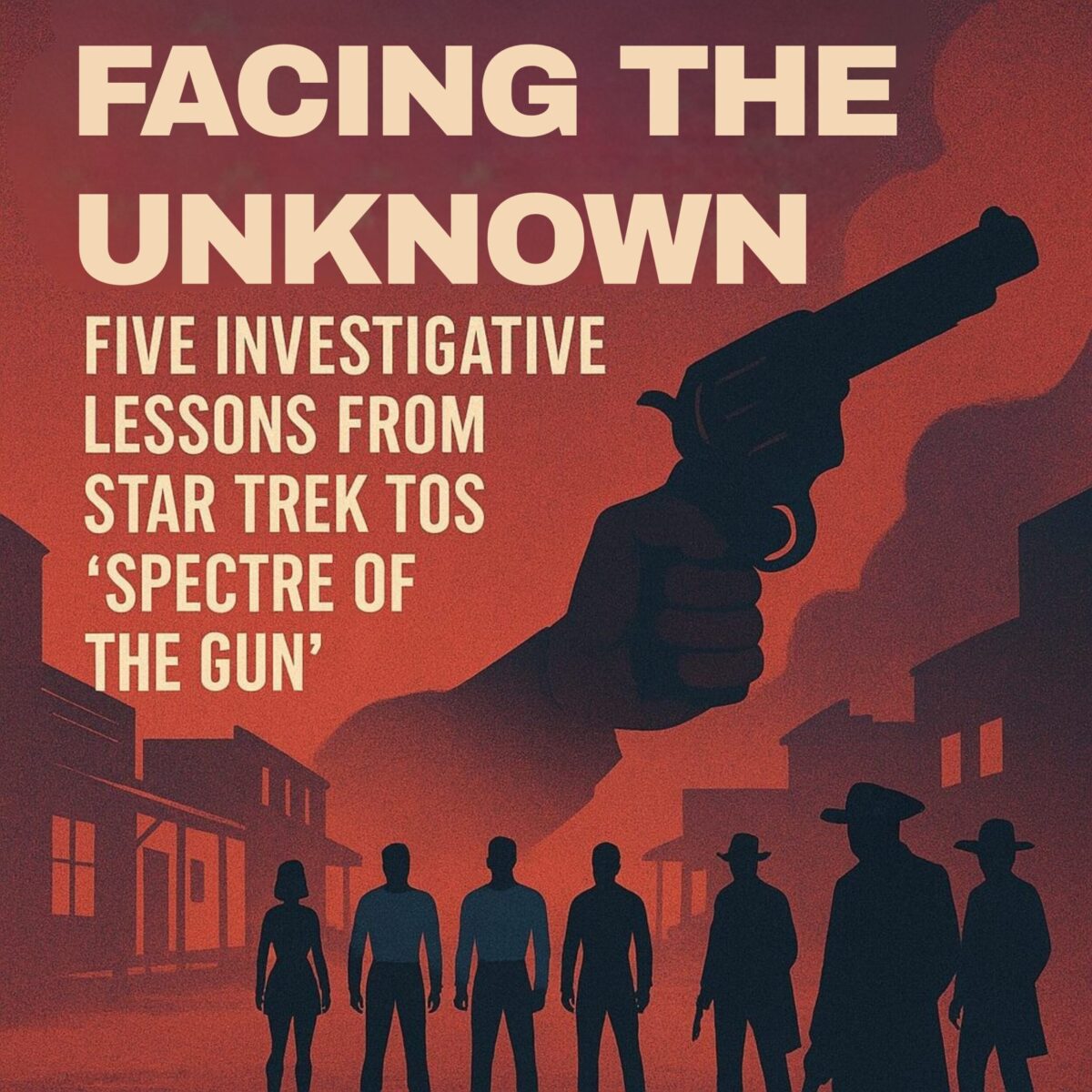
Facing the Unknown: Five Investigative Lessons from Star Trek’s “Spectre of the Gun”

One of the most fascinating aspects of compliance investigations is navigating the unknown—those ambiguous, often illogical circumstances where instinct and method must work together. Few television episodes dramatize this challenge as vividly as the Star Trek: The Original Series (TOS) episode, “Spectre of the Gun.”

In this third-season episode, Captain Kirk and his landing party beam down to a planet of the reclusive and telepathic Melkotians, only to be punished for trespassing. Their punishment? Being cast into a surreal, incomplete recreation of the 1881 Gunfight at the O.K. Corral, destined to play the losing side against the Earps and Doc Holliday. As the Enterprise crew quickly learns, logic, memory, and even physical law are unreliable. Their investigation into their predicament and their survival depends on teamwork, analysis, and the willingness to question what’s real.

The compliance world may not often resemble the Wild West, but the best compliance investigators know that the strange and surreal are not always fiction. Misunderstandings, missing evidence, and “unwritten rules” can make the truth as elusive as any Melkotian illusion. “Spectre of the Gun” provides a powerful lens through which to examine the investigative process.

Today, we saddle up and explore five essential investigative lessons for compliance professionals from Tombstone in the Arizona Territory, as featured in this classic episode.

1. Never Assume Reality Is What It Seems

Illustrated By: From the moment Kirk and his team arrive, things are… off. The town is half-finished, with buildings lacking walls and only a few facades standing. There are missing objects and inexplicable absences. Despite this, the crew initially tries to follow the “script” of Tombstone’s history, assuming their actions will play out as expected.

Compliance Lesson. In a compliance investigation, assumptions are your enemy. Initial appearances can deceive, especially when dealing with incomplete data, manipulated records, or the subtle influence of organizational culture. Like the Enterprise crew, investigators often find themselves in environments that “look” right but don’t quite add up.

A skilled investigator asks:

  • What’s missing from this picture?
  • Are there gaps or inconsistencies in the documentation?
  • Do witness accounts align, or are they conspicuously similar as if rehearsed?

Always challenge the first layer of evidence. Probe for context. Cross-check data sources and resist the urge to “solve” the case too quickly.

Takeaway:

If your compliance investigation feels too neat, step back and re-examine. The truth often lies in the gaps, not the obvious.

2. Stay Calm in the Face of Escalating Pressure

Illustrated By: As the clock ticks toward 5:00, the hour of the gunfight, the tension mounts. The Earps are aggressive, and the townsfolk are hostile or unhelpful. The crew experiences mounting psychological stress, but Kirk repeatedly counsels his team to stay calm and focused, even as the “inevitable” doom approaches.

Compliance Lesson. Investigations often bring high-pressure moments: interviewees who become confrontational, business leaders who want quick resolutions, or whistleblowers who fear retaliation. In these moments, emotions can cloud judgment and cause missteps.

Spectre of the Gun” shows that, when panic rises, clear-headed leadership and methodical process are essential. Kirk’s calm enables the team to think creatively and challenge assumptions, ultimately saving their lives.

In compliance investigations:

  • Set clear ground rules for interviews.
  • Create a calm environment, even when accusations are severe.
  • Support your team and witnesses, especially when the stakes are high.

What should you do now? Under pressure, composure and methodical thinking separate successful investigators from those who react.

3. Leverage Diverse Perspectives and Skills

Illustrated By: Each member of the landing party brings a unique skill to the puzzle. Spock applies logic to interpret the unreality of their situation. McCoy’s medical knowledge helps craft “anti-venom” to counter the gas used by Doc Holliday. Scotty and Chekov offer technical and tactical ideas, while Kirk analyzes motivations and strategy.

Compliance Lesson. No single investigator has all the answers. The best compliance investigations are team efforts, drawing on legal, HR, IT, and business expertise. This diversity helps spot blind spots and ensures that all avenues are explored.

In the episode, Spock recognizes that their environment is illusory, and the group’s willingness to trust his logic unlocks their escape. In your investigations:

  • Gather a multidisciplinary team.
  • Encourage open debate and the airing of alternate theories.
  • Leverage outside expertise when needed, such as forensic accountants or language specialists.

What should you do now? Diversity is not just about backgrounds; it is about thinking styles and problem-solving approaches. Use every tool at your disposal.

4. Test Hypotheses—Don’t Just Accept Stories

Illustrated By: When McCoy attempts to make “real” tranquilizer gas to stop the Earps, it fails, as the gas has no effect, because nothing in their environment is truly real. Spock theorizes that their minds are the only reality that matters. The crew realizes they must test each new hypothesis about their environment, ultimately concluding that belief itself will determine the outcome of the gunfight.

Compliance Lesson. Compliance investigators must go beyond the “story” provided by policy manuals or initial interviews. Every theory, whether about a missing document, a suspicious transaction, or a timeline inconsistency, should be tested.

This may mean:

  • Reconstructing timelines.
  • Running technical or forensic tests.
  • Seeking out independent corroboration for claims.

In the episode, only by testing (and failing) do Kirk and his team realize what’s going on. Similarly, failed hypotheses in your investigation are not a waste; they point you closer to the truth.

What should you do now? Test your investigative theories actively. Do not accept stories at face value; experiment, reconstruct, and challenge.

5. Mindset Shapes Outcomes—Don’t Underestimate the Power of Belief

Illustrated By: As the showdown approaches, Spock deduces that their survival depends on their conviction that the Earps’ bullets cannot harm them. He leads the crew in a Vulcan mind meld, focusing their thoughts on total certainty in their safety. When the bullets fly, they are unharmed—because they believe they cannot be hurt.

Compliance Lesson. While compliance investigators don’t need Vulcan mind melds, the principle is clear: the mindset you bring to your investigation—open-mindedness, integrity, and thoroughness—shapes the outcome. Cynicism, bias, or defeatism can close your eyes to the real issues.

Additionally, the mindset of the organization matters. If employees believe investigations are futile or predetermined, they won’t participate honestly. If they believe in the integrity of the process, you’ll get better results.

Set the tone by:

  • Demonstrating impartiality.
  • Communicating the importance of the investigative process.
  • Encouraging a “speak-up” culture where all feel heard.

What should you do now? The beliefs and values you bring to an investigation shape its success. Foster a culture of open-mindedness, curiosity, and fairness.

Final ComplianceLog Reflections

Spectre of the Gun” is more than a surreal Star Trek adventure; rather, it is a case study in the art and science of investigation. As compliance professionals, we may not face ghostly gunfights at sundown, but we do face situations where logic, courage, and creative teamwork are our only tools against the unknown.

So, as you saddle up for your next compliance investigation, remember the lessons of the Enterprise crew in Tombstone. The truth is out there, sometimes behind the facade, hiding in plain sight.

Resources:

⁠⁠Excruciatingly Detailed Plot Summary by Eric W. Weisstein⁠⁠

⁠⁠MissionLogPodcast.com⁠⁠

⁠⁠Memory Alpha

Categories
Blog

Lessons on Ongoing Monitoring and Continuous Improvement from Star Trek: Spectre of the Gun

Last month, I wrote a blog post on the tone at the top, exemplified in Star Trek’s Original Series episode, Devil in the Dark. Based on the response, some passionate Star Trek fans are out there. I decided to write a series of blog posts exploring Star Trek: The Original Series episodes as guides to the Hallmarks of an Effective Compliance program set out in the FCPA Resources Guide, 2nd edition. Today, I will continue my two-week series by looking at the following Hallmarks of an Effective Compliance Program laid out by the Department of Justice (DOJ) and Securities and Exchange Commission (SEC) in the FCPA Resources Guide, 2nd edition. Today, we look at lessons learned about ongoing monitoring and continuous improvement from the episode Spectre of the Gun, which provides a compelling narrative to explore the compliance concepts of ongoing monitoring and continuous improvement within a best practices compliance program.

In “Spectre of the Gun,” Captain Kirk and his crew are sent to make contact with the Melkotians, a reclusive alien species. Despite a warning buoy advising them to leave, the crew presses forward, and as a result, the Melkotians transport them into a surreal, incomplete version of the American Wild West. The crew finds themselves in a reenactment of the infamous Gunfight at the O.K. Corral, with Kirk, Spock, McCoy, Scotty, and Chekov cast as the doomed Clanton gang. The situation forces the crew to adapt rapidly, relying on their ingenuity and continuous assessment of their circumstances to survive. This scenario provides valuable lessons for compliance professionals on monitoring and constant improvement.

Lesson 1. Ongoing Monitoring and Continuous Assessment

In the Melkotian scenario, the Enterprise crew must continuously assess their environment to understand its limitations and potential dangers. The partial nature of the setting indicates that their perceptions can influence outcomes, requiring constant vigilance and situational awareness.

Continuous assessment is crucial for effective compliance programs. Organizations must be keenly aware of their regulatory environment and internal operations to identify potential risks and changes affecting compliance. This involves regular audits, risk assessments, and monitoring of key performance indicators to detect issues early. By maintaining situational awareness, compliance teams can proactively address emerging risks and ensure adherence to policies and regulations.

Lesson 2. Adapting Strategies Based on Feedback

Throughout the episode, the crew receives feedback from their interactions within the environment, leading them to adjust their strategies. Spock’s logical deductions and Kirk’s leadership guide the crew in adapting their actions to overcome the perceived threat.

Adaptability and flexibility are essential components of continuous improvement in compliance programs. Organizations should encourage a culture where feedback is sought and used to refine compliance strategies and controls. Implementing regular reviews and updates to compliance policies based on feedback and lessons learned ensures that the program remains effective and responsive to changes. Continuous improvement processes, such as after-action reviews and root cause analyses, enable organizations to refine their approaches and enhance compliance outcomes.

Lesson 3. Leveraging Expertise and Collaboration

The crew relies on Spock’s logical analysis and each member’s unique skills to navigate the challenges of the scenario. Their ability to collaborate and leverage individual strengths is key to their survival.

Effective compliance programs rely on the expertise and collaboration of diverse teams. Organizations should foster cross-functional collaboration, bringing together individuals from different departments to address compliance challenges comprehensively. Leveraging expertise from legal, risk management, operations, and other areas enhances the organization’s ability to monitor compliance effectively and implement improvements. Encouraging open communication and teamwork ensures that diverse perspectives contribute to developing robust compliance solutions.

Lesson 4. Proactive Problem-Solving and Innovation

The crew’s success in the scenario depends on their ability to innovate and develop creative solutions to their challenges. Spock realizes that the bullets are not real, and the crew’s collective belief in this fact allows them to avoid harm.

Proactive problem-solving and innovation are critical for continuous improvement in compliance programs. Organizations should encourage employees to think creatively and explore innovative solutions to compliance challenges. This involves fostering a culture that supports experimentation and learning from successes and failures. By empowering employees to propose and test new approaches, organizations can continuously enhance their compliance programs and remain agile in the face of change.

Lesson 5. Staying Vigilant

In the episode, the Enterprise crew is transported to an alternate reality where they must participate in a deadly reenactment of the O.K. Corral shootout. The crew must constantly adapt their strategies and tactics as the scenario changes. Similarly, compliance professionals need to remain vigilant and be prepared to adjust their compliance programs to address evolving risks, regulations, and business environments. Compliance professionals should take a comprehensive approach, conducting holistic risk assessments that consider obvious and obscure compliance risks across the organization.

As the crew faces new challenges in the alternate reality, they must quickly learn from their experiences and refine their strategies. Compliance professionals should similarly adopt an iterative approach to improving their programs, constantly evaluating their effectiveness and making adjustments as needed. By drawing these parallels between the lessons from “The Spectre of the Gun” and the practices of effective compliance management, compliance professionals can strengthen their programs and foster a culture of continuous improvement within their organizations.

Spectre of the Gun provides valuable insights into ongoing monitoring and continuous improvement compliance concepts. The episode highlights the importance of constant assessment, adaptability, collaboration, and proactive problem-solving in navigating complex and dynamic challenges. For compliance professionals, the key takeaway is the need to establish robust monitoring systems, encourage adaptability and innovation, and foster a culture of collaboration and continuous improvement. By applying these principles, organizations can enhance compliance programs, effectively manage risks, and achieve sustainable success in an ever-evolving regulatory landscape. Just as the Enterprise crew adapted to and overcame the challenges presented by the Melkotians, compliance professionals must remain vigilant and proactive in navigating the complexities of modern compliance environments.

Join us tomorrow as we consider the lessons on mergers and acquisitions from the Star Trek episode The Ultimate Computer.

Categories
Trekking Through Compliance

Trekking Through Compliance – Episode 61 – Using Technology in Compliance Investigation found in Spectre of the Gun

In this episode of Trekking Through Compliance, we consider the episode Spectre of the Gun, which aired on October 25, 1968, with a Star Date of 4385.3.

On a mission to establish contact with the reclusive Melcotians, Kirk ignores the message of a space probe. The landing party encounters a Melcotian who informs them they are an outside disease that must be destroyed. Their trespassing is to be punished by death, and the pattern of their death will be taken from Kirk’s memories. As Kirk’s ancestors pioneered the West, the landing party was teleported to Tombstone, Arizona, on October 26, 1881.

Desperately, Bones and Spock cooperate to build a tranquilizer bomb that will incapacitate the Earps. Scotty volunteers to test the potion Bones has cooked up. Despite Bones’ careful preparation, something else is needed. Spock is the only one who understands the significance of this fact, saying, “You do not seem to understand. It did not function. But it must function.” Spock realizes that nothing around them is real; the whole scenario occurs in their minds.

They end up at the OK Corral, and the Melcotians, impressed that Kirk did not kill, then extend an invitation to establish relations with the Federation.

Commentary

Tom recounts the storyline where Kirk and his team face an illusionary recreation of the historic gunfight at the O.K. Corral. The discussion extends to how technology can aid compliance officers in investigations, covering seven key areas: data analytics and visualization, automated monitoring systems, digital forensics, collaboration platforms, predictive analytics and machine learning, robotic process automation, and regulatory compliance management platforms. Through these techniques, compliance officers can improve the effectiveness and efficiency of their compliance processes.

Key Highlights

  • Key Moments and Analysis
  • Technology in Compliance Investigations
  • Conclusion and Next Episode Preview

Resources

Excruciatingly Detailed Plot Summary by Eric W. Weisstein

MissionLogPodcast.com

Memory Alpha

Categories
Trekking Through Compliance

Trekking Through Compliance-Episode 61 – Spectre of the Gun

In this episode of Trekking Through Compliance, we consider the episode Spectre of the Gun which aired on October 25, 1968, Star Date 4585.3.
Compliance Takeaways:

  1. How can you overcome biases?
  2. Have you looked at your supply chain for compliance innovation?
  3. Moving compliance into the DNA of your organization.