Categories
Trekking Through Compliance

Trekking Through Compliance: Episode 6 – Human Trafficking Lessons from Mudd’s Women

In this episode of Trekking Through Compliance, we consider the episode Mudd’s Women, which aired on October 13, 1966, Star Date 1329.1. In this eye-opening episode of Trekking Through Compliance, we examine Mudd’s Women, one of the earliest and most ethically provocative episodes of Star Trek. While Harcourt Fenton Mudd provides his usual comic bluster, the underlying story is a disturbing metaphor for human trafficking. The three women he transports appear glamorous, but they are victims of manipulation, economic coercion, and chemical dependency—all tactics that mirror modern trafficking schemes. From the illusion of choice to abusive power dynamics and the responsibility of organizations to prevent exploitation in their supply chains, Mudd’s Women provides a surprisingly timely framework for modern compliance professionals.

Story

Harry Mudd attempts to evade the Enterprise with his small Class J cargo ship and leads it into an asteroid field. The Enterprise extends its shields over Harvey’s ship, burning out three of its four lithium crystals. The crew of the Enterprise becomes fascinated with the three beautiful women Mudd has been transporting.

As a result of the destruction of three of its lithium crystals, the Enterprise is forced to divert to Rigel 12 to obtain new crystals. Mudd makes his bargain with the lithium miners on the planet. At Mudd’s prompting, the miners offer to provide Kirk with lithium only in exchange for Mudd’s freedom and the release of the three women. Kirk learns the women’s beauty secret: Mudd has been providing them with the Venus drug. Kirk beams down to collect the lithium from Childress while providing Evie with red gelatin she believes to be the Venus drug. Evie believes herself again to be beautiful and unintentionally reveals her natural inner beauty. In the end, Kirk gets his lithium, Evie remains with Childress, and Mudd is taken into custody.

Key highlights:

1. Illusion of Consent—When “Choice” is Conditioned by Coercion

🖖Illustrated by: The women believing they must take the Venus drug to be desirable and accepted.

The women in this episode appear to be making choices—but those choices are shaped by manipulation, desperation, and dependency. The Venus drug becomes a stand-in for traffickers’ tools: debt bondage, false promises, or immigration threats. Compliance officers must recognize that surface-level consent does not equal genuine autonomy when coercion lurks beneath.

2. Economic Exploitation—Vulnerability Creates Risk

🖖Illustrated by: The miners’ willingness to trade vital resources for the women, commodifying human beings.

The deal Mudd brokers—exchanging women for lithium crystals—lays bare the dynamics of commodification. In today’s terms, this is a form of transactional trafficking. Vulnerable individuals are offered to influential economic players in exchange for profit. Companies operating in high-risk jurisdictions or industries must thoroughly vet third-party recruiters and labor brokers.

3. Deception and Misrepresentation—The Role of Fraud in Trafficking

🖖Illustrated by: Mudd’s concealment of the Venus drug and misrepresentation of the women’s condition to both the women and the miners.

Human trafficking often begins with lies. Whether it’s a promise of employment, education, or escape, traffickers rely on fraud to lure victims. Mudd’s entire operation is built on deceit. A strong compliance program includes rigorous due diligence processes to detect falsified credentials, labor contract inconsistencies, and red flags in vendor onboarding.

4. Victim Support and Recognition—Beyond Enforcement to Empathy

🖖Illustrated by: Kirk’s ultimate compassion toward Evie and her rediscovery of her inner strength without the drug.

While the episode ends with Mudd in custody, the more powerful moment is Evie realizing her self-worth independent of manipulation. This reflects a crucial compliance principle: anti-trafficking programs must prioritize survivor-centered support. This means creating ethical exit strategies, providing access to justice and care, and fostering environments where individuals are not dependent on exploitative systems to survive.

5. The Responsibility to Intervene—Compliance Can’t Be a Bystander

🖖Illustrated by: Kirk’s decision to arrest Mudd and expose the drug deception despite the miners’ interest in continuing the transaction.

Kirk could have turned a blind eye—but he doesn’t. This is the model for corporate action: when exploitation is found, the response must be swift and straightforward. Compliance programs must include escalation pathways and partnerships with law enforcement and NGOs to act decisively when trafficking risks emerge.

Final StarLog Reflections

Mudd’s Women may begin with lighthearted charm, but it ends with one of the most haunting portraits of exploitation in Star Trek. Beneath the fantasy is a cautionary tale of deception, dependency, and commodification—core ingredients of human trafficking today.

For compliance professionals, this episode serves as a call to action: look deeper, build proactive detection systems, and empower vulnerable individuals throughout your value chain.

Resources:
Excruciatingly Detailed Plot Summary by Eric W. Weisstein

MissionLogPodcast.com

Memory Alpha

Categories
Blog

Mudd’s Women: Illusions of Consent and the Ethics of Exploitation

In this eye-opening episode of Trekking Through Compliance, we examine Mudd’s Women, one of the earliest and most ethically provocative episodes of Star Trek. While Harcourt Fenton Mudd provides his usual comic bluster, the underlying story is a disturbing metaphor for human trafficking. The three women he transports appear glamorous, but they are victims of manipulation, economic coercion, and chemical dependency, all tactics that mirror modern trafficking schemes.

I review the key compliance lessons by breaking down how this episode reflects red flags in trafficking risk. From the illusion of choice to abusive power dynamics and the responsibility of organizations to prevent exploitation in their supply chains, Mudd’s Women provides a surprisingly timely framework for modern compliance professionals.

Key Highlights and Human Trafficking Case Illustrations

1. Illusion of Consent—When “Choice” is Conditioned by Coercion

Illustrated by: The women believing they must take the Venus drug to be desirable and accepted.

The women in this episode appear to be making choices, but those choices are shaped by manipulation, desperation, and dependency. The Venus drug becomes a stand-in for traffickers’ tools: debt bondage, false promises, or immigration threats. Compliance officers must recognize that surface-level consent does not equal genuine autonomy when coercion lurks beneath.

2. Economic Exploitation—Vulnerability Creates Risk

Illustrated by: The miners’ willingness to trade vital resources for the women, commodifying human beings.

The deal Mudd brokers—exchanging women for lithium crystals—lays bare the dynamics of commodification. In today’s terms, this is a form of transactional trafficking. Vulnerable individuals are offered to influential economic players in exchange for profit. Companies operating in high-risk jurisdictions or industries must vet third-party recruiters and labor brokers with exceptional diligence

3. Deception and Misrepresentation—The Role of Fraud in Trafficking 

Illustrated by: Mudd’s concealment of the Venus drug and misrepresentation of the women’s condition to both the women and the miners.

Human trafficking often begins with lies. Whether it’s a promise of employment, education, or escape, traffickers rely on fraud to lure victims. Mudd’s entire operation is built on deceit. A strong compliance program includes rigorous due diligence processes to detect falsified credentials, labor contract inconsistencies, and red flags in vendor onboarding.

4. Victim Support and Recognition—Beyond Enforcement to Empathy

Illustrated by: Kirk’s ultimate compassion toward Evie and her rediscovery of her inner strength without the drug.

While the episode ends with Mudd in custody, the more powerful moment is Evie realizing her self-worth independent of manipulation. This reflects a crucial compliance principle: anti-trafficking programs must prioritize survivor-centered support. This entails creating ethical exit strategies, ensuring access to justice and care, and cultivating environments where individuals are not reliant on exploitative systems to survive.

5. The Responsibility to Intervene—Compliance Can’t Be a Bystander 

Illustrated by: Kirk’s decision to arrest Mudd and expose the drug deception despite the miners’ interest in continuing the transaction.

Kirk could have turned a blind eye, but he doesn’t. This is the model for corporate action: when exploitation is found, the response must be swift and straightforward. Compliance programs must include escalation pathways and partnerships with law enforcement and NGOs to act decisively when trafficking risks emerge.

Final ComplianceLog Reflections

Mudd’s Women may begin with lighthearted charm, but it ends with one of the most haunting portraits of exploitation in Star Trek. Beneath the fantasy is a cautionary tale of deception, dependency, and commodification, the core ingredients of human trafficking today. For compliance professionals, this episode serves as a call to action: look deeper, build proactive detection systems, and empower vulnerable individuals throughout your value chain.

Resources:
Excruciatingly Detailed Plot Summary by Eric W. Weisstein

MissionLogPodcast.com

Memory Alpha

Categories
Blog

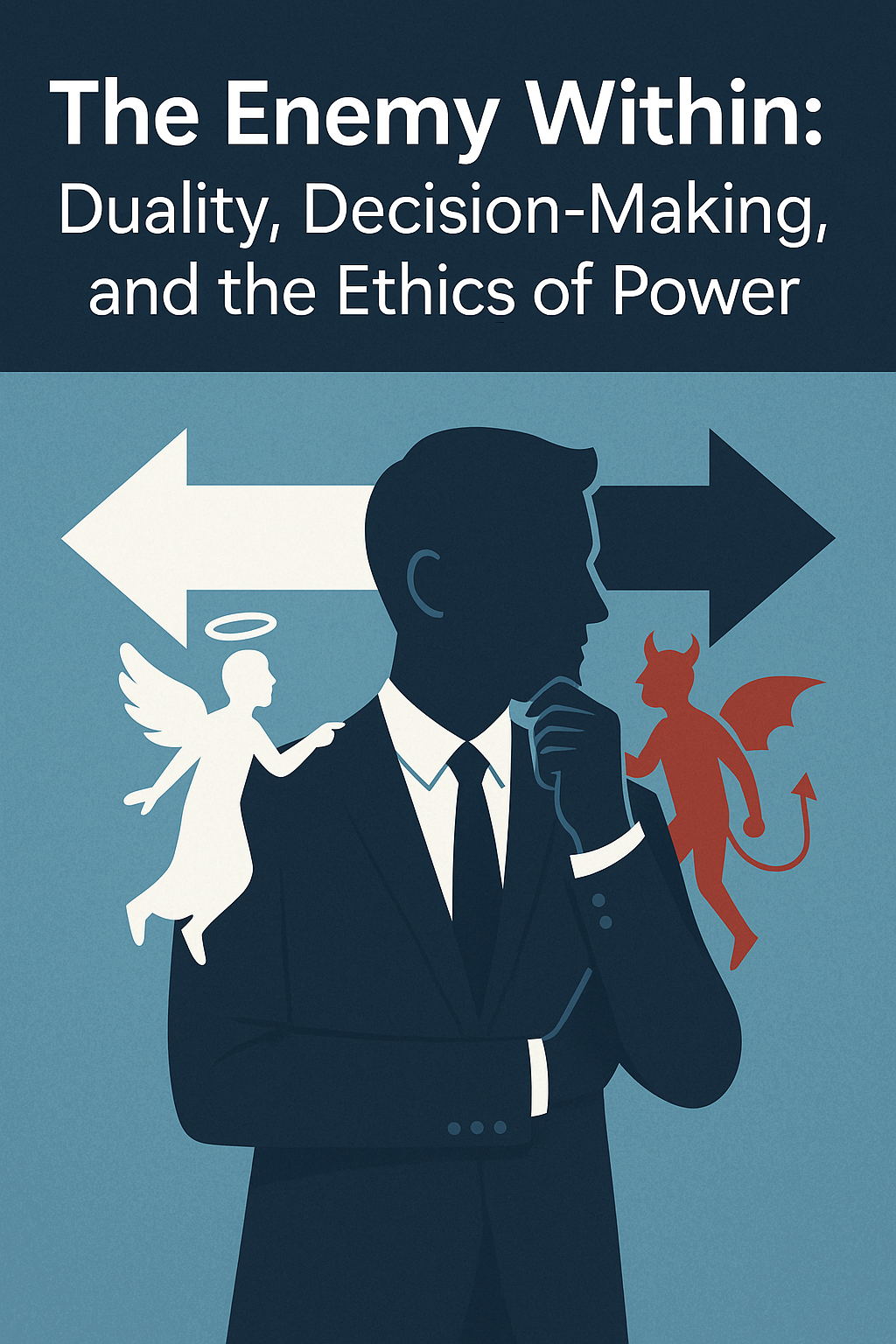
The Enemy Within: Duality, Decision-Making, and the Ethics of Power

Show Summary

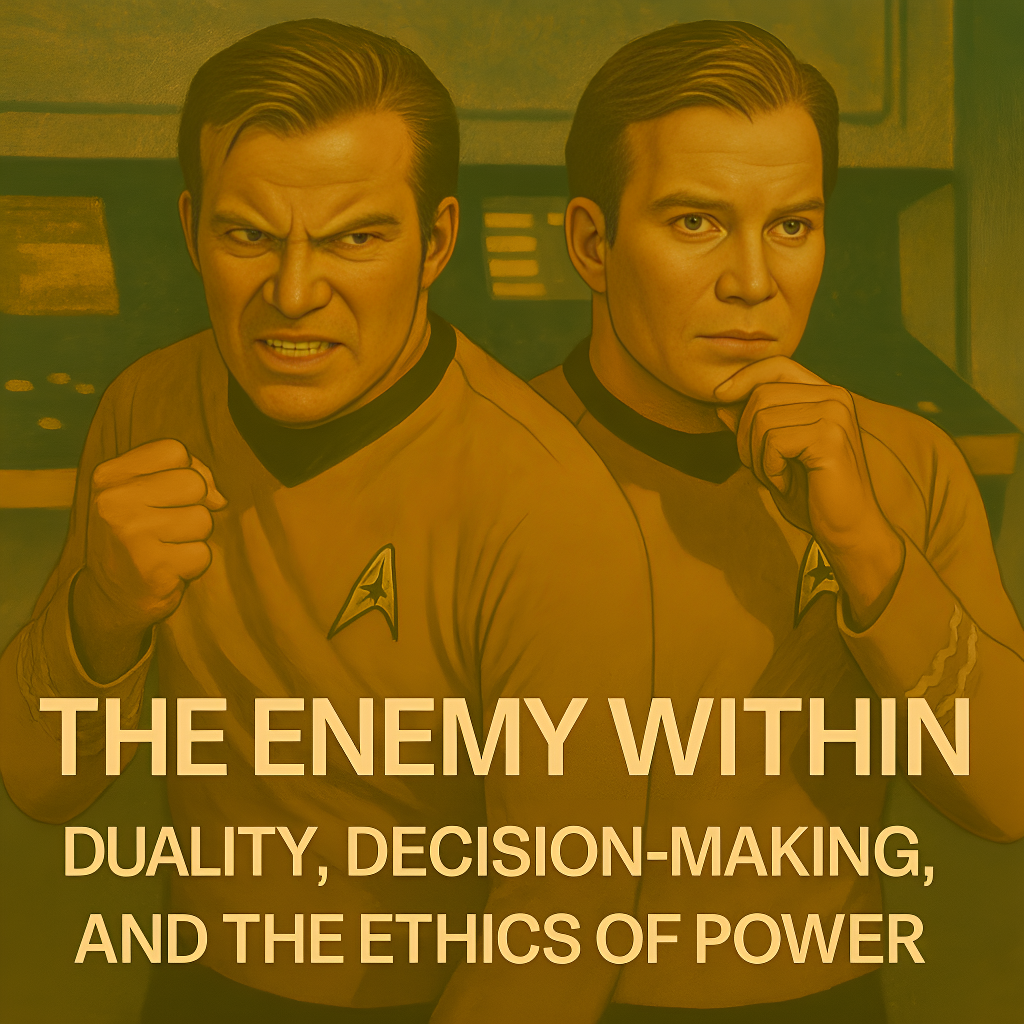
Today, we examine one of the most psychologically compelling Star Trek episodes to date: The Enemy Within. A transporter malfunction splits Captain Kirk into two versions of himself: one good and one evil. Each represents different aspects of leadership, impulse, and integrity. As the crew struggles to respond to the fractured captain, we’re given a front-row seat to the ethical breakdowns and Me Too-era lessons still resonant today. I explore five key compliance takeaways from this tale of divided identity, linking them directly to scenes aboard the Enterprise that show what happens when power is unmoored from principle and when control systems, both technical and ethical, fail.

Key Highlights and Star Trek Case Studies

1. The Dangers of Unchecked Power—When ‘Authority’ Becomes Assault

Illustrated by: Evil Kirk attacking Yeoman Janice Rand in her quarters.

One of the most disturbing moments in early Trek canon, this assault serves as a stark warning about the abuse of power. Evil Kirk resembles the captain and carries his authority, but lacks a conscience. It’s a Me Too moment that reveals the need for every organization to install guardrails, even around its most powerful figures. Compliance must include mechanisms to protect the vulnerable from those who misuse rank or influence.

2. Ethical Decision-Making Requires Wholeness—The Fragmented Leader Can’t Lead 

Illustrated by: Good Kirk losing decisiveness, compassion becoming indecision.

As “good” Kirk weakens, Spock and McCoy realize that without the aggressive, assertive part of his personality, the captain cannot lead. This reinforces the idea that ethical leadership is not about being soft; it is rather about striking a balance. Compliance leaders need the courage to act and the heart to guide. Ethical strength is integrative, not binary.

3. Crisis Response and Chain of Command—When Leadership Wavers, Chaos Breeds

Illustrated by: Evil Kirk taking the bridge and ordering the ship away from orbit.

With no one certain which Kirk is in control, the crew becomes vulnerable to manipulation. This episode serves as a cautionary tale about the importance of clarity in the chain of command and protocols for handling leadership incapacitation. In corporate compliance, crisis scenarios must anticipate rogue actors with access to decision-making tools.

4. Investigating Allegations—Belief, Process, and Support Matter

Illustrated by: Spock and McCoy interviewing Rand after her assault.

Their interview is subtle but painful. The tension in believing victims, navigating hierarchical power, and confronting uncomfortable truths is deeply relevant today. A strong compliance program ensures that all allegations are taken seriously, investigated professionally, and addressed with empathy and integrity.

5. Reintegration and Remediation—Restoring What Was Broken

Illustrated by: The merging of good and evil Kirk through a restored transporter.

Rebuilding trust and a unified identity requires technology, trust, and time. Just as Kirk must reabsorb the parts of himself to lead again, organizations recovering from misconduct must integrate the lessons learned into their culture, policies, and leadership. The ultimate goal is not punishment alone but rather to restore the organization’s ethical function.

Final Compliance Log Thoughts

The Enemy Within is more than a science fiction tale. It’s a mirror to every compliance program, showing us how quickly things unravel when power is unrestrained, when voices are ignored, and when organizations fail to integrate strength with morality. It is also a hopeful reminder that even fractured systems can be repaired if we face the truth with clarity and courage.

Resources:

Excruciatingly Detailed Plot Summary by Eric W. Weisstein

MissionLogPodcast.com

Memory Alpha

Categories
Trekking Through Compliance

Trekking through Compliance – Episode 5 – The Enemy Within

In this episode of Trekking Through Compliance, we examine “The Enemy Within,” which aired on October 6, 1966, at Star Date 1672.1. In this powerful installment of Trekking Through Compliance, we examine one of the most psychologically compelling episodes of Star Trek to date: “The Enemy Within.” A transporter malfunction splits Captain Kirk into two versions of himself—one good, one evil—each representing different aspects of leadership, impulse, and integrity. As the crew struggles to respond to the fractured captain, we are given a front-row seat to the ethical breakdowns and Me Too-era lessons still resonant today. We examine five key compliance takeaways from this tale of divided identity, linking them directly to scenes aboard the Enterprise that illustrate what happens when power is unmoored from principle and when control systems, both technical and ethical, fail.

Key highlights:

1. The Dangers of Unchecked Power—When ‘Authority’ Becomes Assault🖖 Illustrated by: Evil Kirk attacking Yeoman Janice Rand in her quarters. One of the most disturbing moments in early Trek canon, this assault serves as a stark warning about the abuse of power. Evil Kirk resembles the captain and carries his authority, but lacks a conscience. It’s a Me Too moment that reveals the need for every organization to install guardrails—even around its most powerful figures. Compliance must include mechanisms to protect the vulnerable from those who misuse rank or influence.

2. Ethical Decision-Making Requires Wholeness—The Fragmented Leader Can’t Lead. 🖖 Illustrated by: Good Kirk losing decisiveness and compassion, becoming indecisive. As “good” Kirk weakens, Spock and McCoy realize that without the aggressive, assertive part of his personality, the captain cannot lead. This reinforces the idea that ethical leadership is not about being soft—it’s about balance. Compliance leaders need the courage to act and the heart to guide. Ethical strength is integrative, not binary.

3. Crisis Response and Chain of Command—When Leadership Wavers, Chaos Breeds🖖 Illustrated by: Evil Kirk taking the bridge and ordering the ship away from orbit. With no one certain which Kirk is in control, the crew becomes vulnerable to manipulation. This episode serves as a cautionary tale about the importance of clarity in the chain of command and protocols for handling leadership incapacitation. In corporate compliance, crisis scenarios must anticipate rogue actors with access to decision-making tools.

4. Investigating Allegations—Belief, Process, and Support Matter🖖 Illustrated by: Spock and McCoy interviewing Rand after her assault. Their interview is subtle but painful. The tension in believing victims, navigating hierarchical power, and confronting uncomfortable truths is deeply relevant today. A strong compliance program ensures that all allegations are taken seriously, investigated professionally, and addressed with empathy and integrity.

5. Reintegration and Remediation—Restoring What Was Broken🖖 Illustrated by: The merging of good and evil Kirk through a restored transporter. Rebuilding trust—and a unified identity—requires technology, trust, and time. Just as Kirk must reabsorb the parts of himself to lead again, organizations recovering from misconduct must integrate the lessons learned into their culture, policies, and leadership. The end goal isn’t punishment alone—it’s the restoration of ethical function.

Final Starlog Reflections

The Enemy Within is more than a science fiction tale. It’s a mirror to every compliance program, showing us how quickly things unravel when power is unrestrained, when voices are ignored, and when organizations fail to integrate strength with morality. It’s also a hopeful reminder that even fractured systems can be repaired—if we face the truth with clarity and courage.

Resources:

Excruciatingly Detailed Plot Summary by Eric W. Weisstein

MissionLogPodcast.com

Memory Alpha

Categories
Blog

The Naked Time: Ethics Unmasked – What Happens When Compliance Breaks Down

Show Summary

Today, we beam aboard the Enterprise as it orbits PSI 2000, a dying planet and ground zero for one of the most revealing episodes in the Star Trek canon. When a mysterious contagion strips away the crew’s inhibitions, what follows is a masterclass in the importance of ethical behavior, self-control, and leadership under pressure. This episode, “The Naked Time,” is not simply a sci-fi drama; rather, it is a vivid case study of what happens when a culture of compliance fails and chaos creeps onto the bridge. Today, we consider nine ethical and compliance lessons from this wild yet insightful episode, tying each one to critical incidents aboard the Enterprise that every compliance officer should be aware of.

Key Highlights and Star Trek Case Studies

1. The Importance of Self-Control—Emotion Is Not a Governance Strategy

Illustrated by: Spock breaking down in tears after being infected, paralyzed by emotional conflict.

Even the most disciplined individuals can falter without a strong foundation. Spock’s loss of composure reminds us that ethical leadership requires internal strength and consistency. Compliance begins with individuals having the discipline to adhere to their values, even in the face of stress.

2. Accountability—There Are No Passengers on the Bridge

Illustrated by: Kirk’s descent into paranoia and doubt, undermining his command authority.

As the contagion spreads, Kirk becomes increasingly unstable, underscoring the risks that arise when leaders fail to hold themselves accountable. In any compliance crisis, leadership must model accountability, or the entire control structure may collapse.

3. Transparency—Hidden Failures Breed Organizational Chaos

Illustrated by: The landing party’s mishandling of infection protocols.

The contamination spreads due to a failure to report or recognize the risk. A culture of silence allows small mistakes to spiral into organizational shortcomings. Transparency isn’t optional; it’s a requirement for risk containment.

4. Respect for Others—Ethics Are About Boundaries

Illustrated by: Nurse Chapel’s emotional outburst to Spock and Sulu’s delusional antics on the bridge.

Personal boundaries break down during the episode, resulting in wildly inappropriate behavior. Respect for coworkers and professional conduct is foundational. Without it, trust and compliance vanish.

5. Ethical Leadership—Who Leads When the Leaders Falter?

Illustrated by: Riley seizing control of engineering and broadcasting Irish ballads across the ship.

In the absence of strong leadership, bad actors or well-meaning fools will fill the vacuum. Riley’s mutiny-through-microphone demonstrates that ethical lapses at the top invite misrule from below.

6. Decision-Making Under Pressure—Testing the Limits of Command

Illustrated by: The desperate antimatter mix to save the ship from planetary destruction.

Forced into a life-or-death scenario, the crew turns to an untested formula. Sometimes, compliance demands fast and decisive action—but that action must be informed, not reckless. The crisis is the moment when decision-making discipline matters most.

7. Understanding Human Vulnerabilities—Culture Requires Compassion

Illustrated by: Every crew member exhibiting different emotional vulnerabilities when infected.

From Spock’s guilt to Kirk’s isolation, the infection exposes everyone’s core fears. A good compliance culture recognizes that ethics is human and supports systems that help people do the right thing, even when they feel they are wrong.

8. The Consequences of Ethical Lapses—Small Failures, Big Fallout

Illustrated by: The initial failure to follow decontamination protocols that leads to a near-catastrophe.

One dropped protocol leads to a ship-wide crisis. Even minor ethical lapses can have a cascading effect. This is why rigorous compliance training and clear procedures are non-negotiable.

9. A Commitment to Ethical Standards—Rebuilding After Crisis

Illustrated by: The final moments where Bones delivers the antidote and the ship resets to pre-incident time.

Recovery is possible, but it requires decisive intervention and reflection. The crew is given a second chance. In compliance, remediation and culture change can turn failure into a foundation if lessons are learned and systems are strengthened.

Final ComplianceLog Reflections

The Naked Time” is a wild and unforgettable reminder that when compliance fails, chaos reigns, but also that every ethical failure presents an opportunity to learn, rebuild, and recommit. It is a cautionary tale wrapped in fencing sabers, teardrops, and space-time distortion, and it holds more relevance today than ever.

Resources:

Excruciatingly Detailed Plot Summary by Eric W. Weisstein

MissionLogPodcast.com

Memory Alpha

Categories
Blog

Where No Compliance Has Gone Before: Power, Ego, and the Ethics of Control

Show Summary

Here, we board the Enterprise as it breaches the edge of the galaxy and the boundaries of its ethical power. When a mysterious force transforms navigator Gary Mitchell into a godlike being with unchecked telepathic abilities, his rapid descent into tyranny presents a sobering metaphor for the compliance professional. With rising powers come rising risks, and Kirk must choose between loyalty to a friend and duty to his crew. We break down the five key compliance takeaways from ‘Where No Man Has Gone Before,’ showing how early-stage risk, power imbalances, and ethical hesitation can transform even trusted employees into existential threats to your organization.

Key Highlights and Star Trek Case Studies

1. Emerging Risks—Early Signs Should Trigger Action, Not Complacency

🖖 Illustrated by: Gary Mitchell’s glowing eyes and ESP abilities appear shortly after the Enterprise crosses the galactic barrier.

The moment Mitchell begins reading faster, manipulating objects, and demonstrating control over the ship’s systems, it becomes clear that something is wrong. However, initial responses are muted, much like in many corporate environments where emerging risks are often downplayed. Compliance teams must be trained to take anomalies seriously, regardless of the individual’s charisma or seniority.

2. Leadership and Ethical Courage—Friendship vs. Responsibility

🖖 Illustrated by: Kirk’s emotional struggle to deal with Mitchell, his long-time friend.

Kirk hesitates because of his relationship with Mitchell. But ultimately, he chooses duty over sentiment. Compliance officers are often put in a similar position: when someone close to leadership violates ethical norms, will the organization take action? Ethical courage means prioritizing institutional integrity over personal comfort.

3. Power Without Accountability—Why Guardrails Matter

🖖 Illustrated by: Mitchell’s growing powers and his assertion of superiority over the crew.

With no checks on his abilities, Mitchell quickly develops a god complex. This is a chilling representation of what happens when key employees, such as CFOs, procurement officers, or engineers, operate without oversight. Just because someone is brilliant or “indispensable” doesn’t mean they’re beyond the reach of your compliance program.

4. Escalation Protocols and the Role of Outside Advisers

🖖 Illustrated by: Spock’s insistence that Mitchell be isolated and marooned.

Spock plays the role of outside counsel, offering unemotional advice grounded in logic. Every company needs this voice. Internal politics often cloud judgment; a good compliance officer, like Spock, keeps the focus on what must be done to protect the enterprise. His advice to act decisively is what ultimately saves the crew

5. Shared Risk and Collective Action—The Role of Allies in Enforcement

🖖 Illustrated by: Dr. Dehner’s decision to sacrifice herself to stop Mitchell.

Dehner, who initially defends Mitchell, comes to see the threat he poses and joins Kirk in neutralizing him. Her journey mirrors that of employees who shift from enabling bad behavior to becoming whistleblowers or allies in enforcement. Compliance success depends on empowering people like Dehner to act before it’s too late.

Final ComplianceLog Reflections

Where No Man Has Gone Before gives us a blueprint for compliance at the edge of the unknown. It reminds us that rapid change, whether driven by new technology, new hires, or new business environments, demands rapid and courageous compliance responses. Waiting too long to act can mean the difference between course correction and catastrophe.

Resources:

Excruciatingly Detailed Plot Summary by Eric W. Weisstein

MissionLogPodcast.com

Memory Alpha

Categories
Trekking Through Compliance

Trekking Through Compliance – Episode 2 – Leadership and Training Lessons from Charlie X

In this episode of Trekking Through Compliance, we consider Charlie X, which aired on September 15, 1966, Star Date 1533.6.

Story

The USS Enterprise meets the merchant vessel Antares to take charge of Charlie Evans, the sole survivor of a transport ship that crashed on Thasus. For fourteen years, seventeen-year-old Charlie grew up alone, stranded in the wreckage, learning to communicate with the ship’s computer systems, which remained intact.

Despite his eagerness to please, Charlie becomes obnoxious since his lack of upbringing has left him with no knowledge of social norms or control of his emotions. He latches on to Captain Kirk as a father figure and develops an infatuation with Yeoman Janice Rand. He demonstrates extraordinary powers of telepathy and matter transmutation. When the Antares is nearly out of sensor range, it transmits a message to the Enterprise. The message is cut off before it can convey a warning. Scanners show that Antares has been reduced to debris.

Realizing Charlie’s powers are too great to be controlled, Kirk opts to divert from Alpha V to at least keep Charlie away from a civilized world where he would wreak havoc. Charlie discovers Kirk’s plans and takes control of the Enterprise.

A Thasian ship approaches and restores the Enterprise and its crew to their proper forms. The Thasian commander says that his race gave Charlie his powers so he could survive in their world, but these powers (which they can’t remove from him) make him too dangerous to live among humans. Charlie begs Kirk not to let the aliens have him since the Thasians lack any physical form or capacity for love. However, the Thasians reject Kirk’s argument that Charlie belongs with his kind, with a final echoing wail of “I wanna stay!

Commentary

The episode explores the story of Charlie Evans, a young man with dangerous telekinetic powers, and draws parallels to modern compliance and mental health issues. Tom discusses the responsibilities that come with power, the importance of training and supervision, handling unpredictable behavior, clear communication, crisis management, and addressing misconduct. He also reflects on recent real-world events, such as the Uvalde school shooting and the challenges of addressing mental health in compliance programs.

Key highlights:

1. The Responsibilities of Power—Strength Without Structure

🖖 Illustrated by: Charlie turning crew members into nothingness when they anger him.

Charlie is gifted with tremendous abilities but lacks any ethical framework or boundaries. This is a vivid metaphor for what happens when individuals inside an organization gain influence or access without training or accountability. Think of an unmonitored executive with access to financial controls or an engineer with override access but no compliance training—a ticking time bomb.

2. Training and Supervision—It’s Not Optional, It’s Essential

🖖 Illustrated by: Kirk’s attempt to guide Charlie and his later regret at not recognizing the full scope of the risk.

Charlie’s guardianship was left to chance. No proper onboarding, no safety protocols. Sound familiar? In corporate compliance, onboarding isn’t just about day one—it’s about culture shaping. Organizations must ensure that individuals with a higher risk potential receive both guidance and oversight from the outset.

3. Unpredictable Behavior and Ethical Culture—From Red Flag to Alarm Bell

🖖 Illustrated by: Charlie’s mood swings and escalating aggression, which are repeatedly ignored until it’s too late.

The crew notices early signs—jealousy, possessiveness, emotional outbursts—but tolerates them. This reflects the real-world danger of brushing off early signs of a toxic culture. A strong compliance function identifies behavioral red flags before they escalate into corporate crises.

4. Communication and Escalation Protocols—Say Something, Do Something

🖖 Illustrated by: Janice Rand’s discomfort and unease around Charlie, which she initially tries to manage on her own.

Rand’s growing fear underscores the difficulty of speaking up, especially when someone powerful appears to be protected. Her reluctance reminds us that a speak-up culture is not automatic. Companies must establish genuine channels for complaints, empower employees to utilize them, and respond promptly and transparently.

5. Crisis Management—Too Late is Still Too Late

🖖 Illustrated by: The crew’s loss of control over the Enterprise, forcing alien intervention to remove Charlie.

The crew fails to contain the situation internally. It takes external, godlike beings to restore order—a cautionary tale for compliance leaders. If a company waits until the crisis has gone public or regulatory bodies step in, internal credibility is lost. Crisis planning and early intervention are crucial in protecting the organization before outside authorities are required to intervene.

Resources:

Excruciatingly Detailed Plot Summary by Eric W. Weisstein

MissionLogPodcast.com

Memory Alpha

Categories
Blog

Charlie X: Power Without Boundaries – A Compliance Nightmare

Today, we explore the explosive volatility of Charlie X—a story about unchecked power, emotional instability, and the dire consequences of failing to enforce rules and structure. Charlie Evans, a teenage orphan raised by aliens, is taken aboard the Enterprise, possessing extraordinary telekinetic abilities but lacking social training, emotional discipline, and accountability. That combination proves disastrous. We consider how Charlie’s descent into violence mirrors risks faced by compliance professionals when misconduct is ignored, misbehavior is tolerated, and power is given without oversight. In today’s corporate world, “Charlie X” is less about space and more about leadership responsibility, psychological safety, and early intervention.

Key Highlights and Star Trek Case Studies:

1. The Responsibilities of Power—Strength Without Structure

This is illustrated by Charlie turning crew members into nothingness when they anger him.

Charlie is gifted with tremendous abilities but lacks any ethical framework or boundaries. This is a vivid metaphor for what happens when individuals inside an organization gain influence or access without training or accountability. Think of an unmonitored executive with access to financial controls or an engineer with override access but no compliance training—a ticking time bomb.

2. Training and Supervision—It’s Not Optional, It’s Essential

This is illustrated by Kirk’s attempt to guide Charlie and his later regret at not recognizing the full scope of the risk.

Charlie’s guardianship was left to chance, with no proper onboarding and no safety protocols in place. Sound familiar? In corporate compliance, onboarding isn’t just about day one—it’s about culture shaping. Organizations must ensure that individuals with a higher risk potential receive both guidance and oversight from the outset.

3. Unpredictable Behavior and Ethical Culture—From Red Flag to Alarm Bell

This is illustrated by Charlie’s mood swings and escalating aggression, which are repeatedly ignored until it’s too late.

The crew notices early signs, such as jealousy and possessiveness, but tolerates them. This reflects the real-world danger of brushing off early signs of a toxic culture. A strong compliance function identifies behavioral red flags before they escalate into corporate crises.

4. Communication and Escalation Protocols—Say Something, Do Something

This is illustrated by Janice Rand’s discomfort and unease around Charlie, which she initially tries to manage on her own.

Rand’s growing fear underscores the difficulty of speaking up, especially when someone powerful appears to be protected. Her reluctance reminds us that a speak-up culture is not automatic. Companies must establish genuine channels for complaints, empower employees to utilize them, and respond promptly and transparently.

5. Crisis Management—Too Late is Still Too Late

This is illustrated by the crew’s loss of control over the Enterprise, forcing alien intervention to remove Charlie.

The crew fails to contain the situation internally. It takes external, godlike beings to restore order—a cautionary tale for compliance leaders. If a company waits until the crisis has gone public or regulatory bodies step in, internal credibility is lost. Crisis planning and early intervention are crucial in protecting the organization before outside authorities are required to intervene.

Final ComplianceLog Reflections

Charlie X reminds us that power without oversight is perilous, that emotional and psychological health must be part of our compliance focus, and that red flags must not be ignored simply because they come wrapped in charm or vulnerability. Compliance is not simply about policies, procedures, or even rules but rather readiness, responsiveness, and respect for the human element.

Resources:

Excruciatingly Detailed Plot Summary by Eric W. Weisstein

MissionLogPodcast.com

Memory Alpha

Categories
Blog

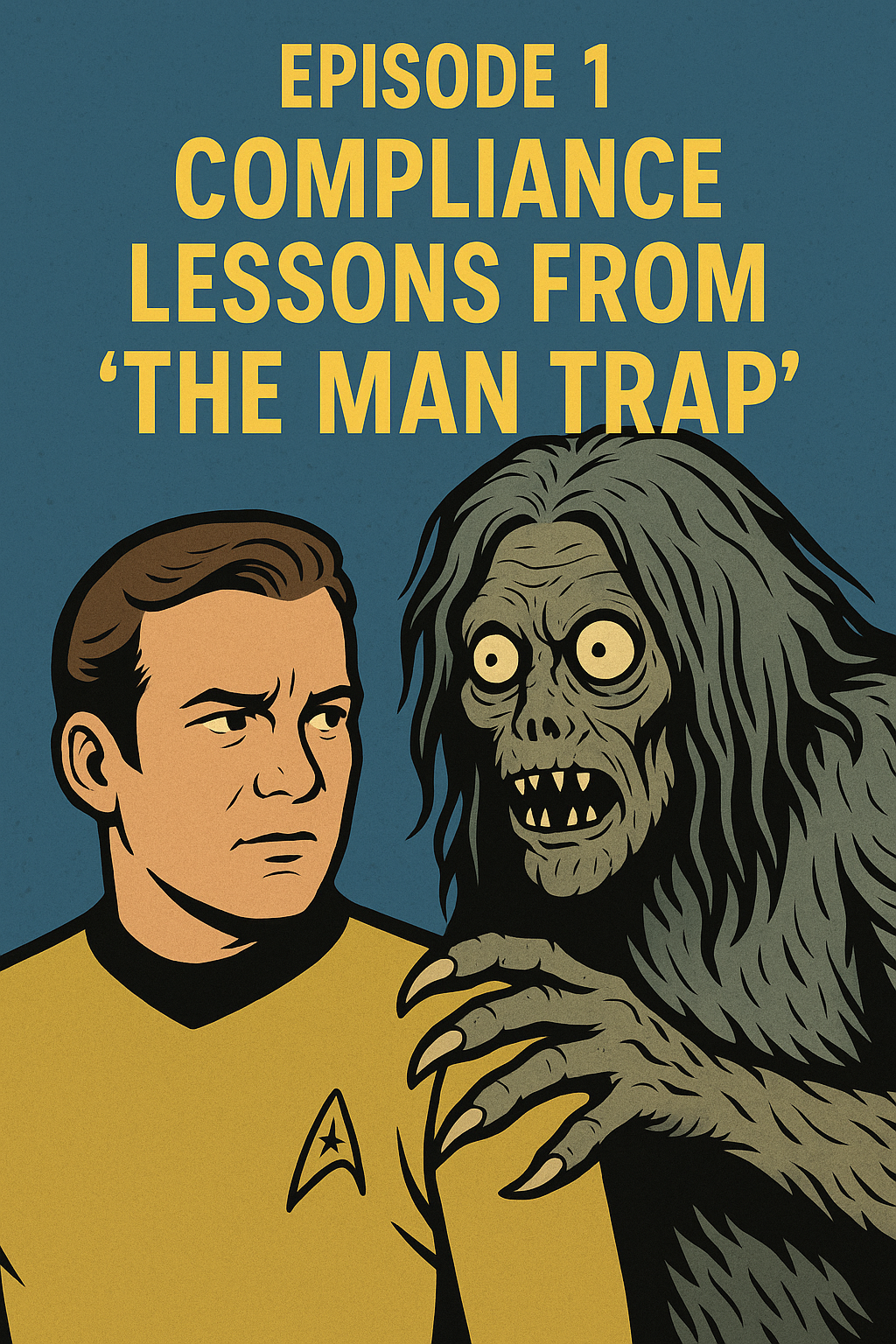
The Man Trap: Salt Vampires, Soft Controls, and the Price of Inaction

Today we consider the episode The Man Trap which aired on June 3, 1969, Star Date 5298.5. We begin by beaming down to Planet M113 with Captain Kirk and crew to uncover the compliance and leadership lessons buried in the salt-thirsty narrative of The Man Trap. This first aired Star Trek episode is not simply science fiction, rather it is a parable for today’s compliance professional. When a creature with the ability to shape-shift into anyone it wants hides among the crew, deception, emotional blind spots, and ethical hesitation threaten the integrity of the mission and the lives aboard the Enterprise.

Story

In this episode, a landing party from the Enterprise beams down to perform an annual checkup of scientist Bob Crater and his wife Nancy, who have lived on the planet M113 for 5 years. Dr. Crater and Nancy appear to be in good health, but Dr. Crater goes out of his way to request an additional salt supply from the Enterprise’s stores. A crewman wanders off and dies under mysterious circumstances. Further tests show that his body is completely devoid of salt.

Scanning the planet’s surface reveals only a single life form, so Spock and Kirk realize that Nancy must have beamed aboard the Enterprise and started searching for her. They question Dr. Crater and learn that Nancy is dead and that her form has been taken over by the planet’s last remaining indigenous creature, which can assume any form and requires salt to live.

Kirk and Spock then beam Dr. Crater aboard the Enterprise, who prevents Kirk from killing the creature (which he still sees as Nancy Crater), and then stands idly by as she begins to drain the salt from Kirk’s body. At this juncture, Spock rushes in and demonstrates to McCoy that the woman attacking Kirk could not be Nancy by striking her repeatedly and forcefully. Nancy does not flinch, sending Spock flying across the room with a single counterblow. When the creature attacks Kirk again, its proper alien form is revealed, and Bones kills it with a phaser, even after it reverts to Nancy’s form.

Key Highlights:

1. Compliance and Leadership Lessons – The Cost of Denial
Key Scene- Dr. Crater’s refusal to acknowledge the danger posed by the creature impersonating his wife Nancy.
Leadership is about difficult truths, not convenient fantasies. Dr. Crater’s emotional attachment blinds him to reality, echoing the risks faced when leaders ignore clear signs of compliance breakdowns. Just as he stalls Kirk and enables the creature’s deception, real-world executives who refuse to confront corruption or misconduct endanger the entire ship.

2. Character Dynamics – Trust, Bias, and Team Decision-Making
Key Scene- The landing party’s conflicting views of Nancy—each member sees her differently.
This episode reminds us how biases cloud judgment. The creature manipulates the crew’s perceptions, much like a charismatic fraudster might mislead auditors or compliance officers. Effective compliance teams must cultivate objectivity and challenge assumptions, especially when red flags appear under familiar disguises.

3. Ethical Decision-Making and Vigilance – When Loyalty Becomes Liability
Key Scene- McCoy’s inability to act until it’s almost too late.
McCoy’s emotional paralysis shows the danger of misplaced loyalty in corporate settings. Compliance professionals must prioritize facts over feelings. Only when Spock physically assaults the creature and reveals its true nature does McCoy accept the need for lethal action. It’s a painful but powerful lesson in balancing empathy with professional duty.

4. Storytelling and Visual Branding – Make the Message Memorable
Key Scene- The unforgettable reveal of the creature’s true alien form.
The creature’s transformation is a visual metaphor for uncovering the truth beneath appearances. For compliance programs, this underscores the importance of storytelling, compelling visuals, and emotional engagement. Dry policies don’t stick—memorable messages do. Think of the salt vampire’s final scene as a compliance training module with bite.

5. Balancing Security and Compassion – Don’t Let the Monster in the Room Stay Hidden
Key Scene- The crew’s initial desire to give Nancy space, contrasted with the need for containment.
Compassion is vital, but so is security. The crew’s hesitation to confront “Nancy” creates a vulnerability that costs lives. In corporate compliance, this translates to having the courage to investigate suspicions swiftly and without prejudice. The longer you let a problem impersonate a solution, the greater the risk to your organization

Final ComplianceLog Reflections

As we wrap up this episode, we are reminded that illusions, whether born of nostalgia, bias, or fear; can be deadly in space and in the boardroom. “The Man Trap” teaches us that truth must be pursued with vigilance, that leaders must act decisively in the face of risk, and that compliance is not simply about rules, it is also about readiness.

Resources

Excruciatingly Detailed Plot Summary by Eric W. Weisstein

MissionLogPodcast.com

Memory Alpha

Categories
Trekking Through Compliance

Trekking Through Compliance – Episode 0 – Introduction to the Updated 2025 Series

Since 2017, Tom Fox has posted the podcast “Trekking Through Compliance” each summer. Not only is Tom a full-fledged Trekkie, but many of us in the compliance community share this passion as well. To commemorate the 8th anniversary of this series, Tom has updated each episode with new commentary and insights tailored for compliance professionals and business executives. Each episode is relatively short, lasting around 10 minutes. This allows you to grasp the storyline and the lessons learned from it. So, even if you have listened and re-listened over the past summers, you will learn something new and revisit one of the most significant TV series ever.

In this podcast series, Tom Fox explores compliance, leadership, and risk management through the lens of Star Trek: The Original Series, presented in a 79-episode offering. Each podcast reviews the episode’s creative team and story synopsis, highlighting three key lessons learned in the areas of compliance, leadership, and governance. If you love Star Trek as Tom does, this podcast series is for you. He will use three key resources for each offering: (1) Eric’s Excruciatingly Detailed Star Trek (TOS) Plot Summaries, which has plot summaries for every episode; (2) MissionLogPodcast.com, a Rod Roddenberry podcast where John Champion and Ken Ray explored every episode of Star Trek, the Original Series; and (3) Memory Alpha, a great resource for all things Star Trek. Please note that Tom will use the order of release in this podcast series, so the first episode is the premier TV show, “The Man Trap,” which aired on September 10, 1966. This means that both pilots will appear later in the series. Additionally, the TV premieres are on a schedule that differs from the production schedule. So, listen over the next 79 episodes, revisit one of television’s outstanding achievements, and learn how to use Star Trek to improve your corporate compliance program and yourself as a compliance professional. We are going to have some fun.