Categories
Trekking Through Compliance

Trekking Through Compliance: Episode 15 – Shore Leave – Why Compliance Should be Fun (At Times)

Show Summary

In this episode of Trekking Through Compliance, we beam down to the lush, surreal planet featured in the original Star Trek series episode, “Shore Leave.” Intended as a respite for the fatigued crew of the Enterprise, the planet soon becomes a living playground of the imagination where thoughts turn instantly into reality. Fantasies (and nightmares) from the subconscious materialize: White Rabbits, medieval knights, lost lovers, and even Kirk’s old academy rival, Finnegan.

At first glance, “Shore Leave” may not seem like fertile ground for compliance lessons. But in fact, it offers a powerful metaphor for an often-overlooked truth in corporate ethics and compliance programs: compliance does not always have to be serious to be effective. Sometimes, as Carsten Tams reminds us, it should be playful. In today’s episode, we explore how compliance professionals can make training, communications, and culture-building engaginginteractive, and even fun without ever compromising on rigor or integrity. So join me as we unpack six key lessons from “Shore Leave” that illustrate how playfulness can be a surprisingly powerful tool in your compliance toolkit.

Key highlights:

1. People Learn More When They’re Not Stressed

 Illustrated by: The Enterprise crew’s need for R&R after exhausting missions.

Dr. McCoy, supported by Spock’s logical assessment, insists the crew is showing signs of physical and mental exhaustion. Rest is not a luxury; it is a necessity for operational effectiveness. For compliance professionals, the message is that if you deliver compliance training in a joyless, legalistic tone, you are creating cognitive overload rather than facilitating learning. Neuroscience confirms what “Shore Leave” dramatizes: people learn best when they’re relaxed, open, and stimulated by novelty.

2. Make It Personal, Make It Stick

 Illustrated by: The planet’s ability to tailor experiences to each crew member’s thoughts.

No doubt, anticipating GenAI in compliance training, the planet’s strength lies in its personalization; each experience is unique, vivid, and relevant to the individual. This is precisely what compliance communications should strive to be. People engage with content when it reflects their context, whether that is their role, region, risk exposure, or personal values.

3. Surprise Can Be a Teaching Tool

 Illustrated by: The sudden appearance of surreal figures, from tigers to Alice in Wonderland.

When things feel calm, something unexpected occurs. A knight skewers McCoy. A WW2 fighter plane swoops overhead. These surprises grab attention, trigger curiosity, and break the monotony. The episode feels whimsical, but it delivers deeper insights about stress, psychology, and perception. In your compliance training program, do not underestimate the value of surprise. Unexpected storytelling, clever twists, and humorous “wrong way” examples can all disarm your audience and make learning more memorable. Consider starting a training session with a scene from a movie, a meme, or even a parody of a compliance mistake. Then, pivot into serious learning.

4. Let People Engage on Their Terms

Illustrated by: Different crew members experience the planet in different ways.

While the planet remains the same physical space, everyone interacts with it differently. McCoy goes on a fantasy adventure. Sulu finds joy in weapons. Yeoman Barrows imagines herself in a medieval gown. No one is forced into a particular experience; instead, each crew member chooses their path through the environment, making the experience more personal and fulfilling. Now, apply this principle to your compliance communications strategy. Offer multiple modalities. Some people prefer videos; others prefer articles or podcasts. Some individuals may enjoy scenario-based learning games, while others may prefer simulations or role-playing exercises. Design your training architecture like a multi-lane road: different entry points, same destination.

5. Even Fantasy Has Rules—Define the Boundaries

Illustrated by: The discovery that the planet’s illusions, while playful, can cause real harm.

Initially, the planet seems harmless. However, soon, Kirk and his crew discover that while the Earth is designed for recreation, it can become hazardous if participants fail to understand the boundaries or rules. The solution is not to avoid play but to clarify the framework. This is one of the most important parallels to corporate compliance. Creating engaging, playful content doesn’t mean abandoning standards or structure; it means embracing them freshly and innovatively. The opposite is true. Clear guardrails, defined objectives, code alignment, and measurable outcomes underpin the best compliance engagement programs.

6. Debriefing Deepens Learning

 Illustrated by: Kirk’s reflection with McCoy and Spock at the end of the episode.

At the end of “Shore Leave,” Kirk pauses to reflect on what has happened. He discusses the nature of the planet, its risks, and its benefits. He reflects on his emotional response to Finnegan, his sense of guilt and nostalgia, and what he learned about himself. This moment transforms the experience from play into one of growth. Never end a training without a debrief. Whether your program was fun, serious, or somewhere in between, reflection is what turns experience into understanding. After a game-based simulation, send out discussion questions. After a role-play session, ask participants to share lessons learned or “What would you do differently?”

Final ComplianceLog Reflections:

Compliance Doesn’t Have to Be a “No-Fun Zone”

Sometimes, you need to channel your inner Ronnie Feldman, for if there is one thing Shore Leave teaches us, it is that even the most disciplined teams need room for release, exploration, and imagination. The same is true in compliance. You’re not just teaching policies; you’re also influencing behavior, shaping culture, and earning trust. And if playfulness, humor, and surprise can help you do that more effectively, then beam those strategies aboard.

Compliance has its serious moments, no doubt. But if your entire program is built on fear, formality, and fatigue, you are missing out on one of the most powerful motivators we have: joy.

Resources:

Excruciatingly Detailed Plot Summary by Eric W. Weisstein
MissionLogPodcast.com

Memory Alpha

Categories
Trekking Through Compliance

Trekking Through Compliance – Episode 14 – Investigative Lessons from Balance of Terror

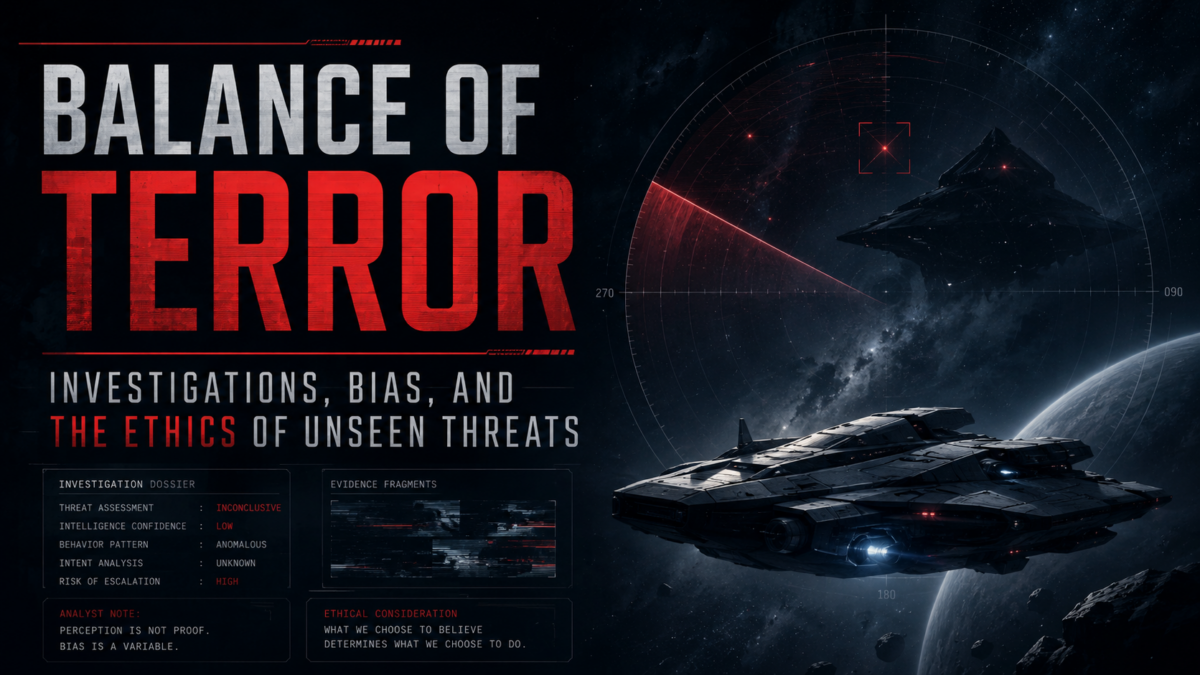
In this episode of Trekking Through Compliance, we consider the episode Balance of Terror, which aired on December 15, 1966, Star Date 1709.1.

In this episode of Trekking Through Compliance, we analyze “Balance of Terror,” the tense, submarine-style showdown between the Enterprise and a Romulan Bird-of-Prey, which introduces one of Star Trek’s most enduring adversaries. The story unfolds as a mystery: Who attacked the Earth outposts? What is this new weapon? Who are the Romulans? And what do their sudden appearances mean for the Federation?

We review the critical investigative lessons this episode offers for compliance professionals: the importance of situational analysis, managing internal bias, respecting operational security, and knowing when to act and when to wait. In this cat-and-mouse episode, we find the foundations of modern investigative best practices.

Key highlights:

1. Situational Awareness and Evidence Gathering—Don’t Jump to Conclusions

🖖Illustrated by: The destruction of Outposts 2 and 3 and the cryptic communication from Outpost 4.

Captain Kirk begins his investigation without clear evidence, gathering fragmented data from the surviving outpost’s transmissions and assessing the damage patterns. For compliance professionals, this illustrates the importance of establishing a clear fact pattern before concluding. Investigations must be driven by objective evidence, not assumptions.

2. Managing Internal Bias—Appearance Is Not Proof

🖖Illustrated by: Lieutenant Stiles’ suspicion of Mr. Spock based on the physical resemblance between Romulans and Vulcans.

Stiles immediately targets Spock as a potential traitor, despite a complete lack of evidence, simply because Romulans and Vulcans share a similar appearance. This moment serves as a cautionary tale in terms of compliance: biases, whether conscious or unconscious, can derail investigations and damage team morale.

3. Strategic Surveillance—Investigate Without Provoking Retaliation

🖖Illustrated by: Kirk shadowing the Romulan ship to determine intent and capabilities before engaging.

Rather than charging into conflict, Kirk chooses to observe the Romulan ship’s behavior. In compliance investigations, particularly those involving fraud or misconduct, covert observation and the secure handling of information are crucial to preventing tip-offs or escalation.

4. Chain of Custody and Documentation—Recording and Communicating the Facts

🖖Illustrated by: The tactical logs Kirk reviews and Spock’s technical input during the confrontation.

Throughout the engagement, Kirk relies on detailed sensor data, eyewitness accounts, and Spock’s analysis to make decisions. Compliance professionals must ensure the proper documentation of interviews, timelines, and data sources for both internal review and external audit.

5. Ethical Leadership During Investigations—Calm in the Face of Conflict

🖖Illustrated by: Kirk’s balance between decisiveness and restraint, even when provoked by Romulan attacks.

Kirk refuses to act out of fear or anger—even as tensions rise. He models ethical leadership: protecting lives, preserving treaty obligations, and maintaining moral clarity. In high-stakes compliance investigations, emotional discipline and ethical consistency are vital.

Final Starlog Reflections

Balance of Terror is a masterclass in investigative poise, procedural discipline, and ethical clarity under pressure. As the Enterprise crew faces a new adversary cloaked in invisibility, we see what real leadership looks like when facts are scarce and risks are high.

For compliance professionals, this episode is a reminder that investigations require patience, vigilance, and integrity. Bias must be checked, facts must be verified, and trust must be earned. The threat may be hidden, but your investigative principles must always remain visible.

Resources:

Excruciatingly Detailed Plot Summary by Eric W. Weisstein
MissionLogPodcast.com

Memory Alpha

Categories
Blog

Balance of Terror: Investigations, Bias, and the Ethics of Unseen Threats

Show Summary

Today, we analyze Balance of Terror, the tense, submarine-style showdown between the Enterprise and a Romulan Bird-of-Prey that introduces one of Star Trek’s most enduring adversaries. The story unfolds as a mystery: Who attacked the Earth outposts? What is this new weapon? Who are the Romulans? And what do their sudden appearances mean for the Federation?

We consider the critical investigative lessons this episode offers for compliance professionals: the importance of situational analysis, managing internal bias, respecting operational security, and knowing when to act and when to wait. In this cat-and-mouse episode, we find the foundations of modern investigative best practices.

1. Situational Awareness and Evidence Gathering—Don’t Jump to Conclusions

Illustrated by: The destruction of Outposts 2 and 3 and the cryptic communication from Outpost 4.

When Captain Kirk is alerted to the destruction of Outposts 2 and 3, followed by a garbled and desperate message from Outpost 4, he does not leap to conclusions. Instead, he begins assembling a coherent picture from incomplete data. It is an approach every compliance professional should emulate. Kirk listens carefully to the fading transmissions, asks questions, and refrains from concluding until the evidence is strong enough to warrant a course of action. In the compliance context, this underscores the importance of establishing a clear and objective fact pattern before initiating formal charges or drawing public conclusions. Whether it is a whistleblower tip, financial irregularity, or cyber breach, investigators must resist the urge to confirm pre-existing assumptions and instead allow the data to guide the inquiry. Rushed investigations lead to false positives, reputational damage, and a loss of credibility. Thorough evidence gathering is not a luxury, and it is the cornerstone of practical and ethical investigations.

2. Managing Internal Bias—Appearance Is Not Proof

Illustrated by: Lieutenant Stiles’ suspicion of Mr. Spock based on the physical resemblance between Romulans and Vulcans.

Lieutenant Stiles immediately casts suspicion on Spock when it is revealed that Romulans resemble Vulcans despite Spock’s long and honorable service aboard the Enterprise. This reflexive distrust, based solely on appearance and ancestry, is a prime example of how bias can derail an investigation and a team. For compliance professionals, this moment serves as a powerful reminder of the damage unconscious bias can cause in investigative settings. Bias leads to tunnel vision, selective interpretation of evidence, and the marginalization of innocent individuals. Investigators must be trained to recognize and eliminate personal biases from their assessments, ensuring that findings are based on behavior and facts rather than on factors such as ethnicity, appearance, age, or background.

Additionally, leaders must protect team dynamics and morale by correcting discriminatory behavior when it arises. Stiles’s conduct not only risked undermining the investigation, but it also threatened the cohesion of the entire bridge crew. In compliance work, fairness is not only a good idea but also a foundational principle.

3. Strategic Surveillance—Investigate Without Provoking Retaliation

Illustrated by: Kirk shadowing the Romulan ship to determine intent and capabilities before engaging.

Captain Kirk chooses patience over aggression. Faced with a technologically advanced Romulan vessel capable of cloaking itself, Kirk adopts a strategy of stealth and surveillance, carefully observing enemy behavior before taking action. This restraint allows him to gather intelligence on the Romulans’ capabilities, decision-making process, and command philosophy. For compliance professionals, this offers a tactical lesson: not every investigation requires immediate confrontation. Especially in matters of internal fraud, harassment, or collusion, premature escalation can trigger retaliation, cover-ups, or destruction of evidence. Surveillance, whether through data audits, transaction monitoring, or employee behavior analytics, can provide valuable insights into patterns of misconduct while maintaining the element of surprise. However, it must be done ethically and lawfully, with careful control over access to sensitive information. Kirk’s calm, measured approach reflects the same principle: watch closely, document thoroughly, and only engage once you fully understand the scope and severity of the issue.

4. Chain of Custody and Documentation—Recording and Communicating the Facts

Illustrated by: The tactical logs Kirk reviews and Spock’s technical input during the confrontation.

Throughout the high-stakes engagement with the Romulans, Captain Kirk and his crew rely not on instinct but on a steady stream of data: tactical logs, sensor readouts, and crew input, particularly from Spock, who filters and interprets technical signals. These layers of documentation provide a clear, defensible foundation for Kirk’s strategic decisions. The lesson for compliance professionals is crystal clear: thorough, contemporaneous documentation is the bedrock of a defensible investigation. Every interview, transaction, policy exception, and timeline must be accurately recorded and stored securely to preserve integrity and facilitate external review. Furthermore, clear communication, especially among multidisciplinary stakeholders, is vital. Just as Kirk integrates science, operations, and command insights to build a complete picture, compliance teams must synthesize data across HR, IT, legal, and finance. Without this coordinated recordkeeping, investigations become vulnerable to challenge or dismissal. Proper documentation not only protects your findings but also protects your credibility.

5. Ethical Leadership During Investigations—Calm in the Face of Conflict

 Illustrated by: Kirk’s balance between decisiveness and restraint, even when provoked by Romulan attacks.

Despite being under extreme pressure and facing an adversary with unknown technology and intentions, Kirk maintains emotional control. He neither rushes to attack nor lets fear override strategic thinking. This poise under fire reflects the ideal ethical leadership model during an investigation. Compliance professionals frequently face high-stakes scenarios involving reputational risk, scrutiny from senior executives, or regulatory exposure. The temptation to react emotionally, whether defensively, aggressively, or politically, can compromise both the integrity and objectivity of the investigation. Like Kirk, compliance leaders must demonstrate restraint, transparency, and ethical consistency, even in moments of heightened tension. Your tone will shape how the team responds, how witnesses perceive the process, and how leadership views the investigation’s validity. Emotional discipline is not detachment, and it is the deliberate choice to anchor every step in principle rather than pressure. In times of uncertainty, ethical leadership is not loud but steady. And that steadiness defines whether your investigation is respected or rejected.

Final ComplianceLog Reflections

Balance of Terror is a masterclass in investigative poise, procedural discipline, and ethical clarity under pressure. As the Enterprise crew faces a new adversary cloaked in invisibility, we see what authentic leadership looks like when facts are scarce and risks are high.

For compliance professionals, this episode is a reminder that investigations require patience, vigilance, and integrity. Bias must be checked, facts must be verified, and trust must be earned. The threat may be hidden, but your investigative principles must always remain visible.

Categories
Trekking Through Compliance

Trekking Through Compliance – Episode 13 – The Conscience of the King

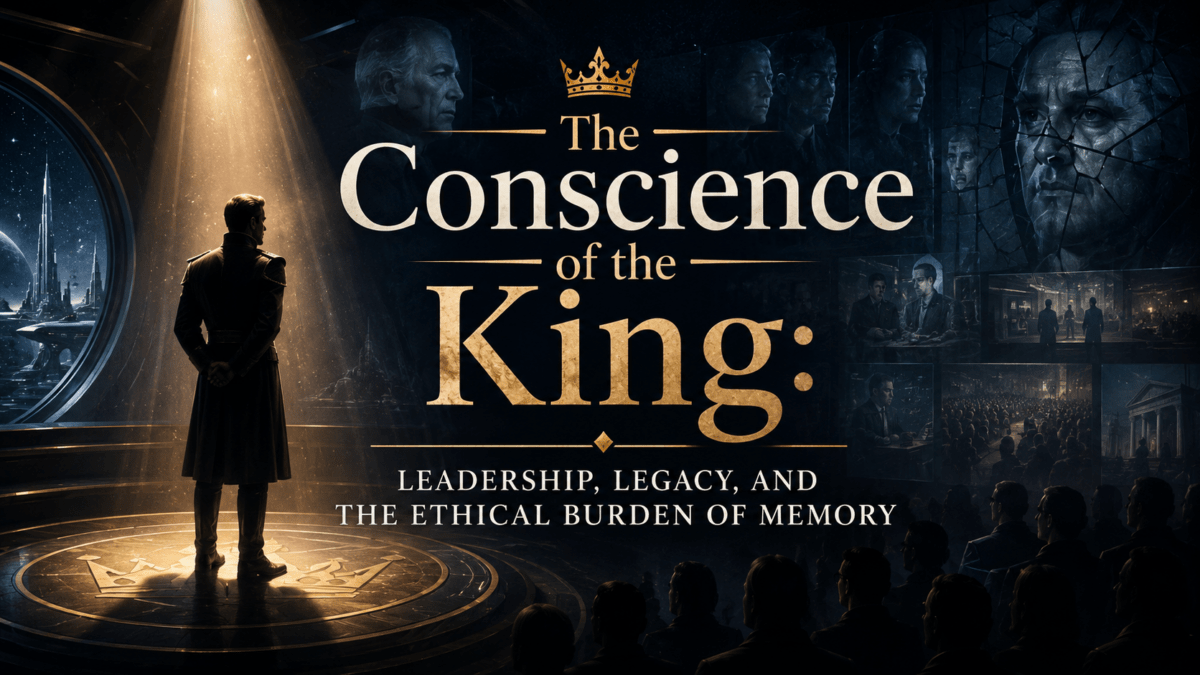
In this episode of Trekking Through Compliance, we consider the episode The Conscience of the King, which aired on December 8, 1966, with a Star Date of 2817.6.

In this episode of Trekking Through Compliance, we turn our attention to The Conscience of the King, a Shakespeare-infused Star Trek story that challenges Captain Kirk—and us—to grapple with the ethics of justice, mercy, and leadership responsibility. When Kirk suspects that the famed actor Anton Karidian is Kodos the Executioner—a governor responsible for ordering the deaths of 4,000 colonists years earlier—he must weigh vengeance, truth, and the costs of reopening old wounds.

As we unpack this episode, we connect Kirk’s internal struggle and ethical decision-making to the real-world challenges compliance professionals face when confronting legacy misconduct, institutional cover-ups, and questions of redemption in corporate culture.

Story Synopsis

Dr. Thomas Leighton calls the Enterprise Planet Q. Leighton suspects Anton Karidian, the leader of a Shakespearean acting troupe currently on the planet, is Kodos the Executioner, the former governor of the Earth colony of Tarsus IV. Kodos ordered that half the population of 8,000 be put to death during a food shortage. Both Leighton and Kirk were eyewitnesses.

Kirk arranges to ferry the acting troupe to its next destination. Spock learns the history of the massacre, Kirk’s connection to it, and that seven of the nine witnesses had died in each case when Karidian’s troupe was nearby. Kirk confronts Karidian with his suspicions. Karidian does not admit to being Kodos.

Karidian, overhearing, is disturbed, and Lenore tries to reassure him by revealing that she has been killing the witnesses to his crimes. Kirk moves to arrest them both. Lenore snatches a phaser and accidentally kills Karidian.

Key highlights:

1. The Weight of Past Decisions—Leadership Never Forgets

🖖Illustrated by: Kirk’s memory of witnessing the atrocities of Tarsus IV as a young man.

Great leaders never leave their past behind—they carry it forward as context and compass. When legacy issues, such as old FCPA violations or dormant discrimination claims, resurface, leaders must face them directly rather than bury them under corporate amnesia.

2. Silent Complicity and Ethical Courage—Speak Up, Even Years Later

🖖Illustrated by: Dr. Leighton’s insistence that Karidian is Kodos, despite the passage of time.

Leighton models the whistleblower’s dilemma: does the pursuit of truth justify disrupting someone’s life decades later? The answer, in compliance, is yes; when lives are harmed or injustice is committed, silence is complicity.

3. Leadership and Doubt—Action Without Certainty

🖖Illustrated by: Kirk’s internal struggle over whether Karidian is truly Kodos and whether justice still matters.

Kirk wrestles with doubt, a hallmark of responsible leadership. Unlike the rigid commander stereotype, Kirk shows us that great leaders pause, reflect, and sometimes hesitate before acting.

4. When the Next Generation Fails—Managing Succession and Oversight

🖖Illustrated by: Lenore Karidian’s vigilante campaign to eliminate witnesses to her father’s past.

Lenore’s misguided sense of loyalty and justice highlights the risks of leadership failure in succession. In a corporate setting, this highlights the importance of mentoring future leaders, integrating ethics into the culture, and establishing oversight during transitions.

5. Justice vs. Mercy—Leadership Must Balance the Two

🖖Illustrated by: Kirk’s decision not to kill Karidian but to hold him accountable through due process.

Ultimately, Kirk refuses to exact revenge. He chooses lawful action over vigilante justice. This restraint is perhaps the greatest leadership lesson of the episode: compliance is not about punishment; it is about principled action.

Final Starlog Reflections

The Conscience of the King is more than a mystery; it is a meditation on the responsibilities of leadership and the ethics of remembrance. Compliance professionals often find themselves at the intersection of institutional memory and moral action. Whether addressing legacy misconduct, evaluating redemptive narratives, or confronting cover-ups, we must carry the same conscience Kirk bears: one rooted in justice, tempered by mercy, and guided by truth.

As we say in the world of compliance, investigate when others ignore the issue. Act when others hesitate. Lead when others bury the past.

Resources:

Excruciatingly Detailed Plot Summary by Eric W. Weisstein
MissionLogPodcast.com

Memory Alpha

Categories
Blog

The Conscience of the King: Leadership, Legacy, and the Ethical Burden of Memory

Show Summary

Today, we turn our attention to The Conscience of the King. This Shakespeare-infused Star Trek story challenges Captain Kirk to grapple with the ethics of justice, mercy, and leadership responsibility. When Kirk suspects that the famed actor Anton Karidian is Kodos the Executioner, a governor responsible for ordering the deaths of 4,000 colonists years earlier, he must weigh vengeance, truth, and the costs of reopening old wounds.

As we unpack this story, we connect Kirk’s internal struggle and ethical decision-making to the real-world challenges compliance professionals face when confronting legacy misconduct, institutional cover-ups, and questions of redemption in corporate culture. We provide five key highlights for the compliance professional.

1. The Weight of Past Decisions—Leadership Never Forgets

Illustrated by: Kirk’s memory of witnessing the atrocities of Tarsus IV as a young man.

Leaders are shaped by what they have seen and experienced, as well as what they may have survived. Kirk’s commitment to uncovering the truth about Karidian isn’t about revenge; it’s about moral closure and honoring the memory of those lost. For compliance professionals, this serves as a reminder that legacy issues—whether they’re unresolved FCPA violations, historical human rights abuses, or systemic failures—do not simply fade with time. If anything, they cast a longer shadow. Ethical leadership requires confronting past wrongdoing with transparency and resolve. A failure to address yesterday’s misconduct risks undermining today’s culture. Institutional memory is not a burden, and it is a compass that should guide future ethical decisions.

2. Silent Complicity and Ethical Courage—Speak Up, Even Years Later

Illustrated by: Dr. Leighton’s insistence that Karidian is Kodos, despite the passage of time.

Dr. Leighton embodies the ethical courage it takes to speak the truth, especially when public interest has waned over time. His determination underscores a core compliance truth: there is no statute of limitations on accountability. When misconduct has caused real harm, silence becomes complicity. Leaders must create compliance cultures where reporting long-dormant concerns is viewed as a moral responsibility, not disloyalty or disruption. Whistleblower protections shouldn’t only apply to active employees but also encourage former employees, partners, or community stakeholders to come forward. Organizations must foster environments where the pursuit of truth is always welcome, regardless of how inconvenient or uncomfortable that truth may be.

3. Leadership and Doubt—Action Without Certainty

Illustrated byKirk’s internal struggle over whether Karidian is truly Kodos and whether justice still matters.

Kirk’s doubt is not a sign of weakness; it is a sign of leadership maturity. He could act rashly, but chooses restraint and investigation. This reminds compliance professionals that ethical decision-making often requires grappling with uncertainty. There won’t always be a perfect set of facts or unanimous agreement. However, delaying action indefinitely out of fear of being wrong can allow misconduct to persist. Effective compliance officers must learn to manage ambiguity, gather facts diligently, and still move forward with measured integrity. Courage lies not in having every answer but in taking ethical steps toward resolution, even when the path is unclear.

4. When the Next Generation Fails—Managing Succession and Oversight

Illustrated by: Lenore Karidian’s vigilante campaign to eliminate witnesses to her father’s past.

Lenore’s actions reflect a failure of ethical inheritance. Her misplaced loyalty to her father led her to believe that protecting his reputation, even through murder, was justified. This is what happens when leadership fails to instill ethical values in successors. For compliance leaders, it’s a cautionary tale: legacy is not only what you accomplish but also what you teach others to carry forward. Ethics must be embedded through mentoring, continuous training, and a succession plan that prizes transparency and accountability. Without intentional cultural transmission, the next generation may feel entitled to protect the institution’s image at the cost of truth and justice.

5. Justice vs. Mercy—Leadership Must Balance the Two

Illustrated by: Kirk’s decision not to kill Karidian but to hold him accountable through due process.

Kirk is presented with the opportunity to exact personal vengeance, but chooses institutional justice instead. His restraint highlights a critical ethical principle: leadership is not about indulging emotion but about modeling fairness and integrity. In the compliance world, it’s tempting to punish harshly to “make an example,” but true justice lies in proportionality and process. Compliance officers must strike a balance between the need for deterrence and the values of fairness, remediation, and restorative opportunity. Mercy is not weakness. It is a disciplined response rooted in ethical clarity. By refusing to be judge and executioner, Kirk upholds not just justice but the integrity of his leadership.

Final ComplianceLog Reflections

The Conscience of the King is more than a mystery; it is a meditation on the responsibilities of leadership and the ethics of remembrance. Compliance professionals often find themselves at the intersection of institutional memory and moral action. Whether addressing legacy misconduct, evaluating redemptive narratives, or confronting cover-ups, we must carry the same conscience Kirk bears: one rooted in justice, tempered by mercy, and guided by truth.

As we say in the world of compliance, investigate when others ignore the issue. Act when others hesitate. Lead when others bury the past.

Categories
Blog

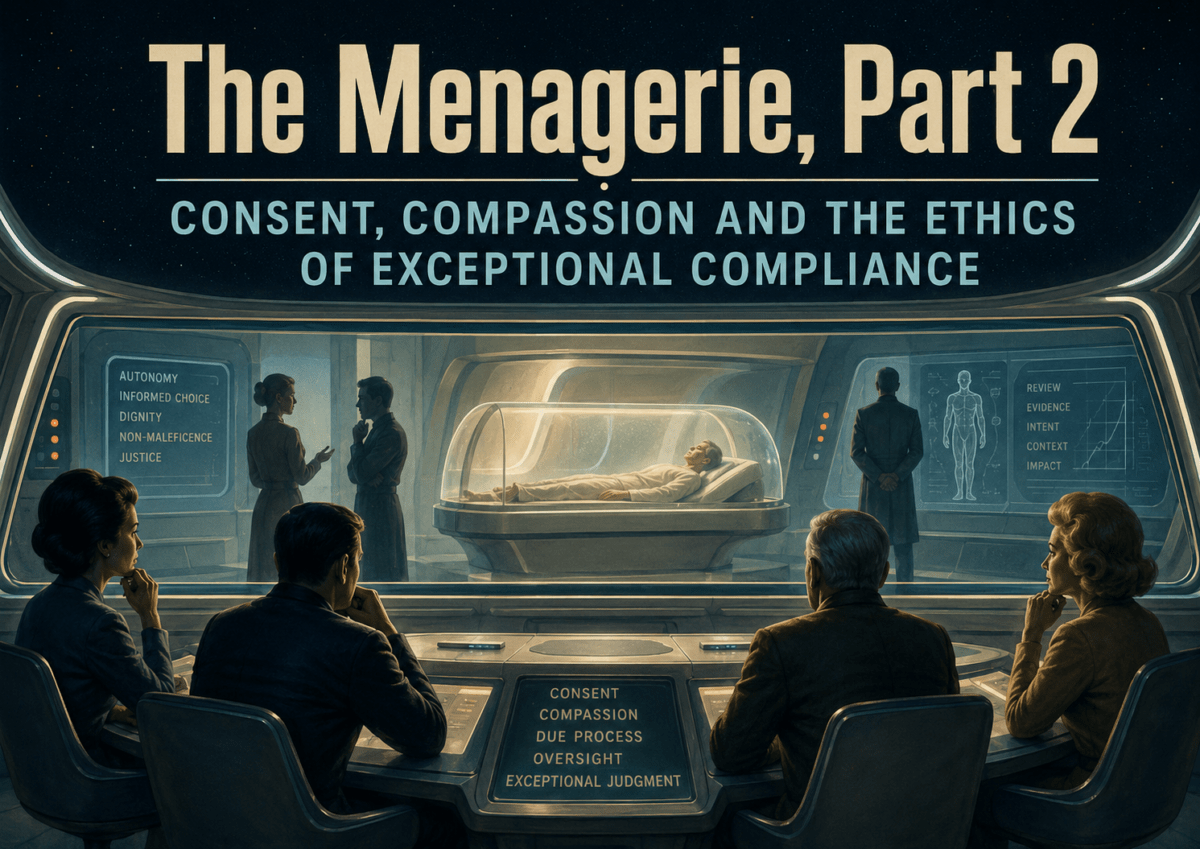
The Menagerie, Part 2 – Consent, Compassion and the Ethics of Exceptional Compliance

Show Summary

Today, we conclude the two-part saga of The Menagerie, a story that redefined what ethical decision-making looks like in leadership. When we left off in Part 1, Spock had surrendered himself for court-martial after hijacking the Enterprise and transporting his former captain, the severely disabled Christopher Pike, to the forbidden world of Talos IV. As Part 2 unfolds, we learn the true motivation behind Spock’s defiance and the profound ethical reasoning that underpins it.

This episode is not simply a continuation of a trial. Instead, it can be seen as a meditation on autonomy, empathy, and what it means to act ethically in a rigid system. For compliance professionals, The Menagerie, Part 2, is rich with insights into the complex choices we must make when policy, principle, and human dignity are at odds. In today’s blog post, we examine five major ethical themes from this story and illustrate how each one is grounded in a specific scene from the episode, providing compliance leaders with a framework for navigating real-world dilemmas within their organizations.

1. Autonomy and Informed Consent—Giving Voice to the Voiceless

Illustrated by: At the heart of this episode is Pike—a former starship captain, now paralyzed and confined to a life support chair, capable only of answering “yes” or “no” via a blinking light. When the Talosians offer him the chance to live in a world of illusion, he is asked if he wants to stay. He says, “Yes.”

Ethical Lesson:

This moment underscores a foundational principle of ethics: the right to self-determination. Pike is not coerced. He is not manipulated. He is fully informed of what Talos IV offers—freedom through illusion—and he consents. In compliance terms, this is the gold standard of ethical choice: voluntary, informed, and communicated.

For compliance professionals, it serves as a reminder that we must go beyond the checkbox approach to obtaining consent. Whether the issue is data privacy, workplace investigations, or employee monitoring programs, “informed consent” means more than legal formality. It means the individual understands the choice, has time to consider it, and is free to say no without fear of retaliation. Pike’s “yes” only matters because he has the freedom to say no.

2. Compassion as Compliance—Bending the Rules to Uphold Human Dignity

Illustrated by: Spock’s entire plan is illegal. He falsifies orders, hijacks a starship, and brings Pike to a planet that is off-limits under the most severe Federation regulation. Why? Because it’s the only place where Pike can live a life of meaning and peace.

Ethical Lesson:

This is perhaps the most potent lesson of The Menagerie, Part 2: sometimes, strict adherence to policy can result in cruelty. And in those moments, compliance must yield to compassion. Spock’s decision to act outside the rules was not made lightly; instead, it was made because no other pathway would preserve Pike’s dignity.

In real-world corporate ethics, this translates into the idea that rules should serve people, not the other way around. A zero-tolerance policy without exceptions is often a warning sign of a compliance culture that lacks empathy and understanding. Compliance leaders must ask, is the rule doing what it was meant to do, or has it become a barrier to doing what’s right?

3. Leadership, Legacy, and Ethical Loyalty

Illustrated by: The entire reason Spock risks his career and his freedom is because of Pike’s legacy. Pike once led with integrity, courage, and fairness—and now, Spock is repaying that leadership with a courageous act of his own. It’s a profoundly emotional portrayal of ethical loyalty.

Ethical Lesson:

This theme touches on a more profound truth for compliance professionals: how you lead today shapes how others will behave tomorrow. If you foster a culture of fairness, transparency, and ethical behavior, your team will carry those values forward, even when you’re no longer in charge. Pike’s silent presence throughout the episode reminds us that leadership never truly ends. Compliance officers who mentor, guide, and uphold ethical values may not see the immediate benefits of their work. Still, they build organizations that continue to act ethically, even in times of crisis. Spock is evidence of that.

4. Ethics and Illusion – When Appearance Isn’t Reality

Illustrated by: On Talos IV, Pike appears whole again, walking beside Vina in a paradise shaped entirely by illusion. The Talosians, with their extraordinary mental abilities, create an environment that allows Pike to escape his physical limitations. And yet, they ask for his consent. They do not impose.

Ethical Lesson:

This plot element speaks to the fine ethical line between influence and manipulation. Illusions are not inherently unethical, provided the subject is aware of and agrees to them. In corporate settings, this theme is reflected in marketing ethics, internal communications, and the deployment of AI or surveillance tools. Are you presenting employees or customers with reality or a version that has been curated to control behavior? The Talosians’ decision to inform Pike and let him choose demonstrates the ethical use of influence. Compliance professionals must ensure the same: transparency about tools and methods, respect for personal agency, and a refusal to exploit trust.

5. Strategic Deception and Transparency in Purpose

Illustrated by: The court-martial is revealed to be a ruse, a diversion designed to buy time to reach Talos IV. Commodore Mendez himself turns out to be an illusion projected by the Talosians, orchestrated to ensure Pike’s safe arrival. Yet, once the objective is achieved, the Talosians shut off the illusion and reveal everything.

Ethical Lesson:

Here, we see a nuanced, almost paradoxical ethical lesson: strategic deception, when used to advance truth and dignity, can be morally justifiable only if it ultimately leads to complete transparency. The court believed Spock’s actions to be treason. In the end, they see them as mercy. But that re-evaluation is only possible because Spock allows the process to run its course and discloses all.

In compliance work, this is akin to delaying disclosure of a suspected fraud to complete an internal investigation, but only if the delay is justified, temporary, and ultimately resolved through complete transparency. Ethical leadership means not only making the right call but also being willing to explain it afterward.

Final ComplianceLog Reflections

The Menagerie, Part 2, brings to a close one of the most deeply ethical stories in the entire Star Trek franchise. It’s a courtroom drama, but more importantly, it is a test of values. Spock breaks the law not to defy it but to defend a higher truth. Pike chooses not to escape reality but to find peace. And the Federation, to its credit, sees that sometimes rules must serve people, not imprison them.

For compliance professionals, the takeaway is this: never forget the humans behind the policies. Whether you’re writing a code of conduct, leading an investigation, or implementing controls, ask yourself: Does this uphold dignity and respect? Does it protect the agency? Does it serve the truth?

Ultimately, compliance isn’t solely about preventing risk. It’s about protecting people just as Spock protected Pike, not by obeying policy but by honoring his legacy, his dignity, and his will.

Categories
Blog

The Menagerie, Part 1 – Rules, Mutiny, and the Ethics of Exceptional Compliance

Show Summary

In this episode of Trekking Through Compliance, we beam down into one of the most compelling courtroom dramas in Star Trek canon—The Menagerie, Part 1. This two-part saga is not just a creative reuse of Star Trek’s unaired original pilot (The Cage) but a deep dive into the themes of loyalty, risk, duty, and the tension between rigid compliance and ethical decision-making. When Mr. Spock commandeers the Enterprise in direct violation of Starfleet orders, fabricates communications, and defies his captain, all to bring his former commander, the incapacitated Christopher Pike, to the forbidden planet Talos IV, it sets up one of the most dramatic ethical showdowns in Starfleet history.

In today’s blog post, we examine how this episode provides rich material for compliance professionals, particularly those navigating the delicate balance between adhering to policy and upholding higher principles. We break down five core compliance lessons and link each one to specific incidents in the episode that bring those lessons to life. Along the way, we will also consider how compliance leaders can apply these lessons to build more ethical, resilient, and human-centered organizations.

1. Ethical Mutiny: When Breaking the Rules Is the Right Thing to Do

Illustrated by Spock, hijacks the Enterprise by falsifying voice commands from Captain Kirk, overrides ship controls, and charts a course to Talos IV, a planet placed under the most severe travel prohibition in Starfleet history.

This opening act is one of the most jarring in the history of Star Trek. Spock, the emblem of logic and duty, commits mutiny. And he does not hide it. After allowing Kirk and Commodore Mendez to catch up to the Enterprise, he turns himself in and demands a court-martial.

Compliance Lesson:

Doing the right thing for an individual or stakeholder may technically violate internal policy or even law. While compliance is generally rooted in the enforcement of established rules, the ethical dimension of compliance leadership sometimes calls for courage, the kind Spock displays.

For example, think of the whistleblower who exposes illegal conduct despite violating a non-disclosure agreement. Or the compliance officer who bypasses a sluggish internal protocol to alert regulators of an imminent safety risk. These are modern-day echoes of Spock’s actions.

What matters most in these scenarios is intent, proportionality, and documentation. If you break protocol to serve a higher ethical obligation, make your reasoning transparent, and be prepared to accept scrutiny. Spock did just that, and compliance professionals can learn from his model.

2. Informed Consent and the Rights of the Vulnerable

Illustrated by Captain Pike, now confined to a life-support chair following a catastrophic accident, is capable of communicating only through blinking lights, one blink for “yes,” two for “no.” Despite this profound disability, Spock makes decisions on his behalf, presumably with his blessing, to bring him to Talos IV.

Compliance Lesson:

One of the most overlooked yet essential aspects of modern compliance is ensuring that all individuals, regardless of their ability or role, are given the opportunity to provide informed consent. Too often, we see vulnerable populations—such as individuals with disabilities, language barriers, or economic dependence—marginalized in decision-making processes.

In Spock’s case, we are left to infer that Pike approved of the plan. However, the lack of transparency and documented consent raises important questions. In corporate settings, this would be akin to assuming a disabled or junior employee is on board with a high-risk strategy without fully briefing them or securing a formal agreement.

The key takeaway for compliance professionals is to consistently seek and document informed consent, particularly when an individual’s ability to communicate or resist is compromised. It’s not just about legal risk—it’s about human dignity.

3. Due Process and Transparency in Internal Investigations

Illustrated by Spock’s court-martial, it begins aboard the Enterprise, with Commodore Mendez presiding. Instead of denying the charges, Spock cooperates fully and presents a surprising defense—video footage from a previous classified mission to Talos IV.

Compliance Lesson:

Investigations must be conducted fairly, transparently, and supported by evidence. What makes this incident so interesting is that Spock does not simply confess; he insists on a formal process to air the whole truth. He respects Starfleet’s legal structure and uses it not to avoid punishment but to contextualize his actions.

This approach mirrors what strong compliance programs should look like: not about covering up or avoiding accountability, but about utilizing internal mechanisms, such as hearings, audits, and investigations, to surface the truth, not suppress it. Always remember that compliance is the guardian of institutional justice and institutional fairness.

Moreover, it emphasizes the importance of allowing investigations to run their course. By submitting himself to judgment, Spock reinforces trust in the system, even as he challenges its rigidity. Competent compliance officers will recognize that transparency and integrity go hand in hand—even during a breach.

4. Data Use, Privacy, and Chain of Custody

Illustrated by: The footage Spock presents to the court-martial board is revealed to be an unauthorized transmission from Talos IV, one of the most tightly controlled sources of information in the galaxy. The footage itself is emotionally charged and deeply personal and raises questions about how it was obtained and used.

Compliance Lesson:

This is a prime example of modern data privacy risks. In today’s world, this would be akin to accessing and sharing confidential patient or employee data without formal approval, even if done with good intent. For compliance professionals, the lesson is clear: the ethical use of data requires a secure chain of custody, limited access, and an articulated purpose. Even benevolent motives, such as restoring dignity to a suffering colleague, do not justify breaching established data protections. If the situation is exceptional, escalation to legal or ethics committees is essential.

5. Leadership Accountability and Ethical Stewardship

Illustrated by Kirk being blindsided by Spock’s actions and struggling with the realization that someone he trusts deeply has broken the chain of command. Yet, Kirk doesn’t retaliate in anger. He allows the investigation to proceed, listens to the evidence, and reflects carefully before responding.

Compliance Lesson:

This is a case study in mature leadership. Compliance leaders are often put in the uncomfortable position of adjudicating actions by trusted colleagues. Emotional responses, especially when loyalty is called into question, can cloud judgment. Kirk’s restraint is a model for those faced with internal breaches by high performers or close allies. Accountability does not mean vengeance; it means ensuring the rules apply equally and fairly, even when your friends are involved. Ethical stewardship encompasses empathy, as well as clarity and responsibility.

Final ComplianceLog Reflections

The Menagerie, Part 1 is not just a legal drama in space; rather, it is a parable about leading with principle in the face of policy. Spock’s decision to violate orders in service of a higher ethical goal challenges us to ask, “What do we do when the rules are wrong?” When does policy block compassion? When does protocol punish empathy? Compliance professionals are uniquely positioned at this crossroads every day. And while very few of us will hijack a starship in the name of justice, we will all face situations that test whether we are rule followers or ethical leaders. Let Spock’s courage and Kirk’s humility remind us that compliance is not about blind enforcement. It is about ethical discernment, moral courage, and doing right by people, even when it means breaking the mold.

Categories
Trekking Through Compliance

Trekking Through Compliance – Episode 8 – Miri

In this episode of Trekking Through Compliance, we consider the episode Miri, which aired on October 27, 1966, Star Date 2713.5. In this episode of Trekking Through Compliance, we explore one of the eeriest and most profound cautionary tales in the Star Trek canon: “Miri.” When the crew responds to a distress signal from a planet that’s an exact duplicate of Earth, they find a society ravaged by a failed experiment in human longevity. Only children remain, while the adults, the “grups,” have all died from a virulent disease.

This haunting story is not simply science fiction. It is a case study of what happens when risk management is treated as an afterthought. We draw parallels between the biohazard breakdowns on the planet and the kinds of failures that modern compliance officers must guard against, whether in public health readiness, supply chain risk, or workforce welfare.

Episode Summary

A disfigured man attacks a landing party, who die after Kirk strikes him. They discover a preadolescent, Miri, who ran away from them because “grups” kill and maim children before dying. She and her friends are “onlies,” the only ones left. The distress call is traced to an automated signal. The landing party, except for Spock, notices purple lesions on their bodies; Miri tells them that these are the first signs of the disease, and they will soon develop into the same condition as the other adults. When the disease begins, its victims have seven days to live. Although Spock is immune, he considers himself a carrier who could infect the Enterprise if he returns.

Back on the Enterprise, after vaccinating everyone and leaving the children in the care of a medical team, Kirk sends for teachers and advisers to help the children improve their lives.

Key highlights:

1. Disaster Preparedness—A Cure Without a Contingency Plan

🖖Illustrated by: The civilization’s experiment to extend life, which instead wipes out all adults.

This central failure underscores the risks associated with scientific advancement that lacks proper risk assessment. The developers had no fallback, no regulatory oversight, and no crisis management framework in place. For compliance professionals, this serves as a reminder that innovation must be paired with effective scenario planning and disaster recovery protocols.

2. Environmental and Public Health Compliance—Invisible Risks Become Existential Threats

🖖Illustrated by: The crew’s infection with the disease upon beaming down, with lesions appearing days later.

This serves as a metaphor for health and safety non-compliance. Enterprises must be vigilant about how workplace conditions, unseen hazards, and biological risks can impact staff and operations. Proactive monitoring and rapid-response mechanisms are essential components of any risk management strategy.

3. Data Governance and Early Warning Systems—Responding Too Late

🖖Illustrated by: The automated distress signal continued even though no adult survivors remained.

The signal was still active, but no one was listening until it was far too late. In modern organizations, this is equivalent to ignoring audit logs, internal control alerts, or whistleblower reports that go unread. A culture of attentiveness to data and signals is crucial to catching issues before they cascade.

4. Supply Chain Risk—Critical Resource Shortages in the Field

🖖Illustrated by: The crew’s struggle to develop a cure with limited time, no labs, and deteriorating conditions.

Kirk and McCoy were caught without adequate resources. This scenario mirrors the real-world risks companies face when they lack redundancy in their supply chains, fail to conduct thorough vendor audits, or fail to plan for logistical disruptions. A robust compliance framework includes stress-testing the supply chain for resilience under duress.

Employee Welfare and Isolation—Psychological and Ethical Concerns in Hazard Zones

🖖Illustrated by: Spock’s decision not to return to the Enterprise due to the risk of contamination.

Spock’s sacrifice is a model of ethical risk containment. In any risk environment, whether it is a pandemic, data breach, or financial misconduct, companies must empower employees to make ethically sound decisions while providing mental health support for those isolated by crisis response roles.

Final Starlog Reflections

Miri is a chilling illustration of what happens when ambition outpaces ethics and planning. The children left behind are the victims of a society that prioritizes progress over protection. For compliance professionals, this episode serves as a vivid reminder that a well-crafted compliance program is not just about preventing misconduct—it’s about preparing for the unknown.

Resources

Excruciatingly Detailed Plot Summary by Eric W. Weisstein
MissionLogPodcast.com

Memory Alpha

Categories
Blog

The Enemy Within: Duality, Decision-Making, and the Ethics of Power

Show Summary

Today, we examine one of the most psychologically compelling Star Trek episodes to date: The Enemy Within. A transporter malfunction splits Captain Kirk into two versions of himself: one good and one evil. Each represents different aspects of leadership, impulse, and integrity. As the crew struggles to respond to the fractured captain, we’re given a front-row seat to the ethical breakdowns and Me Too-era lessons still resonant today. I explore five key compliance takeaways from this tale of divided identity, linking them directly to scenes aboard the Enterprise that show what happens when power is unmoored from principle and when control systems, both technical and ethical, fail.

Key Highlights and Star Trek Case Studies

1. The Dangers of Unchecked Power—When ‘Authority’ Becomes Assault

Illustrated by: Evil Kirk attacking Yeoman Janice Rand in her quarters.

One of the most disturbing moments in early Trek canon, this assault serves as a stark warning about the abuse of power. Evil Kirk resembles the captain and carries his authority, but lacks a conscience. It’s a Me Too moment that reveals the need for every organization to install guardrails, even around its most powerful figures. Compliance must include mechanisms to protect the vulnerable from those who misuse rank or influence.

2. Ethical Decision-Making Requires Wholeness—The Fragmented Leader Can’t Lead 

Illustrated by: Good Kirk losing decisiveness, compassion becoming indecision.

As “good” Kirk weakens, Spock and McCoy realize that without the aggressive, assertive part of his personality, the captain cannot lead. This reinforces the idea that ethical leadership is not about being soft; it is rather about striking a balance. Compliance leaders need the courage to act and the heart to guide. Ethical strength is integrative, not binary.

3. Crisis Response and Chain of Command—When Leadership Wavers, Chaos Breeds

Illustrated by: Evil Kirk taking the bridge and ordering the ship away from orbit.

With no one certain which Kirk is in control, the crew becomes vulnerable to manipulation. This episode serves as a cautionary tale about the importance of clarity in the chain of command and protocols for handling leadership incapacitation. In corporate compliance, crisis scenarios must anticipate rogue actors with access to decision-making tools.

4. Investigating Allegations—Belief, Process, and Support Matter

Illustrated by: Spock and McCoy interviewing Rand after her assault.

Their interview is subtle but painful. The tension in believing victims, navigating hierarchical power, and confronting uncomfortable truths is deeply relevant today. A strong compliance program ensures that all allegations are taken seriously, investigated professionally, and addressed with empathy and integrity.

5. Reintegration and Remediation—Restoring What Was Broken

Illustrated by: The merging of good and evil Kirk through a restored transporter.

Rebuilding trust and a unified identity requires technology, trust, and time. Just as Kirk must reabsorb the parts of himself to lead again, organizations recovering from misconduct must integrate the lessons learned into their culture, policies, and leadership. The ultimate goal is not punishment alone but rather to restore the organization’s ethical function.

Final Compliance Log Thoughts

The Enemy Within is more than a science fiction tale. It’s a mirror to every compliance program, showing us how quickly things unravel when power is unrestrained, when voices are ignored, and when organizations fail to integrate strength with morality. It is also a hopeful reminder that even fractured systems can be repaired if we face the truth with clarity and courage.

Resources:

Excruciatingly Detailed Plot Summary by Eric W. Weisstein
MissionLogPodcast.com

Memory Alpha

Categories
Blog

Where No Compliance Has Gone Before: Power, Ego, and the Ethics of Control

Show Summary

Here, we board the Enterprise as it breaches the edge of the galaxy and the boundaries of its ethical power. When a mysterious force transforms navigator Gary Mitchell into a godlike being with unchecked telepathic abilities, his rapid descent into tyranny presents a sobering metaphor for the compliance professional. With rising powers come rising risks, and Kirk must choose between loyalty to a friend and duty to his crew. We break down the five key compliance takeaways from ‘Where No Man Has Gone Before,’ showing how early-stage risk, power imbalances, and ethical hesitation can transform even trusted employees into existential threats to your organization.

Key Highlights and Star Trek Case Studies

1. Emerging Risks—Early Signs Should Trigger Action, Not Complacency

🖖 Illustrated by: Gary Mitchell’s glowing eyes and ESP abilities appear shortly after the Enterprise crosses the galactic barrier.

The moment Mitchell begins reading faster, manipulating objects, and demonstrating control over the ship’s systems, it becomes clear that something is wrong. However, initial responses are muted, much like in many corporate environments where emerging risks are often downplayed. Compliance teams must be trained to take anomalies seriously, regardless of the individual’s charisma or seniority.

2. Leadership and Ethical Courage—Friendship vs. Responsibility

🖖 Illustrated by: Kirk’s emotional struggle to deal with Mitchell, his long-time friend.

Kirk hesitates because of his relationship with Mitchell. But ultimately, he chooses duty over sentiment. Compliance officers are often put in a similar position: when someone close to leadership violates ethical norms, will the organization take action? Ethical courage means prioritizing institutional integrity over personal comfort.

3. Power Without Accountability—Why Guardrails Matter

🖖 Illustrated by: Mitchell’s growing powers and his assertion of superiority over the crew.

With no checks on his abilities, Mitchell quickly develops a god complex. This is a chilling representation of what happens when key employees, such as CFOs, procurement officers, or engineers, operate without oversight. Just because someone is brilliant or “indispensable” doesn’t mean they’re beyond the reach of your compliance program.

4. Escalation Protocols and the Role of Outside Advisers

🖖 Illustrated by: Spock’s insistence that Mitchell be isolated and marooned.

Spock plays the role of outside counsel, offering unemotional advice grounded in logic. Every company needs this voice. Internal politics often cloud judgment; a good compliance officer, like Spock, keeps the focus on what must be done to protect the enterprise. His advice to act decisively is what ultimately saves the crew

5. Shared Risk and Collective Action—The Role of Allies in Enforcement

🖖 Illustrated by: Dr. Dehner’s decision to sacrifice herself to stop Mitchell.

Dehner, who initially defends Mitchell, comes to see the threat he poses and joins Kirk in neutralizing him. Her journey mirrors that of employees who shift from enabling bad behavior to becoming whistleblowers or allies in enforcement. Compliance success depends on empowering people like Dehner to act before it’s too late.

Final ComplianceLog Reflections

Where No Man Has Gone Before gives us a blueprint for compliance at the edge of the unknown. It reminds us that rapid change, whether driven by new technology, new hires, or new business environments, demands rapid and courageous compliance responses. Waiting too long to act can mean the difference between course correction and catastrophe.

Resources:

Excruciatingly Detailed Plot Summary by Eric W. Weisstein
MissionLogPodcast.com

Memory Alpha