Categories
Blog

Boldly Going Together: Cross – Cultural Compliance Lessons from Star Trek’s “Journey to Babel”

In the ever-expanding universe of corporate compliance, the question of how to bridge cultural divides is as critical as it is complex. Navigating global operations, integrating diverse teams, and balancing conflicting interests. These challenges would be familiar to Captain Kirk and the crew of the Enterprise, particularly in the Star Trek: The Original Series classic “Journey to Babel.”

In this episode, the Enterprise is tasked with transporting 114 ambassadors from across the Federation to a pivotal diplomatic conference. The plot thickens as old enmities, conflicting interests, and even attempted murder threaten the mission’s success. At the heart of the episode lies a powerful message: cross-cultural competence is not just an HR catchphrase. It is a critical compliance and ethical imperative.

Today, we explore five essential cross-cultural compliance lessons, each grounded in a scene from “Journey to Babel.” These insights are not simply for the Starship Enterprise. Instead, they are vital for every compliance professional in today’s globalized business world.

Lesson 1: Cultural Awareness is the Foundation of Trust

Illustrated By: The Enterprise hosts a diplomatic reception. Ambassadors Sarek (Vulcan) and Gav (Andorian) nearly come to blows over the proposed admission of Coridan to the Federation.

The opening scenes aboard the Enterprise are a masterclass in cultural complexity. The ambassadors, each representing worlds with deep-seated histories and conflicting interests, demonstrate how easily cultural misunderstandings and political baggage can undermine trust.

Compliance Lesson: Cultural awareness is the bedrock of ethical business practice. As compliance professionals, we must recognize that every culture brings its perspectives, values, and sensitivities to the table. Failure to understand these nuances can breed suspicion and derail collaboration, just as the Vulcan and Andorian ambassadors struggle to find common ground.

Prioritize cultural training as part of compliance education. Ensure that codes of conduct are not only translated but also contextually adapted, and that your team is prepared to identify and address cultural gaps before they become compliance risks.

Lesson 2: Personal Bias Must Never Trump Professional Duty

Illustrated By: Kirk discovers that Spock’s parents, Sarek and Amanda, are aboard. Despite personal tensions—especially between Spock and his father—Spock insists on performing his duties during the crisis, even when Sarek’s life is at stake.

This episode famously reveals Spock’s human mother and Vulcan father, bringing family dynamics into the mix. Yet, when Sarek is gravely injured and a heart operation is required, Spock refuses to leave the bridge while the ship is in danger. His professional commitment outweighs personal emotion.

Compliance Lesson: In cross-cultural or high-pressure environments, personal biases and relationships can threaten objective decision-making. Compliance professionals must create policies and foster cultures that prioritize professional integrity above personal interest, even (or especially) when emotions run high.

Implement clear conflict-of-interest policies and foster an environment where recusal and transparency are not just encouraged but expected—train staff to recognize when personal loyalties or cultural allegiances might compromise objective action.

Lesson 3: Open Communication is Critical in Preventing Escalation

Illustrated By: Tensions flare after Ambassador Gav’s murder. Accusations fly, especially toward Sarek, who had argued publicly with Gav just before his death. The crew’s refusal to jump to conclusions, coupled with ongoing dialogue among all parties, helps keep the situation from spiraling.

The murder mystery at the heart of “Journey to Babel” is propelled by suspicion and lack of trust. Yet Kirk, Spock, and Dr. McCoy consistently push for fact-based investigation, communication, and transparency, resisting pressure to act on rumor or assumption.

Compliance Lesson: When dealing with culturally diverse teams or stakeholders, open and transparent communication is your most effective defense against misunderstanding, rumor, and escalation. Silence or closed-door decisions breed mistrust and can quickly escalate a manageable issue into a full-blown crisis.

Establish robust reporting, investigation, and escalation protocols that emphasize transparency and communication. Utilize regular cross-cultural dialogues and forums to identify concerns before they become compliance issues.

Lesson 4: Ethical Leadership Means Making the Hard Call

Illustrated By: Kirk, gravely wounded during an assassination attempt, insists on returning to the bridge rather than receiving treatment so that Spock can perform surgery on Sarek. Both men make personal sacrifices for the greater good and the safety of the mission.

At the height of the crisis, leadership is defined not by rank but by the ethical choices made. Kirk’s and Spock’s willingness to sacrifice for the mission —Kirk risking his life, Spock postponing surgery on his father —demonstrates that ethical leadership means prioritizing the welfare of the collective over personal comfort or interest.

Compliance Lesson: Effective compliance leaders are those who lead by example, making tough decisions that may be unpopular or personally costly, but which uphold the organization’s mission and values. This is especially true in global environments, where decisions often have cross-cultural ripple effects.

Cultivate leadership at all levels that models ethical decision-making. Recognize and reward those who act in the organization’s best interests, even when it is personally inconvenient. Build ethics into leadership development and performance evaluations.

Lesson 5: Unity Through Diversity Drives Mission Success

Illustrated By: Despite assassination attempts, sabotage, and political intrigue, the Enterprise ultimately succeeds in its mission. Thanks in large part to the combined talents and perspectives of its diverse crew and the ambassadors aboard.

In the final act, the ship faces a Romulan attack, and only through the unique expertise of its multicultural crew does the Enterprise survive. The message is clear: unity does not require uniformity. Diversity of culture, thought, and background can be a superpower when harnessed ethically and collaboratively.

Compliance Lesson: In global organizations, diversity is not a problem to be managed, but an asset to be leveraged. Cross-cultural teams, when managed ethically, produce better solutions, more robust risk assessments, and more effective compliance outcomes. But this only works if compliance programs move beyond lip service to real inclusion and empowerment.

Ensure your compliance program explicitly values diversity, not just demographically, but also in terms of ideas and problem-solving approaches. Involve diverse voices in policy creation, risk assessments, and investigations. Use cultural differences as a resource, not a barrier.

Final ComplianceLog Reflections

Journey to Babel” reminds us that successful missions, whether in interstellar diplomacy or global business, depend on more than technical expertise or strategic positioning. They require cultural competence, ethical leadership, and a willingness to prioritize the mission over personal interests.

For the compliance professional, the lessons are clear: invest in cultural awareness, build transparency, foster ethical leadership, and leverage diversity as a driver of success. In today’s interconnected world, the road to Babel is one we all travel. It is your job as a compliance professional to ensure we do so ethically, collaboratively, and boldly.

Resources:
Excruciatingly Detailed Plot Summary by Eric W. Weisstein

MissionLogPodcast.com

Memory Alpha

Categories
Trekking Through Compliance

Trekking Through Compliance: Episode 38 – Professionalism in the Unknown: Compliance Leadership Lessons from “Metamorphosis”

In the universe of corporate compliance, pressure is a constant. Whether facing a sudden investigation, navigating a crisis, or mediating high-stakes negotiations, the capacity to remain professional and ethically grounded is what separates a merely good compliance officer from a great one. Few pop culture references embody this principle more vividly than the classic Star Trek: The Original Series episode, “Metamorphosis.” Today, we dive into critical lessons for compliance professionals, each illustrated by a pivotal scene from “Metamorphosis.”

Lesson 1: Maintain Calm Objectivity—Even When You’re Under Fire

Illustrated By: Upon realizing that the Companion has hijacked their shuttle and they’re trapped on the planetoid, tensions run high.

Compliance Lesson: Professionalism in such situations demands composure and objectivity. A compliance officer’s ability to remain unflappable, not just for their own sake, but to reassure and stabilize others, is essential for effective problem-solving and ethical decision-making.

Lesson 2: Empathy and Respect Are Critical—Even for Those You Don’t Understand

Illustrated By: The crew quickly learns the Companion is an alien being beyond their understanding, communicating in ways that defy their usual protocols.

Compliance Lesson:

Professionalism requires empathy, respect, and a genuine effort to understand all perspectives, not just those that align with our own.

Lesson 3: Uphold Procedural Fairness—Even When Expediency Tempts You

Illustrated By: Desperate to return Commissioner Hedford to the Enterprise for urgent medical care, Kirk considers using force against the Companion.

Compliance Lesson: Compliance professionalism means adhering to investigative protocols, ensuring fairness for all parties, even if it slows down the process or complicates things.

Lesson 4: Ethical Decision-Making Requires Teamwork and Diverse Perspectives

Illustrated By: When initial attempts to reason with the Companion fail, Kirk doesn’t go it alone. Solution: merging Hedford’s consciousness with the Companion, which saves her life and resolves the impasse.

Compliance Lesson: Compliance professionalism is reinforced by seeking out diverse viewpoints, including legal, operational, cultural, and human.

Lesson 5: Never Lose Sight of Humanity—The “Why” Behind Compliance

Illustrated By: As the Companion merges with Commissioner Hedford, she is given a second chance at life but must remain on the planetoid.

Compliance Lesson: True professionalism and ethical compliance leadership mean never losing sight of the human element. The best compliance professionals serve not just the organization but also the individuals whose lives are impacted by their actions.

Final ComplianceLog Reflections

“Metamorphosis” stands as one of Star Trek’s most poignant explorations of transformation, not just of an alien being, but of the attitudes and perspectives of everyone involved. For compliance professionals, it serves as a powerful reminder: professionalism is not merely a matter of following procedures but of embodying the best of our values under pressure.

Maintaining objectivity, empathy, fairness, teamwork, and humanity, even in the face of the unknown, are the true hallmarks of ethical leadership in compliance. Every investigation, every high-stress moment, is an opportunity to transform not only the situation but also ourselves and our organizations.

Resources:

Excruciatingly Detailed Plot Summary by Eric W. Weisstein

MissionLogPodcast.com

Memory Alpha

Categories
Blog

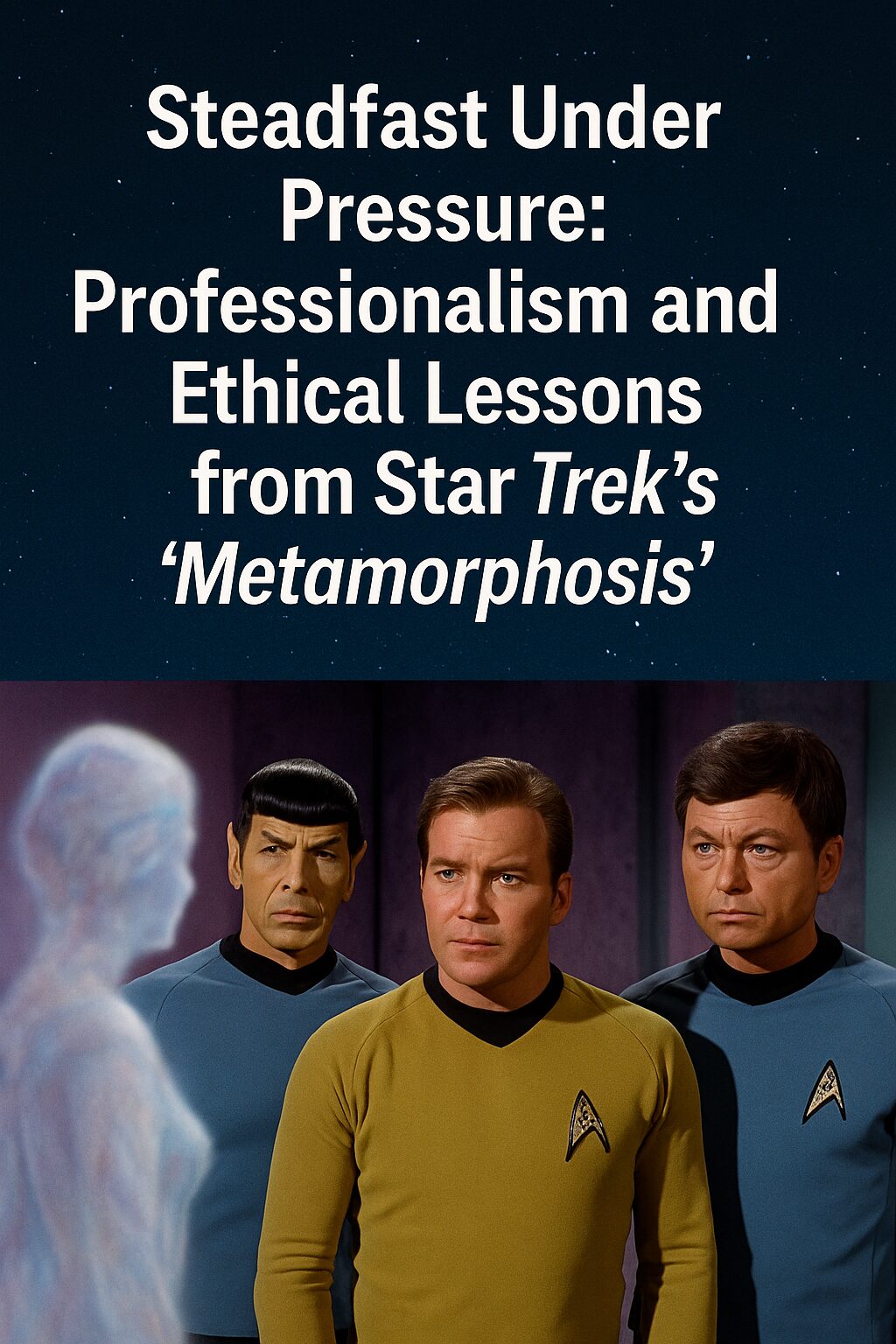
Steadfast Under Pressure: Professionalism and Ethical Lessons from Star Trek’s “Metamorphosis”

In the universe of corporate compliance, pressure is a constant. Whether facing a sudden investigation, navigating a crisis, or mediating high-stakes negotiations, the capacity to remain professional and ethically grounded is what separates a merely good compliance officer from a great one. Few pop culture references embody this principle more vividly than the classic Star Trek: The Original Series episode, “Metamorphosis.”

Set against the backdrop of a forced landing on a remote asteroid, “Metamorphosis” finds Captain Kirk, Spock, Dr. McCoy, and Commissioner Nancy Hedford stranded by an enigmatic alien entity known as the Companion. Their struggle to survive and mediate a clash of perspectives. It provides a near-perfect parallel to the kinds of professional and ethical challenges compliance professionals routinely face during investigations and stressful situations. Today, we dive into critical lessons for compliance professionals, each illustrated by a pivotal scene from “Metamorphosis.”

Lesson 1: Maintain Calm Objectivity—Even When You’re Under Fire

Illustrated By: Upon realizing that the Companion has hijacked their shuttle and they’re trapped on the planetoid, tensions run high. Commissioner Hedford, suffering from a life-threatening illness and a rapidly fading hope for rescue, becomes increasingly distraught. Yet Kirk and Spock methodically assess their environment and resources, refusing to let panic cloud their decision-making.

Compliance Lesson:

Investigations and crises often produce high-stress, high-stakes environments where anxiety and emotion run rampant. Professionalism in such situations demands composure and objectivity. A compliance officer’s ability to remain unflappable, not just for their own sake, but to reassure and stabilize others, is essential for effective problem-solving and ethical decision-making.

Train teams in stress management and crisis communication. Develop checklists and playbooks for investigative response to minimize decision-making under duress—model calm behavior to set the tone for the entire team.

Lesson 2: Empathy and Respect Are Critical—Even for Those You Don’t Understand

Illustrated By: The crew quickly learns the Companion is an alien being beyond their understanding, communicating in ways that defy their usual protocols. Instead of responding with hostility or frustration, Kirk and Spock seek to understand the Companion’s motives, with Spock even attempting a technological “translation” to bridge the communication gap.

Compliance Lesson: During investigations or stressful encounters, it’s easy to become impatient with those who seem uncooperative or “different,” whether they’re interview subjects, whistleblowers, or business partners from unfamiliar cultures. Professionalism requires empathy, respect, and a genuine effort to understand all perspectives, not just those that align with our own.

Integrate empathy training into your compliance curriculum. Remind investigators and managers that cultural, emotional, and even technological barriers are not obstacles to ignore but invitations to connect.

Lesson 3: Uphold Procedural Fairness—Even When Expediency Tempts You

Illustrated By: Desperate to return Commissioner Hedford to the Enterprise for urgent medical care, Kirk considers using force against the Companion. However, both Spock and McCoy caution against a hasty, confrontational approach. The crew ultimately respects due process, attempting diplomacy and dialogue before resorting to more drastic measures.

Compliance Lesson: Under pressure, shortcuts can seem tempting, such as skipping interviews, overlooking evidence, or rushing conclusions for the sake of expediency. However, professionalism in compliance means adhering to investigative protocols, ensuring fairness for all parties, even if it slows down the process or complicates things.

Institute clear, step-by-step protocols for investigations, and hold teams accountable for following them. Empower compliance personnel to speak up when they see due process being sidestepped.

Lesson 4: Ethical Decision-Making Requires Teamwork and Diverse Perspectives

Illustrated By: When initial attempts to reason with the Companion fail, Kirk doesn’t go it alone. He gathers input from Spock, McCoy, and even Commissioner Hedford, blending logic, medicine, diplomacy, and personal perspective. This collective approach yields a creative solution: merging Hedford’s consciousness with the Companion, which saves her life and resolves the impasse.

Compliance Lesson: Complex investigations rarely have easy answers. Ethical professionalism is reinforced by seeking out diverse viewpoints—legal, operational, cultural, and human—ensuring a comprehensive understanding of the issues at hand. The best compliance outcomes emerge from teams that respect each member’s expertise and encourage candid dialogue.

Promote cross-functional collaboration in every investigation. Debrief as a team after each case, capturing different perspectives and lessons learned for future improvement.

Lesson 5: Never Lose Sight of Humanity—The “Why” Behind Compliance

Illustrated By: As the Companion merges with Commissioner Hedford, she is given a second chance at life but must remain on the planetoid. Kirk and his crew, despite their desire to return to the Enterprise, recognize the profound importance of personal dignity and happiness in their resolution. They leave Hedford/Companion with Cochrane, honoring the choice made for love and fulfillment.

Compliance Lesson: In the rush to resolve crises or complete investigations, it’s easy to focus on policy, rules, and process at the expense of people. But true professionalism and ethical compliance leadership mean never losing sight of the human element. The best compliance professionals serve not just the organization but also the individuals whose lives are impacted by their actions.

Balance every investigative and crisis response protocol with compassion. Regularly revisit the organization’s values and “why” behind the compliance program. Use stories and real-life examples to remind teams of the human cost and benefit of ethical professionalism.

Final ComplianceLog Reflections

“Metamorphosis” stands as one of Star Trek’s most poignant explorations of transformation, not just of an alien being, but of the attitudes and perspectives of everyone involved. For compliance professionals, it serves as a powerful reminder: professionalism is not merely a matter of following procedures but of embodying the best of our values under pressure.

Maintaining objectivity, empathy, fairness, teamwork, and humanity, even in the face of the unknown, are the true hallmarks of ethical leadership in compliance. Every investigation, every high-stress moment, is an opportunity to transform not only the situation but also ourselves and our organizations.

As you lead your team through the next compliance challenge, remember the example set by Kirk, Spock, and McCoy. Stay calm. Seek to understand. Uphold fairness. Embrace teamwork. And above all, never forget the people at the heart of every compliance story.

Resources:

Excruciatingly Detailed Plot Summary by Eric W. Weisstein

MissionLogPodcast.com

Memory Alpha

Categories
Trekking Through Compliance

Trekking Through Compliance: Episode 37 – Corporate Governance Lessons from Star Trek’s “I, Mudd”

Who could have imagined that “I, Mudd,” a quirky, comedic episode from Star Trek: TOS, would offer valuable lessons in corporate governance? Yet, here we are, boldly going where no compliance blogger has gone before, using the misadventures of Captain Kirk and the enigmatic Harry Mudd to distill governance wisdom for modern compliance practitioners.

In this episode, “I, Mudd,” the Enterprise crew encounters Harry Mudd once more, stranded on a planet ruled by androids who are both obsessed with order and baffled by human irrationality. Mudd attempts to exploit the androids’ logic for his gain but soon finds himself captive to their strict interpretation of governance, leading Kirk and crew to intervene with creative tactics. Beneath the humor and hijinks lie critical corporate governance principles highly relevant to today’s compliance professionals.

Lesson 1: Transparency is Essential in Leadership

Illustrated By: Discovery of Harry Mudd’s True Motives and History with the Androids.

Governance Lesson. In corporate governance, transparency is equally crucial. Leaders who operate without openness risk organizational distrust, inefficiency, and dysfunction. Transparent leadership is foundational in governance; it supports robust stakeholder trust, improves organizational effectiveness, and mitigates potential scandals or compliance failures.

As compliance professionals, our role includes advocating for transparent communication channels, clear decision-making processes, and openly accessible policies and procedures. Creating a corporate culture of transparency ensures that the organization remains credible and effective in meeting both regulatory requirements and stakeholder expectations.

Lesson 2: Balance Between Structure and Flexibility

Illustrated By: The Androids’ Rigid Governance Framework. The androids in “I, Mudd” operate within an inflexible, logic-driven governance structure, incapable of handling unpredictable or irrational behavior. Their strict adherence to rules, without flexibility or situational judgment, ultimately leads to their downfall, as Kirk creatively exploits their rigidity.

Governance Lesson. This episode perfectly illustrates the need for governance structures to maintain balance. Compliance professionals must strive to find the optimal balance, developing corporate governance frameworks that are robust enough to ensure compliance while also being adaptable enough to meet the shifting regulatory and business environments.

Lesson 3: Importance of Ethical Leadership and Integrity

Illustrated By: Harry Mudd’s Attempts to Manipulate Android Governance.

Governance Lesson. This scenario resonates deeply within corporate governance. Integrity and ethical behavior must underpin all governance activities. Leaders who prioritize short-term gains over ethical conduct inevitably compromise their organization’s long-term health and credibility.

Lesson 4: Critical Thinking and Challenging Assumptions

Illustrated By: Kirk and Crew’s Strategy to Confuse the Androids with Illogical Behavior.

Governance Lesson. In a corporate context, governance systems sometimes become complacent, relying heavily on assumptions about internal controls, the effectiveness of risk management, and ethical conduct. Compliance leaders must encourage ongoing critical thinking, regularly challenging these assumptions to uncover vulnerabilities and weaknesses.

Lesson 5: The Value of Diversity and Human Insight in Governance

Illustrated By: The Androids’ Failure to Comprehend Human Nuance and Individuality.

Governance Lesson. Corporate governance similarly benefits from diverse perspectives, experiences, and insights. Organizations overly dependent on homogeneous leadership perspectives or mechanical decision-making processes become vulnerable to blind spots, groupthink, and systemic errors.

Final ComplianceLog Reflections

Who could have predicted that governance wisdom would emanate so vividly from the colorful escapades aboard the Enterprise with Harry Mudd and the androids? Yet, as compliance evangelists, we learn that corporate governance principles, such as transparency, ethical leadership, balanced structures, critical thinking, and diversity, are truly timeless.

Resources:

Excruciatingly Detailed Plot Summary by Eric W. Weisstein

MissionLogPodcast.com

Memory Alpha

Categories
Blog

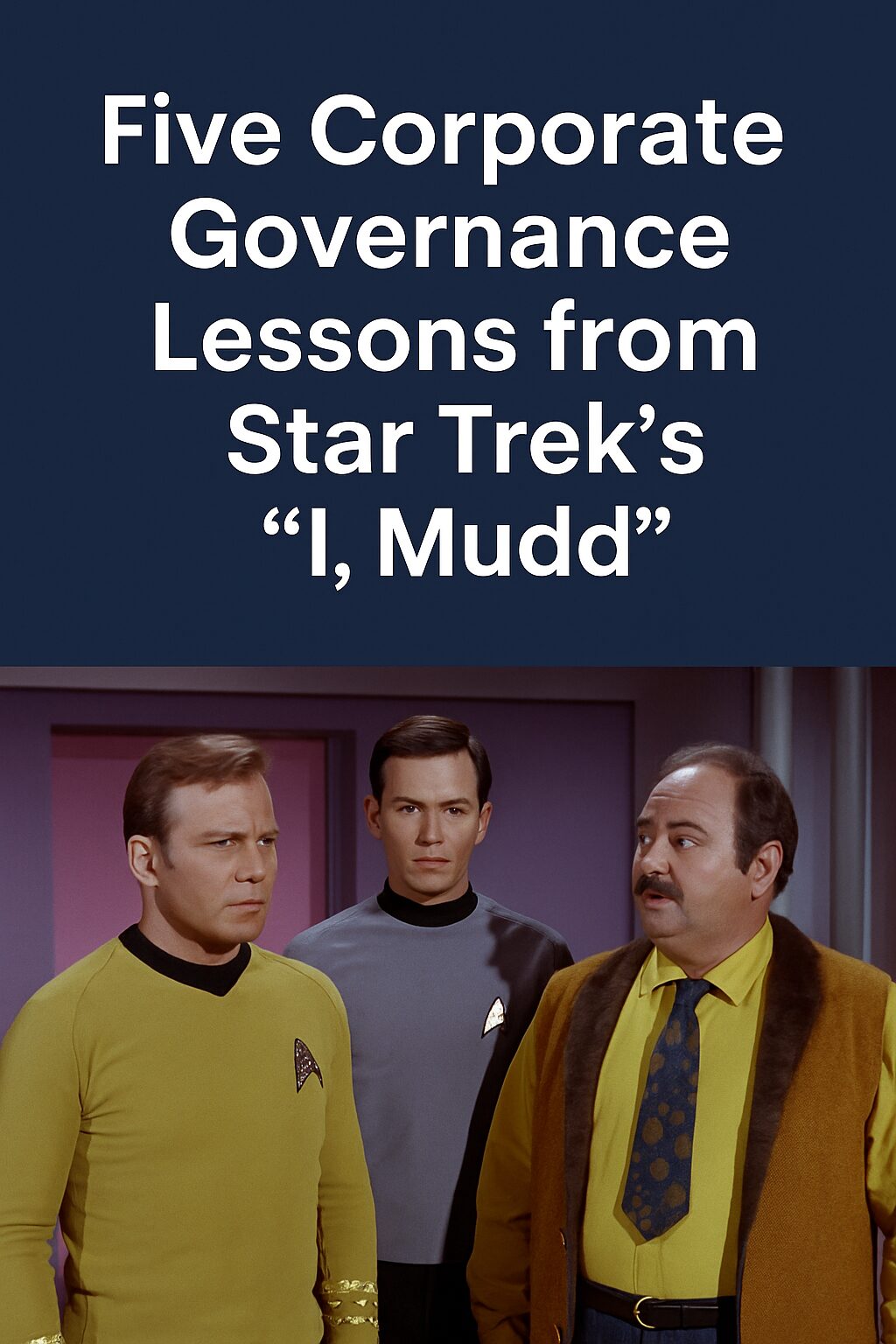
Governing Wisely: Five Corporate Governance Lessons from Star Trek’s “I, Mudd”

Who could have imagined that “I, Mudd,” a quirky, comedic episode from Star Trek: The Original Series, would offer valuable lessons in corporate governance? Yet, here we are, boldly going where no compliance blogger has gone before, using the misadventures of Captain Kirk and the enigmatic Harry Mudd to distill governance wisdom for modern compliance practitioners.

In this episode, “I, Mudd,” the Enterprise crew encounters Harry Mudd once more, stranded on a planet ruled by androids who are both obsessed with order and baffled by human irrationality. Mudd attempts to exploit the androids’ logic for his gain but soon finds himself captive to their strict interpretation of governance, leading Kirk and crew to intervene with creative tactics. Beneath the humor and hijinks lie critical corporate governance principles highly relevant to today’s compliance professionals. Let’s dive deeper.

Lesson 1: Transparency is Essential in Leadership

Illustrated By: Discovery of Harry Mudd’s True Motives and History with the Androids.

Early in the episode, Kirk and the Enterprise crew uncover that Harry Mudd has deceived both them and the androids, presenting himself falsely to hide his questionable motives. His lack of transparency ultimately erodes trust, causing tension, conflict, and misunderstandings.

In corporate governance, transparency is equally crucial. Leaders who operate without openness risk organizational distrust, inefficiency, and dysfunction. Transparent leadership is foundational in governance—it supports robust stakeholder trust, improves organizational effectiveness, and mitigates potential scandals or compliance failures.

As compliance professionals, our role includes advocating for transparent communication channels, clear decision-making processes, and openly accessible policies and procedures. Creating a corporate culture of transparency ensures that the organization remains credible and effective in meeting both regulatory requirements and stakeholder expectations.

Lesson 2: Balance Between Structure and Flexibility

Illustrated By: The Androids’ Rigid Governance Framework. The androids in “I, Mudd” operate within an inflexible, logic-driven governance structure, incapable of handling unpredictable or irrational behavior. Their strict adherence to rules, without flexibility or situational judgment, ultimately leads to their downfall, as Kirk creatively exploits their rigidity.

This episode perfectly illustrates the need for governance structures to maintain balance. Excessively rigid controls can stifle innovation, responsiveness, and organizational resilience. Conversely, too much flexibility can lead to inconsistent decision-making and compliance vulnerabilities. Compliance professionals must strive to find the optimal balance, developing corporate governance frameworks that are robust enough to ensure compliance while also being adaptable enough to meet the shifting regulatory and business environments. A well-balanced governance approach allows organizations to respond effectively to unforeseen challenges while maintaining critical controls.

Lesson 3: Importance of Ethical Leadership and Integrity

Illustrated By: Harry Mudd’s Attempts to Manipulate Android Governance. Harry Mudd’s self-serving manipulations and attempts to exploit governance structures for personal gain represent a classic example of unethical leadership. His disregard for ethical integrity generates instability and places everyone, including himself, at risk.

This scenario resonates deeply within corporate governance. Integrity and ethical behavior must underpin all governance activities. Leaders who prioritize short-term gains over ethical conduct inevitably compromise their organization’s long-term health and credibility.

Compliance professionals play a vital role in deeply embedding ethics into an organization’s culture and governance processes. Encouraging ethical leadership, providing comprehensive ethics training, and embedding ethical considerations into all governance decisions fortifies the organization’s resilience against corruption, scandals, and regulatory scrutiny.

Lesson 4: Critical Thinking and Challenging Assumptions

Illustrated By: Kirk and Crew’s Strategy to Confuse the Androids with Illogical Behavior. Perhaps the most memorable and amusing scene in “I, Mudd” occurs when Kirk and his crew use creative, illogical behaviors to disrupt the androids’ strictly logical governance system. This tactic underscores the importance of critical thinking and challenging assumptions inherent in established governance practices.

Governance Lesson. In a corporate context, governance systems sometimes become complacent, relying heavily on assumptions about internal controls, the effectiveness of risk management, and ethical conduct. Compliance leaders must encourage ongoing critical thinking, regularly challenging these assumptions to uncover vulnerabilities and weaknesses.

Regular audits, testing governance procedures through scenario planning and tabletop exercises, and encouraging critical questioning by employees help ensure governance systems remain robust, flexible, and prepared to manage emerging threats. This proactive approach safeguards organizations from complacency-induced governance failures.

Lesson 5: The Value of Diversity and Human Insight in Governance

Illustrated By: The Androids’ Failure to Comprehend Human Nuance and Individuality. In “I, Mudd,” the androids’ governance system fails primarily because they cannot appreciate human diversity, emotional intelligence, and individuality. Their failure underscores the importance of these factors in effective governance.

Governance Lesson. Corporate governance similarly benefits from diverse perspectives, experiences, and insights. Organizations overly dependent on homogeneous leadership perspectives or mechanical decision-making processes become vulnerable to blind spots, groupthink, and systemic errors.

Compliance officers must advocate vigorously for diversity across governance committees, senior management teams, and boards. Diverse perspectives, combining analytical rigor and human insight, allow governance processes to anticipate better, understand, and manage risks, regulatory requirements, and ethical considerations. Encouraging and valuing diverse voices and fostering inclusion greatly enhances organizational decision-making and governance efficacy.

Final ComplianceLog Reflections

Who could have predicted that governance wisdom would emanate so vividly from the colorful escapades aboard the Enterprise with Harry Mudd and the androids? Yet, as compliance evangelists, we learn that corporate governance principles, such as transparency, ethical leadership, balanced structures, critical thinking, and diversity, are truly timeless.

By integrating these lessons into governance practices, compliance professionals can cultivate organizations that are capable of navigating complexities, mitigating risks, and ensuring adherence to ethical and regulatory standards. As Captain Kirk and his intrepid crew demonstrate, effective governance requires clarity, adaptability, ethical strength, critical thinking, and diverse insights—qualities indispensable for addressing today’s corporate governance challenges.

Resources:

Excruciatingly Detailed Plot Summary by Eric W. Weisstein

MissionLogPodcast.com

Memory Alpha

Categories
Trekking Through Compliance

Trekking Through Compliance: Episode 36 – Crisis Management in Compliance: Lessons from Star Trek’s “Catspaw”

Today, we boldly journey into the Star Trek: TOS episode “Catspaw,” an engaging yet somewhat eerie tale, to uncover practical crisis management insights that can benefit corporate compliance practitioners. In “Catspaw,” Captain Kirk and his stalwart crew encounter alien beings who utilize illusions, fear tactics, and psychological manipulation to control the Enterprise. Today, Tom Fox outlines five specific lessons derived from key scenes in the episode and explains their relevance to the compliance profession.

Lesson 1: Understand and Define the Nature of the Crisis Clearly (Scene: Initial Loss of Crew Members)

Illustrated By: At the outset of the episode, Kirk and the Enterprise crew become concerned when an away team led by Chief Engineer Scott fails to respond. Kirk quickly recognizes the absence of communication as a genuine crisis, one that warrants immediate investigation.

Compliance Lesson: For compliance officers, clarity in defining a crisis is paramount.

Lesson 2: Avoid Being Misled by Surface Appearances or Initial Assumptions (Scene: Spooky Castle and Illusions)

Illustrated By: Kirk, Spock, and Dr. McCoy find themselves faced with a mysterious castle, complete with witches and haunting illusions, which is deliberately designed to mislead and manipulate their perceptions.

Compliance Lesson: Compliance crises similarly often come cloaked in misleading appearances. Fraud, bribery, corruption, or regulatory violations may initially seem improbable or manifest subtly, disguised by legitimate-seeming transactions or credible rationalizations.

Lesson 3: Maintain Clear, Consistent Communication Under Pressure (Scene: Communication Between the Enterprise and Kirk’s Away Team)

Illustrated By: Throughout “Catspaw,” Spock and Kirk rely heavily upon continuous, clear, and precise communications with the Enterprise.

Compliance Lesson: Clear communication is the compliance professional’s most potent tool during crises. Timely, transparent information flows across teams, departments, senior management, and external stakeholders are crucial.

Lesson 4: Foster Team Cohesion and Trust to Overcome Crisis (Scene: Crew Unity and Reliance Under Alien Manipulation)

Illustrated By: When confronted by their alien adversaries, Sylvia and Korob, who create illusions to sow division and confusion, the Enterprise crew remains steadfast, unified, and supportive.

Compliance Lesson: In compliance crises, organizational cohesion and trust are indispensable. Fear, blame, and suspicion often arise naturally during high-stress situations.

Lesson 5: Innovate and Adapt Rapidly in Response to Changing Situations (Scene: Kirk’s Recognition and Exploitation of Alien Weakness)

Illustrated By: Ultimately, Kirk identifies that the aliens, Sylvia and Korob, utilize advanced technology to create their illusions but lack practical experience with human reality.

Compliance Lesson: Compliance professionals frequently encounter novel crises that challenge standard procedures and existing playbooks. The capability to innovate and adapt quickly becomes critical.

Final ComplianceLog Reflections

Star Trek’s “Catspaw reveals, beneath its fantastical veneer, the powerfully demonstrated fundamental principles of crisis management: rapid identification and clear definition of crises, disciplined investigative rigor, effective communication, team cohesion, and strategic innovation. Compliance professionals are regularly challenged by uncertainty, disruption, and confusion, much like those faced by the Enterprise crew. Adopting and embedding these five core lessons into your compliance strategy ensures your organization is equipped to withstand and even thrive in challenging, unpredictable environments.

Resources:

Excruciatingly Detailed Plot Summary by Eric W. Weisstein

MissionLogPodcast.com

Memory Alpha

Categories
Blog

Unmasking Crisis Management Guidance from Star Trek’s ‘Catspaw’

Unexpected crises often confront compliance professionals, with threats appearing seemingly out of nowhere and confusing situations that defy initial explanation. As I frequently highlight, valuable compliance lessons usually lurk in surprising places, including iconic television episodes. Today, we boldly journey into the Star Trek: TOS episode “Catspaw,” an engaging yet somewhat eerie tale, to uncover practical crisis management insights that can benefit corporate compliance practitioners.

In “Catspaw,” Captain Kirk and his stalwart crew encounter alien beings who utilize illusions, fear tactics, and psychological manipulation to control the Enterprise. Despite the fantasy-like scenario, the core elements of crisis management—clarity, preparation, communication, team cohesion, and innovation—stand out vividly. Today, I outline five specific lessons derived from key scenes in the episode and explain their relevance to the compliance profession.

Lesson 1: Understand and Define the Nature of the Crisis Clearly (Scene: Initial Loss of Crew Members)

Illustrated By: At the outset of the episode, Kirk and the Enterprise crew become concerned when an away team led by Chief Engineer Scott fails to respond. Kirk quickly recognizes the absence of communication as a genuine crisis, one that warrants immediate investigation. Rather than assuming routine difficulties, Kirk takes decisive action by personally leading an investigative team.

Compliance Lesson: For compliance officers, clarity in defining a crisis is paramount. Sometimes, compliance breaches initially manifest as seemingly minor irregularities, such as unanswered inquiries, unusual data patterns, or minor reporting errors. Ignoring or delaying a response could significantly amplify risk. Compliance professionals must swiftly identify red flags and clearly define the nature, severity, and urgency of a crisis to promptly activate the proper protocols.

Regular compliance training, ongoing communication channels, and robust internal monitoring processes enable early recognition of crises and ensure immediate escalation to the appropriate stakeholders. Just as Captain Kirk wasted no time in defining and addressing the initial disappearance, compliance teams must be swift and decisive when detecting irregularities that signal looming issues.

Lesson 2: Avoid Being Misled by Surface Appearances or Initial Assumptions (Scene: Spooky Castle and Illusions)

Illustrated By: Upon landing on the planet Pyris VII, Kirk, Spock, and Dr. McCoy find themselves faced with an eerie, castle-like structure straight from Earthly folklore. Though initially skeptical, they cautiously approach and explore the site. This mysterious castle, complete with witches and haunting illusions, is deliberately designed to mislead and manipulate their perceptions.

Compliance Lesson: Compliance crises similarly often come cloaked in misleading appearances. Fraud, bribery, corruption, or regulatory violations may initially seem improbable or manifest subtly, disguised by legitimate-seeming transactions or credible rationalizations. Compliance officers must diligently resist making hasty assumptions or superficial judgments. Rigorous, objective fact-finding and thorough investigative processes are critical.

Ensuring objectivity involves carefully verifying data, validating assumptions, interviewing multiple stakeholders, and cross-checking facts against independent sources to ensure accuracy and reliability. By refusing to be misled by appearances and committing to disciplined investigative rigor, compliance professionals avoid costly misunderstandings and position their organizations to address the true crisis effectively.

Lesson 3: Maintain Clear, Consistent Communication Under Pressure (Scene: Communication Between the Enterprise and Kirk’s Away Team)

Illustrated By: Throughout “Catspaw,” Spock and Kirk rely heavily upon continuous, clear, and precise communications with the Enterprise. Even when disrupted or facing deceptive attempts from the aliens, both shipboard and away teams continually seek to re-establish accurate communication. This steadfast commitment enables eventual problem-solving and rescue.

Compliance Lesson: Clear communication is perhaps the compliance professional’s most potent tool during crises. Timely, transparent information flows across teams, departments, senior management, and external stakeholders are crucial. Clear messaging about the crisis, the response plan, interim steps, and resolution strategy reduces panic, confusion, and misinformation that crises often amplify.

To emulate the Enterprise’s example, compliance teams should regularly rehearse crisis communication plans, define clear messaging templates, and establish designated points of contact to ensure effective communication. Consistency and clarity foster organizational alignment and significantly enhance response effectiveness, allowing compliance officers to guide their organization safely through tumultuous events.

Lesson 4: Foster Team Cohesion and Trust to Overcome Crisis (Scene: Crew Unity and Reliance Under Alien Manipulation)

Illustrated By: When confronted by their alien adversaries, Sylvia and Korob, who create illusions to sow division and confusion, the Enterprise crew remains steadfast, unified, and supportive. Despite being subjected to fearful illusions explicitly designed to break morale and trust, Kirk, Spock, and McCoy rely upon mutual trust and team cohesion to maintain their sanity and effectiveness.

Compliance Lesson: In compliance crises, organizational cohesion and trust are indispensable. Fear, blame, and suspicion often arise naturally during high-stress situations. However, compliance teams that have proactively cultivated trust, mutual support, and clarity of roles can resist these divisive pressures and continue operating effectively.

Proactive team-building exercises, role-specific training, crisis scenario rehearsals, and clear communication all contribute to building trust and unity. Compliance leaders who emphasize cooperation and support foster resilience, ensuring that when crises arise, teams respond with cohesion rather than panic.

Lesson 5: Innovate and Adapt Rapidly in Response to Changing Situations (Scene: Kirk’s Recognition and Exploitation of Alien Weakness)

Illustrated By: Ultimately, Kirk identifies that the aliens, Sylvia and Korob, utilize advanced technology to create their illusions but lack practical experience with human reality. Quickly adapting, Kirk leverages this knowledge, creatively disrupting the aliens’ control by questioning their understanding and exploiting their inexperience. His decisive innovation allows the Enterprise crew to break free from the crisis scenario.

Compliance Lesson: Compliance professionals frequently encounter novel crises that challenge standard procedures and existing playbooks. The capability to innovate and adapt quickly becomes critical. Standard protocols are essential, but compliance leaders must also empower teams to identify and creatively exploit opportunities for resolution outside predefined frameworks.

Encouraging compliance professionals to engage in scenario planning, creative problem-solving training, and strategic flexibility builds innovation capacity. Like Kirk’s decisive adaptation under pressure, creative compliance professionals can rapidly devise new strategies or repurpose existing resources to resolve unprecedented crises effectively.

Final ComplianceLog Reflections

Star Trek’s “Catspaw” reveals, beneath its fantastical veneer, fundamental principles of crisis management: rapid identification and precise definition of crises, disciplined investigative rigor, effective communication, team cohesion, and strategic innovation.

Compliance professionals are regularly challenged by uncertainty, disruption, and confusion, much like those faced by the Enterprise crew. Adopting and embedding these five core lessons into your compliance strategy ensures your organization is equipped to withstand and even thrive in challenging, unpredictable environments.

Indeed, as Kirk, Spock, and their team consistently demonstrate, effectively confronting crises hinges not only upon preparedness and planning but also upon clarity, objectivity, teamwork, communication, and adaptability. Integrating these lessons positions your compliance program for long-term resilience and effectiveness, regardless of how extraordinary or unexpected the crisis may seem.

Resources:

Excruciatingly Detailed Plot Summary by Eric W. Weisstein

MissionLogPodcast.com

Memory Alpha

Categories
Trekking Through Compliance

Trekking Through Compliance: Episode 35 – Root Cause Lessons from Star Trek’s “The Doomsday Machine”

Compliance professionals are forever tasked with pinpointing the root causes behind organizational failures, missteps, or breaches. This deep dive is critical, not only for remediating issues but also for ensuring they don’t recur. In this compliance exploration, let’s boldly go where few compliance bloggers have gone before, into the riveting episode “The Doomsday Machine.”

Here are five lessons, each anchored directly in the narrative of this classic Star Trek episode, emphasizing how thorough root cause analyses can strengthen your compliance function and safeguard your organization.

Lesson 1: Identify the Problem to Solve the Correct Issue

Illustrated By: Commodore Decker incorrectly identifies the root cause. He believes the Doomsday Machine is a conventional threat rather than an unfeeling, mechanical entity beyond traditional warfare.

Compliance Lesson. In compliance terms, this parallels the imperative first step in any root cause analysis: defining the correct problem. Misidentifying the fundamental issue can lead to misguided corrective actions that fail to prevent recurrence.

Lesson 2: Gather Complete Data Before Making Decisions

Illustrated by: Commodore Decker’s hasty decisions are predicated upon incomplete and inadequate data.

Compliance Lesson. Drawing premature conclusions from incomplete data gathering can lead to inadequate analyses, resulting in ineffective solutions and the recurrence of issues.

Lesson 3: Recognize and Address Human Factors

Illustrated By: The human element, including stress, fatigue, and emotional response, significantly impacts decision-making.

Compliance Lesson. In your root cause analyses, it is essential to consider human factors rigorously.

Lesson 4: Establish and Follow Clear Protocols

Illustrated By: Captain Kirk, once back in command, establishes a disciplined approach to address the crisis.

Compliance Lesson. Root cause analyses similarly benefit immensely from disciplined adherence to clearly established investigative protocols.

Lesson 5: Develop Sustainable Preventive Solutions, Not Temporary Fixes

Illustrated By: The Enterprise crew devises an effective solution by leveraging detailed knowledge of the Doomsday Machine’s design and vulnerabilities.

Compliance Lesson. In compliance with this, root cause analyses aim to create permanent, preventive solutions. Short-term patches that treat symptoms rather than underlying causes merely set organizations up for future compliance breakdowns.

Final ComplianceLog Reflections

As corporate compliance professionals, our role parallels that of Starfleet officers, tasked with safeguarding our organizations against compliance risks that can threaten their very existence. The Star Trek episode “The Doomsday Machine” highlights the crucial importance of effective root cause analysis, which involves accurately identifying issues, collecting comprehensive data, understanding human factors, adhering to disciplined investigative procedures, and implementing sustainable solutions.

Resources:

Excruciatingly Detailed Plot Summary by Eric W. Weisstein

MissionLogPodcast.com

Memory Alpha

Categories
Blog

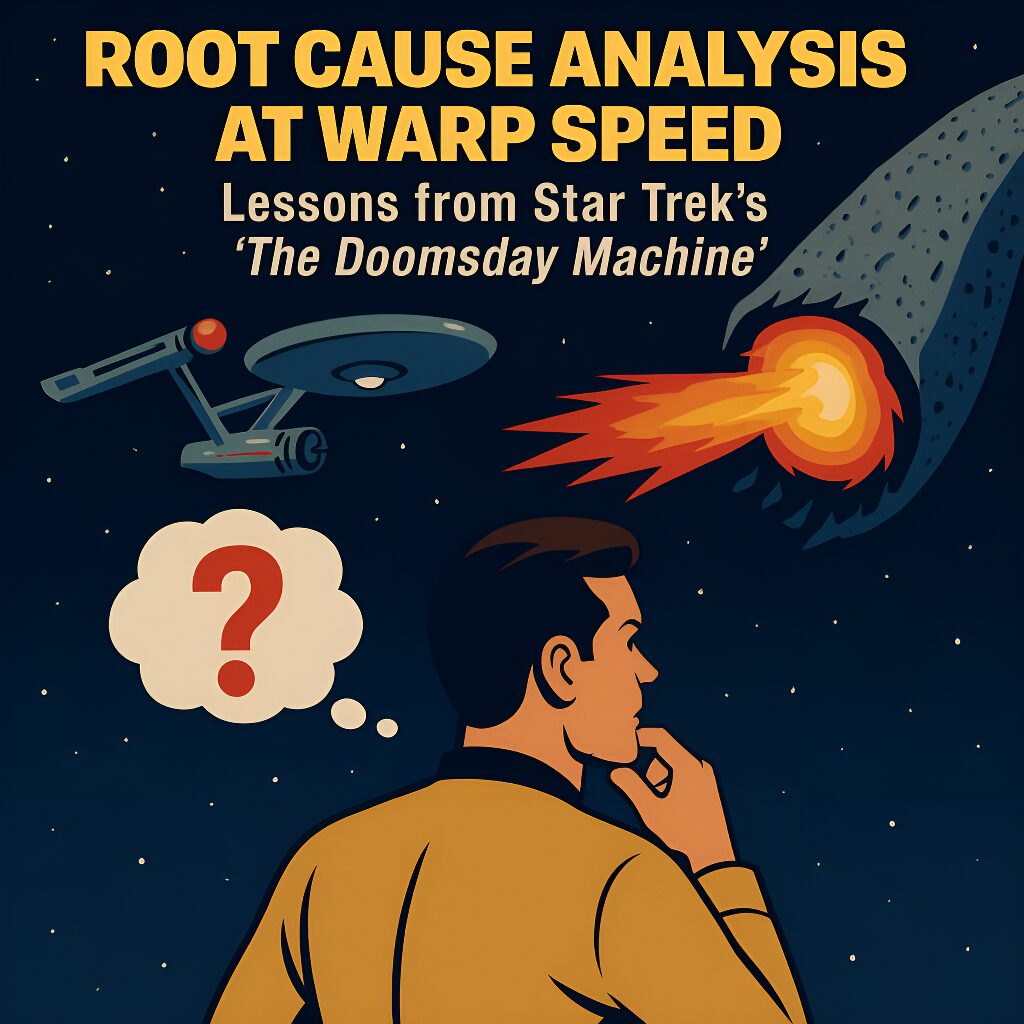
Root Cause Analysis at Warp Speed: Lessons from Star Trek’s “The Doomsday Machine”

Compliance professionals are forever tasked with pinpointing the root causes behind organizational failures, missteps, or breaches. This deep dive is critical, not only for remediating issues but also for ensuring they do not recur. In this compliance exploration, let’s boldly go where few compliance bloggers have gone before, into the riveting episode “The Doomsday Machine.”

As a refresher, in “The Doomsday Machine,” the crew of the USS Enterprise encounters a planet-killing automated weapon of mass destruction from another galaxy. This relentless machine obliterates entire worlds to fuel itself. The Enterprise finds Commodore Matt Decker, captain of the now-destroyed USS Constellation, driven to obsession and near madness by his failure to protect his ship and crew from the Doomsday Machine. Commodore Decker’s flawed decisions and the ultimate resolution led by Captain Kirk provide rich material to glean essential lessons in root cause analysis for today’s compliance professionals.

Here are five lessons, each anchored directly in the narrative of this classic Star Trek episode, emphasizing how thorough root cause analyses can strengthen your compliance function and safeguard your organization.

Lesson 1: Identify the Problem to Solve the Correct Issue

Illustrated By: Commodore Decker incorrectly identifies the primary issue—he treats the Doomsday Machine as a conventional threat rather than an unfeeling, mechanical entity beyond traditional warfare. Driven by guilt and obsession, he assumes the machine can be fought head-on without thoroughly analyzing its origins or functions.

Compliance Lesson. In compliance terms, this parallels the imperative first step in any root cause analysis: defining the correct problem. Misidentifying the fundamental issue can lead to misguided corrective actions that fail to prevent recurrence. Compliance teams must focus clearly and objectively, free from bias, emotion, or hurried assumptions, on identifying the core compliance problem before proposing solutions.

Lesson 2: Gather Complete Data Before Making Decisions

Illustrated by: Commodore Decker’s hasty decisions are predicated upon incomplete and inadequate data. Driven by trauma from losing his crew, he commandeers the Enterprise in a futile, direct assault without fully understanding the nature of his adversary. His rushed judgment puts the entire Enterprise crew at risk.

Compliance Lesson. Compliance professionals must always gather comprehensive, factual, and relevant data before making decisions in a root cause analysis. Premature conclusions without thorough data gathering can lead to incomplete analyses, resulting in ineffective solutions and the recurrence of issues. Data completeness and accuracy must guide your investigative processes to ensure the development of appropriate and practical action plans.

Lesson 3: Recognize and Address Human Factors

Illustrated By: The human element, including stress, fatigue, and emotional response, significantly impacts decision-making. The psychological trauma of his losses compromises Decker’s mental state. Yet, no one initially intervenes to assess his emotional fitness for command. This omission exacerbates the crisis.

Compliance Lesson. In your root cause analyses, it is essential to consider human factors rigorously. Compliance issues rarely occur in a vacuum of policies and systems; they usually involve human decision-making under various pressures and emotions. Addressing these human factors explicitly helps in devising better support, more transparent communication, and strengthened leadership accountability.

Lesson 4: Establish and Follow Clear Protocols

Illustrated By: Captain Kirk, once back in command, establishes a disciplined approach to address the crisis. Kirk carefully follows clearly defined Starfleet procedures to formulate a rational, effective response to neutralize the Doomsday Machine. He remains calm, clear-headed, and systematic.

Compliance Lesson. Root cause analyses similarly benefit immensely from disciplined adherence to clearly established investigative protocols. Proper frameworks, such as the “Five Whys” and Ishikawa Fishbone Diagrams or other standardized methods, help teams structure their analyses logically, ensuring a thorough exploration of contributing factors and root causes. Such discipline and rigor prevent shortcuts and superficial solutions.

Lesson 5: Develop Sustainable Preventive Solutions, Not Temporary Fixes

Illustrated By: The Enterprise crew devises an effective solution by leveraging detailed knowledge of the Doomsday Machine’s design and vulnerabilities, destroying it by detonating the crippled USS Constellation from within. Their method isn’t simply a reprieve but a durable solution to eliminate the threat permanently.

Compliance Lesson. In compliance with this, root cause analyses aim to create permanent, preventive solutions. Short-term patches that treat symptoms rather than underlying causes merely set organizations up for future compliance breakdowns. Invest your efforts in sustainable solutions that incorporate procedural changes, enhanced training, strengthened oversight, or technological adjustments to prevent recurrence effectively.

Final ComplianceLog Reflections

As corporate compliance professionals, our role parallels that of Starfleet officers tasked with safeguarding our organizations against compliance risks that can threaten their very existence. The Star Trek episode “The Doomsday Machine” highlights the crucial importance of practical root cause analysis, which involves proper issue identification, comprehensive data collection, understanding human factors, adhering to disciplined investigative procedures, and implementing sustainable solutions.

By absorbing these vital lessons, compliance leaders can ensure they are fully equipped to navigate their organizations safely through even the most daunting compliance challenges. Indeed, conducting effective root cause analyses is more than just solving problems; it is essential to preserving integrity, sustainability, and corporate resilience.

In a universe fraught with unknown risks, it’s reassuring to know that diligent compliance practices and structured root-cause analyses can turn a potential disaster into confident, controlled responses. Star Trek may have brought us entertainment, but it also offers enduring, pragmatic lessons in compliance. So, compliance professionals, let us boldly analyze areas that have not been examined before, leveraging these lessons to fortify our organizations against whatever “doomsday machines” might arise next.

Resources:

Excruciatingly Detailed Plot Summary by Eric W. Weisstein

MissionLogPodcast.com

Memory Alpha

Categories
Trekking Through Compliance

Trekking Through Compliance: Episode 34 – Ethical Insights from the “The Apple”

One of the most rewarding experiences for a compliance professional is identifying ethics and integrity lessons in seemingly unrelated fields, especially in unexpected places, such as the far reaches of space, as depicted in the classic “Star Trek: The Original Series” episode “The Apple.” This imaginative story about the crew’s encounter with a seemingly idyllic but oppressive paradise, Vaal, offers powerful ethical lessons highly relevant to corporate compliance professionals today.

Lesson 1: The Dangers of Blind Obedience—Questioning Authority Matters

Illustrated By: The opening scenes of “The Apple” find Captain Kirk and his crew on Gamma Trianguli VI, a world that appears lush, tranquil, and perfect. However, it quickly becomes evident that the inhabitants’ peaceful existence depends entirely upon their blind obedience to the godlike entity Vaal. 

Compliance Lesson. In corporate compliance, this situation mirrors employees blindly following directives without exercising independent judgment or ethical scrutiny. 

Lesson 2: The Illusion of Benevolent Dictatorship—Long-term Harm from Short-term Convenience

Illustrated by Vaal, the natives are provided for, ensuring they never have to struggle or face uncertainty. While seemingly kind and protective, this arrangement ultimately stifles growth, curiosity, and development. 

Compliance Lesson. For organizations, relying on a centralized, overly controlling compliance or management structure can similarly produce unintended negative consequences. 

Lesson 3: Transparency and Communication Are Crucial—The Pitfalls of Hidden Controls

Illustrated By: A critical ethical issue in “The Apple” is the hidden mechanism of control maintained by Vaal. 

Compliance Lesson. Transparency and open communication are equally essential in a compliance context. A company that hides critical facts or maintains opaque operational practices places itself at considerable risk of ethical failures. 

Lesson 4: Cultivating Ethical Independence—Empowering Employees to Make Ethical Choices

Illustrated by: In one particularly illuminating scene, Kirk and Spock realize the villagers have no concept of making personal decisions. They have never had to confront moral or ethical dilemmas because Vaal dictates every aspect of their lives. 

Compliance Lesson. Corporations that over-regulate or excessively constrain ethical discretion similarly create a workforce that is incapable of making independent ethical decisions. 

Lesson 5: Consequences of Disrupting Status Quo—Planning for Ethical and Cultural Change

Illustrated By: At the episode’s conclusion, Kirk disables Vaal, freeing the planet’s inhabitants. This sudden transition underscores a critical compliance insight: ethical and cultural shifts demand thorough preparation and intentional transition management.

Compliance Lesson. Corporate compliance programs often face the need to introduce significant changes in organizational behavior or ethical expectations, whether due to new regulatory mandates, cultural realignment initiatives, or remedial compliance actions following an incident. 

Final ComplianceLog Reflections

In conclusion, the Star Trek TOS episode “The Apple” provides profound insights into the ethical obligations of compliance officers and their corporate counterparts. Through powerful metaphor and storytelling, it highlights critical issues such as the necessity of fostering independent thinking, the perils of opaque governance structures, the value of transparency, the vital importance of cultivating ethical independence, and the thoughtful management of cultural change. These enduring lessons from the Final Frontier underscore the universal truths essential for maintaining an effective, sustainable, and ethically sound compliance culture.

Resources:

Excruciatingly Detailed Plot Summary by Eric W. Weisstein

MissionLogPodcast.com 

Memory Alpha