


Categories
The ESG Report

Jared Connors – Using Tech to Support ESG


In today’s ESG Report, Tom Fox is pleased to be joined by supply chain risk management professional extraordinaire, Jared Connors. They’re discussing the work done at Assent Compliance Inc., one of the leading organizations in supply chain sustainability management. 


Becoming a Leader in the World of ESG 
Assent has worked on a variety of regulations to support its clients’ compliance journeys, including substance and modern slavery regulations. Within that context, there are often reputational impacts of compliance. At Assent, the natural extension is to encourage customers to assess their suppliers’ abilities to support and adhere to these regulations. 
 
The Impact of the Conflict Minerals Regulation 
The Conflict Minerals Regulation was one of the first regulations to promote greater transparency of the upstream supply chain and is a pioneering regulation that’s driven companies to look beyond their Tier 1 suppliers. According to Jared, the Conflict Minerals Regulation isn’t just about source of origin verification, but also about chain of custody.

Reputational Damage 
Jared tells a story that highlights the significance of reputational damage, and how it can facilitate an organization’s downfall, “This started out with reputational impacts and led to a lot of other tangible risks from a monetary perspective.” 
 
Direct and Indirect Engagement 
Directly engaging suppliers involves asking them about internal controls, management procedures, and their ability to provide metrics on certain topics. This, however, is insufficient, and therefore, indirect evaluation is required. “You can’t just look at the first level,” says Jared, “You have to get deeper.” These further evaluations are necessary to understand if suppliers can “walk that talk”, because that should have huge implications in doing business with them. 
 
RESOURCES 
Tom Fox’s email
Jared Connors | LinkedIn | Assent
 

Categories
Innovation in Compliance

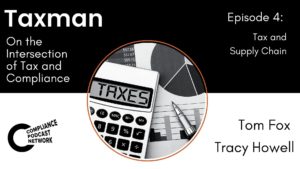
Taxman: Tax and Supply Chain


As the Taxman five-part series nears the end, Tom Fox and Tracy Howell tackle an important topic that has become more prominent over the years: tax and supply chain. 


How Tax Can Help Supply Chain
Supply chain in a traditional sense focuses on the acquisition of goods, in particular the quality, cost, and delivery. There can be a substantial tax component in each of those steps to help companies attain goods at the lowest possible cost. Consequently, if supply chain does not have a relationship with tax, it can result in additional surprise costs being attached to goods. Data beyond the cost of goods, material, and service can be used to model and predict the additional tax burden so that better procurement decisions can be made. 

Mitigating the Risk of Mission Creep 
Establishing a connection between tax and supply chain in an organization is good, but the relationship needs to be kept fresh for a positive impact. In a company, people may be focused on so many different things that they forget to interact. Creative people tend to expand their roles and look for goods and services in different locations, which can be the cause of a mission creep. Hence, having constant close interaction between supply chain and tax allows for changes in functionality to be documented and implemented into the organizational framework.
 
Elements of a Tax-Efficient Supply Chain
Tom and Tracy discuss the elements of a tax-efficient supply chain. This includes:

  • Examination of the entire scope of what’s being manufactured and sold to allow the creation of tax opportunities to bring value based on special purpose entities. 
  • Coordination of transactions in a supply chain with transfer pricing. 
  • Compliance with tax laws and regulations. 
  • Documentation of the process. 

 
Resources
Tracy Howell | Email | LinkedIn 
 

Categories
Blog

Tax and Compliance: Tax and Supply Chain

What is the intersection of tax and compliance? Why does a Chief Compliance Officer (CCO) or compliance professional need to sit down with the corporate head of tax? How does a corporate tax function fit into a best practices compliance program? It turns out there is quite a bit a compliance professional can learn from a tax professional. Moreover, there are many aspects of tax which should be considered by a CCO and compliance professional from an overall risk management perspective. Unfortunately, these questions are rarely explored in the compliance community.
To explore these issues (and remedy this lack of awareness) I recently sat down with noted tax professional Tracy Howell to explore these and other questions. We tackled these issues and others in a five-part podcast series for Innovation in Compliance. Today, we consider the role of tax in the Supply Chain. We also expand that to compliance, because compliance also has a huge role in this area.

Obviously, this topic has become more prominent over the last couple of years during the pandemic. Over the past couple of weeks, with the Russia invasion of Ukraine, it has become even more hyper-critical. One of the things we saw in the pandemic was that many companies with long established Supply Chains, perhaps not single source suppliers, but close to single source suppliers, found themselves scrambling when huge swaths. With the Russian invasion of Ukraine, we have had the largest amount of economic sanctions delivered by any administration in the modern era. Companies are struggling with not only responding to the sanctions but responding to the business dislocation from Russia and Belarus to Ukraine and into eastern Europe.
Clearly Supply Chain is critical for an organization, especially an organization that manufactures and has any substantial delivery of materials and services. There is also the question of where the highest risk in your Supply Chain might be. Is it in the critical component(s) in the acquisition of goods? Is it in the delivery of services? Or is it simply in the manufacturing process itself? Moreover, if you think of Supply Chains as only having a traditional focus on the acquisition of goods, comprising both the quality of the goods and the cost of the goods, and concluding with the delivery of the goods for consumption or later sale; you are missing a key component. That key component is tax and as Howell stated, “there can be a substantial tax component in each one of those steps of acquisition costs. If you are buying goods in foreign jurisdictions that can be transaction taxes, such as GST or VAT.”
Howell provided the following example. “If a company’s buying raw materials in a third country, in the shipping terms, we’d normally say title transfers in international waters, that’s a good thing for the buyer. Because that means if I’m buying something and I take title in international waters, it should not trigger any transaction taxes. However, if you are not paying attention to where you acquire goods from and then you take title within the country of origin’s territory, guess what? That could trigger up to a VAT liability of 15 to 20%. This means that if your Supply Chain is not interacting or does not have a relationship with tax, and the taxes can add a 15% to 20% component to the cost of goods in a transaction, which dramatically impacts the company’s cost of goods sold (COGS).”
However, if there is a good relationship between tax and Supply Chain, there can also be additional benefits tax brought to the fore and such benefits are more critical in 2022 and beyond because they can help a company plan for disruptions in the supply chain. For instance, if Supply Chain looks for alternative suppliers, or a different geo-region for component parts, tax can step in and do an analysis that would at least give them an estimate of what the tax costs are going to be.
Howell said that tax can provide “Supply Chain with the data that is beyond the cost of good, or the cost of material, or the cost of service. A tax professional can do so by modeling out the liability that a multinational could incur, including up to five different possible sources for goods and materials. From there you can extend your model out to see what the additional tax burden would be in each one of those scenarios. From there you can check to see if there are any tax incentives that either exist or that your organization can go negotiate.”
But the risk management that tax can bring to Supply Chain does not end there; particularly once tax and Supply Chain have established a relationship and it is understood how tax can assist Supply Chain in the procurement of goods and services. Through a documented process, it creates and entire framework for the organization to use going forward because at any given time Supply Chain will be looking for goods and services in different locations. Howell said, “you can have a mission creep. It is important for tax to have that relationship with Supply Chain so as their functionality changes and your organization is acquiring new goods in different locations, you can document the changes, and update your framework as needed when new tax issues can come to play.”

Join us tomorrow for our concluding post when we consider the role of tax in a corporate ESG program. Check out the full podcast series Taxman: On the Intersection of Tax and Compliance on the Compliance Podcast Network. Check out Tracy Howell on LinkedIn.

Categories
This Week in FCPA

Episode 293 – the Ukraine Hangs On edition


As Ukraine hangs on from the Russian invasion, Jay is on assignment so fan fav Kristy Grant-Hart joins this week as a co-host with Tom to look at some of the week’s top compliance and ethics stories from the impact of the Ukrainian crisis in the Ukraine Hangs On edition. 
Stories

  1. What Russia invasion means for companies and compliance. Tom with a series in the FCPA Compliance and Ethics Blog. Matt Kelly in Radical Compliance.
  2. Dick Cassin says sanctions may lead to more corruption in the FCPA Blog.
  3. Jaclyn Jaeger looks at supply chain disruption and issues in Compliance Week (sub req’d)
  4. Matthew Murray asks if Putin invaded Ukraine to advance corruption, in GAB.
  5. Chasing oligarchs’ money, from the Washington Post.
  6. The Swiss approach to Ukraine crisis. Mark Pieth in Risk and Compliance Europe.
  7. Mike Volkov focuses on new and evolving sanctions, in Corruption Crime and Compliance.
  8. Economic nationalism and corporate governance. Martin Geller, in Harvard Law School Forum on Corporate Governance.
  9. Illicit finance and High-value art. Sullivan & Cromwell lawyers in Compliance and Enforcement.
  10. The invasion and cybersecurity. Jonathan Armstrong in Cordery Compliance.

Podcasts and More

  1. In March on The Compliance Life, I visit with Audrey Harris, Managing Director at AMI, formerly CCO at BHP. In Part 1, she discusses her academic background and early professional career.
  2. On the FCPA Compliance Report, Tom has a 2-part series with Trade Compliance guru Matt Silverman on the full extent of possible Russia sanctions (Part 1) and the corporate response you need to make (Part 2).
  3. Tom and Loren Steffy look energy issues and fallout from the Russian invasion in Greetings and Felicitations.
  4. Tom and Matt Kelly take a deep dive into the compliance weeds about the Russian invasion on Compliance into the Weeds.
  5. Silvia Surman devotes the entire week to Russian trade sanctions and economic issues in The Compliance Kitchen.
  6. Tom celebrates Texas Independence Day and the anniversary of the Alamo in a podcast with Don Frazier, Executive Director of the Texas Institute at Schreiner University on The Hill Country Podcast.

Tom Fox is the Voice of Compliance and can be reached at tfox@tfoxlaw.com. Kristy Grant-Hart is Compliance Kristy and can be reached at kgranthart@sparkcompliance.com.

Categories
Daily Compliance News

November 30, 2021 the New Blood Diamonds edition


In today’s edition of Daily Compliance News:

  • IDB debars Belgium engineering company for fraud and corruption. (FCPA Blog)
  • Are batteries the new blood diamonds? (NYT)
  • Esper sues DoD over book redactions. (WSJ)
  • NY highest court holds disgorgement is not a penalty. (D&O Diary)
Categories
Compliance Kitchen

America’s Supply Chains


The Biden Administration’s 100 day review first set of reports under the “America’s Supply Chains” Executive Order are out and we take a look at what the findings and where is the White House planning to take them.

Categories
Daily Compliance News

December 9, 2020-the Supply Chain Woes edition


In today’s edition of Daily Compliance News:

  • Who is in your supply chain? (WaPo)
  • McKinsey apologizes. (NYT)
  • Employee security concerns increase in WFH era. (WSJ)
  • Nationstar fined $91MM over fraudulent foreclosures. (WSJ)
Categories
Daily Compliance News

September 12, 2020-the Glass Ceiling Broken edition


In today’s edition of Daily Compliance News:

  • Supply Chain fragility exposed. (McKinsey)
  • Citigroup appoints first female head of major US bank. (WaPo)
  • Compliance efforts mitigate Deutsche Bank fine. (WSJ)
  • Faucci says masks will be needed in theaters thru 2021. (NYT)
Categories
31 Days to More Effective Compliance Programs

Risk ranking in the Supply Chain


One of the areas many companies do not focus on enough is possible corruption in their supply chain for goods and services provided on a company’s behalf. The FCPA risks can be just as great through those entry points as it can be through the sales side of an organization. You need to know who your company is doing business with through this channel as much as you need to know your agents seeking business opportunities on your behalf. Most companies have exponentially more vendors than sales agents, so this task may seem daunting. However, a well thought out plan to risk rank your company’s third-parties on the supply chain side can go a long way towards ameliorating this issue. The key is to set reasonable parameters and then management those third-parties which present true corruption risk to your organization.
This determination of the level of due diligence and categorization of a supplier should depend on a variety of factors, including, such factors as whether the supplier is (1) located, or will operate, in a high risk country; (2) associated, or recommended or required by, a government official; (3) currently under corruption investigation, or has been recently convicted of any form of corruption; (4) a multinational publicly traded corporation with a recognized exemplary system of compliance and internal controls; or (5) a provider of widely available services and products that are not industry specific. You should note that any supplier, which has foreign government touch points, should move up into a higher level of scrutiny.
My suggestion is that you create a three-tiered risk matrix consisting of (1) high-risk suppliers, (2) low-risk suppliers, and (3) minimal-risk suppliers. Below this final category is another category for providers of goods which are commonly available and pose almost no corruption risk.
You need to risk rank the third-parties which your supply chain might engage with for FCPA exposure. It should be based on your company’s experience and risk going forward. As with all other third-party risk management issues, you must “Document, Document, and Document”.
Three key takeaways:

  1. Risk rank your supply chain based on well-conceived strata.
  2. Consider not only the compliance risk but also your business risk.
  3. Only manage those suppliers which present a corruption risk.
Categories
Daily Compliance News

July 22, 2020-the Supply Chain edition


In today’s edition of Daily Compliance News:

  • Tapestry CEO forced to resign. (NYT)
  • CFTC Chair pushes to finalize Dodd-Frank rules. (WSJ)
  • Supply chain vulnerabilities. (WSJ)
  • Apple and sustainability. (WaPo)