Categories
Trekking Through Compliance

Trekking Through Compliance: Episode 71 – Surviving the Unknown: Risk Management Lessons from “That Which Survives”

In compliance, risk management is more than a checklist. It is the ongoing discipline of identifying threats, assessing their potential impact, and implementing measures to mitigate or neutralize them before they cause harm.

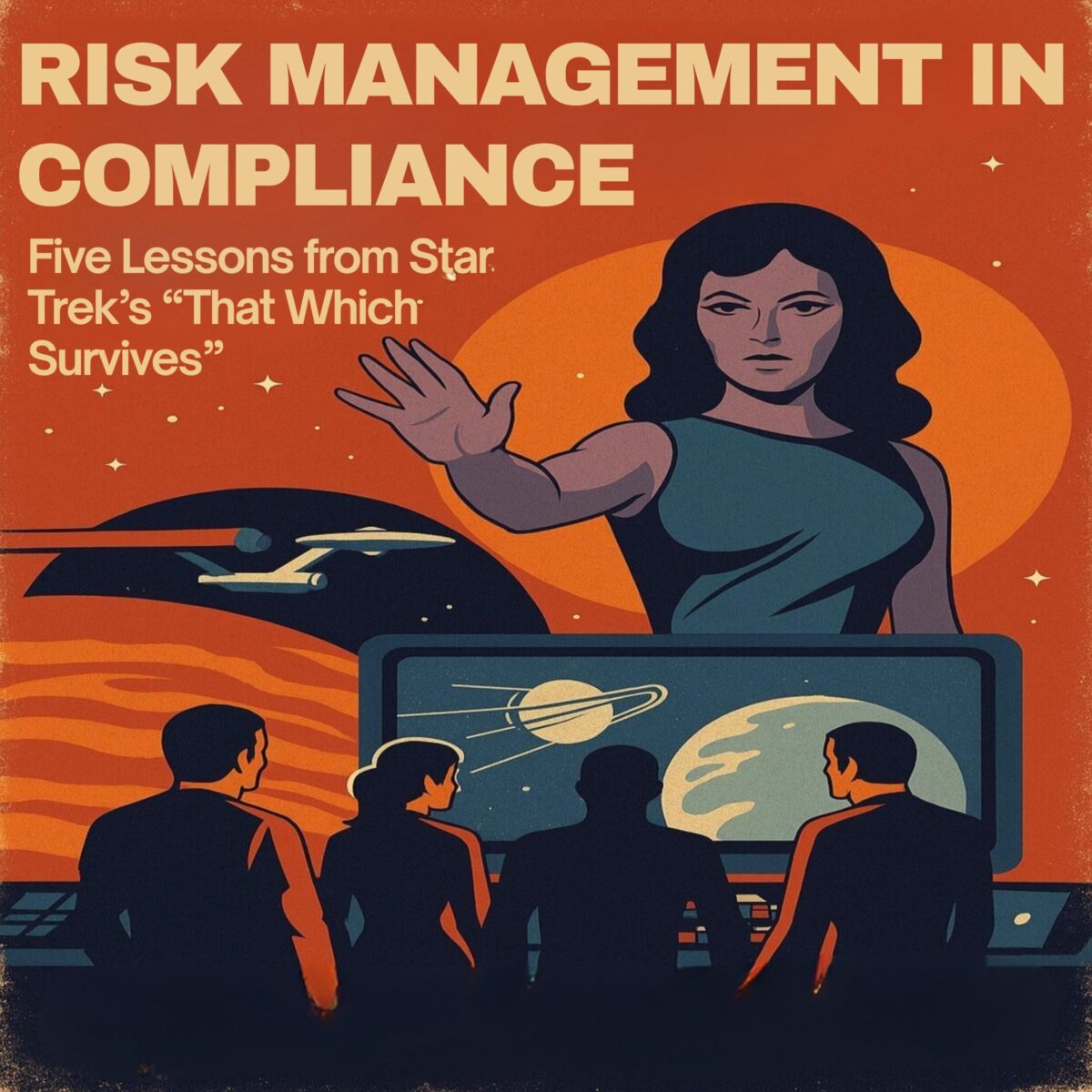
Few Star Trek episodes illustrate the escalating consequences of underestimated risks as effectively as That Which Survives. In it, the Enterprise crew encounters a seemingly lifeless planet guarded by Losira, an alien projection who can kill with a single touch. Her purpose is to protect the planet’s secrets, but her method is indiscriminate, deadly, and poorly aligned to the situation at hand.

For compliance professionals, this episode offers five important lessons on anticipating, assessing, and responding to risks, both known and unknown, within an organization.

Lesson 1: Identify Risks Before Engaging in New Ventures

Illustrated By: The Enterprise arrives at an uncharted planet. Within moments, a mysterious woman materializes and kills a crew member simply by touching him.

Compliance Lesson. Too often, companies rush into new markets, partnerships, or projects without conducting a thorough risk assessment. This can expose the organization to sanctions violations, corruption risks, cybersecurity vulnerabilities, or operational failures.

Lesson 2: Understand That Some Risks Are Intelligent and Adaptive

Illustrated By: Losira targets specific individuals and adapts her approach to their vulnerabilities.

Compliance Lesson. Not all risks are static. Fraudsters change tactics, cyber threats evolve, and corrupt third parties find new ways to conceal misconduct. A compliance program must anticipate that some risks will actively seek to bypass controls.

Lesson 3: Don’t Dismiss Low-Probability, High-Impact Threats

Illustrated By: At first, the crew assumes Losira’s appearances are isolated incidents, but they quickly realize she poses an existential threat.

Compliance Lesson. Rare events, such as a single high-value bribery transaction, a lone rogue employee, or a targeted cyberattack, can have catastrophic consequences. Organizations sometimes underprepare for these scenarios because they seem unlikely.

Lesson 4: Risk Mitigation Requires Cross-Functional Coordination

Illustrated By: The landing party on the planet and the Enterprise crew in orbit are each facing threats from Losira, but their survival depends on sharing information and coordinating responses. Without clear communication, both groups would be doomed.

Compliance Lesson. Compliance cannot manage risk in isolation. It must work with legal, internal audit, operations, IT, and HR to identify threats and implement controls.

Lesson 5: Address the Root Cause, Not Just the Symptoms

Illustrated By: The crew eventually discovers that Losira is an automated defense mechanism left behind by an extinct race. Once the crew understands her origin and purpose, they can neutralize the threat.

Compliance Lesson. In risk management, addressing surface-level problems without finding the underlying cause only delays future incidents. Compliance should integrate root cause analysis into all investigations.

Final ComplianceLog Reflections

That Which Survives is more than a suspense episode; it is a cautionary tale about the dangers of underestimating risk. Losira was not inherently evil; she was a misunderstood, unexamined part of an environment the crew did not fully assess before engagement.

The compliance officer’s mandate is to ensure the company doesn’t make the same mistake: to scan for threats before beaming in, to adapt to risks that evolve, to prepare for unlikely but devastating events, to coordinate across the enterprise, and to address the root cause when problems arise. Risk management is not just about surviving; it is about ensuring that your organization thrives in any environment, whether it’s an unexplored planet or a rapidly changing market.

Resources:

⁠⁠Excruciatingly Detailed Plot Summary by Eric W. Weisstein⁠⁠

⁠⁠MissionLogPodcast.com⁠⁠

⁠⁠Memory Alpha

Categories
Blog

Risk Management in Compliance: Five Lessons from Star Trek’s That Which Survives

In compliance, risk management is more than a checklist. It is the ongoing discipline of identifying threats, assessing their potential impact, and implementing measures to mitigate or neutralize them before they cause harm.

Few Star Trek episodes illustrate the escalating consequences of underestimated risks as effectively as That Which Survives. In it, the Enterprise crew encounters a seemingly lifeless planet guarded by Losira, an alien projection who can kill with a single touch. Her purpose is to protect the planet’s secrets, but her method is indiscriminate, deadly, and poorly aligned to the situation at hand.

For compliance professionals, this episode offers five important lessons on anticipating, assessing, and responding to risks, both known and unknown, within an organization.

Lesson 1: Identify Risks Before Engaging in New Ventures

Illustrated By: The Enterprise arrives at an uncharted planet, scans it briefly, and beams down a landing party. Within moments, a mysterious woman materializes and kills a crew member simply by touching him.

Compliance Lesson. Too often, companies rush into new markets, partnerships, or projects without conducting a thorough risk assessment. This can expose the organization to sanctions violations, corruption risks, cybersecurity vulnerabilities, or operational failures. Compliance should lead or be deeply involved in pre-engagement risk assessments. Before “beaming down” into a new business environment, map potential threats—regulatory, operational, reputational—and identify safeguards. Skipping this step can lead to preventable harm and costly remediation.

Lesson 2: Understand That Some Risks Are Intelligent and Adaptive

Illustrated By: Losira’s ability to appear anywhere, both on the planet and aboard the Enterprise, shows she is not a passive hazard. She targets specific individuals and adapts her approach to their vulnerabilities.

Compliance Lesson. Not all risks are static. Fraudsters change tactics, cyber threats evolve, and corrupt third parties find new ways to conceal misconduct. A compliance program must anticipate that some risks will actively seek to bypass controls. Build adaptive monitoring into your compliance systems. Use continuous transaction monitoring, real-time alerts, and data analytics to detect changes in patterns. A one-time risk assessment is not enough—ongoing vigilance is essential.

Lesson 3: Don’t Dismiss Low-Probability, High-Impact Threats

Illustrated By: At first, the crew assumes Losira’s appearances are isolated incidents, but they quickly realize she poses an existential threat. Even though she is only one individual, her capabilities could destroy the Enterprise if not addressed.

Compliance Lesson. Rare events, such as a single high-value bribery transaction, a lone rogue employee, or a targeted cyberattack, can have catastrophic consequences. Organizations sometimes underprepare for these scenarios because they seem unlikely. Compliance departments should incorporate low-probability, high-impact risks into the risk register. Conduct tabletop exercises to simulate rare but potentially devastating events, ensuring the organization has both prevention and response plans in place.

Lesson 4: Risk Mitigation Requires Cross-Functional Coordination

Illustrated By: The landing party on the planet and the Enterprise crew in orbit are each facing threats from Losira, but their survival depends on sharing information and coordinating responses. Without clear communication, both groups would be doomed.

Compliance Lesson. Compliance cannot manage risk in isolation. It must work with legal, internal audit, operations, IT, and HR to identify threats and implement controls. Silos breed blind spots, and blind spots breed crises. Establish cross-functional risk committees or working groups. Ensure that incident reporting and escalation procedures are well understood across departments. Make compliance the hub of a collaborative risk network, not a separate spoke.

Lesson 5: Address the Root Cause, Not Just the Symptoms

Illustrated By: The crew eventually discovers that Losira is an automated defense mechanism left behind by an extinct race. She’s not malicious—she’s simply executing a program without context or adaptability. Once the crew understands her origin and purpose, they can neutralize the threat.

Compliance Lesson. In risk management, addressing surface-level problems without finding the underlying cause only delays future incidents. For example, punishing an employee for violating a policy without examining why the policy was ignored leaves the organization vulnerable to repeat violations. Compliance should integrate root cause analysis into all investigations. Whether it’s a process flaw, cultural issue, or oversight gap, solving the real problem is the only way to reduce recurrence.

The Enterprise as a Risk Management Model

Captain Kirk and his crew succeed not because they are lucky, but because they adapt quickly, share intelligence, and dig deeper to understand the nature of the threat. These are precisely the attributes a corporate compliance department needs to lead risk management:

  • Proactive assessment before engagement.
  • Adaptive controls that respond to evolving risks.
  • Preparation for rare but high-impact events.
  • Collaboration across organizational functions.
  • Root cause remediation for lasting solutions.

Practical Compliance Takeaways

From That Which Survives, compliance professionals can draw these operational insights:

  1. Integrate Compliance Early—Risk management starts before contracts are signed or operations begin, not after.
  2. Invest in Technology—Data analytics, AI monitoring, and continuous auditing tools make adaptive risk management possible.
  3. Conduct Scenario Planning—Practice responding to “Losira-like” threats: targeted, intelligent, and hard to predict.
  4. Build Risk Alliances—Partner with all departments to create a unified threat picture.
  5. Close the Loop—Use each incident to strengthen your program against future threats.

Final ComplianceLog Reflections

That Which Survives is more than a suspense episode; it is a cautionary tale about the dangers of underestimating risk. Losira was not inherently evil; she was a misunderstood, unexamined part of an environment the crew did not fully assess before engagement.

The compliance officer’s mandate is to ensure the company doesn’t make the same mistake: to scan for threats before beaming in, to adapt to risks that evolve, to prepare for unlikely but devastating events, to coordinate across the enterprise, and to address the root cause when problems arise.

In other words, risk management is not just about surviving; it is about ensuring that your organization thrives in any environment, whether it’s an unexplored planet or a rapidly changing market.

Resources:

⁠⁠Excruciatingly Detailed Plot Summary by Eric W. Weisstein⁠⁠

⁠⁠MissionLogPodcast.com⁠⁠

⁠⁠Memory Alpha

Categories
Trekking Through Compliance

Trekking Through Compliance-Episode 72-That Which Survives

In this episode of Trekking Through Compliance, we consider the episode That Which Survives which aired on January 24, 1969, Star Date unknown.
Compliance Takeaways:

  1. What is your risk tolerance?
  2. How do you manage sales risk?
  3. How does your Board look at risk?