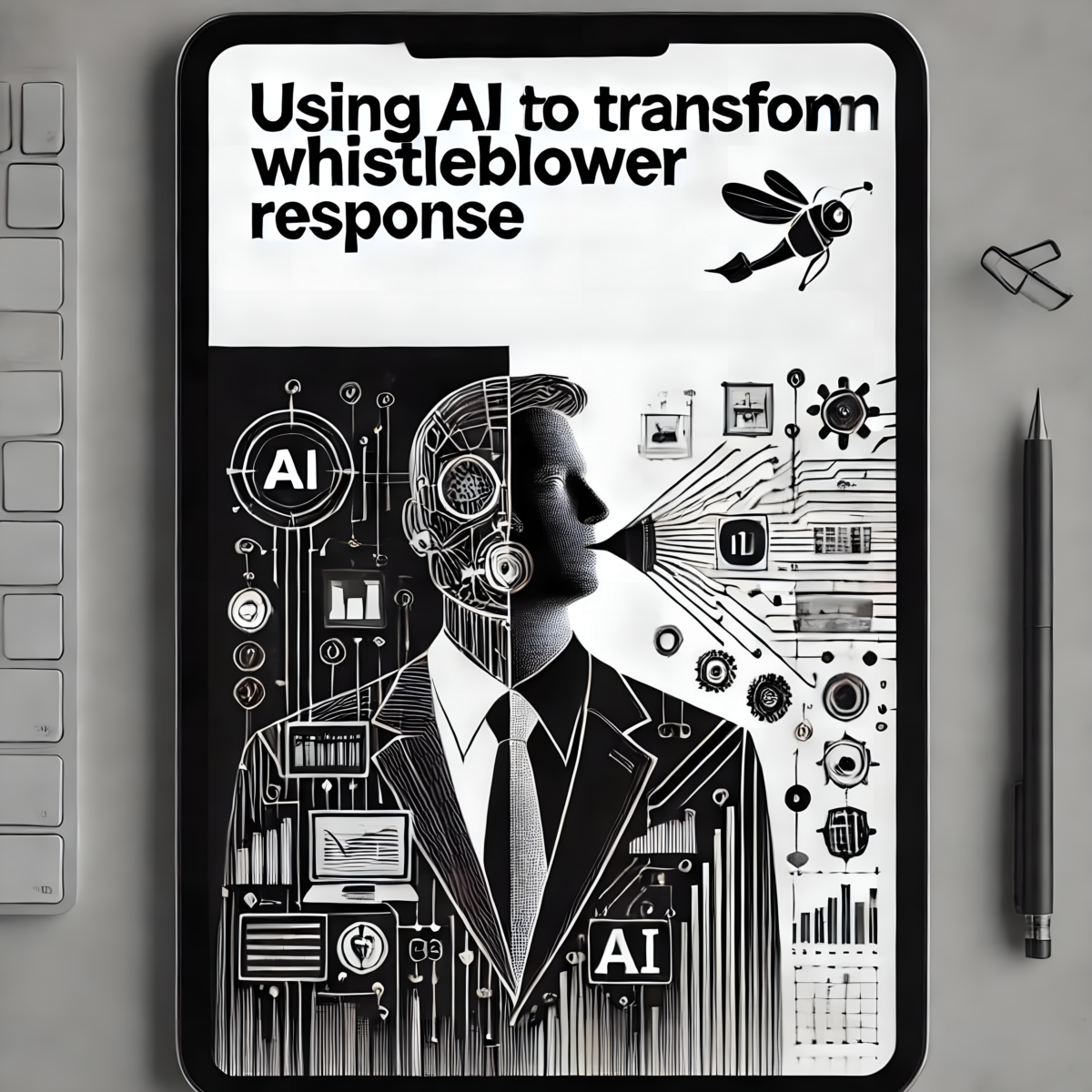
When it comes to internal reporting programs, the days of the lonely 1-800 hotline are over. Today’s compliance landscape demands real-time action, smarter triage, greater protections for whistleblowers, and trust. Fortunately, we now have the tools to meet that demand. Artificial Intelligence (AI) and predictive analytics transform whistleblower programs from sluggish, reactive systems into powerful, proactive compliance assets.
This shift could not be timelier. Regulators like the DOJ and SEC have clarified that robust, responsive whistleblower programs are not just a “nice to have” but mandatory. Companies that fail to get this right risk regulatory penalties and devastating hits to their reputation and employee trust. AI offers the compliance community a tremendous opportunity to enhance whistleblower protection, build credibility, and drive a true culture of compliance. Today, I want to summarize key lessons compliance professionals can draw from this evolving space.
Lesson 1: AI as a Guardian of Whistleblower Anonymity
Historically, fear of retaliation has been the Achilles’ heel of internal reporting programs. Employees hesitate to come forward when they don’t trust the system to protect them.
AI changes that. Using sophisticated Natural Language Processing (NLP), AI systems can automatically strip away identifiers, names, job titles, and department names from reports while preserving the critical context needed for an investigation. This is not simply a technical improvement. Instead, it should be seen as a trust builder. Compliance officers must lean into these anonymization technologies and communicate their existence to employees. If employees know the system genuinely protects their identities, the likelihood of them speaking up and doing so internally increases dramatically.
The bottom line: anonymity protections powered by AI are no longer optional; they’re essential.
Lesson 2: Real-Time Prioritization Through Machine Learning
Another game-changer AI brings is the ability to sort and prioritize whistleblower reports in real-time. In the old world, investigators had to slog through hundreds or thousands of cases manually, often missing the truly high-risk ones. Machine learning algorithms today can review incoming reports, categorize them by urgency, and identify patterns that would otherwise go unnoticed.
This means faster action on serious allegations and earlier intervention to mitigate legal and reputational risks. Compliance professionals should build KPIs around AI-driven triage: How quickly are high-risk reports escalated? How often are machine-prioritized cases substantiated? What’s the employee satisfaction rate with the process?
AI-powered triage means your whistleblower system can evolve from a passive intake mechanism to a real-time risk management engine.
Lesson 3: Meet Employees Where (and How) They Communicate
Here is a hard truth in compliance: if your speak-up program is still just a hotline, you are losing the next generation of reporters. Vince Walden puts it best: different generations communicate differently. Millennials, Gen Z, and certainly Gen Alpha are far more comfortable with digital chat-based systems than voice calls. In fact, in one major telecom company, the top question employees asked the compliance chatbot was, “Is this a conflict of interest?” Thus, proving how valuable and revealing these interactions can be.
The lesson is clear: You need chatbots, mobile-first platforms, and AI-driven systems that not only receive reports but also interact, guiding users through the reporting process, clarifying ambiguous issues, and capturing better data upfront. Modernizing your intake channels is not just about technology; it’s about inclusivity and building a true culture of compliance that meets employees where they are.
Lesson 4: Expansion of the Grievance Mechanism Use Case
Compliance isn’t just about FCPA violations and insider trading anymore.
New regulatory frameworks like Europe’s Corporate Sustainability Due Diligence Directive (CSDDD) require grievance mechanisms that extend to supply chain employees and local communities affected by a company’s operations. Your AI-enhanced grievance mechanisms must be flexible enough to receive and triage various issues, such as code of conduct violations, human rights complaints, community grievances, and more.
Andrew McBride has noted that AI-driven intake systems can immediately ask follow-up questions when an initial report is unclear, vastly improving the quality of the information collected. That front-end improvement makes triage, investigation, and resolution much more efficient.
Lesson learned: Build a grievance mechanism that isn’t one-size-fits-all. Flexibility is the new mandate.
Lesson 5: AI for Smarter, Scalable Triage
Finally, Matt Galvin has pointed out the richest opportunity: using AI to automate and scale the triage process fully. Imagine a system trained on thousands of past investigations that can predict the most likely next steps for each new report, whether a simple follow-up, a deep-dive investigation, or escalation to senior leadership.
AI models developed from 5,000 annual complaints identified predictable investigative paths at one company, making triage faster, smarter, and far more cost-effective. Of course, Galvin wisely cautioned that you need a robust and affordable solution to make this practical, especially if you’re operating across high-cost jurisdictions. But the payoff is immense: more efficient investigations, lower operating costs, and a stronger, data-driven compliance posture.
Lesson: The future of whistleblower response is not simply about responding; rather, it is about predicting, prioritizing, and preempting risk.
Final Thoughts
The future of whistleblower programs is not about adding more hotlines or printing more posters. It is about embedding AI and predictive analytics into every layer of your reporting system, from intake to triage to resolution. AI helps compliance teams protect anonymity, prioritize real risk, meet employees where they are, expand the use cases for grievance mechanisms, and scale triage operations without scaling costs.
AI doesn’t replace the demands of human judgment compliance—it amplifies them. The compliance officers who understand this shift, embrace these tools, and lead their organizations through the transition will not just improve whistleblower response. They will make compliance a strategic asset that drives transparency, trust, and sustainable growth.
In short, the future of whistleblower programs is here—and it’s intelligent.
The above is from my latest book, Upping Your Game: How Compliance and Risk Management Move to 2030 and Beyond, available from Amazon.com.