Welcome to “Compliance Tip of the Day,” the podcast where we bring you daily insights and practical advice on navigating the ever-evolving landscape of compliance and regulatory requirements. Whether you’re a seasoned compliance professional or just starting your journey, we aim to provide bite-sized, actionable tips to help you stay on top of your compliance game. Join us as we explore the latest industry trends, share best practices, and demystify complex compliance issues to keep your organization on the right side of the law. Tune in daily for your dose of compliance wisdom, and let’s make compliance a little less daunting, one tip at a time.
Today, we conclude a week of AI in compliance by seeing Trump’s Executive Order for compliance as standing at the turning point.
For more on embedded compliance, check out my new book, Upping Your Game: How Compliance and Risk Management Move to 2030 and Beyond, available from Amazon.com.
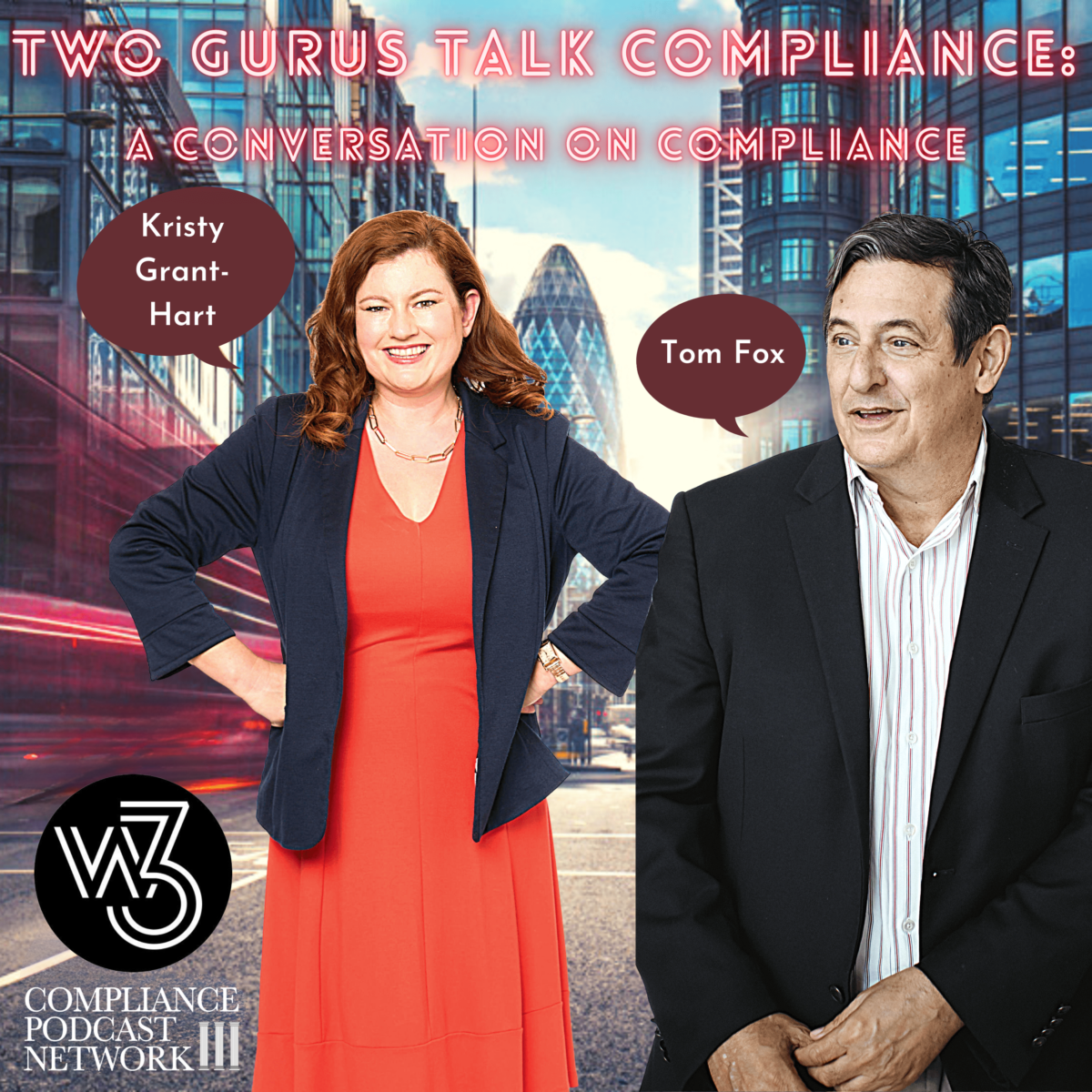
What happens when two top compliance commentators get together? They talk compliance, of course. Join Tom Fox and Kristy Grant-Hart in 2 Gurus Talk Compliance as they discuss the latest compliance issues in this week’s episode!
As compliance professionals, we are at a turning point. We either embrace the opportunity that Trump has presented us, or our professionals will be consigned to an organization’s technical back office function. AI is not merely an intriguing possibility for tomorrow; it has become the reality of today’s compliance landscape. From predictive analytics to behavioral monitoring, embedded compliance education, and conversational chatbots, AI is fundamentally reshaping the compliance function. Organizations that embrace this revolution achieve greater operational efficiency and risk management and position themselves as ethical leaders in an increasingly complex and demanding regulatory world.
AI is now indispensable to robust compliance practices. Yet, technology itself is not the endpoint. Instead, AI is the catalyst driving compliance teams from reactive, check-the-box mentalities toward proactive, strategic, and culturally embedded roles. It empowers compliance to engage employees at every organizational level in real-time, turning passive observers into active participants in cultivating an ethical business culture.
Consider third-party risk management, historically burdened by static, manual reviews and periodic due diligence. AI-driven predictive analytics and blockchain-backed transparency have emerged as game-changing technologies, continuously evaluating third parties, rapidly identifying emerging risks, and automating enforcement actions through smart contracts. There are documented and substantial benefits of reducing compliance risk, enhancing commercial efficiency, and minimizing legal exposure. AI fundamentally alters the equation, enabling compliance teams to achieve real-time transparency and responsiveness unimaginable a decade ago.
In continuous monitoring, Andrew McBride’s compelling vision of compliance as the “Holy Grail” reveals a future already upon us, where AI synthesizes vast datasets from internal transactions to communications, pinpointing anomalies with unprecedented precision. Real-time monitoring, once aspirational, is now achievable, providing compliance teams the agility to act swiftly and decisively. The necessity of integrating such systems has grown urgent, underscored by regulators like the DOJ, whose 2024 Evaluation of Corporate Compliance Programs explicitly cites real-time analytics as integral to compliance excellence.
Yet, the transformative power of AI extends beyond risk mitigation alone. The most profound innovation lies in compliance education. Long constrained by rigid formats and yearly box-checking exercises, today’s compliance training leverages AI and gamification, transforming learning into immersive, personalized experiences. Microlearning and scenario-driven simulations have replaced passive information absorption with active, ongoing engagement. This approach embeds compliance principles into daily workflows, reinforcing knowledge when employees need it. Vorecol’s striking revelation that virtual reality can enhance knowledge retention by up to 75% illustrates how transformative these approaches have become. Compliance training is now an integrated, real-time, strategic advantage rather than a peripheral, periodic chore.
Behavioral analytics offer another revolutionary dimension. By analyzing employee behavior, survey data, and internal communications in real-time, compliance teams can proactively identify cultural risks and implement targeted interventions. Albemarle’s practical experience clearly demonstrates how behavioral analytics foster cross-functional collaboration, prioritize data accessibility, and engage leadership through meaningful insights. By shifting from reactive enforcement to proactive culture shaping, compliance professionals using behavioral analytics are empowered to create resilient, ethically robust organizations.
But perhaps nothing epitomizes AI’s immediacy and practicality better than compliance chatbots. As seen through HSBC’s deployment of the ORRA chatbot, AI-driven conversational agents significantly streamline compliance operations. Employees worldwide gain instant access to precise policy guidance, effectively embedding compliance within everyday business interactions. Chatbots address queries consistently and escalations intelligently and provide compliance teams invaluable insights through analytics. This example illustrates the operational efficiencies achievable through AI and emphasizes the strategic potential of embedding AI tools within an organization’s digital fabric.
Yet, as we embrace these technological innovations, we must heed critical lessons:
Data Quality and Ethical Management: AI’s effectiveness depends on rigorous data governance, ensuring unbiased and comprehensive training data. Ethical use of AI must remain a core commitment, upholding transparency, fairness, and privacy in all deployments.
Continuous Human Oversight: AI systems require ongoing human judgment. Compliance professionals must remain closely engaged, providing nuanced oversight and strategic decision-making, particularly in complex ethical scenarios that algorithms alone cannot resolve.
Strategic Scalability and Agility: Implement AI solutions with future growth in mind, prioritizing adaptable, scalable technologies that swiftly adjust to emerging regulations and evolving compliance needs.
Robust Cross-Functional Collaboration: Successful AI integration demands proactive partnerships across compliance, legal, IT, HR, procurement, and business units. Shared accountability and mutual understanding amplify AI’s impact across the organization.
AI is not replacing compliance professionals—it is empowering them. Our roles shift from manual oversight and routine administrative tasks to strategic leadership, advanced risk anticipation, and deep organizational influence. As compliance programs increasingly leverage predictive analytics, continuous monitoring, conversational AI, and behavioral insights, compliance officers must evolve into visionary strategists who guide their organizations confidently through complex ethical landscapes.
Ultimately, the embrace of AI is a strategic imperative for sustainable success. Organizations slow to adopt these innovations risk falling behind, both operationally and ethically. Meanwhile, forward-thinking compliance teams leveraging AI gain operational advantages and reputational distinction as leaders in responsible, transparent business practices.
Let the insights shared throughout this book be a clarion call. The future of corporate compliance is proactive, predictive, personalized, and powered by AI. This is our new compliance normal. The opportunities are limitless for compliance professionals ready to adapt, innovate, and lead.
The future is now. Embrace AI, embed compliance into every business operation, and lead your organizations confidently toward enduring ethical excellence.
Hui Chen, perhaps the most respected commentator in the compliance arena, has challenged us: “The pause on FCPA enforcement is not a crisis; it is an opportunity to lead with culture, data, and ethics.” Let us all embrace that opportunity.
Welcome to the Daily Compliance News. Each day, Tom Fox, the Voice of Compliance, brings you compliance-related stories to start your day. Sit back, enjoy morning coffee, and listen to the Daily Compliance News. All, from the Compliance Podcast Network. Each day, we consider four stories from the business world: compliance, ethics, risk management, leadership, or general interest for the compliance professional.
Top stories include:
Kohl’s CEO fired for sending business to a romantic partner. (WSJ)
Microsoft dropped the law firm that had settled with Trump. (NYT)
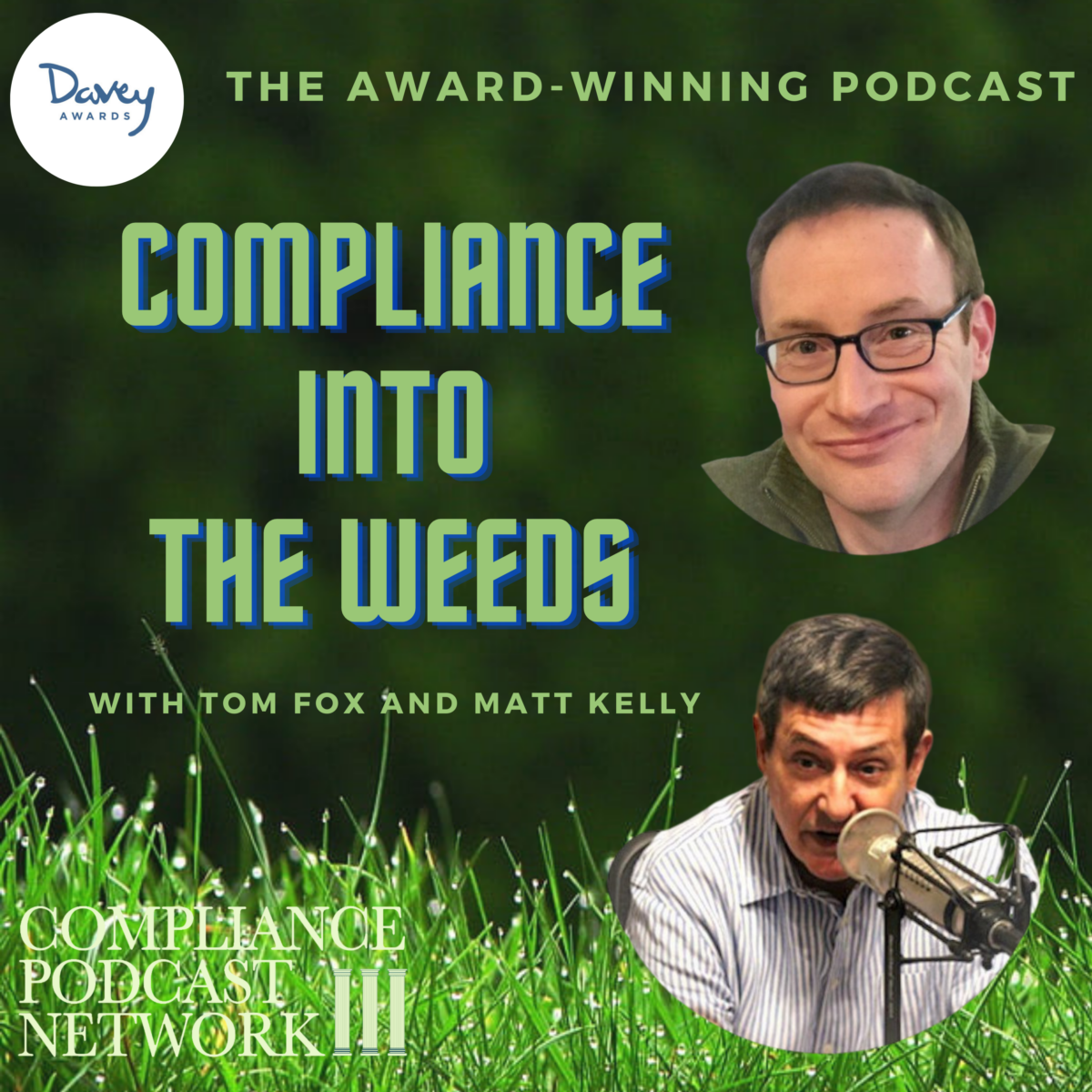
The award-winning Compliance into the Weeds is the only weekly podcast that takes a deep dive into a compliance-related topic, literally going into the weeds to explore a subject more fully. Are you looking for some hard-hitting insights on compliance? Look no further than Compliance into the Weeds! In this episode of Compliance into the Weeds, Tom Fox and Matt Kelly take a deep dive into the settlement of charges by the OCC with two former top audit executives at Wells Fargo for their oversight failures during the bank’s fake accounts scandal.
The Wells Fargo banking scandal is a cautionary tale of unchecked corporate misconduct and the critical role of auditor accountability. This scandal, which erupted due to Wells Fargo’s creation of fake accounts driven by unrealistic sales targets, exposed the bank’s dysfunctional corporate culture and raised questions about the efficacy of internal audits and the broader implications of regulatory actions. They discuss the scandal as emblematic of the broader issues stemming from repealing the Glass-Steagall Act, which blurs the lines between investment and consumer banking, fostering an environment where misconduct could thrive. Kelly points to the enormity of banks’ post-Glass-Steagall repeal as a breeding ground for potential misconduct and highlights the negligence of Wells Fargo’s leadership in failing to curb unethical practices. Both Fox and Kelly underscore the necessity for a comprehensive reevaluation of compliance and audit roles to prevent future scandals of this magnitude.
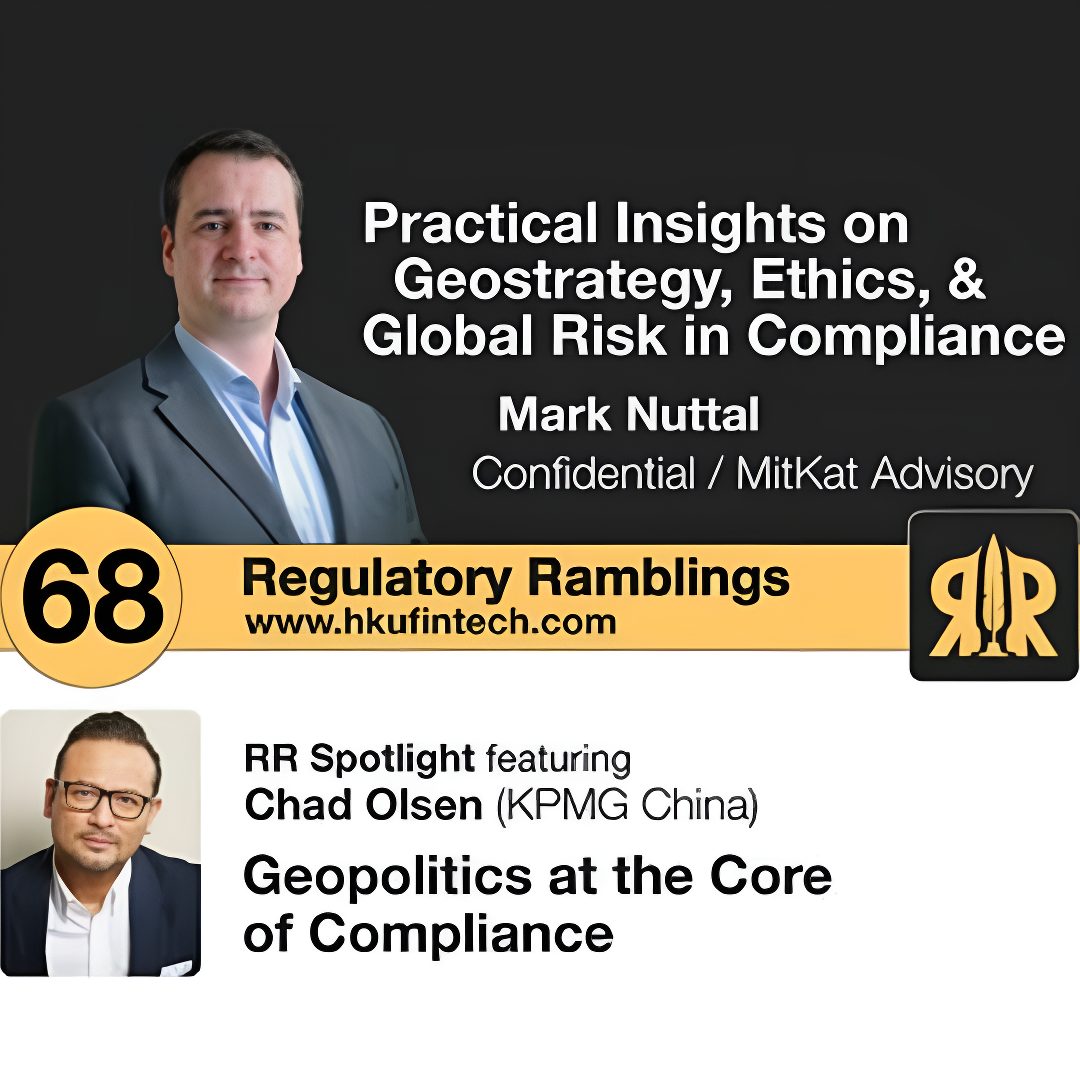
This episode focuses on how compliance and legal staff must incorporate geostrategic risk considerations into their advice and recommendations.
In our initial Regulatory Ramblings Spotlight segment, we chat with Chad Olsen of KPMG China about what professionals in Hong Kong, Greater China, and the region need to know about such considerations.
Following that, we speak with Mark Nuttall, an executive advisor and strategic deal facilitator in Dubai, for a more Middle Eastern perspective.
Chad Olsen
Chad Olsen is based in Hong Kong, where he is the head of forensic services for KPMG China. In that capacity, he oversees matters involving white-collar investigations, anti-money laundering, sanctions and trade controls, fraud, and disputes and arbitration.
Before his current role, Chad was a partner at Deloitte and the head of financial crime. He was also the head of the financial crime intelligence unit at Standard Chartered Bank.
Professionally, he is a Chartered Accountant in Australia and New Zealand. Chad also holds two undergraduate degrees from Curtin University. Relevant to today’s discussion, his focus areas were accounting, finance, political science, and sociology.
Mark Nuttal
Mark Nuttal is an executive, geopolitical advisor, and strategic deal facilitator in Dubai. With over 25 years of experience in strategic leadership, risk management, and business development, he has held roles at the London Metropolitan Police Service, Thomson Reuters, INTERPOL, and Hill & Associates. He also founded the Faustus Consultancy.
He offers executive advisory services across Asia-Pacific, MENA, and Europe, aiming to drive growth, optimize operations, generate deals, and enhance governance.
When it comes to risk management and governance, Mark has implemented plans focused on risk mitigation and resilience while improving governance standards. He has also managed complex investigations and multi-agency operations.
Regarding subject matter expertise, he has delivered advisory services on governance, compliance, risk reduction, finance, leadership, geopolitics, AML, resilience, security, and ESG. Mark has also provided keynote speeches and mentorship to C-suite and geopolitical audiences.
Discussion:
The hasty U.S. withdrawal from Afghanistan in August 2021 under the Biden administration—and the fallout that followed—along with the Russian invasion of Ukraine in February 2022 and the ongoing war, have created inflationary pressures in international oil, gas, and food prices, roiled global markets, and deeply hurt the economies of Western Europe, deprived of cheap Russian fuel.
One thing is certain—it has spurred a deep interest in concepts such as geostrategy, also known as geopolitics. What in an earlier age might have been called political and economic risk analysis and regarded as the remit of social scientists—economists, political scientists, and international relations specialists—is now relevant to a wider range of professions.
Most professions and organizations are increasingly finding the need to adopt an interdisciplinary approach to problem-solving because, in the modern world, myopia and compartmentalization can be fatal. In-house general counsel and compliance staff at banking and financial institutions and multinational corporations need to be cognizant of geostrategic risk factors when advising those they report to.
With that backdrop, Chad speaks with Regulatory Ramblings host Ajay Shamdasani on why geostrategic and political risk analysis should matter to the modern compliance officer and lawyer—and, ultimately, their clients. It’s no longer just about giving advice based on rules and regulations; at most multinational corporations and financial institutions, a more interdisciplinary approach is required to keep pace with broader world developments.
The conversation covers what professionals can do to become more knowledgeable about geopolitical risk, what types of remedial education may be needed, and whether it might make sense to hire a political scientist, international relations specialist, or war/security/strategic studies specialist and place them in a compliance or legal department.
“Keep up with the news from multiple reputable sources” is Chad’s key advice.
Similarly, Mark stresses greater awareness of world events by compliance, legal, and risk professionals. Given his law enforcement background, he places a great deal of emphasis on total situational awareness.
Mark also shares his personal, professional, and educational journey—recounting a time when he was homeless and had absolutely nothing. That experience made him keenly aware of the risks people are willing to take to survive—a lesson today’s political and business leaders would do well to learn.
Coming from a humble background—and never forgetting where he came from—Mark explains how geostrategic and political risk analysis enters the equation when advising family offices in Asia and the Middle East.
Regulatory Ramblings podcasts is brought to you by The University of Hong Kong—Reg/Tech Lab, HKU-SCF Fintech Academy, Asia Global Institute, and HKU-edX Professional Certificate in Fintech, with support from the HKU Faculty of Law.