Categories
TechLaw10

TechLaw10: AI Literacy – What Is It & How Do We Get There?

In this film, Jonathan Armstrong of Punter Southall Law discusses AI literacy with Eric Sinrod, a professor and attorney at Duane Morris LLP in California. This is episode 293 in the popular TechLaw10 series. You can listen to earlier podcasts here. Jonathan talks about literacy under the EU AI Act. FAQs are available here: https://bit.ly/euaifaq. There is also a glossary of AI terms here:

Jonathan Eric also talk about:

  • Facial Recognition & Surveillance
  • The EU Data Act
  • AI in Recruitment (covered previously here.)
  • AgenticAI (covered previously here)
  • Personal Liability
  • AI Affecting Social Change

Jonathan talks about his work on the NYSBA AI Task Force. Details can be found here.

You can learn more about Eric at Duane Morris LLP, and Jonathan here at Punter Southall Law

Connect with the Compliance Podcast Network at:

LinkedIn

Facebook

YouTube

X (formerly Twitter) 

Instagram

Website

Categories
From the Editor's Desk

Episode 30 – Inaugural Episode with Ian Sherr: Compliance Week’s Insights and Reflections from June to July 2025

In this inaugural episode for a new season of ”From the Editor’s Desk,” co-host Tom Fox welcomes Ian Sherr, the new Publishing Director and Editor-in-Chief of Compliance Week. Ian shares his background in journalism and discusses his mission to support the compliance community through Compliance Week. They discuss the significant stories and themes from recent issues, including the importance of tone from the top, soft skills, and the role of compliance in navigating complex global issues. The episode also highlights key takeaways from Compliance Week’s recent conferences, including reflections on women in compliance, third-party risk management, and upcoming stories that focus on critical decision points in compliance.

Highlights include:

  • Meet Ian Sherr: Professional Background
  • Reflections on Compliance Week 2025
  • The Compliance Week Reporting Team
  • Highlighting Key Stories and Case Studies
  • June Conferences: Third-Party Risk Management and Women in Compliance
  • Upcoming Stories and Future Insights

Resources:

Ian Sherr on LinkedIn

Compliance Week

Categories
Daily Compliance News

Daily Compliance News: June 27, 2025, The ABB Gets Out of DPA Edition

Welcome to the Daily Compliance News. Each day, Tom Fox, the Voice of Compliance, brings you compliance-related stories to start your day. Sit back, enjoy a cup of morning coffee, and listen in to the Daily Compliance News. All from the Compliance Podcast Network. Each day, we consider four stories from the business world: compliance, ethics, risk management, leadership, and general interest, all of which are relevant to the compliance professional.

Top compliance stories:

  • Is it a lawsuit settlement or a bribe? (WSJ)
  • Staley ban upheld by British court. (FT)
  • Data and shareholder capitalism. (Bloomberg)
  • ABB was released from its DPA early. (Lexology)
Categories
Trekking Through Compliance

Trekking Through Compliance: Episode 26 – Lessons in Data Analytics from Errand of Mercy

Star Trek’s “Errand of Mercy” has long captivated viewers with its profound examination of conflict, diplomacy, and the limitations of perception. While it might not seem immediately apparent, this episode is rich with insightful lessons for the corporate compliance community, particularly regarding data analytics. Let’s delve into five key data analytics lessons derived from this timeless story, specifically tailored for today’s compliance professionals.

Lesson 1: Data-Driven Awareness Prevents Miscalculations

Illustrated by Captain Kirk and Mr. Spock, they initially underestimate the Organians, perceiving them as primitive due to surface-level observations. Only later do they realize that Organians possess profound power and knowledge far beyond initial assessments.

Compliance Lesson: Compliance professionals must avoid superficial analyses and surface-level assessments. Utilizing comprehensive data analytics enables organizations to understand deeper patterns, accurately predict potential risks, and make informed strategic decisions.

Lesson 2: Real-Time Analytics Facilitate Prompt Intervention

Illustrated By: During their initial stay, the Organians repeatedly attempt to deflect the Federation and Klingon aggression, subtly and promptly intervening as conflicts arise.

Compliance Lesson: Effective compliance management increasingly depends on real-time data analytics to facilitate rapid intervention and corrective actions. Organizations require systems that can deliver real-time or near-real-time insights into compliance violations or risks, enabling them to respond effectively and promptly to these issues.

Lesson 3: Predictive Analytics Enhance Proactive Compliance

Illustrated By: Ultimately, the Organians demonstrate foresight and predictive awareness, recognizing the likely outcomes of Federation and Klingon hostilities and intervening proactively to avoid widespread disaster.

Compliance Lesson: Predictive analytics significantly strengthens proactive compliance initiatives. Leveraging historical data, machine learning algorithms, and risk modeling allows compliance teams to anticipate potential compliance issues before they become significant problems.

Lesson 4: The Value of Integrating Diverse Data Sources

Illustrated by Kirk and Spock initially relying primarily on their direct observations and Federation reports, neglecting potentially valuable alternative perspectives and data points that might have informed a more nuanced understanding of the Organians.

Compliance Lesson: Integrating diverse data sources into compliance analytics significantly enhances the accuracy and effectiveness of decision-making. Organizations should draw on a wide array of data, including internal audit reports, third-party risk assessments, whistleblower reports, and industry-wide compliance trends, to inform their decision-making.

Lesson 5: Ethical Data Use and Transparency Build Trust

Illustrated By: In the episode’s resolution, the Organians reveal their true nature transparently, clearly communicating their intentions and reasons for their actions, which ultimately earns the trust and respect of both Federation and Klingon representatives.

Compliance Lesson: The ethical and transparent use of data is fundamental in maintaining stakeholder trust and ensuring regulatory compliance. Organizations must ensure that their data analytics practices align with privacy regulations, data ethics standards, and transparency principles.

Final ComplianceLog Reflections

“Errand of Mercy” offers a valuable allegory for contemporary compliance professionals, highlighting the importance of in-depth analysis, real-time intervention capabilities, predictive insights, diverse data integration, and ethical transparency. By embracing these data analytics lessons, compliance teams can significantly enhance their organization’s ability to manage and mitigate risks proactively. In today’s complex regulatory landscape, harnessing sophisticated analytics capabilities is not merely advantageous; it is essential. Like Kirk and Spock’s ultimate realization in “Errand of Mercy,” understanding beyond surface appearances and leveraging deep analytical insights can make all the difference in effectively navigating compliance challenges.

Resources:

Excruciatingly Detailed Plot Summary by Eric W. Weisstein

MissionLogPodcast.com

Memory Alpha

Categories
Compliance Tip of the Day

Compliance Tip of the Day – COSO Objective 5 – Monitoring Activities

Welcome to “Compliance Tip of the Day,” the podcast that brings you daily insights and practical advice on navigating the ever-evolving landscape of compliance and regulatory requirements. Whether you’re a seasoned compliance professional or just starting your journey, our goal is to provide you with concise, actionable tips to help you stay ahead in your compliance efforts. Join us as we explore the latest industry trends, share best practices, and demystify complex compliance issues to keep your organization on the right side of the law. Tune in daily for your dose of compliance wisdom, and let’s make compliance a little less daunting, one tip at a time.

Today, we conclude our look at the 5 COSO Objectives: Number V—Monitoring Activities.

For more information on this topic, refer to The Compliance Handbook: A Guide to Operationalizing Your Compliance Program, 6th edition, recently released by LexisNexis. It is available here: https://bit.ly/433bKre

Categories
Blog

COSO’s Corporate Governance Framework: Component 1 – Oversight

We continue our exploration of the recently released COSO  Corporate Governance Framework (the Framework) as a Public Exposure Draft.  Today, we begin a deep dive into the six individual components with a discussion of Component 1: Oversight. It is a pillar that every compliance professional should study with the care of a board director preparing for their first 10-K briefing. The Framework is a clarion call for compliance professionals to rethink how we engage with governance, board structure, and accountability. Today, we will break it down and then dive into five lessons we must take back to our programs.

What Is Oversight in the COSO Framework?

The CGF defines oversight as the foundation of effective governance and long-term value creation. It begins with a board that is informed, independent, and proactive in directing strategy, supervising executive leadership, and maintaining organizational integrity.

But COSO doesn’t stop at roles and titles. The Oversight Component is made up of six principles:

Principle 1: Establish Board Structure and Exercise Oversight

This principle emphasizes that the board must create a well-defined governance structure with clearly assigned roles, responsibilities, and committees. It must actively exercise its oversight duties to support management’s execution of strategy while maintaining accountability to shareholders and stakeholders. Compliance professionals should engage early to ensure that governance structures also include strong compliance and ethics coverage, whether as standalone committees or integrated into audit or risk structures.

Principle 2: Appoint Board Leadership and Members

Boards must appoint competent, diverse, and independent leaders who possess integrity, objectivity, and a range of skills necessary to guide the organization effectively. Board leadership, whether a chair or lead independent director, must also foster effective decision-making and conflict resolution within the boardroom. Compliance teams should be prepared to assess and brief leadership on whether the board’s independence and composition are suited to today’s complex risk environment.

Principle 3: Select CEO and Delegate Authority

The board is responsible for selecting the CEO and formally delegating authority for strategic execution and operational decision-making. This includes maintaining clarity over which powers the board retains and which are delegated to management, ensuring accountability and effectiveness. Compliance should help define these boundaries, ensuring they include escalation protocols for compliance violations, investigations, and significant legal risks.

Principle 4: Establish Executive Structure and Effectively Manage

Executive management, with board oversight, must implement a governance structure that clearly outlines roles and responsibilities while enabling strategic execution, risk management, and ethical conduct. It requires maintaining effective internal communication and accountability mechanisms across business units. This principle affirms the compliance officer’s role in building the scaffolding for transparency and internal integrity in decision-making.

Principle 5: Operate the Board Effectively

Boards must regularly evaluate and refine their processes, calendars, and communication practices to optimize their oversight role. This includes utilizing executive sessions, clear meeting agendas, providing director access to management, and maintaining structured documentation to promote effectiveness and accountability. Compliance can support this effort by briefing directors on best practices for board effectiveness and helping to integrate compliance topics into existing agendas.

Principle 6: Uphold Shareholder Rights and Accountability

Boards and executive leadership must ensure that shareholder rights are protected and that disclosures enable informed decision-making and active engagement. This includes facilitating transparent communication, majority voting, and responding to shareholder concerns with respect and accountability. Compliance should assist in evaluating disclosure risks, supporting governance transparency, and managing the evolving expectations of institutional and activist investors.

Why It Matters to Compliance

Here’s the bottom line: Oversight defines the altitude from which the board governs—and the depth to which management is held accountable. It is where compliance either has a voice or is left scrambling to clean up messes.

As COSO puts it, oversight is shaped by:

  • Legal and regulatory obligations
  • Listing exchange standards
  • Shareholder and stakeholder expectations
  • Evolving risks and strategic complexity

Crucially, effective oversight depends on trust, transparency, and the willingness of directors to challenge management when necessary. If you are a compliance officer, you are the steward of that trust every time you walk into the boardroom or brief an audit committee.

Five Key Lessons for Compliance Professionals

Lesson 1: Structure Drives Behavior—Support the Right Board Composition

COSO reminds us that structure is not simply about paperwork; rather, it is about performance in waiting. Boards must have the right mix of committees, including audit, compensation, and nominating/governance, as well as tailored structures for emerging risks such as cybersecurity, ethics, and compliance.

Compliance Tip:

Be proactive in suggesting committee enhancements. If you see ESG risks mounting, propose a joint compliance-risk-ESG working group. If your board lacks a compliance-specific charter, now is the time to offer a draft. Offer benchmarking from peer organizations or industry regulators. Bring data to the table when proposing changes to board governance.

Lesson 2: Director Independence and Expertise Matter—Help Evaluate It

The CGF emphasizes that a supermajority of the board should be independent and that independence extends beyond a lack of financial ties; it also encompasses freedom from undue influence, appropriate tenure, and cognitive diversity.

Compliance Tip:

Your compliance and risk reports can shape how directors perceive their effectiveness. Provide clear, factual, and nuanced briefings, especially around risk appetite, incident investigations, and policy gaps. Encourage your board to adopt a skills matrix and evaluate directors on competencies related to ethics, compliance, and oversight, in addition to finance and operations.

Lesson 3: Board–Executive Relationships Are a Two-Way Street—Support the Feedback Loop

COSO emphasizes that executive management and the board need a trust-based, collaborative relationship. This means access to information, clarity of delegation, and open channels of communication, especially in a crisis.

Compliance Tip:

Use your role as a bridge, not a barrier, between management and the board. Ensure the board has access to accurate, real-time insights into investigations, emerging compliance issues, and root cause analyses. Help define and document escalation protocols. In times of crisis, ambiguity kills. Clear lines of escalation protect both the board and the business.

Lesson 4: Oversight Extends to Culture—Not Just Numbers

One of the most progressive moves COSO makes in this component is tying board oversight to organizational culture and behavior modeling. Directors must demonstrate ethics, respect, and transparency, just like the CEO.

Compliance Tip:

Start including culture indicators in your regular reporting, such as hotline trends, employee engagement results, training completion rates, and code of conduct violations. Do not simply report metrics; instead, contextualize them to make them more meaningful for your audience. Invite board members to participate in listening sessions or ethics town halls. Direct exposure to employee sentiment builds empathy and accountability.

Lesson 5: Shareholders Are Oversight Partners—Prepare for Transparency

The CGF challenges entities to uphold shareholder rights and engagement through transparent disclosures, majority voting for directors, and stewardship activities.

Compliance Tip:

Work closely with investor relations and legal to ensure your compliance-related disclosures are accurate, meaningful, and aligned with shareholder expectations. Don’t wait until an activist investor demands it. Conduct a pre-mortem with your team and board: If an activist investor were to challenge our compliance program, where would they strike first? Fix that area today.

What’s New and Noteworthy?

There are several leading-edge considerations embedded in the Oversight section that every compliance officer should note:

  • Expanding compensation committee roles to include culture, diversity, and talent oversight
  • Increased use of executive sessions for confidential discussions without management
  • Policies to prevent overboard, especially for sitting executives and CEOs
  • Structured onboarding and offboarding for directors to maintain freshness and avoid stagnation

These are not just governance best practices. They are compliance enablers. A stagnant board is a blind board. A distracted director is a dangerous one.

Final Thoughts: Oversight Is a Team Sport

Too often, compliance professionals think of board oversight as something that happens to us; we prepare the decks, present our updates, and answer tough questions. But COSO’s Oversight Component invites us to flip the narrative. We are not bystanders in governance; we are builders of it. Tell the story.

When we engage with the board with clarity, courage, and consistency, we not only raise the profile of compliance but also enhance our credibility. We help shape an oversight model that can weather disruption, lead through crisis, and deliver long-term value. Let your voice be heard in the boardroom. Do not just brief on the risks; build the systems that make risk manageable. This is our moment. Let’s own it.

To read or comment on the full CGF Public Exposure Draft, click here. The comment period closes on July 11, 2025.


Categories
Regulatory Ramblings

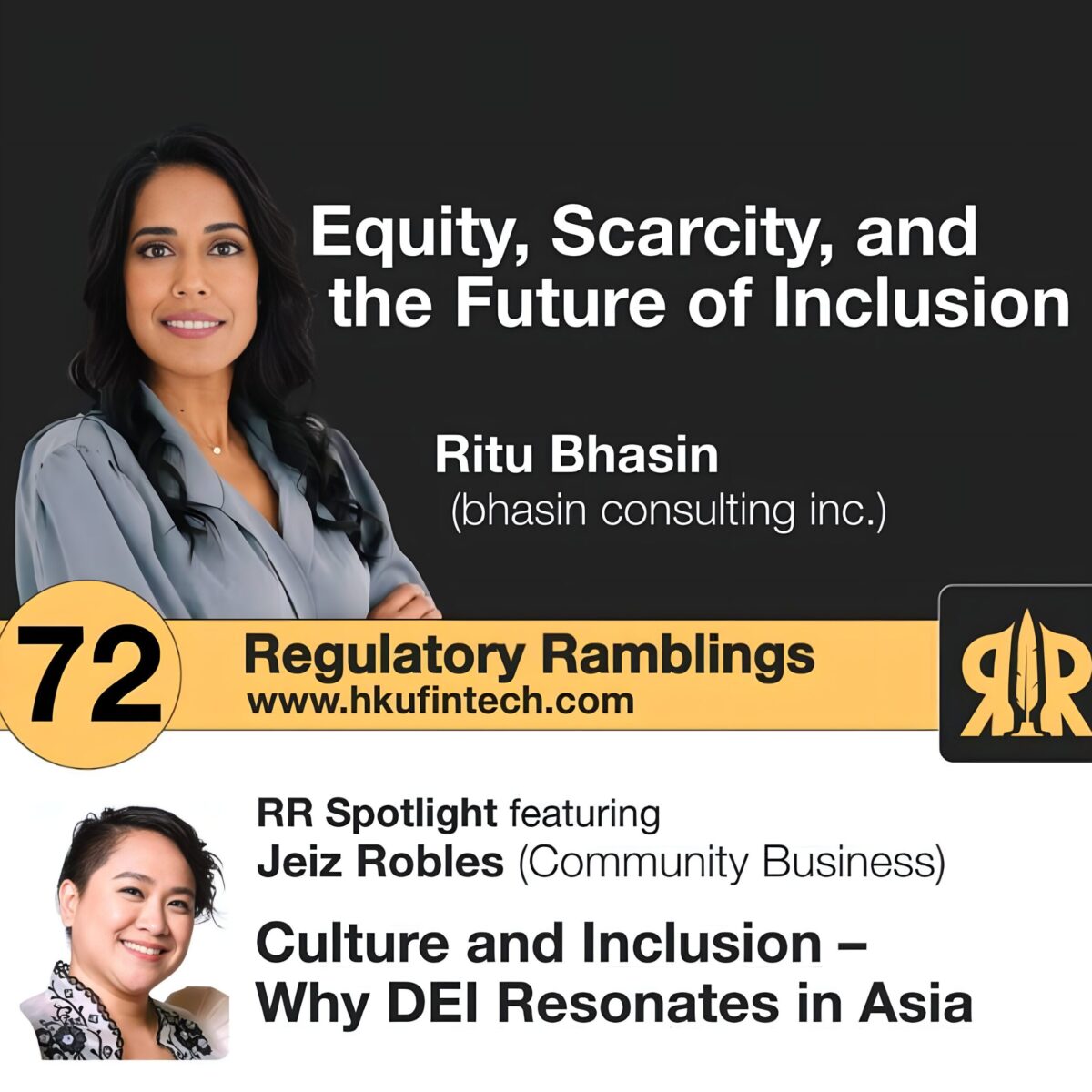
Regulatory Ramblings: Episode 72 – Cultural Roots, Belonging, and the Fear of Change: What’s Next for Inclusion?

This episode focuses on Diversity, Equity, and Inclusion – better known by its acronym DEI. In the initial spotlight segment, we chat with Jeiz Robles, director of diversity, equity, and inclusion at Hong Kong-based Community Business, about what the work of DEI professionals entails.

Following that, we continue the discussion with world-renowned DEI expert Ritu Bhasin for a North American perspective on the future of DEI, as it appears to be under attack in many corporate quarters in the US.

Diversity, equity, and inclusion initiatives were originally intended to, if not fix past injustices, at least ameliorate them in the realms of employment, education, government, and civic institutions by providing opportunities for individuals and groups that had previously been overlooked. DEI seemed all the rage – at least until the reelection of Donald J. Trump to the US presidency last November.

Over the past year, some American law firms have terminated their DEI programs following judicial challenges. And corporate giants in the US, such as Walmart and Target, have also scaled back their efforts to promote inclusion.

Ritu Bhasin

Ritu Bhasin is a world-renowned, award-winning life coach and empowerment speaker, as well as a best-selling author and a much sought-after expert and consultant on leadership, talent management, workplace culture, and inclusion.

A lawyer by training, she has attained an EMBA from the University of Toronto’s Rotman School of Management, where she is also a former instructor in the institution’s executive programs. Additionally, she regularly appears on TV and radio in the U.S. and Canada.

Ritu is also the CEO and founder of her firm, Bhasin Consulting Inc., situated in Toronto. Her mission, as she describes it: “Is to help build diverse and inclusive workplaces and to empower professionals to be strategic in leveraging their strengths in their career development.”

Her firm provides a range of services related to talent management, diversity, and inclusion, including organizational assessments, strategic planning, change management, stakeholder relations, training and leadership development programming, employee engagement and retention strategies, individual career coaching, and team facilitation.

Ritu’s firm also provides one-on-one coaching to individuals in areas such as career development, performance management issues, leadership skills, diversity, and advancing women.

She is also active on the speaker circuit for North American organizations, professional associations, non-profit organizations, educational institutions, and community groups.

Jeiz Robles

Jeiz Robles is a veteran human resources and workplace diversity specialist.  In her current role as Director of Diversity, Equity, and Inclusion at Community Business in Hong Kong, she oversees its DEI portfolio, providing strategic and sustainable direction to various programming – including the flagship Community Business Network.

She also leads teams of DEI consultants, program heads, and thought leaders across Asia in delivering consulting and training services, as well as campaigns focused on LGBTQ+ inclusion, disability, wellbeing, social mobility, and more.

​She also collaborates with Community Business’s corporate partners from various industries and multinational companies, serving as a strategic advisor to their DEI strategy and aspirations. Jeiz also manages strategic partnerships that positively impact varying underrepresented and underprivileged communities across the region.
She has been ranked within the top 10 of Involve’s Global LGBT+ Future Leaders for several years. As a steadfast champion of workplace inclusion, her focus is on driving diversity and inclusion strategies, policies, and programs in the workplace and actively influencing companies to build inclusive cultures across various industries. Ultimately, it is about building “relationships with communities and organizations and driving business growth by leveraging diversity, inclusion, and talent strategies in strategic partnerships,” she says.

As a former human resources leader, she also leads operations of HR services through IBM’s cognitive transformation to deliver a superior employee experience. In that capacity, she has end-to-end expertise in global mobility and relocation, as well as core HR operations, and is experienced in stakeholder management involving vendors, clients, and industry executives.

Through her background in applying agile methodologies and IBM Design Thinking, Jeiz manages and implements projects and strategies to maintain client satisfaction, employee engagement, business efficiency, and cost optimization.

Discussion:

The conversation begins with Jeiz chatting with Regulatory Ramblings host Ajay Shamdasani about what drew her to DEI from her previous role in HR. They discuss what a DEI manager’s role entails daily and why support for DEI appears to be resolute in Asia despite being under attack in the US – even though places like Hong Kong and, to a lesser extent, Singapore are relatively homogeneous.

They conclude that the communitarian nature of Asian societies, which tends to avoid leaving anyone out, lends itself to greater inclusion.

The conversation then shifts to Ritu, who recounts being the proud daughter of Indian Sikh immigrants to Canada and the prejudices and challenges she faced growing up in the 80s and 90s. Indeed, her personal and professional directly led to her current role as an ardent DEI advocate.

Ritu explains why DEI is not a fad or an academic exercise but has genuine utility for society, as it taps into the labor and talents of those who have been previously overlooked.

She acknowledges the current backlash against DEI in corporate America and the generational divide undergirding it. She believes that in a decade, momentum will have shifted, and DEI will be the norm.

As Ritu stressed, when some in an organization are groomed for success and given every opportunity to succeed – including mentoring – it should not come as a surprise that such individuals are more likely to succeed. Yet, what about those who are bypassed?

Regulatory Ramblings podcasts is brought to you by The University of Hong Kong – Reg/Tech Lab, HKU-SCF Fintech Academy, Asia Global Institute, and HKU-edX Professional Certificate in Fintech, with support from the HKU Faculty of Law.

Useful links in this episode:

You might also be interested in:

Connect with RR Podcast at:

LinkedIn: https://hk.linkedin.com/company/hkufintech 
Facebook: https://www.facebook.com/hkufintech.fb/
Instagram: https://www.instagram.com/hkufintech/ 
Twitter: https://twitter.com/HKUFinTech 
Threads: https://www.threads.net/@hkufintech
Website: https://www.hkufintech.com/regulatoryramblings 

Connect with the Compliance Podcast Network at:

LinkedIn: https://www.linkedin.com/company/compliance-podcast-network/
Facebook: https://www.facebook.com/compliancepodcastnetwork/
YouTube: https://www.youtube.com/@CompliancePodcastNetwork
Twitter: https://twitter.com/tfoxlaw
Instagram: https://www.instagram.com/voiceofcompliance/
Website: https://compliancepodcastnetwork.net

Categories
Blog

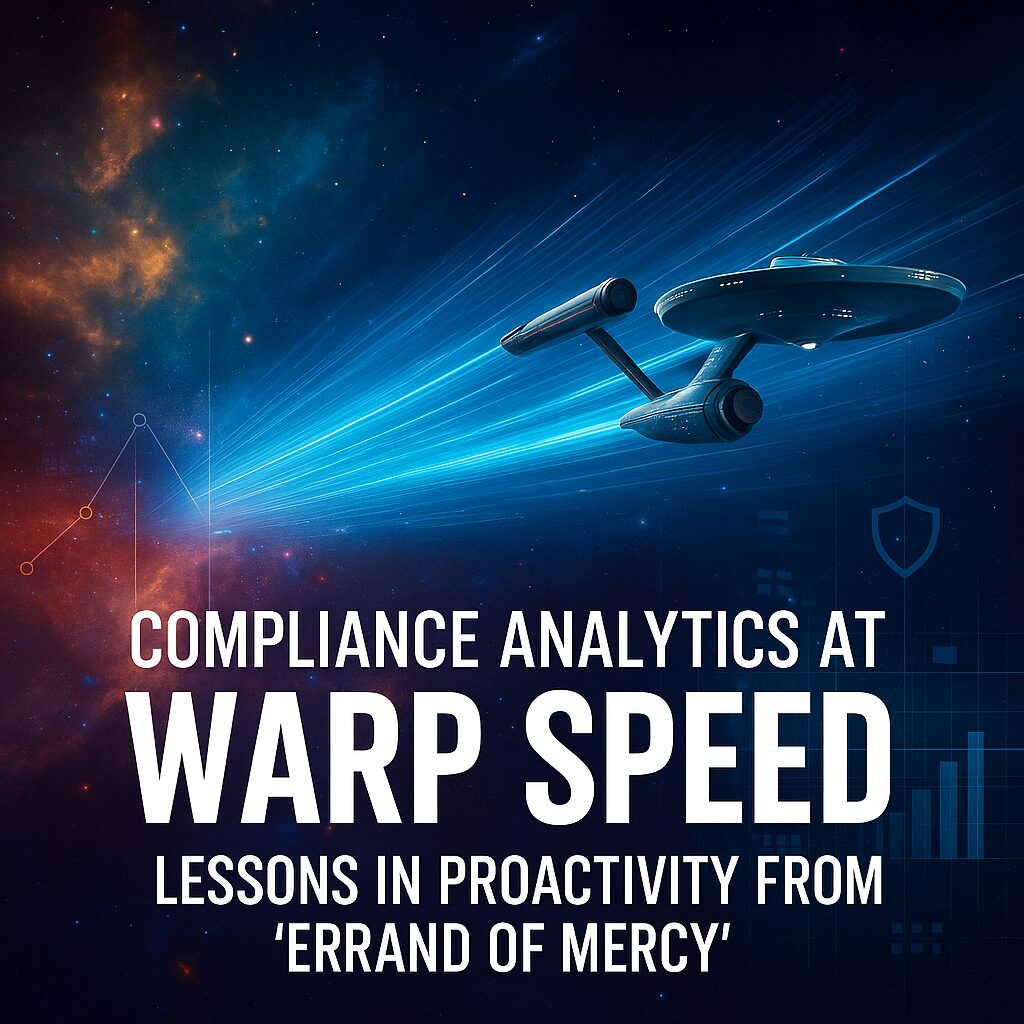
Compliance Analytics at Warp Speed: Lessons in Proactivity from Errand of Mercy

Star Trek’s “Errand of Mercy” has long captivated viewers with its profound examination of conflict, diplomacy, and the limitations of perception. While it might not seem immediately apparent, this episode is rich with insightful lessons for the corporate compliance community, particularly regarding data analytics. Let’s delve into five key data analytics lessons derived from this timeless story, specifically tailored for today’s compliance professionals.

Lesson 1: Data-Driven Awareness Prevents Miscalculations

Illustrated by: Captain Kirk and Mr. Spock initially underestimate the Organians, perceiving them as primitive due to surface-level observations. Only later do they realize that Organians possess profound power and knowledge far beyond initial assessments.

Compliance Lesson: Compliance professionals must avoid superficial analyses and surface-level assessments, just as Kirk and Spock learned not to judge the Organians by outward appearances. Too often, organizations base critical decisions on incomplete or surface-level information. In compliance, this can lead to overlooking systemic risks, misjudging third-party partners, or misunderstanding evolving regulatory threats.

Data-driven awareness is the antidote to this danger. Leveraging advanced analytics, compliance teams can dig deeper into transactional data, employee behavior, vendor histories, and external market signals. Analytics allow organizations to uncover patterns and anomalies that the naked eye might miss, providing early warnings of compliance gaps, fraud, or ethical blind spots. Importantly, robust analytics mitigate the impact of human bias, reducing over-reliance on gut instinct or anecdotal evidence.

By developing dashboards, risk heatmaps, and tailored reporting tools, compliance professionals empower themselves and business leaders to make better, evidence-based decisions. The ultimate lesson: Only through continuous data-driven vigilance can organizations prevent costly miscalculations and ensure their compliance posture is based on reality, not perception.

Lesson 2: Real-Time Analytics Facilitate Prompt Intervention

Illustrated By: During their initial stay, the Organians repeatedly attempt to deflect the Federation and Klingon aggression, subtly and promptly intervening as conflicts arise.

Compliance Lesson: In an era of rapid digital transactions and globalized operations, waiting for quarterly or annual compliance reviews is no longer sufficient. Real-time data analytics is transforming the compliance function from a reactive, after-the-fact process to a dynamic, proactive engine for risk prevention. By monitoring financial transactions, communication patterns, and operational workflows in real time, compliance teams can identify red flags, policy breaches, or suspicious activity as soon as they arise.

This enables immediate investigation, escalation, or remediation long before minor issues escalate into major violations or regulatory crises. Advanced alert systems and AI-powered monitoring platforms now allow the simultaneous tracking of thousands of compliance data points, prioritizing high-risk incidents for human review. Furthermore, real-time analytics support a culture of ongoing accountability, where employees and leaders understand that compliance is not just a box to check but a living, breathing part of business operations. The lesson from the Organians: Subtle, timely intervention can often prevent conflict, just as prompt, real-time analytics can avert disaster in the compliance landscape.

Lesson 3: Predictive Analytics Enhance Proactive Compliance

Illustrated By: Ultimately, the Organians demonstrate foresight and predictive awareness, recognizing the likely outcomes of Federation and Klingon hostilities and intervening proactively to avoid widespread disaster.

Compliance Lesson: The best compliance programs don’t just react to problems—they anticipate them. Predictive analytics is the frontier of proactive compliance, empowering teams to leverage historical data, risk modeling, and machine learning to forecast future threats. By analyzing trends in internal investigations, audit findings, whistleblower reports, and external regulatory actions, compliance professionals can identify emerging patterns of risk before they fully materialize. This capability allows organizations to adjust controls, update training, and allocate resources with maximum impact.

For example, predictive models can highlight geographic regions or business units with an elevated risk profile, enabling preemptive audits or targeted messaging. Predictive analytics also supports dynamic risk scoring, enabling compliance teams to reassess exposure as new data becomes available continually. In the same way that the Organians foresaw and diffused conflict before it erupted, compliance professionals equipped with predictive analytics can guide their organizations around regulatory minefields, reducing both the likelihood and the impact of violations. The key takeaway: In compliance, as in diplomacy, foresight is a powerful tool.

Lesson 4: The Value of Integrating Diverse Data Sources

Illustrated by Kirk and Spock initially relying primarily on their direct observations and Federation reports, neglecting potentially valuable alternative perspectives and data points that might have informed a more nuanced understanding of the Organians.

Compliance Lesson: Siloed data is the enemy of effective compliance. In a world of complex operations, no single data source can provide the complete picture of an organization’s compliance risk. Integrating diverse data streams, including financial records, employee activity logs, whistleblower submissions, market intelligence, third-party assessments, and even social media, enables compliance teams to connect the dots that might otherwise remain isolated. Modern compliance analytics platforms are designed to ingest, normalize, and cross-reference multiple data types, revealing relationships and outliers that static spreadsheets cannot.

By triangulating information from various internal and external sources, organizations enhance the accuracy of their risk assessments, refine investigative outcomes, and identify root causes more quickly. Integration also breaks down barriers between business units, legal, audit, and compliance, fostering a culture of transparency and shared responsibility. The failure to consider alternative perspectives, as demonstrated by Kirk and Spock, is a cautionary tale: Only by synthesizing the broadest possible range of data can compliance leaders ensure that their risk management strategies are as robust and adaptive as the business environment demands.

Lesson 5: Ethical Data Use and Transparency Build Trust

Illustrated By: In the episode’s resolution, the Organians reveal their true nature transparently, clearly communicating their intentions and reasons for their actions, which ultimately earns the trust and respect of both Federation and Klingon representatives.

Compliance Lesson: In an age of big data, artificial intelligence, and heightened regulatory scrutiny, ethical stewardship of data is both a legal requirement and a business imperative. Compliance teams must ensure that their use of data analytics adheres to the highest standards of privacy, security, and fairness. This includes not only complying with applicable regulations (such as GDPR, CCPA, and others) but also establishing clear policies around consent, data retention, and access controls.

Transparency is key; organizations should be open with employees, customers, and regulators about what data is collected, how it is analyzed, and for what purposes. Regular communication and training reinforce trust and demonstrate a commitment to responsible data governance. When stakeholders understand and believe in the integrity of an organization’s data practices, the credibility of the compliance program is strengthened. The Organians’ transparent reveal is a reminder: Trust is earned through clarity and honesty, both in science fiction and in today’s data-driven compliance world.

Final ComplianceLog Reflections

“Errand of Mercy” offers a valuable allegory for contemporary compliance professionals, highlighting the importance of thorough analysis, real-time intervention capabilities, predictive insights, diverse data integration, and ethical transparency. By embracing these data analytics lessons, compliance teams can significantly enhance their organization’s ability to manage and mitigate risks proactively. In today’s complex regulatory landscape, harnessing sophisticated analytics capabilities is not merely advantageous; it is essential. Like Kirk and Spock’s ultimate realization in “Errand of Mercy,” understanding beyond surface appearances and leveraging deep analytical insights can make all the difference in effectively navigating compliance challenges.

Resources:

Excruciatingly Detailed Plot Summary by Eric W. Weisstein

MissionLogPodcast.com

Memory Alpha