Categories
Daily Compliance News

Daily Compliance News: July 17, 2025, The COSO Yanked Edition

Welcome to the Daily Compliance News. Each day, Tom Fox, the Voice of Compliance, brings you compliance-related stories to start your day. Sit back, enjoy a cup of morning coffee, and listen in to the Daily Compliance News. All, from the Compliance Podcast Network. Each day, we consider four stories from the business world, including compliance, ethics, risk management, leadership, or general interest, relevant to the compliance professional.

Top compliance stories:

  • DOJ fires Maxwell prosecutor. (WSJ)
  • ABC heads to the BVI to find out why it is dragging its feet. (The Guardian)
  • COSO pulls its Corporate Governance Framework (Radical Compliance)
  • Samsung boss cleared of fraud charges. (BBC)

You can donate to flood relief for victims of the Kerr County flooding by going to the Hill Country Flood Relief here.

Categories
Compliance Tip of the Day

Compliance Tip of the Day – COSO Governance Framework: Part 4, Culture

Welcome to “Compliance Tip of the Day,” the podcast that brings you daily insights and practical advice on navigating the ever-evolving landscape of compliance and regulatory requirements. Whether you’re a seasoned compliance professional or just starting your journey, our goal is to provide you with bite-sized, actionable tips to help you stay ahead in your compliance efforts. Join us as we explore the latest industry trends, share best practices, and demystify complex compliance issues to keep your organization on the right side of the law. Tune in daily for your dose of compliance wisdom, and let’s make compliance a little less daunting, one tip at a time.

We continue our multi-part review of the new COSO Governance Framework (CGF). Today, we look at Component 3-Culture.

For more information on this topic, refer to The Compliance Handbook: A Guide to Operationalizing Your Compliance Program, 6th edition, recently released by LexisNexis. It is available here.

Categories
Trekking Through Compliance

Trekking Through Compliance: Episode 46 – Compliance Across Cultures: Star Trek’s “A Piece of the Action” as a Guide for Global Ethics

Any compliance professional who has ever led a team into a new country, or even a new region, knows that the journey is never as simple as applying the same playbook. Corporate values may be universal, but their application, reception, and risk profile shift dramatically with local context. Cross-cultural compliance isn’t just about checking legal boxes; it’s about building trust, ensuring fairness, and embedding institutional justice in systems often shaped by histories and norms foreign to headquarters. No pop culture episode illustrates this challenge better than Star Trek: The Original Series’ classic, “A Piece of the Action.”

For the compliance professional, this episode serves as a mirror to our modern experience of entering new regulatory territories. It forces us to ask: How do you enforce ethical standards in a place where the “rules of the game” are so different? How do you model institutional justice when even the definitions of “fairness” and “justice” seem up for grabs?

Lesson 1: Don’t Assume Your Ethics Are Universal

Illustrated By: Kirk, Spock, and McCoy are bewildered as they realize the entire Iotian society is based on a book about Earth’s 1920s gangsters.

Compliance Lesson: The first mistake many organizations make is assuming their ethical and compliance frameworks are immediately translatable.

Lesson 2: Institutional Justice Depends on Transparent Processes

Illustrated By: Kirk tries to “play the game,” cutting a deal with mob boss Bela Okmyx for the greater good, but quickly learns that without clear rules, every agreement is subject to double-cross and confusion.

Compliance Lesson: The absence of a transparent and impartial system leads to chaos. Each boss claims to enforce their version of “justice,” but it’s arbitrary and self-serving.

Lesson 3: The Dangers of Imposed Systems and the Need for Adaptation

Illustrated By: Kirk realizes that simply imposing Federation law will not work. The Iotians are not ready for those systems, and the crew’s heavy-handed attempts nearly spark more violence and instability.

Compliance Lesson: When entering new markets, resist the temptation to impose home-country rules without considering the local context.

Lesson 4: Speak the Local Language—Literally and Culturally

Illustrated By: Spock tries to explain Federation rules logically, but it’s Kirk’s willingness to “talk the talk,” even using gangster slang, that opens doors and earns a modicum of respect.

Compliance Lesson: Effective compliance communications must be locally relevant. This is more than translation; it’s cultural adaptation. What resonates in Houston might be meaningless (or counterproductive) in Hanoi.

Lesson 5: Leave a Positive Legacy—Don’t Repeat “Book Mistakes”

Illustrated By: In the final act, McCoy discovers he’s left his communicator behind, prompting a worried Kirk and Spock to realize the Iotians might reverse-engineer the technology and reshape their society once again.

Compliance Takeaway: Every compliance professional leaves a legacy. When you introduce policies, training, or reporting mechanisms, they will be interpreted and possibly misused by future leaders.

Final ComplianceLog Reflections

Cross-cultural compliance is ultimately about humility, adaptability, and respect for institutional justice as it’s lived and experienced on the ground. “A Piece of the Action” teaches us that leadership is not about enforcing rules by fiat, but about fostering a culture where fairness and justice are owned locally, embedded in hearts, not just in handbooks.

Resources:

Excruciatingly Detailed Plot Summary by Eric W. Weisstein

MissionLogPodcast.com

Memory Alpha

Categories
Blog

Rewarding Integrity: Five Lessons from the DOJ – USPS Whistleblower MOU

As compliance professionals, we stand at the forefront of integrity, transparency, and accountability within our organizations. Recently, an important document has emerged from the Antitrust Division of the United States Department of Justice (Antitrust Division), the United States Postal Service (USPS), and the United States Postal Service Office of Inspector General (USPS OIG)—the Memorandum of Understanding (MOU) regarding the Whistleblower Rewards Program. This MOU represents a significant advancement in promoting corporate transparency, encouraging ethical behavior, and strengthening the reporting channels for criminal antitrust violations.

Understanding the MOU

The MOU is a collaborative agreement among the Antitrust Division of the DOJ, the USPS, and the USPS OIG, designed to establish and operationalize a Whistleblower Rewards Program. The overarching purpose is to incentivize whistleblowers to step forward and report credible and substantial evidence of criminal violations, especially those related to antitrust activities that directly impact the Postal Service’s operations or revenues.

Specifically, this program addresses serious federal criminal offenses, including price fixing, bid rigging, market allocation, and other forms of economic collusion, as well as associated fraud schemes that undermine the integrity of government procurement processes. The initiative reflects a comprehensive and coordinated effort among the Antitrust Division, the USPS, and the USPS OIG to foster accountability and transparency in federal contracts, procurements, and market practices.

A critical component of this MOU is the articulated process for whistleblower engagement and eligibility for rewards. Whistleblowers are encouraged to voluntarily submit original information, which must be specific, credible, timely, and previously unknown to any of the enforcement authorities. Once submitted, this information undergoes a rigorous review by the Antitrust Division, which evaluates its validity, specificity, and potential impact. If the initial assessment finds merit, the information is forwarded to the USPS Inspection Service (USPIS), which determines its relevance to the Postal Service’s operations or finances.

A distinctive feature of the Whistleblower Rewards Program, as detailed in the MOU, is the financial incentive offered to successful whistleblowers. Individuals whose reports lead directly to a criminal prosecution, conviction, deferred prosecution agreement, or non-prosecution agreement resulting in a monetary fine or recovery of at least $1 million may receive financial rewards ranging from 15% to 30% of the collected fine. This explicit reward structure serves to underscore the commitment of federal authorities to rewarding transparency, integrity, and courageous reporting of wrongdoing, providing a clear incentive for ethical action within organizations.

By outlining clear processes, defined roles, specific reporting criteria, and attractive financial incentives, this MOU establishes a strong blueprint for enhancing corporate and governmental compliance efforts, underscoring the critical role whistleblowers play in upholding economic integrity and ethical business conduct.

Five Key Takeaways for the Compliance Professional

1. Embrace Proactive Whistleblower Policies

A primary lesson from this MOU is the importance of proactively establishing robust whistleblower frameworks within your organization. This program demonstrates how structured whistleblower initiatives, backed by clear protocols and monetary incentives, significantly bolster compliance efforts. Organizations should similarly adopt proactive approaches, ensuring their whistleblower programs are transparent, well-publicized, and accessible to all employees and stakeholders. Always remember that 80% of all reported whistleblowers either attempt or do report internally. It is the remaining 20% who go to the government.

2. Original Information and Clear Reporting Channels

Compliance programs must ensure clarity around what constitutes “original information,” as defined by this MOU. Information must be independently obtained, credible, specific, and previously unknown to the enforcement authorities. Clear communication channels and robust internal reporting mechanisms are essential for employees to feel confident in sharing valuable insights, thus fostering an internal culture of integrity and vigilance.

3. Integration with Law Enforcement

Another critical takeaway is the integration and alignment of organizational compliance with external law enforcement agencies. By closely coordinating with entities such as the DOJ Antitrust Division, organizations not only enhance their compliance measures but also demonstrate their commitment to lawful operations and proactive detection of violations. Regular dialogue and clear lines of communication with regulatory and enforcement authorities can ensure alignment and swift action on identified risks.

4. Transparency in Award Determination

The MOU emphasizes transparency and fairness in the distribution of rewards. Rewards are stipulated to range from 15% to 30% of the collected criminal fines, promoting trust and clarity among potential whistleblowers. Compliance professionals must adopt a similarly transparent approach within internal reward and recognition structures, clearly communicating criteria, processes, and the rationale behind award decisions. Transparency fosters trust, boosts morale, and encourages active participation in compliance initiatives.

5. Limitations and Conditions for Whistleblowers

Understanding the MOU’s explicit exclusions and conditions is essential. Individuals excluded from whistleblower eligibility include those who instigated the violation, those with privileged or confidential compliance responsibilities, and those employed by law enforcement or regulatory bodies. Compliance professionals must delineate roles and responsibilities within their organizations, ensuring all team members understand their obligations, the nature of confidential and privileged information, and the boundaries of reporting mechanisms.

Final Thoughts

This Whistleblower Rewards Program MOU is a robust model for fostering a compliance culture and encouraging ethical conduct within corporations. By providing clear incentives, establishing transparent processes, and maintaining close collaboration with regulatory bodies, this program sets a high standard for organizations across industries.

As compliance leaders, it is our responsibility to champion these principles within our organizations, advocating for stronger whistleblower protections, clearer reporting channels, and greater collaboration with external oversight authorities. Only by doing so can we build resilient, transparent, and ethically robust organizations prepared to face tomorrow’s compliance challenges head-on.


Categories
Blog

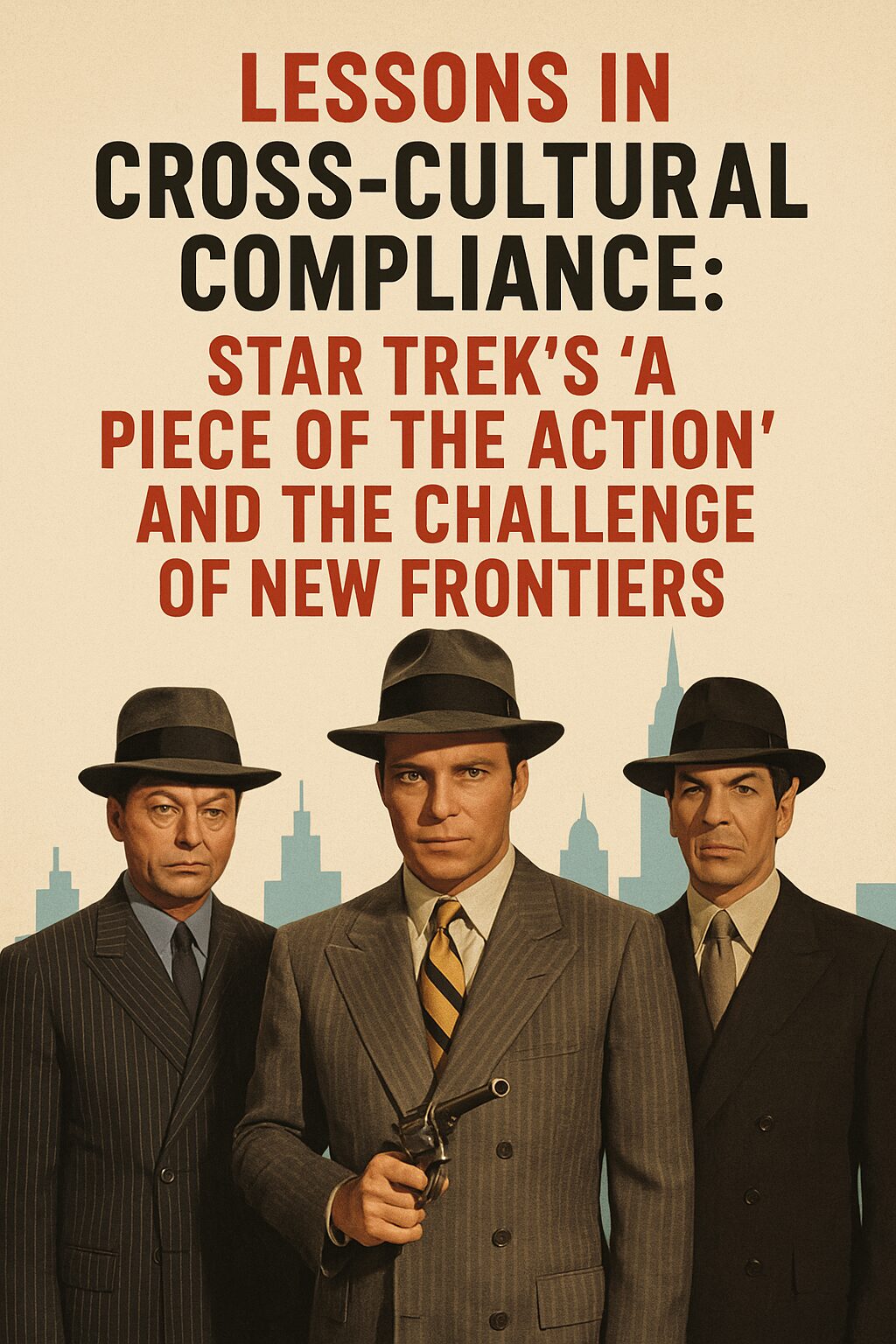
Lessons in Cross-Cultural Compliance: Star Trek’s “A Piece of the Action” and the Challenge of New Frontiers

Any compliance professional who has ever led a team into a new country, or even a new region, knows that the journey is never as simple as applying the same playbook. Corporate values may be universal, but their application, reception, and risk profile shift dramatically with local context. Cross-cultural compliance isn’t just about checking legal boxes; it’s about building trust, ensuring fairness, and embedding institutional justice in systems often shaped by histories and norms foreign to headquarters.

No pop culture episode illustrates this challenge better than Star Trek: The Original Series’ classic, “A Piece of the Action.” In this memorable hour, Captain Kirk and crew beam down to Sigma Iotia II, a planet whose entire society has been shaped by a 1920s Chicago gangster book accidentally left behind by an earlier Earth expedition. The result? A world where the “rules” are alien, an uneasy blend of familiar legality, foreign morality, and institutional chaos.

For the compliance professional, this episode serves as a mirror to our modern experience of entering new regulatory territories. It forces us to ask: How do you enforce ethical standards in a place where the “rules of the game” are so different? How do you model institutional justice when even the definitions of “fairness” and “justice” seem up for grabs?

Today, we boldly go where few compliance professionals have gone before: into the heart of cross-cultural lessons inspired by Kirk, Spock, and McCoy’s misadventures on the planet Vulcan.

Lesson 1: Don’t Assume Your Ethics Are Universal

Illustrated By: Kirk, Spock, and McCoy are bewildered as they realize the entire Iotian society is based on a book about Earth’s 1920s gangsters. What is “normal” here is extortion, double-crossing, and violence.

Compliance Lesson: The first mistake many organizations make is assuming their ethical and compliance frameworks are immediately translatable. On Sigma Iotia II, Kirk’s appeals to law, order, and morality fall flat. Here, the “institutional justice system” is a patchwork of mob bosses, each enforcing their version of fairness.

For Compliance Pros:

  • Start by listening and observing. Before launching training or rolling out policies, invest in local cultural assessments.
  • Engage local stakeholders. They can provide insights into what “justice” and “fairness” mean in practice.
  • Translate—not just language, but values. If your hotline program, reporting mechanisms, or disciplinary systems rely on local trust, learn what earns (or erodes) that trust.

Lesson 2: Institutional Justice Depends on Transparent Processes

Illustrated By: Kirk tries to “play the game,” cutting a deal with mob boss Bela Okmyx for the greater good, but quickly learns that without clear rules, every agreement is subject to double-cross and confusion.

Compliance Lesson: The absence of a transparent and impartial system leads to chaos. Each boss claims to enforce their version of “justice,” but it’s arbitrary and self-serving. For compliance professionals, this is a cautionary tale: if your processes aren’t transparent and predictable, your program risks devolving into selective enforcement or, worse, simply window dressing.

For Compliance Pros:

  • Ensure transparency in policies and procedures. Local teams should understand not only what is expected but also why and what will happen if expectations aren’t met.
  • Communicate the process for raising and resolving concerns. Is there an appeal? Who reviews the case? How are outcomes explained?
  • Build in fairness at every step. Avoid any appearance of “playing favorites” or tailoring decisions to the powerful.

Lesson 3: The Dangers of Imposed Systems and the Need for Adaptation

Illustrated By: Kirk realizes that simply imposing Federation law will not be effective. The Iotians are not ready for those systems, and the crew’s heavy-handed attempts nearly spark more violence and instability.

Compliance Lesson: When entering new markets, resist the temptation to impose home-country rules without considering the local context. This is not just ineffective. It can backfire, causing resentment or noncompliance.

For Compliance Pros:

  • Adapt, don’t transplant. Find ways to harmonize your code of conduct with local customs while upholding core values.
  • Use a risk-based approach. Focus first on the highest-risk behaviors that truly endanger your organization or people.
  • Empower local leaders. Give them ownership over adapting processes and communications so that they are effective and resonate with their audience.

Lesson 4: Speak the Local Language—Literally and Culturally

Illustrated By: Spock tries to explain Federation rules logically, but it’s Kirk’s willingness to “talk the talk,” even using gangster slang, that opens doors and earns a modicum of respect.

Compliance Lesson: Effective compliance communications must be locally relevant. This is more than translation; it’s cultural adaptation. What resonates in Houston might be meaningless (or counterproductive) in Hanoi.

For Compliance Pros:

  • Leverage local stories and examples. Bring policies to life through scenarios that employees recognize.
  • Use local champions. The right messenger can make or break your training or reporting program.
  • Culturally tailor your hotline and reporting mechanisms. In some cultures, direct reporting is perceived as a form of betrayal; consider finding culturally sensitive alternatives (e.g., mediation, ombuds channels).

Lesson 5: Leave a Positive Legacy—Don’t Repeat “Book Mistakes”

Illustrated By: In the final act, McCoy discovers he’s left his communicator behind, prompting a worried Kirk and Spock to realize the Iotians might reverse-engineer the technology and reshape their society once again.

Compliance Takeaway: Every compliance professional leaves a legacy. When you introduce policies, training, or reporting mechanisms, they will be interpreted and possibly misused by future leaders. Are you leaving behind tools for justice or weapons for the next “mob boss” to exploit?

For Compliance Pros:

  • Train for sustainability. Do not just deliver training; build local capacity for ongoing education and oversight.
  • Monitor unintended consequences. Regularly review your program’s impact on local dynamics.
  • Commit to continuous improvement. Don’t just “set it and forget it.” Be prepared to revisit, revise, and reinforce your approach as conditions change.

Final ComplianceLog Reflections

Cross-cultural compliance is ultimately about humility, adaptability, and respect for institutional justice as it’s lived and experienced on the ground. “A Piece of the Action” teaches us that leadership is not about enforcing rules by fiat, but about fostering a culture where fairness and justice are owned locally, embedded in hearts, not just in handbooks.

When we boldly enter new markets, we do so not as conquerors, but as collaborators. Listen, learn, adapt, and, above all, build compliance programs that leave a legacy of justice, fairness, and integrity. Only then will our actions, however small, become a positive piece of the action for years to come.

Resources:

Excruciatingly Detailed Plot Summary by Eric W. Weisstein

MissionLogPodcast.com

Memory Alpha

Categories
Hill Country Hustlers

Hill Country Hustlers: A Journey to Hill Country Hospitality: Jenny McCombs of Full Moon Inn and 1776 Bar

In this episode of the Hill Country Hustlers podcast, host Zachary Green chats with Jenny McCombs, the co-owner of Full Moon Inn Bed and Breakfast and the 1776 Bar in Fredericksburg, Texas. Jenny shares her journey of fulfilling a lifelong dream to live in Fredericksburg, her transition from running a flower shop to owning a B&B, and the unique challenges of managing a historic property. She discusses the community feel of her business, the importance of personal touch and hospitality, and their efforts to create a welcoming environment for guests from all over the world. Jenny also highlights their enthusiastic local engagement through events like live music nights and community potlucks, as well as their vision of using their success to support and uplift others in their community.

Key highlights:

  • Behind the Business: Meet Jenny McCombs
  • Inside the Full Moon Inn Experience
  • Community, Culture & Connection
  • Patriotism and Purpose at 1776 Bar
  • Lessons in Life, Faith & Business

Resources:

Zach Green on LinkedIn

Jenny McCombs on Facebook

Full Moon Inn Bed & Breakfast Website

1776 Bar on Facebook

Full Moon Inn on Facebook

Categories
Hill Country Authors

Hill Country Authors – Exploring the Melody of Words with Author Rob Espenscheid, Jr.

Welcome to a new season of the award-winning Hill Country Authors Podcast, sponsored by Stoney Creek Publishing. In this podcast, Hill Country resident Tom Fox visits with authors who live in and write up the Texas Hill Country. In this episode, Tom visits Rob Espenscheid, Jr., about his newly released book, ‘The Rise of Mad March.’

Rob shares his extensive background as a piano technician and how his love for music influenced his writing. He details the inspiration and writing process behind his fifth novel, a tribute to small-town rock bands of the early 70s. Rob also discusses his journey as an author, beginning in his sixties, and shares his experiences with self-publishing, as well as his collaboration with Stoney Creek Publishing to bring his latest story to life. The discussion offers insights into the importance of adhering to proper timelines in historical fiction and Rob’s passion for the writing process.

Key highlights:

  • Rob’s Professional Background
  • The Rise of the Mad March: Inspiration and Plot
  • Themes and Messages in the Book
  • Writing Process and Challenges
  • Previous Works and Writing Journey
  • Experience with Stony Creek Publishing
  • Where to Find Rob’s Books

Resources:

 Rob Espenscheid, Jr.on Stoney Creek Publishing

The Rise of the Mad March on Texas A&M University Press

Stoney Creek Publishing Website

Rob Espenscheid, Jr. Website

Rob Espenscheid, Jr on Facebook

Rob Espenscheid, Jr on Instagram

 Podcast Cover Art

 Nancy Huffman Fine Art

Tom Fox

Instagram

Facebook

YouTube

Twitter

LinkedIn