Categories
Compliance Tip of the Day

Compliance Tip of the Day – Citibank and Continuous Monitoring

Welcome to “Compliance Tip of the Day,” the podcast that brings you daily insights and practical advice on navigating the ever-evolving landscape of compliance and regulatory requirements. Whether you’re a seasoned compliance professional or just starting your journey, our goal is to provide you with bite-sized, actionable tips to help you stay ahead in your compliance efforts. Join us as we explore the latest industry trends, share best practices, and demystify complex compliance issues to keep your organization on the right side of the law. Tune in daily for your dose of compliance wisdom, and let’s make compliance a little less daunting, one tip at a time.

Today, we consider how Citibank used continuous monitoring as an AML tool.

For more information on this topic, refer to The Compliance Handbook: A Guide to Operationalizing Your Compliance Program, 6th edition, recently released by LexisNexis. It is available here.

Categories
Trekking Through Compliance

Trekking Through Compliance: Episode 54 – Beneath the Surface: Uncovering M&A Risk with Guidance from ‘Bread and Circuses’

If there is one area in business where risk, opportunity, and culture collide, it is in mergers and acquisitions. The promise of new markets, talent, and technology is always balanced against the possibility of hidden liabilities, clashing values, and operational chaos. In the world of corporate compliance, no moment is more perilous or more revealing than when companies come together.

Star Trek: The Original Series’ episode “Bread and Circuses” offers an unlikely but fitting parable for M&A compliance professionals. Here are five key compliance-related M&A due diligence lessons from “Bread and Circuses”.

Lesson 1: Go Beyond Surface Appearances—Assess the True Culture

Illustrated By: On the planet 892-IV, Kirk and his landing party discover an authoritarian state built on forced entertainment and oppression.

Compliance M&A Lesson: It is easy to be seduced by a target company’s top-line numbers, glossy facilities, and impressive management presentations. However, proper due diligence requires a thorough examination beneath the surface.

Lesson 2: Identify Hidden Liabilities—Don’t Ignore the Risks Beneath the Entertainment

Illustrated By: The population of 892-IV is kept docile through violent gladiatorial games, which serve as literal bread and circuses.

Compliance M&A Lesson: Effective due diligence involves identifying these concealed dangers. Compliance professionals must review litigation histories, regulatory filings, environmental and safety records, as well as ongoing investigations and audits to ensure compliance.

Lesson 3: Map Third-Party and Supply Chain Risks—Everyone in the Arena Matters

Illustrated By: Kirk discovers that the planet’s leader, Merikus, is a missing Starfleet captain who has chosen to assimilate rather than resist.

Compliance M&A Lesson: No company operates in isolation. A target company’s third-party relationships, joint ventures, and supply chains can be sources of immense risk, think FCPA, anti-bribery, human rights violations, or simply the risk of operational disruption.

Lesson 4: Understand Local Laws, Customs, and Power Structures—Context Is Everything

Illustrated By: Spock and McCoy are baffled by the local laws and power dynamics.

Compliance M&A Lesson: Every M&A deal is shaped by its legal, regulatory, and cultural context. Don’t assume what works in your home country will transfer easily.

Lesson 5: Don’t Underestimate the Human Element—Values and Ethics Matter

Illustrated By: Throughout the episode, it is the values and resolve of the Enterprise crew and the oppressed “Children of the Sun” that make resistance to tyranny possible. The episode ends not with a technical solution, but with an ethical stand.

Compliance M&A Lesson: Values alignment is not just a “soft” factor; it’s a predictor of post-merger success and resilience in a crisis.

Final ComplianceLog Reflections

Bread and Circuses” is more than just a classic science fiction adventure. It is a powerful parable for today’s compliance professional navigating the high-stakes world of mergers and acquisitions. For compliance officers, the episode’s narrative reinforces that adequate due diligence must go far beyond the numbers and surface-level impressions. It requires a holistic investigation into the culture, values, and relationships that truly define an organization. The success or failure of a merger often hinges on the ability to identify hidden liabilities, assess third-party and supply chain risks, and deeply understand the legal and regulatory landscape unique to each deal.

Resources:

Excruciatingly Detailed Plot Summary by Eric W. Weisstein

MissionLogPodcast.com

Memory Alpha

Categories
Compliance and AI

Compliance and AI: Navigating Risk Management in the AI Era with Gaurav Kapoor

What is the role of Artificial Intelligence in compliance? What about Machine Learning? Are you using ChatGPT? These questions are just three of the many we will explore in this cutting-edge podcast series, Compliance and AI, hosted by Tom Fox, the award-winning Voice of Compliance. In this episode, Tom Fox speaks with Gaurav Kapoor, Vice Chairman, Co-Founder, and Board Member of MetricStream.

Kapoor shares his extensive professional background and the evolving landscape of risk management and compliance, emphasizing the growing importance of cybersecurity, geopolitical risks, climate impacts, and regulatory changes, all within the context of AI advancements. He also discusses how AI can streamline GRC processes, enhance decision-making capabilities, and transform traditional compliance frameworks into more strategic risk management approaches. The conversation also explores the evolving role of Chief Risk Officers and the need for a resilient, risk-aware corporate culture.

Key highlights:

  • Gaurav Kapoor’s Professional Journey
  • The Importance of July in Risk Management
  • AI’s Role in GRC
  • Emerging Risks and AI Applications
  • Counseling Boards on Risk Management
  • Top Concerns for the Rest of 2025
  • Shifting from Compliance to Risk Resilience

Resources:

MetricStream Website and on LinkedIn

Gaurav Kapoor on LinkedIn

Tom Fox

Instagram

Facebook

YouTube

Twitter

LinkedIn

Categories
Blog

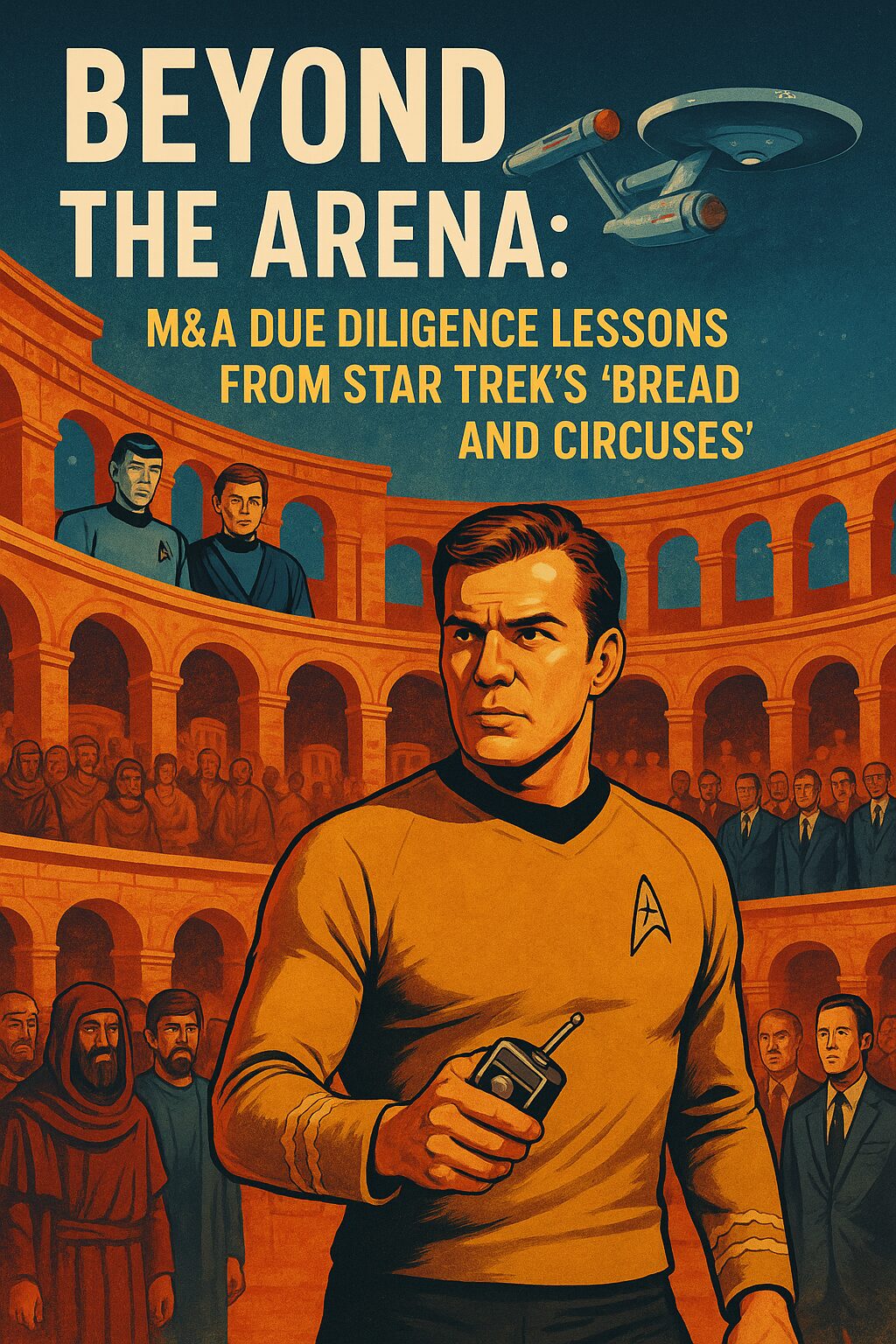
Beyond the Arena: M&A Due Diligence Lessons from Star Trek’s ‘Bread and Circuses’

If there is one area in business where risk, opportunity, and culture collide, it is in mergers and acquisitions. The promise of new markets, talent, and technology is always balanced against the possibility of hidden liabilities, clashing values, and operational chaos. In the world of corporate compliance, no moment is more perilous or more revealing than when companies come together.

Star Trek: The Original Series’ episode “Bread and Circuses” offers an unlikely but fitting parable for M&A compliance professionals. The Enterprise crew stumbles upon a planet with a civilization that mirrors Ancient Rome: gladiatorial games, a rigid class system, and a society that on the surface appears functional but underneath hides deep ethical and existential fault lines. As Captain Kirk, Mr. Spock, and Dr. McCoy navigate the complexities of this alien world, compliance professionals can draw out critical lessons for conducting effective due diligence in the high-stakes world of mergers and acquisitions.

Here are five key compliance-related M&A due diligence lessons from “Bread and Circuses.”

Lesson 1: Go Beyond Surface Appearances—Assess the True Culture

Illustrated By: On the planet 892-IV, Kirk and his landing party are initially impressed by the planet’s technological advancement. It boasts twentieth-century comforts, such as television, cars, and an advanced infrastructure. Yet, beneath the veneer, they discover an authoritarian state built on forced entertainment and oppression.

Compliance M&A Lesson: It is easy to be seduced by a target company’s top-line numbers, glossy facilities, and impressive management presentations. However, true due diligence requires a thorough examination beneath the surface. What’s the real culture? Is there a hidden culture of fear, ethical lapses, or compliance gaps? Cultural misalignment is one of the top reasons M&A deals fail. The Enterprise’s discovery of “Rome with cars” is a reminder to go beyond the show. Investigate how employees act when management isn’t around, what values truly drive decisions, and whether there’s a “bread and circuses” dynamic masking underlying dysfunction.

What should you do? Interview employees at every level, not just leadership. Review whistleblower hotlines, past HR investigations, and third-party reviews to reveal what may be hidden.

Lesson 2: Identify Hidden Liabilities—Don’t Ignore the Risks Beneath the Entertainment

Illustrated By: The population of 892-IV is kept docile through violent gladiatorial games, which serve as literal bread and circuses. The ruling class avoids unrest by distracting the masses, but the peace is an illusion. When Kirk, Spock, and McCoy are thrust into the games, the underlying brutality and danger become clear.

Compliance M&A Lesson: In any transaction, there may be hidden liabilities—such as ongoing investigations, regulatory risks, potential litigation, or toxic business practices that have been overlooked or concealed. The “games” may keep things running, but only until something disrupts the balance. Effective due diligence involves identifying and addressing these hidden dangers. Compliance professionals must review litigation histories, regulatory filings, and environmental and safety records, as well as ongoing investigations and audits.

What should you do? First, do not be distracted by “good news only” presentations.

Request full disclosure of pending investigations, lawsuits, and regulatory actions. Utilize forensic audits and data analytics to examine financials and operational practices thoroughly.

Lesson 3: Map Third-Party and Supply Chain Risks—Everyone in the Arena Matters

Illustrated By: Kirk discovers that the planet’s leader, Merikus, is a missing Starfleet captain who has chosen to assimilate rather than resist. He justifies his choices as necessary for survival, but his complicity also enables oppression and exposes him to risk.

Compliance M&A Lesson: No company operates in isolation. A target company’s third-party relationships, joint ventures, and supply chains can be sources of immense risk, including FCPA, anti-bribery, human rights violations, or the risk of operational disruption. Merikus’s collaboration illustrates how easily “good people” can enable unfavorable outcomes when incentives are misaligned. Map out all third-party relationships and conduct risk-based due diligence on significant partners.

What should you do? Consider the reputational and regulatory risks that the combined entity could pose. Are there red flags in high-risk geographies or industries? Implement a robust third-party due diligence program pre- and post-acquisition. Prioritize high-risk vendors and intermediaries for enhanced review.

Lesson 4: Understand Local Laws, Customs, and Power Structures—Context Is Everything

Illustrated By: Spock and McCoy are baffled by the local laws and power dynamics. What seems irrational by Federation standards makes sense only in the context of this world’s history and social structure. Understanding these nuances proves vital for their survival and escape.

Compliance M&A Lesson: Every M&A deal is shaped by its legal, regulatory, and cultural context. Don’t assume what works in your home country will transfer easily. Local labor laws, anti-corruption regimes, data privacy rules, and unwritten power structures can significantly impact an integration. A failure to appreciate these nuances can result in compliance violations, regulatory penalties, or reputational damage after the deal closes. Contextual awareness—legal and cultural—is non-negotiable.

What should you do? Partner with local counsel and compliance experts to conduct a jurisdiction-by-jurisdiction review. Document and plan for local regulatory requirements in the integration roadmap.

Lesson 5: Don’t Underestimate the Human Element—Values and Ethics Matter

Illustrated By: Throughout the episode, it is the values and resolve of the Enterprise crew—and the oppressed “Children of the Sun”—that make resistance to tyranny possible. The episode ends not with a technical solution, but with an ethical stand.

Compliance M&A Lesson: No due diligence checklist can substitute for evaluating the ethical climate and values of a target organization. Are there tone-at-the-top issues? Does the company reward ethical behavior or cut corners? Is there a history of retaliation against whistleblowers? Ultimately, mergers are about people, bringing together teams, customers, and cultures. Values alignment isn’t just a “soft” factor; it’s a predictor of post-merger success and resilience in a crisis.

What should you do? Include values and ethical culture assessments in your due diligence. Leverage employee surveys, exit interviews, and culture audits to gauge whether ethics are truly embedded.

Final ComplianceLog Reflections

Bread and Circuses” is more than just a classic science fiction adventure. It is a powerful parable for today’s compliance professional navigating the high-stakes world of mergers and acquisitions. As the Enterprise crew discovers, the trappings of prosperity and modernity can easily mask underlying risks, cultural misalignments, and ethical fault lines that, if left unexamined, can undermine even the most promising deal.

For compliance officers, the episode’s narrative reinforces that effective due diligence must go far beyond the numbers and surface-level impressions. It requires a holistic investigation into the culture, values, and relationships that truly define an organization. The success or failure of a merger often hinges on the ability to identify hidden liabilities, assess third-party and supply chain risks, and deeply understand the legal and regulatory landscape unique to each deal. Just as

Kirk and his team had to adapt to a world with its own rules and power structures. Compliance professionals must approach every transaction with humility, curiosity, and an unwavering commitment to ethical standards. In the arena of M&A, organizations that thrive are those that embrace rigorous, context-driven due diligence, protecting not only their assets but also their reputation and long-term success. The “arena” of M&A is as perilous as any gladiatorial contest. With rigorous, holistic due diligence, compliance officers can ensure their organizations don’t become unwitting spectators in someone else’s bread and circuses.

Resources:

Excruciatingly Detailed Plot Summary by Eric W. Weisstein

MissionLogPodcast.com

Memory Alpha

Categories
Data Driven Compliance

Data Driven Compliance – Understanding the UK’s New Failure to Prevent Fraud Offense with Sam Tate

Welcome to Season 2 of the award-winning Data Driven Compliance. In this new season, we will look at the new Failure to Prevent Fraud offense. Join host Tom Fox as we explore this new law and how to comply with it through the lens of data driven compliance. This podcast is sponsored by Kona AI. In this first episode of Season 2, Tom is joined by Sam Tate, Global Head of Regulatory and Investigations at the international law firm Clyde & Co.

Tate to discuss the significant changes brought about by the latest UK law on the Failure to Prevent Fraud offense, which was introduced as part of the Economic Crime and Corporate Transparency Act of 2023 and took effect on September 1, 2025. He also highlights the challenges of prosecuting large corporations for fraud. Tom and Sam examine the new compliance requirements under the law, their impact on multinational companies, and the extended jurisdiction that covers actions affecting the UK. Practical steps for companies to take in response to the new law are also discussed, emphasizing the need for a thorough risk assessment and robust compliance programs.

Key highlights:

  • Overview of the New Fraud Law
  • Implications for US Companies
  • Market Response and Compliance Challenges
  • Prosecutors’ Perspective and Enforcement
  • Corporate Response and Compliance Strategies
  • Impact on International and Regulated Entities

Resources:

Clyde & Co

Sam Tate at Clyde & Co

ECCTA’s Failure to Prevent Fraud Offense—Is your Organisation ready?

Check out KonaAI

Click here for KonaAI White Paper Rethinking Compliance: Practical Steps for Adapting to the UK’s New Fraud Legislation.

Connect with Tom Fox on LinkedIn

Categories
Daily Compliance News

Daily Compliance News: July 25, 2025, The New Sheriff in Town Edition

Welcome to the Daily Compliance News. Each day, Tom Fox, the Voice of Compliance, brings you compliance-related stories to start your day. Sit back, enjoy a cup of morning coffee, and listen in to the Daily Compliance News. All, from the Compliance Podcast Network. Each day, we consider four stories from the business world, including those related to compliance, ethics, risk management, leadership, or general interest, that are relevant to the compliance professional.

Top stories include:

  • Heathrow boss ‘slept through’ the March fire emergency. (BBC)
  • United Health says it is ‘cooperating’ after reports of a DOJ criminal investigation. (NYT)
  • BCG refuses to release the results of the external investigation. (FT)
  • New ABC sheriff in town. (Reuters)

You can donate to flood relief for victims of the Kerr County flooding by going to the Hill Country Flood Relief here.

Categories
Blog

Setting the Tone: Why Top-Level Commitment Is the Heart of Fraud Prevention

In today’s rapidly evolving compliance landscape, one principle has become abundantly clear: effective fraud prevention starts at the top. The Economic Crime and Corporate Transparency Act 2023, with its new offense of failure to prevent fraud, has elevated the expectations for senior leadership and boards across large organizations. Fortunately, the UK government has put out a document entitled “Economic Crime and Corporate Transparency Act 2023: Guidance to organisations on the offence of failure to prevent fraud.” (The Guidance). Section 3.1 of the official guidance, titled “Top Level Commitment,” should be required reading for every compliance professional seeking to build a credible, defensible, and sustainable anti-fraud culture. Today, we take a deep dive into what a top-level commitment is.

The Imperative: Leadership’s Role in Preventing Fraud

Section 3.1 places the responsibility for preventing and detecting fraud squarely on those charged with governance, including the Board of Directors, partners, and senior management. This is not simply a perfunctory statement. The Guidance makes it clear: without authentic buy-in and leadership from the very top, even the best-written policies and controls will falter.

A culture of zero tolerance for fraud must be more than a slogan. The board and senior management must actively foster an environment where fraud is not only discouraged but also considered unthinkable, where profit derived from or assisted by fraud is unequivocally rejected.

Visible Commitment: Not Just Words, But Deeds

What does genuine top-level commitment look like? The Guidance offers a clear framework. It is about visible, consistent action that resonates throughout the organization. This includes:

  • Publicly rejecting fraud, even at the cost of lost business opportunities. Boards and executives must demonstrate that they will walk away from deals if the price compromises their integrity and values.
  • Explaining the business benefits of a strong anti-fraud posture. Protecting the company’s reputation, building trust with customers and business partners, and ensuring long-term sustainability are tangible, valuable outcomes.
  • Backing policies and codes of conduct with consequences. There must be clarity about what happens if someone breaches anti-fraud policies—up to and including contractual and disciplinary action.
  • Acknowledging and endorsing collective anti-fraud efforts. Participation in industry initiatives or trade body actions against fraud demonstrates seriousness of intent.

A leadership statement is only credible if it is backed by real accountability, named roles, and continuous communication.

Governance: Structuring Responsibility for Real Results

Clear governance is the backbone of any fraud prevention framework. Section 3.1 stresses that organizations should define, document, and communicate who is responsible for every aspect of fraud prevention, from risk assessment to whistleblowing, and from detection to disciplinary actions.

Best practice governance includes:

  • Designated responsibility for horizon scanning, risk assessment, policy development, disciplinary action, whistleblowing, investigation, and ongoing review.
  • Direct access for compliance leadership to the board or CEO, even if day-to-day reporting is elsewhere. This ensures critical issues don’t get buried in middle management.
  • Documentation of decisions and actions. Board minutes should capture key compliance decisions, risk reviews, and follow-up actions.
  • Succession planning for compliance leadership. Governance should account for staff turnover and ensure continuity in anti-fraud efforts, even when key personnel are absent or leave the organization.

In some organizations, the board or senior executives will be personally involved in designing fraud prevention measures; in others, they will delegate this responsibility to the Head of Ethics and Compliance while retaining ultimate accountability. The key is active engagement and oversight.

Commitment to Resources: Funding and Training

Fraud prevention is not a costless endeavor. The guidance is explicit: senior management must allocate a reasonable and proportionate budget for compliance leadership, fraud prevention staff, training, and technology, including due diligence tools and platforms. This budget commitment must be sustained for the long term, not just as a one-off initiative.

Training is equally crucial. Senior management must champion not only initial training but also ongoing refreshers and updates, ensuring that all staff, especially those in high-risk roles, are equipped to identify and prevent fraud. Resilience is key: anti-fraud practices must be maintained even when staff are on vacation, sick leave, or when there is turnover.

Leading by Example: The Tone at the Top

The “tone at the top” is more than a catchphrase; it is the bedrock of ethical culture. Senior managers must embody the standards they expect from the rest of the organization. This means:

  • Openly challenging rationalizations for fraud. Whether it’s “everyone does it,” “it’s not material,” or “it’s for the good of the business,” these are dangerous myths that must be confronted.
  • Encouraging early reporting of concerns. Leadership should foster an open culture where staff feel empowered to speak up, no matter how minor the issue may seem. The earlier a problem is raised, the less likely it will snowball into a major scandal.
  • Making ethics a daily practice, not a quarterly campaign. Whether through regular reminders, integration into performance evaluations, or simply modeling the right behaviors, leaders set the ethical weather for the company.

Communication: Reinforcing the Anti-Fraud Message

Top-level commitment must be communicated consistently and credibly to all key audiences, including employees, contractors, agents, suppliers, and business partners. The guidance recommends tailoring the message for different stakeholders; what resonates with employees may differ from what is relevant for contractors or vendors.

Effective anti-fraud communication should:

  • Highlight the organization’s commitment to integrity over short-term gains.
  • Reinforce the real-world consequences of violating anti-fraud policies.
  • Regularly spotlight examples of ethical leadership, transparency, and collective action against fraud.

The Importance of Whistleblowing

Section 3.1 places significant emphasis on whistleblowing—not only establishing clear channels but also creating a culture where speaking up is encouraged and protected. Senior management should ensure:

  • There are safe, independent channels for reporting concerns.
  • Whistleblowers are protected from retaliation.
  • Reports are acted on quickly and transparently.

A strong whistleblowing culture indicates that leadership is committed to identifying and addressing problems before they become systemic.

The “Why” Behind Top-Level Commitment

Why is all of this so critical? Because fraud is adaptive. It thrives in ambiguity, and it flourishes when leadership is distracted, disinterested, or inconsistent. The Economic Crime and Corporate Transparency Act 2023 raises the stakes: organizations now face not just reputational and commercial damage, but also criminal liability if they cannot demonstrate that their prevention procedures were reasonable and implemented with genuine top-level commitment.

The regulators and prosecutors will look for evidence of this commitment. Are senior managers personally invested? Do they walk the talk? Can they demonstrate, with documentation, that anti-fraud policies are embedded in the organization’s DNA?

Practical Steps for Compliance Professionals

What should compliance professionals do today?

  1. Engage with your board and C-suite. Make sure they understand their personal and collective responsibilities under the Act.
  2. Audit your current governance structures. Identify gaps in accountability, communication, or resource allocation.
  3. Refresh your anti-fraud messaging and training. Ensure it is regular, targeted, and endorsed by top management.
  4. Enhance your whistleblowing framework. Benchmark it against best practices and ensure visible support from leadership.
  5. Document everything. If it’s not written down, it didn’t happen. Ensure that minutes, decisions, and compliance actions are accurately recorded.

Conclusion: Leadership Sets the Standard

Section 3.1 is clear: fraud prevention is not just the job of compliance or internal audit. It is the duty of those at the top. Authentic leadership means investing in people, systems, and culture; communicating a vision of integrity; and never wavering, even when the pressure to bend the rules is immense.

For the modern compliance professional, this is both a challenge and an opportunity. With exemplary leadership, organizations can move beyond reactive compliance and build an enduring culture where ethical conduct is the norm and fraud has no place to hide.

Join us tomorrow, where we will consider a fraud risk assessment.

Categories
Regulatory Ramblings

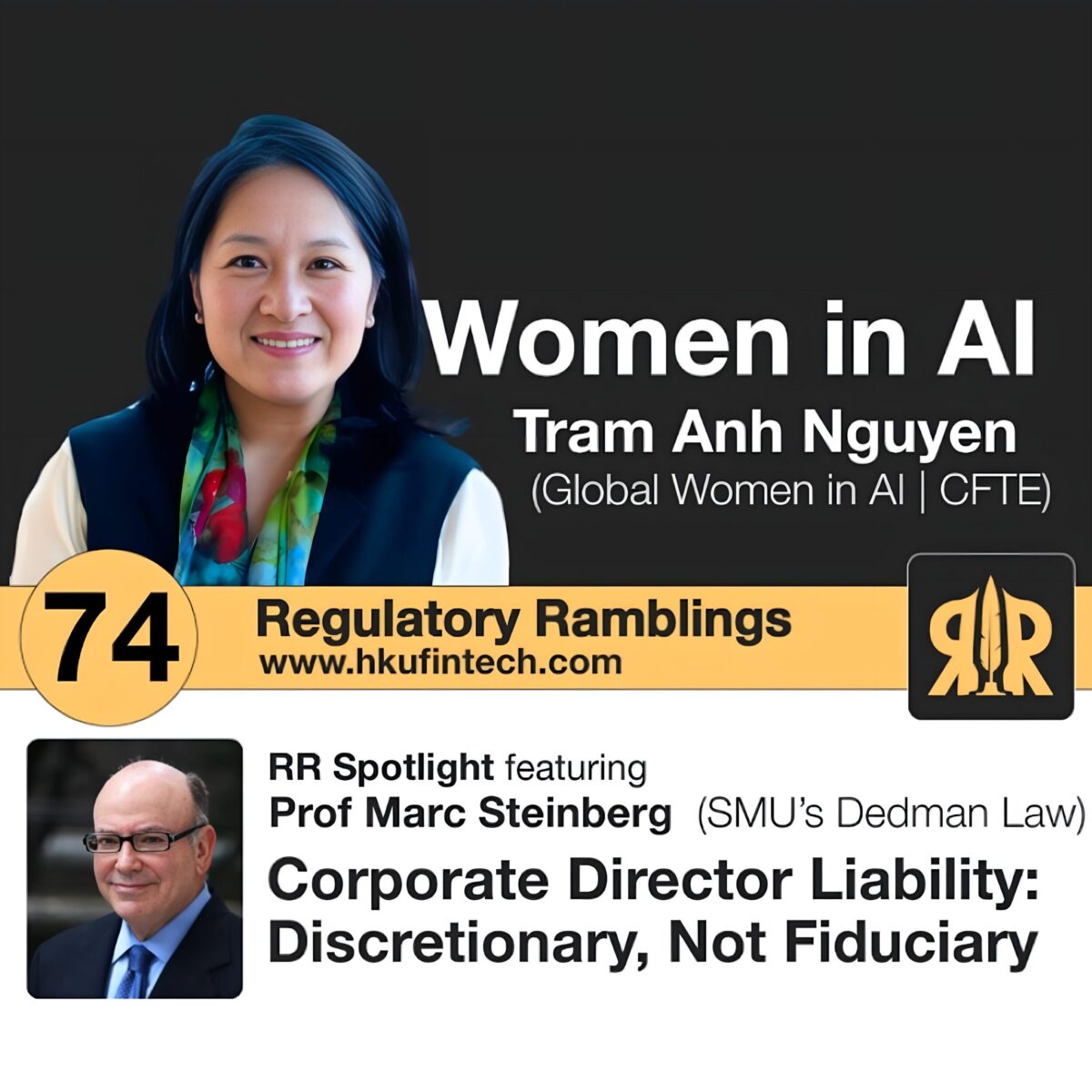
Regulatory Ramblings: Episode 74 – Global Women in AI/Corporate Director Liability: Discretionary, Not Fiduciary with Tram Anh Nguyen and Marc I. Steinberg

In this episode, we feature two conversations exploring different frontiers of finance and technology.

In our opening Spotlight, we welcome back Marc Steinberg, professor at Southern Methodist University’s Dedman School of Law and a leading voice in securities and corporate law. His latest book, Corporate Director and Officer Liability: Discretionary, Not Fiduciary (Oxford University Press), challenges the long-standing view that corporate directors and officers should be labeled as “fiduciaries.” Steinberg examines why current liability standards — from the duty of care to the business judgment rule — are too lenient to support that label and why adopting “discretionary” as a neutral, accurate term could restore clarity and investor trust.

In the second segment, we speak with Tram Anh Nguyen, co-founder of the global digital finance education platform CFTE and Chairwoman of Global Women in AI (GWAI). She shares GWAI’s mission to close gender gaps in AI by equipping women across industries with technical knowledge, leadership skills, and mentorship. She discusses GWAI’s mission to empower women across industries to lead in AI innovation by building skills, networks, and visibility. Tram Anh emphasizes the importance of AI literacy, the barriers that hinder women from accessing AI-driven opportunities, and how GWAI facilitates connections among students, professionals, and policymakers to foster an inclusive ecosystem that shapes the future of technology.

Prof. Marc I. Steinberg is a leading expert and prodigious scholar in the field of US securities and corporate law. He is the Rupert and Lillian Radford Chair in Law and Professor of Law at SMU’s Dedman School of Law. He has served as a professor, fellow, or lectured at several other prominent universities, including HKU, the University of Cambridge, Oxford University, King’s College-University of London, Moscow State University, University of Sydney, UCLA, and the University of Pennsylvania.

Earlier in his career, he served as an attorney for the U.S. Securities and Exchange Commission (SEC) in its Division of Enforcement and Office of General Counsel. He has also been retained as an expert witness in several high-profile cases, including Enron, Martha Stewart, Mark Cuban, and the National Prescription Opioid Litigation.

Professor Steinberg is a prolific author of scholarship on US securities law, having authored approximately 150 law review articles and 50 books.

One of his recent books, Rethinking Securities Law (Oxford University Press, 2021), was awarded the Best Law Book in the United States category for 2021 by American Book Fest.

He is also editor-in-chief of The International Lawyer and The Securities Regulation Law Journal, in addition to being a member of The American Law Institute.

Tram Anh Nguyen is the chairwoman of the Global Women in AI (GWAI) group and co-founder of the London-headquartered Centre for Finance, Technology and Entrepreneurship (CFTE). GWAI is best thought of as a global community empowering women to shape the future of artificial intelligence. Its mission is to equip women across industries with the skills, networks, and visibility they need to thrive in an AI-driven world.

From aspiring professionals to seasoned leaders, the GWAI connects a diverse network of innovators, learners, and changemakers. The group offers hands-on learning experiences, leadership development, mentorship opportunities, and access to global forums—all to empower women to lead with purpose, power, and passion.

Before launching the CFTE in 2017, she had spent nearly two decades with Standard Chartered Bank in New York and Dresdner Kleinwort and UBS Wealth Management in London, advising ultra-high-net-worth clients and family offices. A recognized voice when it comes to the ‘future of work,’ Tram Anh partners with governments, central banks, and tier-one institutions worldwide to deliver large-scale reskilling programs.

She has also co-authored the world’s largest Fintech Job Report. As the founder of the Future Skills Forum, under her leadership, the forum has positioned itself as a global convener of thought leaders, policymakers, educators, and industry innovators to drive forward the agenda of human capital transformation in the age of artificial intelligence.

A champion of lifelong learning in digital finance, Tram Anh works closely with governments, regulators, and financial institutions to build future-ready workforces.

She leads initiatives that bring industry and public sector stakeholders together to design large-scale education strategies, develop forward-looking curricula, and ensure the financial sector is equipped to thrive in an AI-driven economy. Under her leadership, CFTE has expanded its global impact, educating over 260,000 alumni in more than 130 countries and collaborating with over 1,000 industry experts to accelerate the transformation of finance through education.

Discussion:

The conversation begins with some background information on Prof. Steinberg’s book. As he puts it, “For centuries, directors and officers have been identified as fiduciaries, bearing a legal and ethical duty to act in the best interests of those they represent. However, the liability standards that ordinarily exist are too lenient to be characterized as fiduciary. This misrepresentation is detrimental to the rule of law, contravenes reasonable investor expectations, and impairs the integrity of the financial markets.”

Therefore, his book, Corporate Director and Officer Liability—‘Discretionaries’ Not Fiduciaries, argues for removing a fiduciary status for corporate directors and officers, instead favoring adoption of a new, more accurate term: “Corporate directors and officers are, instead, ‘discretionaries.’” Such a term, he says, more accurately portrays the status of corporate directors and officers who are held to varying standards of liability depending on the applicable facts and circumstances.”

With such a new model in mind, “the book addresses a wide range of key issues, including the duty of care, the business judgment rule, exculpation statutes, the duty of good faith, interested director transactions, derivative litigation, mergers and acquisitions, and closely held corporations.”

A thought-provoking addition to the field, Prof. Steinberg’s book provides an alternative framework that enhances corporate governance standards while protecting corporate fiduciaries from undue liability exposure.

He shares with Regulatory Ramblings host Ajay Shamdasani what prompted him to write such a book on the topic now, as well as why it is essential to reframe the role of corporate directors and officers as “discretionaries” rather than “fiduciaries,” and what purpose it serves. As Prof. Steinberg acknowledges, it will change the legal analysis and consequently, the responsibilities and liabilities of the parties concerned. He also comments on what he believes his treatise adds to the preexisting scholarship on the matter.

Following that, we chat with Tram Anh about her background and her rationale for creating the GWAI—especially when similar such bodies already seem to exist.

Looking ahead, she sees GWAI going far and believes its best days are yet to come. As she put it, GWAI is where inspiration meets action—creating pathways for women to lead in AI, together.

From its inception, CFTE has been concerned about inclusive education—that those who want to master the vital technologies of tomorrow should be able to do so without fearing the barriers of cost, class, or their current educational, professional, or social standing. Tram Anh said that GWAI’s creation was part of a larger, longer-term goal; the same motivation that compelled her and her partner and co-founder, Huy Nguyen Trieu.

Indeed, Tram Anh believes the CFTE has come a long way, with offices on multiple continents and numerous groups and individuals receptive to its mission of democratizing the learning of fintech and related topics.

Ultimately, she believes that more needs to be done to encourage women to enter STEM fields, enabling them to contribute to the development of AI and Web3.

Regulatory Ramblings podcasts is brought to you by The University of Hong Kong – Reg/Tech Lab, HKU-SCF Fintech Academy, Asia Global Institute, and HKU-edX Professional Certificate in Fintech, with support from the HKU Faculty of Law.

Useful links in this episode:

You might also be interested in:

Connect with RR Podcast at:

LinkedIn: https://hk.linkedin.com/company/hkufintech 
Facebook: https://www.facebook.com/hkufintech.fb/
Instagram: https://www.instagram.com/hkufintech/ 
Twitter: https://twitter.com/HKUFinTech 
Threads: https://www.threads.net/@hkufintech
Website: https://www.hkufintech.com/regulatoryramblings 

Connect with the Compliance Podcast Network at:

LinkedIn: https://www.linkedin.com/company/compliance-podcast-network/
Facebook: https://www.facebook.com/compliancepodcastnetwork/
YouTube: https://www.youtube.com/@CompliancePodcastNetwork
Twitter: https://twitter.com/tfoxlaw
Instagram: https://www.instagram.com/voiceofcompliance/
Website: https://compliancepodcastnetwork.net