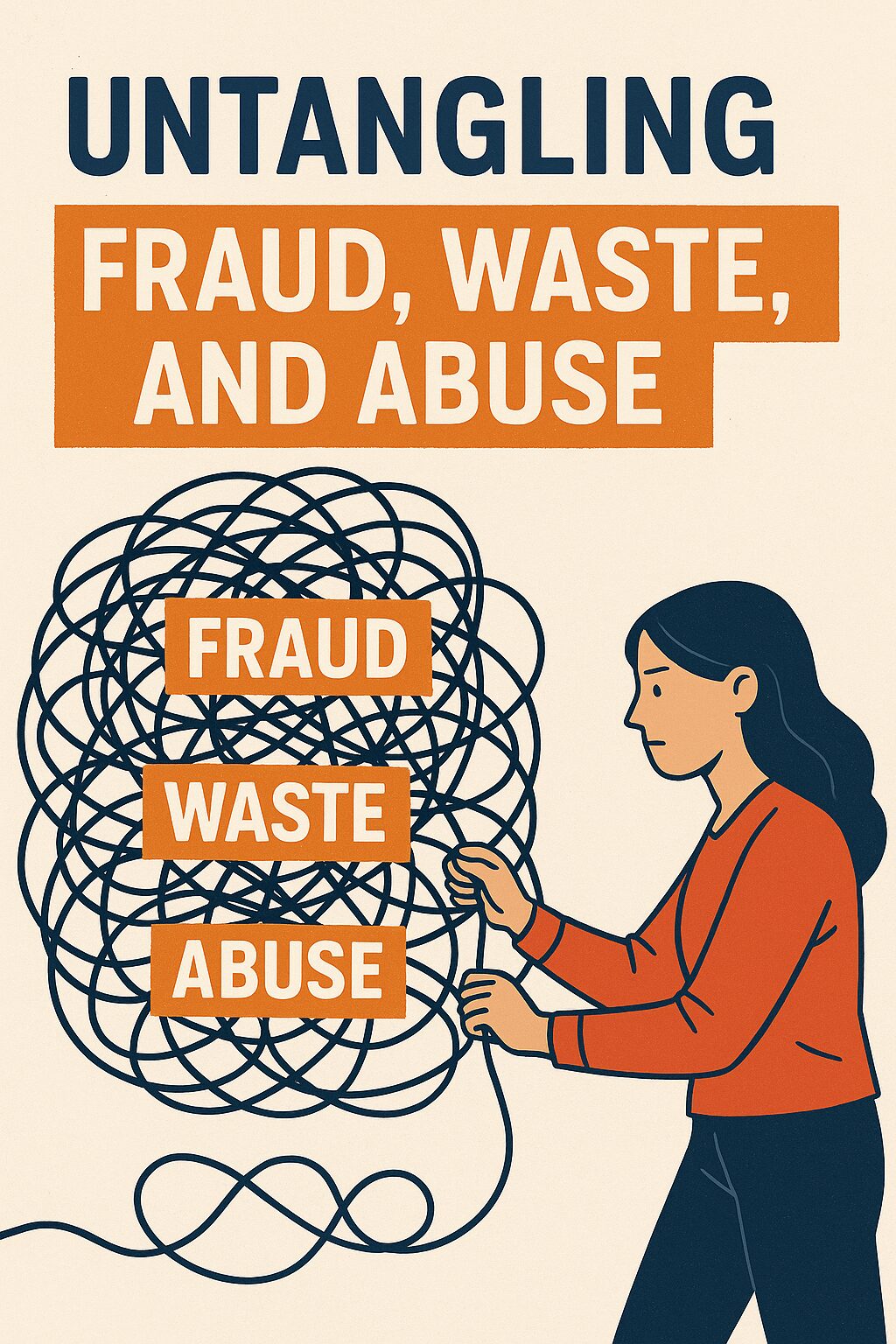
In the world of compliance, few phrases are tossed around with as much frequency and often as little precision as “fraud, waste, and abuse.” In the government sector, this triad is well-defined. Federal and state agencies spend billions each year tracking, auditing, and enforcing rules to combat it. But in the private sector, the phrase is no less relevant. Whether you are managing a global compliance program, overseeing internal controls, or leading an ethics initiative, fraud, Waste, and abuse can quietly erode corporate value, undermine trust, and invite unwanted scrutiny from regulators, auditors, and stakeholders.
Yet too many compliance professionals lump these terms together, failing to appreciate the important differences between them. Fraud, Waste, and abuse may sometimes overlap in practice, but they require distinct prevention strategies, tailored controls, and cultural messaging. Today, we begin a multipart blog post series to unpack what each of these terms means for the private sector and explore how your organization can fight against their scourge.
Fraud: The Deliberate Deception
Fraud is the most familiar of the three. It is intentional deception or misrepresentation made with the knowledge that it will result in an unauthorized benefit. In the corporate world, fraud is not limited to elaborate Ponzi schemes or headline-grabbing accounting scandals; it often hides in plain sight.
Examples from the private sector include:
- Financial statement fraud. Inflating revenue or concealing liabilities to present a healthier picture of the business. Enron, WorldCom, and Wirecard are stark reminders.
- Procurement fraud. Kickbacks from suppliers, false invoices, or bid-rigging. A procurement officer who colludes with a vendor to inflate prices is not just wasting company money; they are stealing it.
- Expense reimbursement fraud. Employees are submitting falsified receipts or double-billing travel expenses. What starts as “a little padding” quickly snowballs into a systemic problem.
Fraud is deliberate, targeted, and harmful by design. It requires intent to deceive. For this reason, fraud often falls under the purview of regulators and prosecutors, resulting in criminal charges, civil penalties, and severe reputational damage.
Waste: The Silent Erosion of Value
Waste, by contrast, is rarely intentional. It refers to the careless or unnecessary use of resources, leading to inefficiency and loss of value. Waste does not always involve dishonesty; usually, it is more often a byproduct of poor management, weak oversight, or cultural indifference.
Examples from the private sector include:
- Operational inefficiencies. A manufacturing line that continues to use outdated machinery, consuming more energy than modern alternatives. However, it can also encompass basic corporate functions, such as failing to timely service vehicles and other large pieces of equipment until they break down.
- Bloated corporate travel. Business units booked last-minute flights in premium class when lower-cost options were available with better planning.
- Technology sprawl. Companies are paying for redundant software licenses because IT and business units fail to coordinate their procurement.
Waste drains profitability. Unlike fraud, it may not land your employees in court, but over time, it corrodes competitiveness, frustrates shareholders, and damages morale. For the compliance professional, Waste is tricky. Because it often lacks intent, it falls into a gray zone between compliance, internal audit, and operations. But leaving Waste unchecked is an abdication of governance responsibility. And of course, it can be very costly.
Abuse: The Exploitation of Loopholes
Abuse sits somewhere between fraud and Waste. It involves the improper or excessive use of resources or authority, but without a clear intent to defraud. Abuse may not violate the letter of company policy, but it often violates its spirit.
Examples from the private sector include:
- Excessive executive perks. A senior leader insists on flying private, despite company policy allowing business class.
- Overtime gaming. Employees schedule themselves in ways that maximize overtime pay, even when workloads do not justify it.
- Supplier favoritism. A manager repeatedly awards contracts to a personal acquaintance without competitive bidding, even if the price is technically “market.”
Abuse thrives in cultures of entitlement and weak oversight. It often signals to employees that procurement rules are flexible or merely suggestions, undermining trust in leadership. Regulators may not always prosecute abuse, but investors, boards, and employees will notice.
Five Key Takeaways for the Compliance Professional
1. Know the Difference
Fraud, Waste, and abuse are often lumped together, but they are distinct risks with different causes and remedies. Fraud is intentional deception designed to enrich the perpetrator at the company’s expense. Waste is careless or inefficient use of resources, often unintentional but just as costly. Abuse sits in the middle ground, exploiting loopholes, gray areas, or authority for personal gain. If you treat these three risks as interchangeable, your controls will be blunt instruments. The savvy compliance professional tailors training, monitoring, and cultural messaging to each risk, ensuring prevention efforts are both precise and effective.
2. Fraud Is Not the Only Threat
Compliance programs often emphasize fraud because it creates legal exposure, attracts regulatory scrutiny, and can lead to criminal liability. Yet fraud is not the only drain on corporate value. Waste can hollow out profitability year after year through inefficiency and mismanagement. Abuse corrodes employee trust, culture, and morale, even when it does not cross a legal line. Boards and shareholders increasingly look beyond compliance “check the box” fraud controls. They demand stewardship, efficiency, and accountability across the enterprise. Expanding your program’s scope to tackle Waste and abuse demonstrates leadership, adds measurable business value, and positions compliance as a strategic partner.
3. Culture Is the Battleground for Abuse
You can design airtight policies and sophisticated controls to prevent fraud or reduce Waste, but abuse is more insidious. It thrives in cultures of entitlement, favoritism, and “wink-and-nod” exceptions to the rules. Abuse may not always break laws or policies, but it violates fairness and damages trust. That is why culture is the key battleground. Compliance leaders must set clear expectations, train managers to model ethical behavior, and empower employees to speak up when necessary. When entitlement and corner-cutting are tolerated, abuse spreads. When accountability, transparency, and stewardship are celebrated, abuse withers. Culture, not checklists, is the ultimate safeguard.
4. Data Is Your Ally
The complexity of modern business means fraud, Waste, and abuse can hide in plain sight. Data analytics provides compliance professionals with the tools to detect risks early. Anomalies in travel expenses may uncover not only fraudulent reimbursement but also systemic Waste in last-minute bookings or abusive upgrades. Procurement analytics can expose inflated invoices, duplicate payments, or favoritism in the vendor selection process. The key is not just gathering data but integrating it across compliance, audit, and finance systems. With proper dashboards and regular reviews, data becomes a proactive ally, identifying red flags before they metastasize into scandals that damage reputation and value.
5. Build Cross-Functional Coalitions
Fraud, Waste, and abuse do not respect organizational silos. They intersect with compliance, audit, HR, procurement, finance, and operations. If each function fights its own battles in isolation, risks will inevitably slip through the cracks. The compliance professional is uniquely positioned to serve as the connector, building coalitions that share data, align incentives, and coordinate responses. For example, a fraud indicator spotted by finance may also highlight Waste tracked by operations. HR may uncover abusive practices that compliance can remediate with policy changes. When functions collaborate, blind spots shrink, accountability rises, and the entire organization becomes more resilient.
Stewardship as Compliance
Fraud, Waste, and abuse may manifest differently, but together they represent a continuum of risks that can erode profitability, corrode culture, and undermine trust in leadership. For the compliance professional, the way forward lies in anchoring your program on five core pillars.
First, you need to understand the difference. Fraud, Waste, and abuse require distinct approaches, and treating them as interchangeable dulls your controls. Second, remember that fraud is not the only threat. Waste and abuse, while less visible, can be just as damaging to shareholders and boards who care about stewardship as much as compliance. Third, recognize that culture is the battleground for abuse. Without accountability and transparency embedded in daily operations, policies and controls are powerless against entitlement and favoritism. Fourth, leverage the fact that data is your ally. Analytics reveal patterns across all three categories, allowing you to act before small issues metastasize. Finally, build cross-functional coalitions. Fraud, Waste, and abuse cut across silos, and only through collaboration can you close the gaps.
Taken together, these five strategies form more than a compliance toolkit; they create a holistic framework for corporate stewardship. By clearly distinguishing risks, broadening your scope, reinforcing your culture, embracing data, and building coalitions, you elevate compliance from a defensive shield to a proactive value driver.
The organizations that thrive in today’s demanding environment will be those that go beyond chasing fraud and instead build resilient, data-driven, and culture-anchored programs to fight fraud, Waste, and abuse in all their forms. That is the mandate for the modern compliance professional.
Join us tomorrow as we explore how your anti-corruption compliance program can help your company combat fraud, Waste, and abuse.