Categories
Compliance Tip of the Day

Compliance Tip of the Day – Using Your ABC Framework to Prevent Fraud Waste and Abuse

Welcome to “Compliance Tip of the Day,” the podcast that brings you daily insights and practical advice on navigating the ever-evolving landscape of compliance and regulatory requirements. Whether you’re a seasoned compliance professional or just starting your journey, our goal is to provide you with bite-sized, actionable tips to help you stay ahead in your compliance efforts. Join us as we explore the latest industry trends, share best practices, and demystify complex compliance issues to keep your organization on the right side of the law. Tune in daily for your dose of compliance wisdom, and let’s make compliance a little less daunting, one tip at a time.

We continue our look at fraud, waste, and abuse. Today, explore using a best practices compliance program to fight these three iniquities.

For more on this topic, check out The Compliance Handbook, a Guide to Operationalizing your Compliance Program, 6th edition, which was recently released by LexisNexis. It is available here.

Categories
Daily Compliance News

Daily Compliance News: September 11, 2025, The Lest We Never Forget Edition

Welcome to the Daily Compliance News. Each day, Tom Fox, the Voice of Compliance, brings you compliance-related stories to start your day. Sit back, enjoy a cup of morning coffee, and listen in to the Daily Compliance News. All, from the Compliance Podcast Network. Each day, we consider four stories from the business world, including compliance, ethics, risk management, leadership, or general interest, relevant to the compliance professional.

Top stories include:

  • Citi and UBS settle with the CFTC over commodity trading compliance violations. (Bloomberg)
  • Goldman Sachs’ GC was once Epstein’s administrator. (WSJ)
  • The son of a Chinese regulator under investigation has been detained. (FT)
  • Gen Z protestors force recognition of Nepali PM. (Reuters)
Categories
AI Today in 5

AI Today in 5: September 11, 2025, The Cruz Sandbox AI Episode

Welcome to AI Today in 5, the newest edition to the Compliance Podcast Network. Each day, Tom Fox will bring you 5 stories about AI, so start your day, sit back, enjoy a cup of morning coffee, and listen in to the AI Today In 5, all from the Compliance Podcast Network. Each day, we consider four stories from the business world, compliance, ethics, risk management, leadership, or general interest related to AI.

Top AI stories include:

  • Navigating the path to AI compliance. (BDO)
  • AI and ML are reshaping financial compliance. (FinExtra)
  • Ted Cruz proposes a free Sandbox. (Tech Policy Press)
  • Why AI alone can’t fix compliance screening. (FinTechGlobal)
  • Empire AI program exceeds expectations, says Gov. (Bloomberg)

For more information on the use of AI in Compliance programs, my new book, Upping Your Game. You can purchase a copy of the book on Amazon.com.

Categories
It's art

It’s Art, Let’s Talk About It – The Journey of Walt Gonske: An Artist’s Path from New York to Taos

The Museum of Western Art is dedicated to excellence in the collection, preservation, and promotion of Western Heritage and the education and cultural enrichment of our diverse audiences. The Museum serves as a bridge between the past and the present, ensuring that the legacy of the American West is preserved for future generations. Western Art is as engaging and important as ever. In this award-winning podcast series, Museum Executive Director Darrell Beauchamp welcomes Walt Gonske to discuss his career, focusing on his latest exhibition, ‘Walt Gonske, the Church Series.’

Their conversation covers Gonske’s early passion for drawing, his transition from a freelance men’s fashion illustrator in New York to a renowned painter in Taos, New Mexico. Gonske shares his experiences, including his unique ‘Paint Mobile,’ painting techniques, and the importance of painting from life. The discussion also touches on his journey of establishing himself in the art world, his collaboration with the Taos Six, and insights for emerging artists.

Highlights include:

  • Walt’s Artistic Beginnings
  • Building a Life and Career in Taos
  • The Taos Six and Artistic Community
  • The First Paint Mobile Experience
  • Techniques and Bright Colors
  • The Church Series Exhibition
  • Advice for Young Artists

Resources:

Museum of Western Art

Darrell Beauchamp on LinkedIn

Walt Gonske – The Church Series

Walt Gonske Fine Art Website

Categories
All Things Investigations

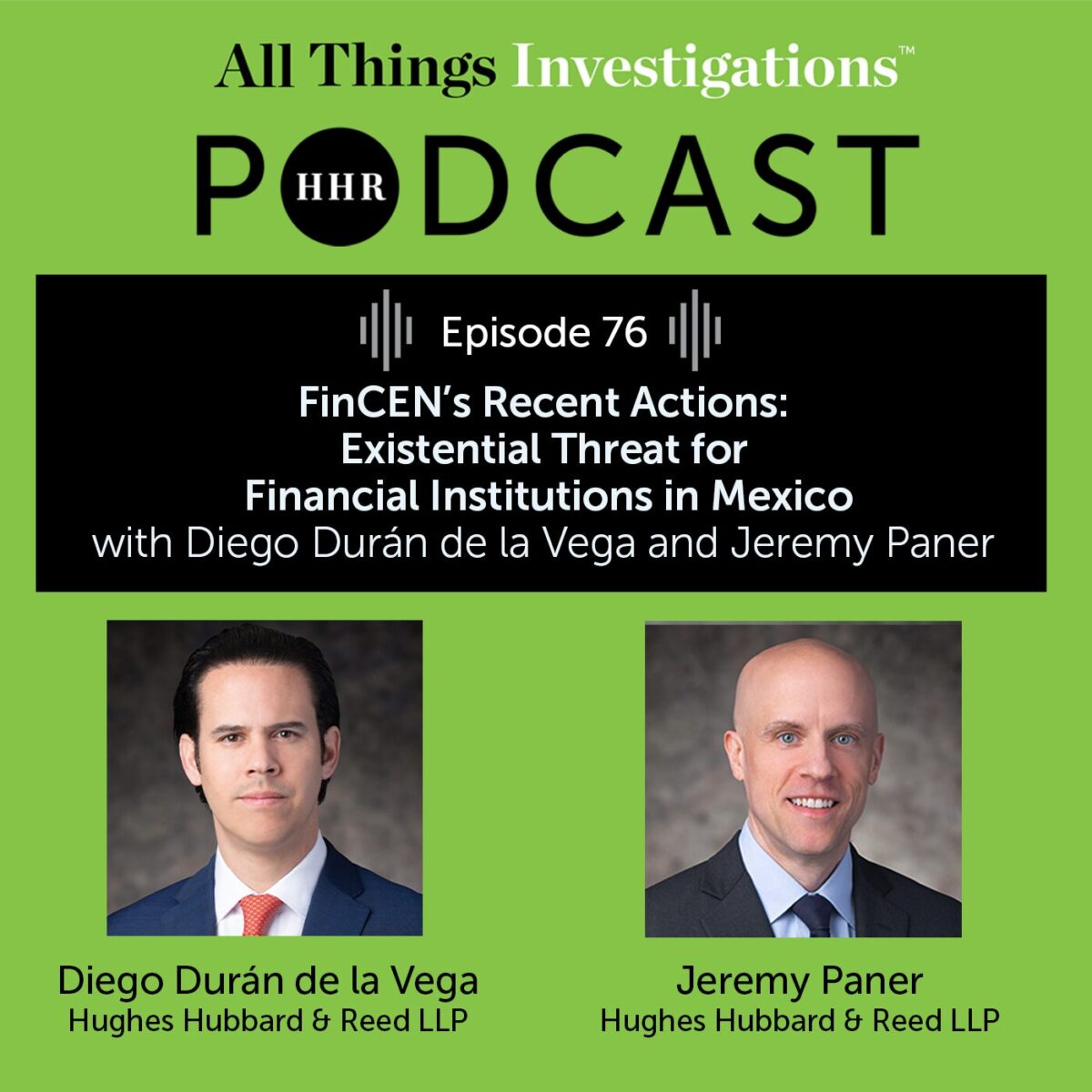
All Things Investigations – FinCEN’s Recent Actions: Existential Threat for Financial Institutions in Mexico

Welcome to the Hughes Hubbard Anti-Corruption & Internal Investigations Practice Group’s podcast, All Things Investigation. In this podcast, host Tom Fox welcomes back Jeremy Paner and Diego Durán de la Vega to discuss recent FinCEN enforcement actions targeting three Mexican financial institutions. The conversation explores the implications of these actions under the Fend Off Fentanyl Act, the evolving regulatory landscape, and the existential risks facing financial institutions operating in Mexico. The guests provide practical compliance guidance, lessons learned, and a forward-looking perspective on U.S. enforcement trends.

Highlights include:

  • Why These Enforcement Actions Matter
  • The Fend Off Fentanyl Act: A New Legal Tool
  • U.S. Government Focus on Mexico
  • Lessons from OFAC Enforcement
  • Compliance Implications for Financial Institutions
  • Responding to Enforcement: Practical Steps
  • Global Jurisdiction and the U.S. Financial System
  • Key Lessons for Compliance Officers
  • Looking Ahead: Future Enforcement Trends

Key Takeaways for Compliance Professionals:

  • The Fend Off Fentanyl Act introduces new, immediate risks for financial institutions, especially those with ties to Mexico.
  • U.S. enforcement actions can have global reach, severing access to the U.S. financial system.
  • Compliance programs must be robust, proactive, and responsive to regulatory advisories and negative media.
  • Effective communication between compliance and legal functions is crucial for mitigating risk.

Resources:

Hughes Hubbard & Reed website

Jeremy Paner

Diego Durán de la Vega

Categories
Blog

From Controls to Culture: Building Anti-Corruption Programs that Address Fraud, Waste, and Abuse

Fraud, waste, and abuse are not just buzzwords in the government sector. They represent a real continuum of risk that every private sector company must confront. In fact, when designing or refreshing an anti-corruption compliance program, these three categories should not be seen as separate from bribery and corruption risks; they are integral to them. Bribery schemes thrive in environments where fraud is unchecked, where waste is tolerated, and where abuse of authority is normalized.

A truly effective anti-corruption compliance program, therefore, must address fraud, waste, and abuse head-on. Each requires different tools, but all rest on the same foundation: clear expectations, adequate controls, data-driven monitoring, and a culture of accountability. Yesterday, we took a deep dive into the three concepts behind fraud, waste, and abuse. Today, we continue our primer on fraud, waste, and abuse for the compliance professional by exploring how compliance professionals can operationalize their ABC framework to help fight these corporate scourges.

1. Fraud Prevention: Strengthening the Control Environment

Fraud sits at the heart of most corruption schemes. Bribery rarely occurs without the use of falsified invoices, fraudulent expense reports, or deceptive third-party contracts. That’s why fraud prevention measures must be embedded directly into your anti-corruption compliance program.

Practical steps include:

  • Segregation of duties. No single employee should have the authority to control both vendor approval and invoice payment. Splitting responsibilities closes off avenues for concealment.
  • Mandatory rotations or vacations. Employees in high-risk positions, such as procurement or finance, should be required to take periodic breaks. This not only reduces burnout but also increases the chance of uncovering irregularities.
  • Third-party due diligence. Vendors, distributors, and consultants are often used as conduits for corrupt payments. Screening them for red flags of fraud and corruption is essential.
  • Hotlines and reporting mechanisms. Anonymous channels encourage employees to report fraudulent or corrupt activity before it escalates.

Finally, modern fraud prevention is inseparable from data analytics. Reviewing transactions for anomalies in billing, procurement, or travel can help compliance officers identify both fraudulent activity and corruption red flags early.

2. Waste Reduction: Linking Efficiency to Integrity

Waste may not sound like a corruption risk at first, but it often creates the environment in which corrupt practices thrive. When organizations tolerate careless spending or redundant processes, they signal that accountability is optional. Waste becomes the fertile soil in which corruption can take root.

Practical steps include:

  • Cross-functional accountability. Compliance should collaborate with finance, procurement, and operations to ensure efficient allocation of resources.
  • Tracking key waste indicators. Duplicate software licenses, unnecessary travel expenses, or high energy consumption may not be fraudulent, but they represent vulnerabilities that can be exploited. Left unchecked, they normalize sloppy practices that corrupt employees can exploit.
  • Integrating waste metrics into compliance dashboards. If a business unit consistently demonstrates waste, it may also be vulnerable to bribery risks, particularly in operations that are heavily reliant on procurement.

By spotlighting waste, compliance leaders not only save the company money but also reinforce a culture of stewardship and integrity, two qualities that reduce the likelihood of corruption.

3. Abuse Control: Guarding Against the Gray Areas

Abuse often serves as the gateway to corruption. It thrives in gray zones, where managers stretch policies, exploit loopholes, or turn a blind eye to questionable behavior. Abuse may not always cross a legal line, but it corrodes culture and opens the door to bribery and unethical decision-making.

Practical steps include:

  • Tone from the top and middle. Executives and line managers alike must model integrity. If leaders exploit perks or bend rules, employees will assume similar behavior is acceptable in dealing with third parties.
  • Policy clarity. Abusive practices often hide in vague policies. For example, a travel policy that allows “reasonable upgrades” without definition invites abuse. Aligning policies with anti-corruption standards closes these loopholes.
  • Incentive structures. Embedding transparency and fairness into performance reviews and rewards ensures managers do not cut ethical corners to hit financial targets.

By shrinking the space in which abuse can thrive, companies make it more difficult for corrupt practices to become normalized.

4. Leverage Data Analytics: Uncovering Patterns Across Risk Categories

Corruption schemes are rarely isolated. They often weave together fraud, waste, and abuse. That’s why analytics should not be siloed. A robust anti-corruption program integrates monitoring across multiple risk vectors.

Practical applications include:

  • Travel and entertainment analytics. Reviewing expense reports can uncover fraudulent receipts, wasteful spending, or abusive upgrades. These same reports may also reveal bribery risks if entertainment involves government officials or high-risk clients.
  • Procurement analytics. Comparing vendor pricing across regions may reveal fraudulent invoicing, excessive costs (resulting in wasteful spending), or favoritism (abuse of power). It can also reveal third parties that may be used as conduits for corruption.
  • Cross-data integration. Linking procurement, HR, and finance data highlights unusual patterns. For example, a sudden spike in overtime in a high-risk market may flag both payroll abuse and potential red flags for corruption.

Data analytics transforms compliance from a reactive to a proactive discipline, catching issues before they metastasize into a full-blown corruption scandal.

5. Whistleblower Empowerment: The Human Early Warning System

Even the most advanced controls and analytics cannot replace human intelligence. Employees are the first to notice when fraud, waste, or abuse is occurring. But unless they feel safe speaking up, those observations remain hidden.

Practical steps include:

  • Robust reporting channels. Multiple options, including hotlines, digital portals, or direct reporting to compliance, all make it easier for employees to raise concerns.
  • Protection against retaliation. Employees must trust that speaking up won’t cost them their careers. Policies must be clear, and enforcement consistent.
  • Timely follow-up. When employees report fraud, waste, or abuse, prompt investigation and feedback demonstrate that the company takes reports seriously.

In the context of anti-corruption compliance, whistleblowers are invaluable. They can flag bribery schemes before external regulators or auditors uncover them.

Building Resilience by Tackling All Three

An anti-corruption compliance program that focuses only on bribery risks but ignores fraud, waste, and abuse is incomplete. Fraud fuels corruption, waste fosters the conditions where it flourishes, and abuse normalizes the behavior that enables it.

By embedding fraud prevention, waste reduction, abuse control, data analytics, and whistleblower empowerment into your anti-corruption framework, you create a resilient program that goes beyond compliance checklists. You demonstrate stewardship to shareholders, accountability to employees, and integrity to regulators.

The fight against corruption is not won by policing bribery alone. It is won by creating a culture where fraud, waste, and abuse cannot survive and where transparency, efficiency, and fairness are the norm. That is the true mandate for today’s compliance professional.


Categories
Hill Country Hustlers

Hill Country Hustlers: Building a Business with Heart: Juan Marquez’s Journey with NVS Custom and Collisions

In this episode of the Hill Country Hustlers podcast, Juan Marquez, co-owner of NVS Customs & Collision, shares his entrepreneurial journey, from the company’s inception in 2011 with his brother Alex, to becoming one of the busiest collision and restoration shops in the area.

Juan discusses the key struggles they faced, such as gaining customer trust and managing growth, and emphasizes the importance of passion, transparency, and strong customer relationships in their business model. He also offers valuable advice for aspiring entrepreneurs, highlighting the significance of loving what you do over solely focusing on making money.

Key highlights:

  • Juan Marquez’s Journey
  • Growth with Quality
  • Team and Leadership
  • Customer Relationships
  • Lessons for Entrepreneurs

Resources:

Visit and Follow NVS Customs & Collision on:

Instagram

Facebook

Categories
Hill Country Authors

Hill Country Authors Podcast – Aviation Therapy: From the Air Force to Southwest Airlines with David Dale

Welcome to a new season of the award-winning Hill Country Authors Podcast, sponsored by Stoney Creek Publishing. In this podcast, Hill Country resident Tom Fox visits with authors who live in and writes up the Texas Hill Country. In this episode, Tom Fox interviews David Dale, a retired Air Force officer and current Southwest Airlines pilot.

Dale shares his fascinating journey from his 20-year tenure in the Air Force to his 21-year career as a pilot at Southwest Airlines. He discusses his new book ‘Aviation Therapy – Stories of Perseverance and Personal Growth,’ for October release, which started as a collection of flying stories and evolved into a memoir encompassing his military career, personal experiences, and family life. Dale recounts significant moments in his aviation journey, including missions during the Mogadishu operation, Desert Storm, and being airborne on September 11, 2001. Dale also explores his passion for flying from a young age, the impact of aviation on his personal growth, and his dedication to inspiring the next generation of pilots. The interview concludes with Dale sharing insights into his writing process and his collaboration with Stoney Creek Publishing on the release of his book.

Key highlights:

  • David Dale’s Journey in Aviation
  • The Story Behind Aviation Therapy
  • The Impact of 9/11
  • Lessons from the Skies
  • Inspiring the Next Generation

Resources:

Pre-Order Aviation Therapy – Stories of Perseverance and Personal Growth on:

TamuPress

Amazon

Google Books

Stoney Creek Publishing

Follow David Dale on:

Facebook

LinkedIn

Instagram

Stoney Creek Publishing Profile

Website: PilotDavidDale.com 

Podcast Cover Art

Nancy Huffman Fine Art

Tom Fox

Instagram

Facebook

YouTube

Twitter

LinkedIn