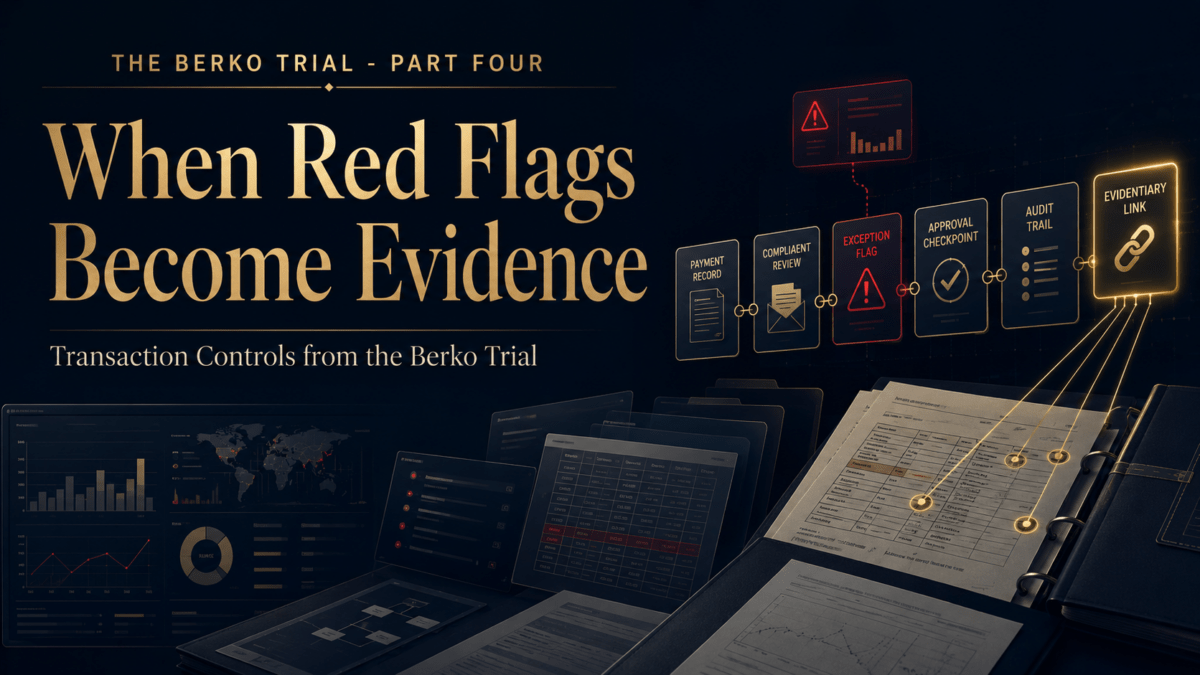
Today in Part 4, I want to focus on some of the compliance lessons from the Asante Berko FCPA trial. The compliance lesson from the Berko trial is not simply that employees should not pay bribes. Every code of conduct already says that. The harder question is whether the compliance program can interrupt the operating pattern: a politically connected intermediary, milestone-linked invoices, personal email, cash discussions, incomplete diligence answers, and a commercial team under pressure to close. These were some of the questions that Goldman Sachs faced and successfully answered.
That is where policy becomes performance. Trial reporting described a legitimate infrastructure project surrounded by evidence that prosecutors said showed corrupt intent and concealment. The same emails, diligence questions, payment records, and escalation decisions that once lived inside a transaction later became evidence before a jury. For compliance professionals, the case is a control map. It shows where a high-risk deal can be tested, paused, corrected, or stopped before red flags mature into criminal exposure.
Begin With the Business Model
Your business justification should begin with how the deal is expected to work, not with a standard questionnaire. In the Berko transaction, commercial urgency, a major public need, concentrated government discretion, substantial projected fees, and local intermediaries all increased the risk profile. None of those facts establishes bribery. Together, however, they demand a more disciplined control environment.
The deal team should be required to explain the legitimate path to success. Which officials control each approval? Which regulatory, legislative, and contractual milestones must occur? What service does every intermediary perform? How is that service connected to value rather than access? Where could commercial pressure tempt someone to bypass the process?
This is consistent with the DOJ Evaluation of Corporate Compliance Programs (ECCP), which asks whether a company understands its business from a commercial perspective and devotes appropriate attention and resources to high-risk transactions. A generic country score is not enough. The risk assessment must reflect the transaction’s economics, approval structure, counterparties, compensation model, technology, and pressure points.
Make Third-Party Diligence Operational
Third-party diligence often fails because it is treated as an onboarding event. The questionnaire is completed, screening is run, a risk rating is assigned, and the business moves on. High-risk public-sector work requires continuous control.
Before engagement, the company should document the business rationale, beneficial ownership, politically exposed person and family links, qualifications, reputation, service scope, deliverables, compensation, payment terms, and proposed bank account. Compensation should be benchmarked against the actual work. Enhanced review should apply when fees are success-based, tied to government milestones, disproportionate to services, routed through unrelated entities or individuals, or connected to officials who control approvals.
After onboarding, controls must follow the intermediary into contracting, invoicing, payment, and monitoring. The DOJ guidance asks whether the company understands the business rationale, confirms that services were actually performed, assesses whether compensation is appropriate, tracks red flags, uses audit rights, and manages third parties throughout the relationship. The relevant question is not whether the intermediary passed diligence once. It is whether the relationship still makes sense when the invoice arrives.
Control the Channels Where Business Occurs
Personal email is not proof of bribery. The Berko facts were more specific. According to the trial reporting, sensitive payment discussions occurred through personal accounts. At the same time, routine deal work proceeded through corporate systems, and one exchange referred to the monitoring of a Goldman account. The control issue was the combination of channel separation, sensitive content, and knowledge of monitoring.
Companies need clear rules for personal email, messaging applications, approved mobile platforms, and bring-your-own-device arrangements. Those rules require technical support: approved-channel design, retention settings, monitoring consistent with law, exception approval, employee attestations, and escalation when business moves outside the system. The program should also test whether records can actually be collected and preserved across the jurisdictions where the company operates.
The ECCP asks how companies manage and preserve business communications on personal devices and messaging platforms. The DOJ Corporate Enforcement and Voluntary Self-Disclosure Policy (VSD) likewise identifies appropriate controls over personal and ephemeral communications as part of timely remediation. A policy that cannot preserve the evidence it covers is not an effective control.
Give Compliance Real Stop Authority
Escalation is not effective if compliance can ask questions but cannot pause the transaction. High-risk deals need defined hard stops. Examples include incomplete beneficial ownership, inconsistent diligence answers, refusal to identify service providers, unexplained compensation, undisclosed PEP relationships, requests for cash, payments to personal or nominee accounts, and destination changes without a credible business reason.
A hard stop does not require the company to abandon every transaction containing a red flag. It requires the risk to be resolved before money or value moves. The control framework should identify who may impose a pause, who may clear it, whether any override is permitted, what evidence supports an override, and which risk decisions require senior escalation.
Trial testimony reportedly described months of compliance questions about the Ghanaian intermediary and inconsistent or incomplete answers, followed by Goldman’s withdrawal from the contemplated financing. That sequence should not be converted into a claim that every control operated early enough or that the company was legally exonerated. The more useful lesson is that the decision trail mattered. It documented the questions, the resistance, the escalation, and the exit.
Connect Diligence, Invoices, and Money
Many programs distribute the relevant facts across separate systems. Procurement sees the contract. Compliance sees the screening. Accounts payable sees the invoice. Treasury sees the destination account. Investigations see the allegation. No one sees the complete pattern.
Payment controls should require proof of service, account-name matching, country and entity consistency, independent approval for destination changes, and tight restrictions on cash. Analytics should flag round-dollar invoices, duplicate invoice numbers, payment splitting, milestone-timed consulting fees, payments to employees or related parties, high-risk correspondent routes, and transfers followed by cash withdrawals.
The decisive step is integration. Due diligence, PEP screening, contracting, procurement, accounts payable, treasury, and case-management data should be capable of producing a transaction-level view. That view allows compliance to ask whether a payment is not only properly approved but also commercially credible.
Build an Evidence-Grade Record
The defense’s most forceful theme was the missing last mile: no downstream bank record showing money reaching a Ghanaian official, no alleged recipient on the witness stand, and no eyewitness to a bribe. The jury nevertheless convicted Berko on all three charged counts. For an internal investigation, the lesson cuts both ways. Suspicion is not proof, but weak tracing can leave the company unable to determine what happened.
Preserve native emails, attachments, metadata, messaging exports, payment records, approval histories, translations, and custodial provenance—record who made each factual determination and what evidence supported it. For multilingual material, preserve the original, use qualified translators, document dialect and ambiguity, and maintain a process for reviewing disputed language. Financial tracing should move from payer to intermediary to ultimate recipient, including related-party accounts and cash conversion.
The current FCPA enforcement guidelines emphasize individual misconduct and caution against attributing nonspecific malfeasance to corporate structures. That makes an evidence-grade corporate record especially important. It can help separate an individual’s conduct from the organization’s response while also showing whether the program was designed and implemented effectively.
Test the Controls Before the Crisis
An effective program does not promise that no misconduct will ever occur. DOJ recognizes that even a strong program may fail to prevent an offense. The question is whether the program is risk-based, detects concerns, responds promptly, and improves from experience.
Replay a recent public-sector transaction against the Berko pattern. Could the company identify every approval-controlling official and intermediary? Would milestone-linked payments trigger review? Could compliance pause the deal? Would personal email activity be detected and preserved? Could investigators trace funds beyond the first intermediary? Measure time from red flag to pause, overdue enhanced diligence, unresolved PEP issues, payment exceptions, control overrides, and closure of remediation.
The practical takeaways are clear. Commercial urgency calls for greater discipline, not reduced scrutiny. Third-party diligence must remain connected to invoices, payments, monitoring, and escalation. Off-channel communications become an intent and preservation issue when combined with sensitive content and known monitoring. A deal exit matters, but an earlier hard stop may reduce exposure and preserve more business value.
Join us tomorrow as we conclude our 5-part series by moving the transaction to the enterprise. In it, we will explore such questions as who owns these controls, who funds and tests them, how accountability is imposed, and what your Board of Directors should demand as evidence that the program works in practice.
Resources:
Stewart Bishop, “Goldman Jury Sees Cash Talk in Energy Deal Email Deluge,” Law360, Aug. 1, 2026; Stewart Bishop, “Goldman Exec Was Linchpin to Ghana Bribery Ploy, Jury Told,” Law360, Aug. 5, 2026.
Stewart Bishop, “Ex-Goldman Exec Convicted of Ghana Bribery Plot,” Law360, Aug. 6, 2026. Supplied trial reporting.
U.S. Attorney’s Office for the Eastern District of New York, “Former Goldman Sachs Investment Banker Convicted of Foreign Bribery and Money Laundering,” Aug. 6, 2026, DOJ Press Release.
Stewart Bishop, “Goldman Jury Sees Undercover Video as Bribe Trial Nears End,” Law360, Aug. 4, 2026—supplied trial reporting.
Stewart Bishop, “Shady Power Deal Used in Goldman Compliance Prep, Jury Told,” Law360, July 29, 2026
Stewart Bishop, “Like Milli Vanilli, Goldman FCPA Case Is a Ruse, Jury Told,” Law360, July 28, 2026.
SEC Final Judgment against Asante Berko
SEC Complaint against Asante Berko