Categories
Word of the Week

Word of the Week with Kenneth O’Neal – Understanding Resilience

Each week, Kenneth O’Neal discusses a word that describes a principle or value of the Qualities of Success. We suggest that you incorporate the Word of the Week into your thoughts, deeds, and actions. You might currently possess the quality and desire to develop it to a higher level.  You could replace a bad habit with a good habit. Write an action step and use it daily to develop the Quality in your life. In this Word of the Week episode, Kenneth discusses the word – Resilience.

Rick and Kenneth discuss the concept of resilience. They explore the definition, importance, and historical background of resilience, emphasizing its role in overcoming adversity. Kenneth shares insights on how resilience relates to perseverance, faith, and strength. He provides actionable daily habits to cultivate resilience, including silent reflection, expressing gratitude, mindful consumption, physical exercise, affirmations, and service to others. The conversation also addresses the challenges presented by modern technology and social disruptions, and how resilience can help individuals and communities navigate these turbulent times.

Highlights:

  • Word of the Week: Resilience
  • Historical Context and Importance of Resilience
  • Daily Habits for Building Resilience

Resources:

KRONEAL Consulting

Categories
Daily Compliance News

Daily Compliance News: October 7, 2025, The Co-CEO Edition

Welcome to the Daily Compliance News. Each day, Tom Fox, the Voice of Compliance, brings you compliance-related stories to start your day. Sit back, enjoy a cup of morning coffee, and listen in to the Daily Compliance News. All, from the Compliance Podcast Network. Each day, we consider four stories from the business world, including compliance, ethics, risk management, leadership, or general interest, relevant to the compliance professional.

Top stories include:

  • Co-CEOs are becoming more common. (NYT)
  • EY’s auditing cleanup. (WSJ)
  • Halkbank faces criminal charges. (FT)
  • The Trump administration made illegal criminal referrals of its foes. (Reuters)
Categories
Upping Your Game

Upping Your Game: Episode 9 – Leveraging Chatbots for Enhanced Compliance Efficiency

In February, the Trump Administration suspended investigations under and enforcement of the FCPA. Many compliance professionals have since wondered what this will mean for corporate compliance programs going forward. Hui Chen challenged compliance professionals with the statement, “It’s time to up your game.”

This podcast series, sponsored by Ethico and co-hosted with Ethico co-CEO Nick Gallo, hopes to meet Hui Chen’s challenge. We will discuss how compliance professionals can ‘Up Their Game’ by utilizing currently existing Generative AI (GenAI) tools to significantly improve their compliance programs. As compliance professionals, it is critical to recognize that this moment is not merely about incremental improvements but about elevating our profession to an entirely new level of effectiveness, efficiency, and organizational value.

In this episode, Tom and Nick discuss the rising use of chatbots in corporate compliance programs. They explore how chatbots can serve as a powerful tool for addressing policies, procedures, and FAQs, thereby increasing efficiency and reducing the burden on compliance departments. The conversation explores the benefits of chatbots, including improved data collection, enhanced consistency, and democratized access to information. They also discuss practical strategies for implementing chatbots, including focusing on specific use cases, maintaining human oversight, rigorous testing, and continuous improvement. Real-world examples from both large corporations and smaller entities illustrate the practical applications and significant advantages of adopting chatbot technology in compliance operations.

Key highlights:

  • Implementing Chatbots for Internal Use
  • Benefits and Challenges of Chatbots
  • Building Effective Chatbots
  • Meeting Employees Where They Are
  • Ethico’s Approach to Chatbots

Resources:

Upping Your Game-How Compliance and Risk Management Move to 2030 and Beyond on Amazon.com

Nick Gallo on LinkedIn

Ethico

Tom Fox

Instagram

Facebook

YouTube

Categories
Compliance Tip of the Day

Compliance Tip of the Day – Compliance Lessons from Shell

Welcome to “Compliance Tip of the Day,” the podcast that brings you daily insights and practical advice on navigating the ever-evolving landscape of compliance and regulatory requirements. Whether you’re a seasoned compliance professional or just starting your journey, our goal is to provide you with bite-sized, actionable tips to help you stay ahead in your compliance efforts. Join us as we explore the latest industry trends, share best practices, and demystify complex compliance issues to keep your organization on the right side of the law. Tune in daily for your dose of compliance wisdom, and let’s make compliance a little less daunting, one tip at a time.

This week, we begin a look at how companies are using AI in their business operations and draw compliance lessons from this use for compliance professionals. Today, we continue with lessons from Shell Oil Company.

For more information on this topic, refer to The Compliance Handbook: A Guide to Operationalizing Your Compliance Program, 6th edition, recently released by LexisNexis. It is available here.

Categories
AI Today in 5

AI Today in 5: October 7, 2025, The AI for HR Edition

Welcome to AI Today in 5, the newest edition to the Compliance Podcast Network. Each day, Tom Fox will bring you 5 stories about AI, so start your day, sit back, enjoy a cup of morning coffee, and listen in to the AI Today In 5, all from the Compliance Podcast Network. Each day, we consider four stories from the business world, compliance, ethics, risk management, leadership, or general interest related to AI.

Top AI stories include:

  • AI rules for HR across the country. (SHRM)
  • AI in global packaging compliance? (Recycling Today)
  • OpenAI is now partnering with AMD to make and use chips. (WSJ)
  • Anthropic and Deloitte to partner on AI solution for regulated industries. (PYMNTS)
  • Deloitte has to repay Australia for using AI in a report. (ColombiaOne)

For more information on the use of AI in Compliance programs, my new book, Upping Your Game. You can purchase a copy of the book on Amazon.com.

Categories
Innovation in Compliance

Innovation in Compliance: Mastering Compliance Branding on LinkedIn: Insights from Carol Kaemmerer

Innovation comes in many areas, and compliance professionals need to be ready for it and embrace it. Join Tom Fox, the Voice of Compliance, as he visits with top innovative minds, thinkers, and creators in the award-winning Innovation in Compliance podcast. In this episode, Tom Fox is joined by returning guest Carol Kaemmerer, author of ‘LinkedIn for the Savvy Executive.’

Carol shares valuable insights on how compliance professionals can leverage LinkedIn to build their personal brand and gain credibility with senior management. She introduces her Brilliance Framework, which includes strategies such as leading with authenticity, utilizing the rule of three for memorable branding, maximizing digital real estate, and emphasizing the importance of engagement. Tune in to enhance your LinkedIn strategy and make a lasting impression in your career.

Key highlights:

  • Building a Compliance Professional’s Brand
  • Reframing Compliance Communication
  • Introducing the LinkedIn Brilliance Framework
  • Maximizing LinkedIn’s Digital Real Estate
  • The Importance of Visuals on LinkedIn
  • Engagement: The Gold of LinkedIn

Resources:

Carol Kaemmerer on LinkedIn

Carol Kaemmerer Website

LinkedIn for the Savvy Executive Second Edition

The LinkedIn Brilliance Framework™: Amplify Your Professional Presence

Tom Fox

Instagram

Facebook

YouTube

Twitter

LinkedIn

Categories
Blog

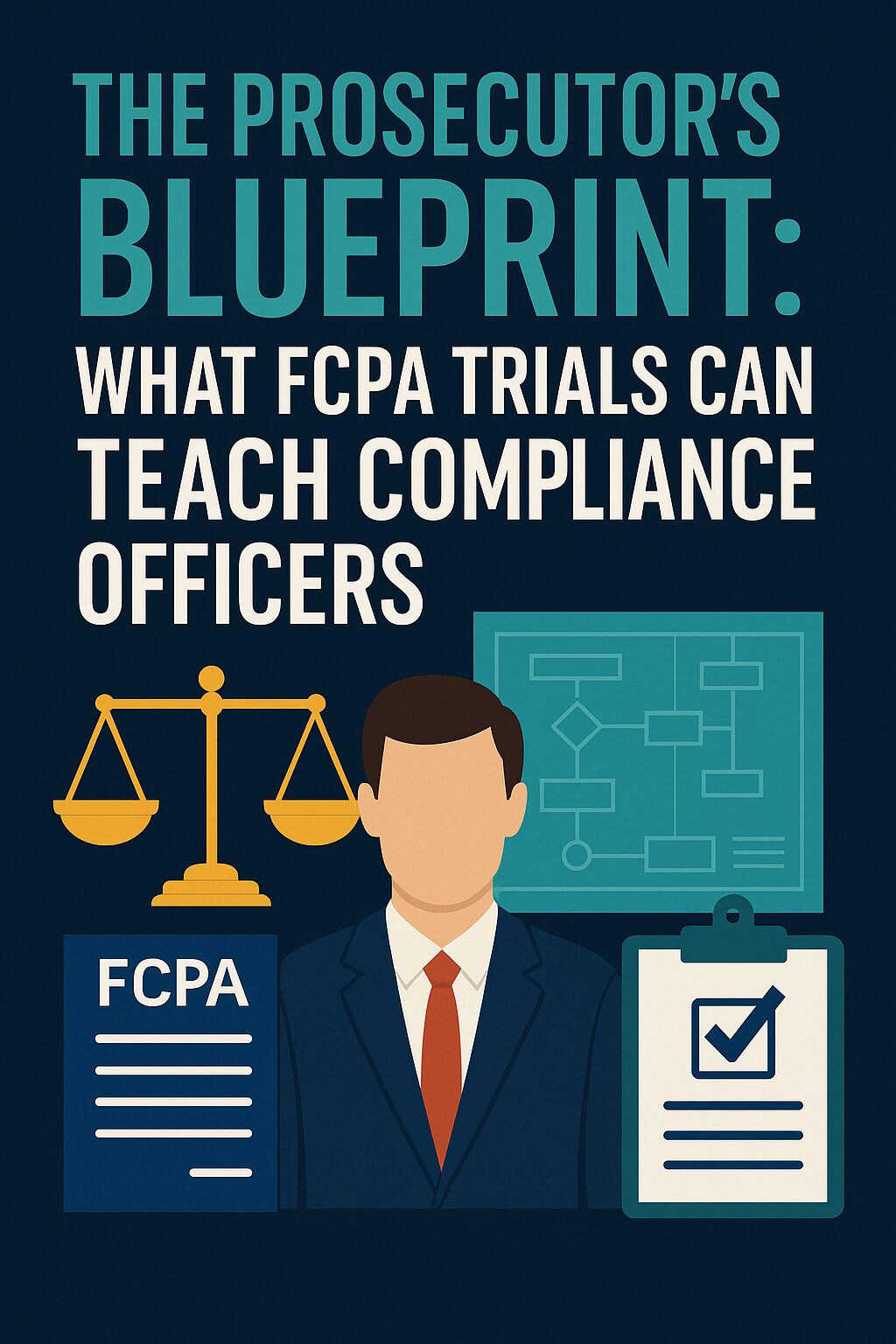
The Prosecutor’s Blueprint: What FCPA Trials Can Teach Compliance Officers

The U.S. Department of Justice (DOJ) has long recognized that trying Foreign Corrupt Practices Act (FCPA) cases before juries can be a challenging endeavor. Unlike fraud schemes that hit close to home, such as Medicare fraud, securities fraud, or insider trading, origin bribery can feel distant, abstract, and even irrelevant to the average juror. Yet in 2024, the DOJ secured three high-profile FCPA trial convictions, each time leaning heavily on four central themes that resonate deeply with juries: local impact, abuse of power, financial motive, and concealment. James Koukios recently looked at these cases in a Law360 article titled “Expect DOJ To Repeat 4 Themes From 2024’s FCPA Trials.” His article is highly instructive for compliance professionals.

For compliance professionals, these prosecutorial themes are more than courtroom rhetoric. They provide a roadmap of how the DOJ will frame corruption and why companies must align their compliance strategies to both mitigate risk and reinforce ethical culture. As we head into another round of trials in 2025 and 2026, including U.S. v. ZaglinU.S. v. Bautista, and U.S. v. Hobson, compliance officers should expect the DOJ to repeat these themes. More importantly, they should recognize the lessons embedded in them.

Local Impact: Bringing Foreign Bribery Home

One of the DOJ’s perennial challenges is convincing jurors that foreign bribery matters in their own communities. In the Polit trial, prosecutors hammered home the point with the refrain: “Here in Miami.” Over and over again, jurors were reminded that more than $10 million in bribe money was not just siphoned off in Ecuador; it was laundered into Miami real estate deals and commercial properties.

The Aguilar trial leaned on a similar approach in Brooklyn. While the bribery schemes involved Ecuador and Mexico, prosecutors pointed out that the contracts were negotiated “by lawyers right here in New York” and that some of the incriminating recordings were made “right here in Brooklyn.” Even in Oztemel, where the links were weaker, the government still stressed connections to Connecticut-based companies.

For compliance professionals, this theme underscores the importance of localizing the impact of compliance risk. Anti-bribery isn’t just about preventing corruption “out there” in some far-off jurisdiction. It’s about controlling the flow of illicit funds into our banks, real estate markets, and financial systems. It’s about recognizing that corruption abroad has ripple effects at home.

Compliance takeaway: In training and communications, draw a clear connection between global corruption and its local consequences. Employees must understand that misconduct overseas can lead to reputational harm, regulatory exposure, and even economic implications in the communities where they live and work.

Abuse of Power: Betrayal of Public Trust

The second theme, abuse of power, may be the DOJ’s most powerful narrative device. Jurors instinctively recoil at the idea of officials betraying their duty for personal gain. In Polit, prosecutors emphasized that as Ecuador’s comptroller general, the defendant was responsible for ensuring government funds were used correctly. Instead, he monetized his office, lifting fines and manipulating audits in exchange for bribes.

Similarly, Aguilar was portrayed as inducing officials who “held positions of influence and public trust” to sell that trust in return for contracts. In Oztemel, the DOJ framed the case as Petrobras officials betraying their fiduciary duties to Brazil by steering deals outside competitive bidding.

This framing does more than persuade jurors; it dovetails neatly with the statutory elements of the FCPA, which requires proof that defendants induced foreign officials to misuse their authority. By showing jurors that bribery equals betrayal, prosecutors tap into a deep well of civic values.

Compliance takeaway: Abuse of power is not just a courtroom theme; it is a significant corporate compliance risk: train leaders, managers, and employees on how the misuse of authority erodes trust. Ensure your compliance program monitors for conflicts of interest, undue influence, and improper discretionary decisions. And remind employees that even the perception of selling influence can damage both individual careers and the organization’s reputation.

Financial Motive: Greed as Intent

Greed is a straightforward concept for juries to understand. It is also one of the DOJ’s preferred tools for establishing criminal intent. In the Polit case, prosecutors highlighted the defendant’s Coral Gables mansion and Coral Way office building as tangible evidence of bribe proceeds. In Aguilar, they emphasized that when Vitol made money, it was because Vitol made money. His salary, bonuses, and equity increased significantly as the scheme expanded, with his stake rising from $6.2 million to $75.5 million.

In Oztemel, jurors were told that his compensation was directly tied to closing deals with Petrobras, deals secured through bribes. The message was clear: these weren’t noble businesspeople operating in gray areas; they were greedy actors lining their own pockets at the expense of others.

Compliance takeaway: Incentives matter. If your compensation structure encourages employees to “win at all costs,” you’re creating fertile ground for misconduct. Compliance professionals should partner with HR and leadership to ensure that performance metrics and reward systems don’t encourage employees to make unethical choices. Align financial incentives with compliance values, reward transparency, ethical decision-making, and adherence to policy, not just revenue and deal volume.

Concealment: Proof of Guilt

The fourth theme is concealment. The DOJ doesn’t just show jurors the bribes; it shows them the elaborate measures defendants took to hide them. These concealment tactics serve as both evidence of guilt and reinforcement of money laundering charges.

In Polit, prosecutors mapped the circuitous route of the bribe funds through Panama shell companies, loan agreements, and ultimately to Miami real estate. They showcased fake invoices and nominee ownership structures as evidence of deliberate deception. In Aguilar, they exposed “007” alias email accounts, sham consulting contracts, and layered transfers. In Oztemel, prosecutors emphasized fake consulting agreements, intermediaries, and disguised bank transfers.

The DOJ’s message: honest people do not create sham entities, falsify invoices, or route payments through multiple jurisdictions. Concealment equals consciousness of guilt.

Compliance takeaway: Transparency is your best defense. Encourage employees to document decisions, keep accurate records, and avoid the appearance of concealment. Utilize technology to monitor transactions for potential red flags, such as payments routed through unnecessary intermediaries or suspiciously complex transfers. When your systems detect unusual patterns, treat them as opportunities for early intervention.

Why These Themes Matter for Compliance

Taken together, Koukios explained that the DOJ’s four trial themes provide a simple but powerful compliance roadmap. Each theme cuts through the complexity of international finance and corporate structures to tell a story jurors can understand and compliance professionals can apply.

  • Local impact reminds us to connect global risk to local consequences.
  • Abuse of power highlights the dangers of unchecked authority.
  • Financial motive underscores the need for ethical incentives.
  • Concealment warns against opacity and poor record-keeping.

As prosecutors prepare for upcoming trials, ZaglinBautista, and Hobson can be expected to revisit these themes. And as compliance professionals, we should expect regulators to measure our programs by how well we anticipate and address these very risks.

Conclusion: Preparing for What’s Next

The DOJ’s FCPA trial playbook is no secret. Prosecutors know what resonates with jurors, and they’ll continue to use those narratives until they stop working. The real question is whether companies are learning the same lessons. Compliance officers have an opportunity to get ahead of the curve by internalizing these themes. Train employees on the local consequences of bribery and corruption. Build a culture that rejects the abuse of authority. Align incentives with ethics. And create systems that promote transparency over concealment.

By doing so, you not only prepare for the possibility of DOJ scrutiny but also build a compliance program that protects your organization, strengthens its culture, and reinforces trust with stakeholders. That is the true lesson of the DOJ’s four FCPA trial themes: corruption may be global, but its impact, its motives, and its cover-ups are universal. And compliance professionals are on the front lines of preventing them.


Categories
Red Flags Rising

Red Flags Rising: S01 E29: Affiliates Rule Aftermath – Finding the Right Path Forward

Mike and Brent take an even deeper dive into the “Affiliates” or “50%” Rule announced by the Bureau of Industry & Security (BIS) on September 29, 2025. They identify several misperceptions in the public discussion, explain why they are misperceptions, and identify the pitfalls of operating under those misperceptions—especially in response to inquiries by BIS about pre-rule due diligence on affiliates of entities on the entity list. Specifically, they discuss why the Affiliates Rule is a close cousin to the Office of Foreign Assets Control’s own 50% rule, but why and how BIS’s Affiliates Rule serves different national security objectives and operates a bit differently (02:42); whether the Affiliates Rule brings new compliance burdens and, if so, risk-based due diligence strategies and likely questions from BIS regarding why (10:26); why in the current geopolitical context the benefit of local, boots-on-the-ground compliance might be overstated—or significantly discounted by the U.S. government—and what to do about it (16:18); why it would be a mistake to think that BIS is not today able to bring enforcement actions based on the Affiliate Rule, especially given their ability to bring enforcement actions on the “full” definition of knowledge to include “an awareness of a high probability” (19:26); and why it is dangerous to think of “knowledge” as only “actual knowledge,” and thereby misperceiving that the new Affiliates Rule—by reminding everyone that the catch-all provision under which the Entity List is promulgated is a strict-liability regulation, even as to awareness—has someone taken away a previously available “absence of actual knowledge” defense (23:00).

Mike and Brent then offer practical tips for applying for the license available under the Affiliates Rule for situations where the exporter, reexporter, or transferor is aware of “red flags” as to ownership that it cannot resolve through risk-based due diligence (28:20).

Mike and Brent then conclude with a special edition of Brent Carlson’s “Managing Up,” in which Brent offers some valuable self-reflection (34:58).

Resources:

More about Brent: www.redflagsrising.com

Contact Brent: brent@redflagsrising.com

Mike: https://www.linkedin.com/in/mhuneke/https://www.morganlewis.com/bios/michaelhuneke

Contact Mike: michael.huneke@morganlewis.com

BIS’s “Export Control Decision Tree”