Welcome to the Daily Compliance News. Each day, Tom Fox, the Voice of Compliance, brings you compliance-related stories to start your day. Sit back, enjoy a cup of morning coffee, and listen in to the Daily Compliance News. All, from the Compliance Podcast Network. Each day, we consider four stories from the business world, compliance, ethics, risk management, leadership, or general interest for the compliance professional.
Top stories include:
SEC wants to reduce the salaries of PCAOB Board members. (WSJ)
San Mateo County Sheriff removed for corruption. (Police1)
Welcome to a special production of the Hill Country Podcast, which is a 12-part series collaboration with the communicators of tomorrow from right here in the Texas Hill Country. The Hill Country Podcast and the Texas Hill Country Podcast Network have partnered with the talented students from Dr. Adolfo Mora’s Communications class at Schreiner University to turn the microphone over to them. Join us each episode as these fresh voices explore critical topics, challenge modern ideas, and provide their unique perspectives on the world of communication.
In this first episode, Carter, Connor, and Nathan discuss how music intensifies the viewer’s experience of different film genres such as drama, romance, and comedy. They explore various aspects such as the psychological effects of instruments, the use of light motifs, and the role music plays in animated and CGI films. The conversation delves into how music enhances storytelling, connects the audience emotionally, and influences cultural perceptions. The hosts provide examples from iconic movies like Star Wars, Toy Story, and the Fast and Furious series, examining how different musical themes contribute to the films’ popularity and impact.
Welcome to “Compliance Tip of the Day,” the podcast where we bring you daily insights and practical advice on navigating the ever-evolving landscape of compliance and regulatory requirements. Whether you’re a seasoned compliance professional or just starting your journey, we aim to provide you with bite-sized, actionable tips to help you stay on top of your compliance game. Join us as we explore the latest industry trends, share best practices, and demystify complex compliance issues to keep your organization on the right side of the law. Tune in daily for your dose of compliance wisdom, and let’s make compliance a little less daunting, one tip at a time.
This week, we consider issues around internal controls in a best practices compliance program. Today, we consider how you can leverage AI to enhance your AI control framework.
For more on this topic, check out The Compliance Handbook: A Guide to Operationalizing Your Compliance Program, 6th edition, which LexisNexis recently released. It is available here.
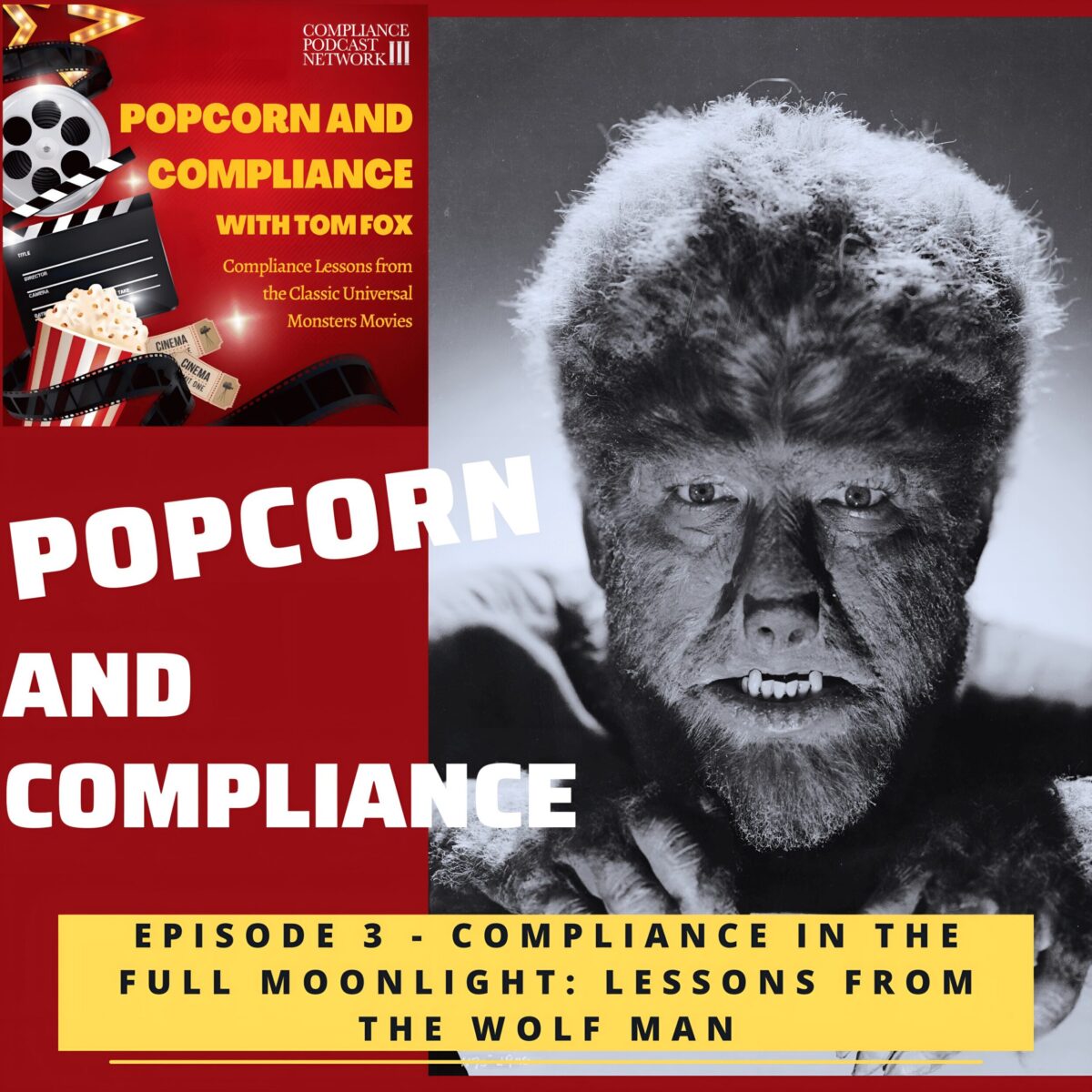
Welcome to a special series of Popcorn and Compliance. In this series, we will be looking at the Classic Universal Monster Movies from the 30s and 40s and mining them for compliance lessons. (Yes, it really is an excuse to rewatch them all.) In this series, we will look at Frankenstein, Dracula, The Wolf Man, The Mummy, and end with The Invisible Man. In this episode, Tom explores critical compliance insights drawn from Lon Chaney Jr.’s portrayal of The Wolf Man.
In this episode, we take a deep dive into my favorite Classic Universal Monster, The Wolf Man, to unpack five critical lessons, including the danger of ignoring warnings, the importance of timely intervention, and the challenges of recognizing risks in ordinary people under extraordinary circumstances. Listeners are encouraged to consider how these timeless themes apply to modern corporate compliance, emphasizing proactive measures to prevent potential catastrophes. Join Tom, along with AI hosts Fiona and Timothy, for a surprisingly relevant exploration of compliance through the eerie lens of Hollywood’s iconic monster movies.
Key highlights:
The Relevance of the Wolf Man to Modern Compliance
Lesson 1: Ordinary People Can Become Compliance Risks
Lesson 2: Warnings Ignored Become Disasters Realized
Lesson 3: The Curse of Silence and Stigma
Lesson 4: Risk is Cyclical and Predictable
Lesson 5: Tragedy Comes from a Lack of Intervention
Welcome to AI Today in 5, the newest edition to the Compliance Podcast Network. Each day, Tom Fox will bring you 5 stories about AI, so start your day, sit back, enjoy a cup of morning coffee, and listen in to the AI Today In 5, all from the Compliance Podcast Network. Each day, we consider four stories from the business world, compliance, ethics, risk management, leadership, or general interest related to AI.
Top AI stories include:
AI data centers are building their own power grids. (WSJ)
For more information on the use of AI in Compliance programs, my new book, Upping Your Game, is available. You can purchase a copy of the book on Amazon.com
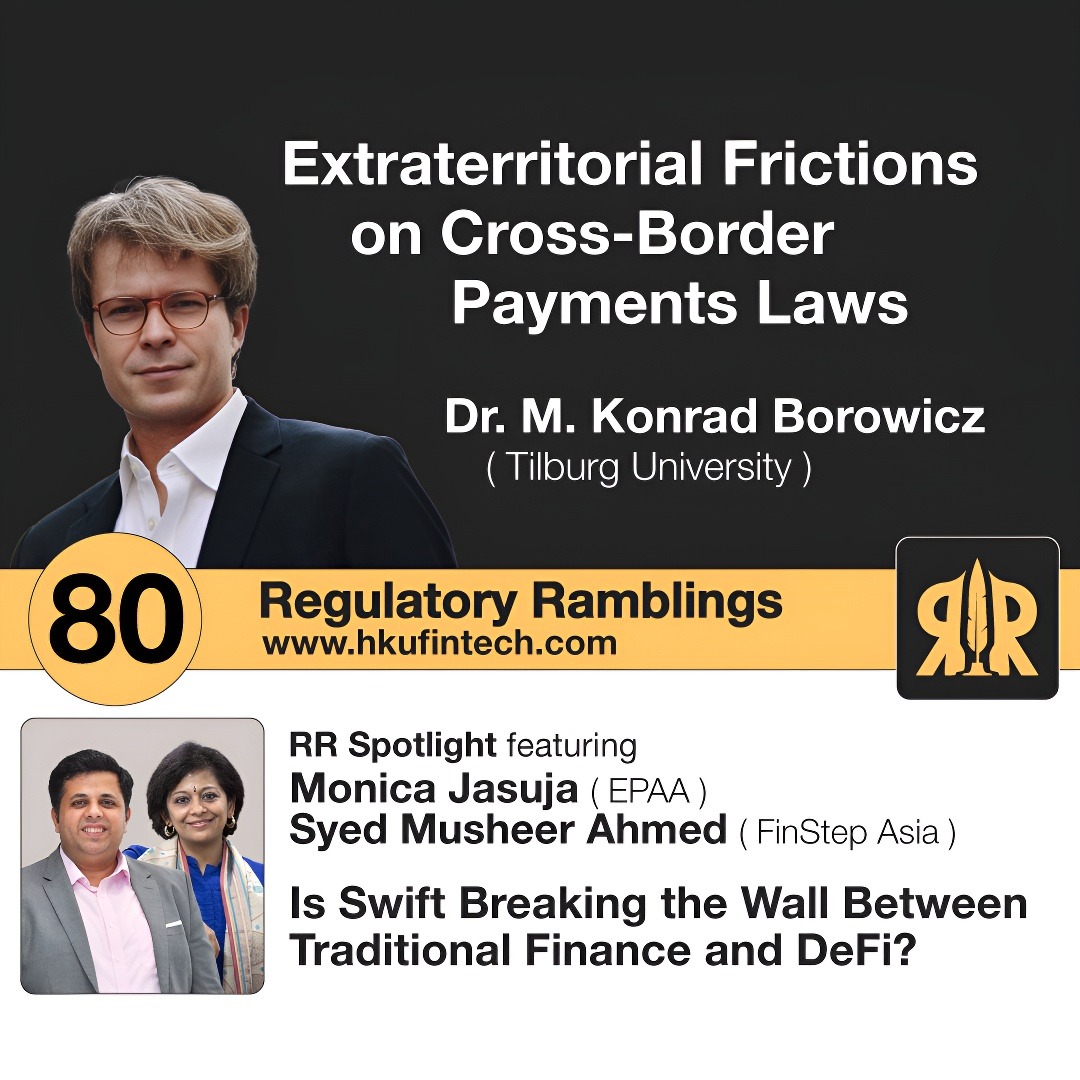
Today’s podcast commences with a brief discussion with Syed Musheer Ahmed of FinStep Asia and Monica Jasuja of the Emerging Payments Association on a recent LinkedIn post1 of Musheer’s stating that the lines between traditional finance and decentralized finance, or DeFi, have not just blurred but have merged thanks to SWIFT’s announcement at its annual conference in late-September that it will add a Blockchain based ledger to its infrastructure stack to hasten and scale the benefits of across over 200 countries and territories worldwide.
Following that, we chat with finance and technology lawyer M. Konrad Borowicz, an assistant professor at Tilburg Institute for Law, Technology and Society in the Netherlands, about a paper he recently presented entitled “Extraterritorial Frictions in the Law of Cross-Border Payments”2 at the European Central Bank’s Legal Research Program seminar in Frankfurt.
Syed Musheer Ahmed has over 18 years of extensive experience as an ecosystem builder in the realms of capital markets, fintech, and virtual assets. This includes a decade as a global markets trader before he came to Hong Kong to attain his MBA from the University of Hong Kong and London Business School’s joint program.
Since 2016, Musheer has contributed extensively to building the region’s fintech and virtual assets ecosystem, particularly as the co-founder, concurrent board member, and inaugural general manager of the Fintech Association of Hong Kong.
For almost five years, he has been the managing director of FinStep Asia, a firm that he founded. In the interim, from October 2022 until January 2024, he served as a financial markets risk assurance lead with the Virtual Assets Regulatory Authority in Dubai.
Monica Jasuja is the chief expansion & innovation officer of the Emerging Payments Association Asia, and is the advisory board chair of the India-based Fintech Fusion. She is a veteran digital business executive with over two decades of global experience in strategizing, defining, leading, building, and deploying commercially viable innovative software products and solutions, primarily in financial services.
She has a passion for solving consumer problems in the areas of digital payments and consumer products. She says that continuously learning to help businesses grow and disrupt is “both my strength and a key driver.”
Monica is also an accomplished product leader, having managed multi-year strategic initiatives across the fields of design, development, deployment, and go-to-market (primarily for the financial services sector). She has ample international exposure in markets such as the US, Singapore, Taiwan, and India.
Since 2017, she has spearheaded a new vertical for large digital players and emerging fintech initiatives across sales, business development, product, and other cross-functional areas (legal, marketing, and policy) to create new revenue and expansion opportunities for payment rails across India.
M. Konrad Borowicz is a finance and technology lawyer whose research focuses on the regulation of credit, payments, and open data. Currently, he is an assistant professor at Tilburg Institute for Law, Technology and Society in the Netherlands, and a research coordinator at the Tilburg Law and Economics Center.
He has held visiting research and teaching positions at HKU, FGV São Paulo in Brazil, and Nova University in Lisbon, Portugal. Konrad’s work has appeared in the Journal of Financial Regulation, Capital Markets Law Journal, and the New York University Journal of Law and Business, among other publications. He is currently developing a book on EU Payments Law and Regulation, together with Emanuel van Praag, for Oxford University Press. Before coming to academia, Konrad was a finance lawyer at Ropes & Gray in London.
Discussion:
Why does the Swift organization’s action matter? The Swift network is used by over 11,500 financial institutions in more than 220 countries, making it the backbone of international finance. Essentially, every corner of the world: “It facilitates the transfer of value between banks globally underpinned by its messaging service, and roughly every three days, the world’s GDP passes over their network.”
Suppose a bank or financial institution already has SWIFT rails. In that case, they are likely to continue to leverage this TradFi institution – usually owned and run by the banks as a collective – to underpin their tokenized finance initiatives.”
Swift and a group of more than 30 financial institutions globally will develop a shared digital ledger, with the initial focus on real-time 24/7 cross-border payments. Specifically, Swift will work with Consensys (founded by the Cofounder of Ethereum) on a conceptual prototype of the ledger, which will leverage Swift’s unmatched resiliency, security, and scalability to facilitate transactions using any form of regulated tokenized value.
The initiative will see Swift partner up with Bank of America, Citigroup, NatWest, and others to develop a shared digital ledger for tokenized assets, including stablecoins.
It will combine straight-through processing and value+messaging capabilities on a single platform that every major bank uses.
The conversation starts with Musheer and Monica explaining why they believe the lines between TradFi and DeFi no longer hold the same significance. They also talk about the stablecoin implications of Swift building its own blockchain to enable transactions between banks worldwide, with HKU’s Regulatory Ramblings host Ajay Shamdasani.
Critics have dismissed correspondent banking as slow and outdated while praising stablecoins as faster and superior. But that narrative shifts the moment Swift brings blockchain into its rails, leading to improvement.
Separately, building on earlier pilots, Swift will also add the capability to support interoperability across existing and emerging systems for various use cases. “Developments are part of Swift’s strategy to power a best-in-class experience through innovation on parallel tracks – upgrading existing rails while creating future digital rails to maximize infrastructure choice for the industry.”
Monica and Musheer then share their thoughts on whether this can unlock interoperable tokenized bank deposits alongside other tokenized assets on SWIFT’s ledger. It is an open question as to whether the impact on global payments will be transformational or just a modification.
We then turn to Konrad to discuss his recently written paper. It is currently under review at Law and Geoeconomics and is closely related to the work done by HKU Law’s very own—and Regulatory Ramblings’ team leader—Prof. Douglas Arner—on the regionalization of payment systems.
Konrad’s paper discusses the extraterritorial frictions arising when policymakers seek to reconcile the payment systems of different countries. The main areas of friction are settlement finality, data protection, AML, and governance. In the paper, he proposes several institutional reforms aimed at reducing those frictions, namely – a model law on cross-border payment finality, narrowly tailored safe harbors for data sharing and an international payments forum under the auspices of august global bodies such as the Bank of International Settlements or the Financial Stability Board, though, as Ajay asks him: “Given that the BIS and FSB are legacy organizations that are slow to change, is that likely or prudent?”
The abstract to Konrad’s paper reads: “In 2020, the G20 placed cross-border payments at the top of the global financial agenda, spurring experiments to make transfers faster, cheaper, and more inclusive. Many build on instant or fast payment systems (FPS), yet linking infrastructures is as much a legal and geopolitical challenge as a technological one. When systems interconnect, they project domestic law across borders, generating extraterritorial frictions and giving rise to sovereignty concerns. This article compares three models of FPS interlinking—bilateral links, multilateral hubs, and direct access arrangements—showing how each produces frictions around settlement finality, AML/CFT and sanctions compliance, data protection, and governance. It then considers various policy proposals aimed at reducing these frictions, such as prefunding of accounts and the use of privacy-enhancing technologies. The analysis shows that technical fixes cannot resolve the structural frictions of cross-border payments, supporting the view that payment infrastructures embody sovereignty and that integration will likely proceed through regional blocs rather than a single global framework.”
He shares with Ajay why he chose to write his article now and what he thinks it adds to the existing literature on payments. Konrad elaborates on the three interlinking models of FPS — bilateral links, multilateral hubs, and direct access arrangements — delineated in his piece. He discusses how each produces frictions around settlement finality, AML/CFT and sanctions compliance, data protection, and governance.
Konrad acknowledges there are drawbacks to the multilateral model. That harmonization of law is often impeded because everyone must agree to the rules, which sometimes come up against rigid notions of sovereignty and regulatory ‘turf wars’ for some countries.
He concludes by saying that regional payment blocks will likely define the future, and how these different blocks interact will be key as regional payment infrastructures continue to improve.
“Regional payment blocks seem to be a way to circumvent sanctions, which are geopolitical weapons,” Konrad says. “That is why regional blocks will emerge, [because] people will disagree on what will be sanctioned. Ultimately, it is a political question, not a technical fix.”
Regulatory Ramblings podcasts is brought to you by The University of Hong Kong – Reg/Tech Lab, HKU-SCF Fintech Academy, Asia Global Institute, and HKU-edX Professional Certificate in Fintech, with support from the HKU Faculty of Law.
As many of my readers know, I am a huge fan of the Classic Universal Picture Movie Monsters, focusing on the period from 1931 to the mid-1950s. In October, I traditionally use our Halloween-ending month to explore the Classic Universal Movie Monsters, along with other films from the Hammer Studio, those produced by Val Lewton, and those starring Vincent Price. This year, I wanted to go back to basics by looking at the Classic Universal Movie Monsters, starting with Dracula and Frankenstein in 1931, followed by The Invisible Man in 1933, The Mummy in 1936, and ending with The WolfMan in 1940.
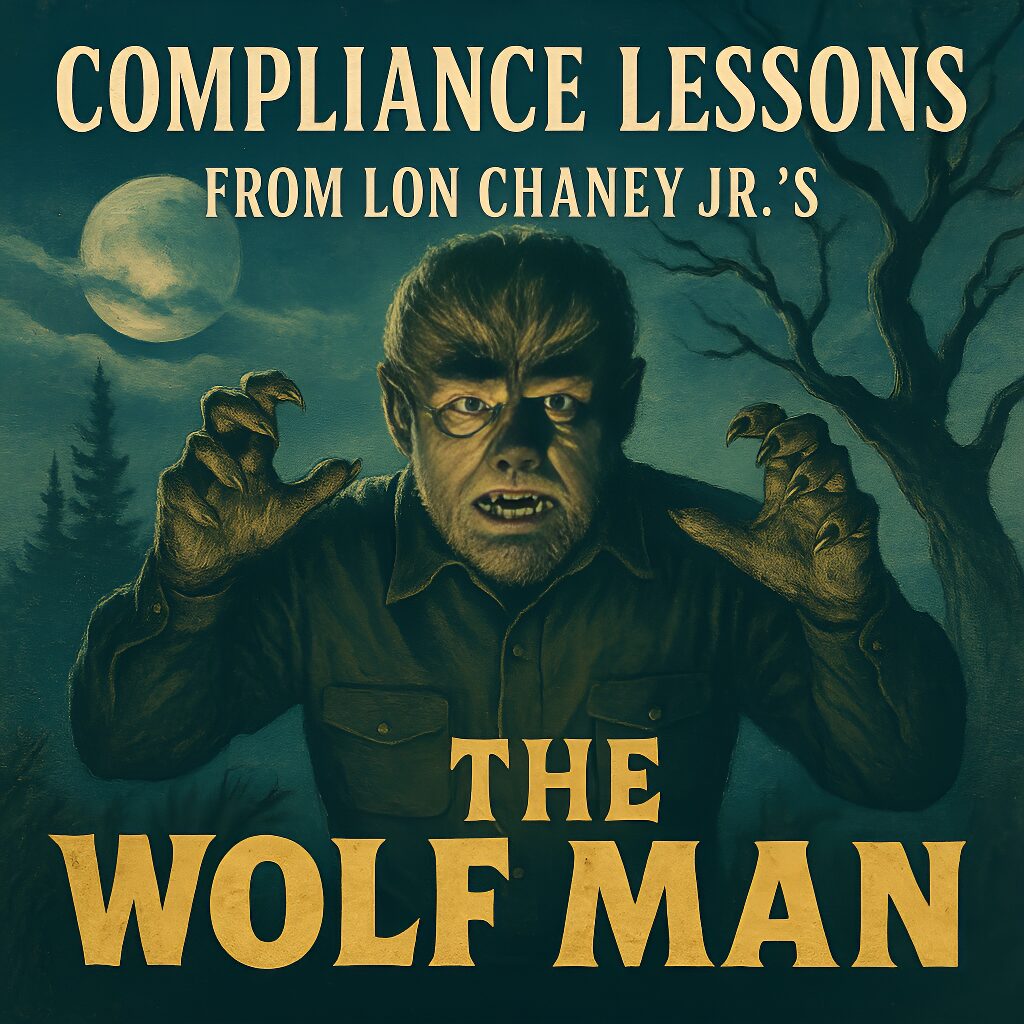
Over the five Fridays in October, I will examine each of these movies through the lens of compliance and extract compliance lessons from each one. Today, I continue with perhaps the most psychologically complicated of the top 5: the Classic Universal Movie Monster Lon Chaney Jr.’s version of The Wolf Man.If you want to take a deeper dive into this movie in the podcast format, check out the special series on Popcorn and Compliance, hosted by my friends Fiona and Timothy. These podcasts will be posted alongside the blog post each Friday during October.
When Lon Chaney Jr. first appeared on screen as Larry Talbot in The Wolf Man (1941), audiences were introduced to one of the most enduring monsters in cinema. Unlike Frankenstein’s creation or Lugosi’s Dracula, Chaney’s Wolf Man was not entirely “other.” He was human, a son returning home, trying to reconnect with family, and falling victim to forces beyond his control. His torment was that he transformed into a monster against his will, unable to control the destruction he unleashed.
For compliance professionals, The Wolf Man offers some striking lessons. Chaney’s performance shows how good people can end up in bad situations, how organizations ignore warning signs at their peril, and how systems must be designed not only to catch intentional wrongdoing but also to address risks that emerge when ordinary individuals are put under pressure.
We continue our exploration of Classic Universal Monster Movies by considering five compliance lessons from Lon Chaney Jr.’s The Wolf Man.
1. Ordinary People Can Become Compliance Risks
Larry Talbot begins as an essentially decent man. He returns to his family estate, reconciles with his father, and awkwardly woos the local shopkeeper’s daughter. There is nothing inherently villainous about him. But after being bitten, he becomes something he cannot control. By moonlight, he turns into the Wolf Man and wreaks havoc. This duality mirrors what compliance professionals often see. Not every compliance violation comes from a “bad actor.” Sometimes it comes from ordinary employees under extraordinary circumstances: pressure, opportunity, or rationalization (the famous “fraud triangle”). Even good employees can become risks if they are put in the wrong situation without proper safeguards.
Compliance takeaway: Programs must be designed to account for human weakness. Training should emphasize not only rules but also ethical decision-making. Monitoring should not assume intent but look for patterns of behavior that may indicate an employee is slipping into risk. Like Larry Talbot, sometimes risk comes from within.
2. Warnings Ignored Become Disasters Realized
Throughout the film, there are clear warnings. Locals whisper about werewolves. An old Romani woman (played by great character actor Maria Ouspenskaya) gives a direct warning: “Even a man who is pure in heart and says his prayers by night, may become a wolf when the wolfsbane blooms and the autumn moon is bright.” But these warnings are dismissed as folklore, superstition, or exaggeration.
This is a common compliance failure: ignoring red flags. Whether it is a whistleblower report, suspicious payments, or unusual accounting entries, companies often rationalize risks away until they become unavoidable crises. Regulators such as the DOJ have repeatedly emphasized that ignoring warning signs is tantamount to negligence.
Compliance takeaway: Listen to the warnings. Investigate whistleblower reports promptly, document your findings, and act on them. A culture that treats red flags as noise will end up in crisis. As in The Wolf Man, the warnings were there. The failure was in dismissing them.
3. The Curse of Silence and Stigma
One of the most tragic elements of The Wolf Man is Larry Talbot’s isolation. He tries to tell others about what is happening to him, but he is met with disbelief, ridicule, or silence. The stigma of his transformation keeps him from getting the help he needs.
This resonates powerfully with the experience of corporate whistleblowers. Too often, employees who raise concerns are ignored, marginalized, or retaliated against. The result is silence, and silence allows misconduct to thrive. In its 2024 Evaluation of Corporate Compliance Programs (2024 ECCP), the DOJ emphasized the need to encourage reporting, keep whistleblowers informed, and protect them from retaliation.
Compliance takeaway: Break the curse of silence. Companies must foster cultures where employees feel safe raising concerns. Reporting channels must be confidential, retaliation must be prohibited, and whistleblowers should be treated as allies, not threats. Without breaking the stigma, organizations risk letting problems grow in the shadows.
4. Risk Is Cyclical and Predictable
Larry Talbot’s transformations follow a cycle; the full moon triggers his change into the Wolf Man. The risk is not random; it is predictable. Once you understand the pattern, you can anticipate the danger. This is precisely how compliance professionals must view risk. Corruption, fraud, and misconduct often follow cycles such as end-of-quarter pressure, market entry into high-risk jurisdictions, merger and acquisition activity, or supply chain disruptions. These moments are “full moons” in corporate life, where risks spike and vulnerabilities appear.
Compliance takeaway: Compliance must not only react but anticipate. Use data analytics and risk assessments to map the cycles of risk within your organization. Build monitoring around predictable pressure points. Just as villagers could expect when the Wolf Man would appear, compliance officers must anticipate when and where misconduct risks are most likely to emerge.
5. Tragedy Comes from Lack of Intervention
The story of The Wolf Man is, at its heart, a tragedy. Larry Talbot’s father refuses to believe him. Authorities dismiss his pleas. Friends ignore his warnings. No one intervenes until it is too late. By the end, Larry is destroyed, both man and monster, undone by neglect. The same pattern appears in many corporate scandals. Think of Wells Fargo’s sales practices scandal, Volkswagen’s emissions testing fraud, or recent FCPA enforcement actions. In nearly every case, someone knew. Red flags were visible. But intervention never came, whether out of fear, complacency, or willful blindness.
Compliance takeaway: Timely intervention is the difference between a near miss and a full-blown scandal. Compliance officers must have authority, resources, and independence to intervene early. Boards and executives must empower compliance not only to identify risk but also to act upon it. Without intervention, tragedy is inevitable.
Conclusion: The Wolf Man as a Compliance Parable
What makes Lon Chaney Jr.’s The Wolf Man so enduring is his humanity. He is not a monster by choice, but by circumstance. He represents the vulnerability of all people—how, under the wrong pressures, even the best of us can cross into dangerous territory. For compliance professionals, the lesson is not to hunt down “bad apples” alone, but to design systems that recognize, support, and mitigate human weakness before it becomes destructive.
As compliance officers, our role is to act before the full moon rises. We must listen to warnings, protect whistleblowers, anticipate risk cycles, and intervene decisively. Lon Chaney Jr.’s The Wolf Man is more than a gothic tragedy; rather, it is a case study in compliance failure.
The DOJ and SEC may not speak in the language of werewolves and curses, but their message is the same: prevent risk before it transforms into something uncontrollable. Because once the transformation occurs, once the Wolf Man is loose, no compliance officer can undo the damage already done.