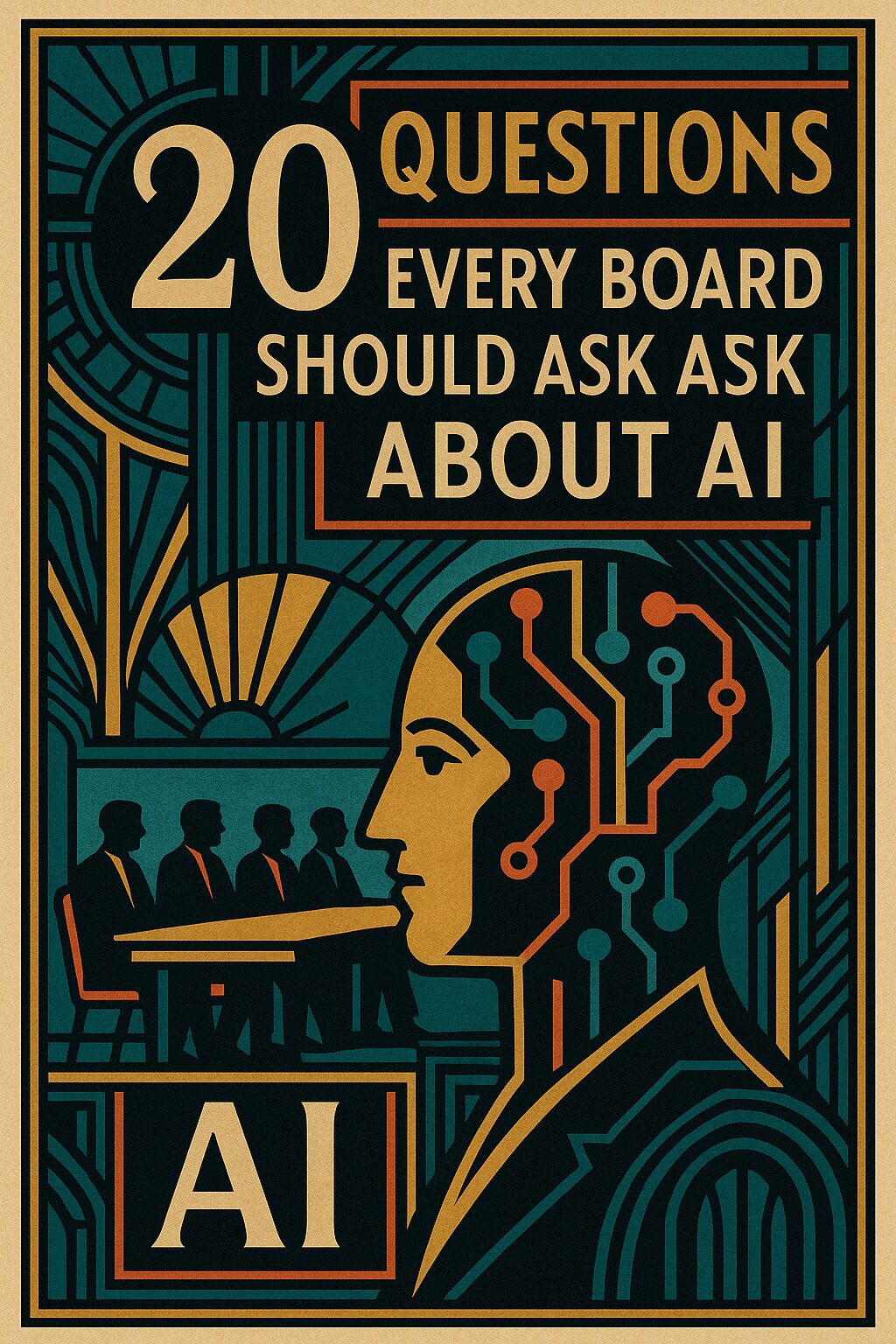
In boardrooms around the world, one theme now appears with more regularity than cyber risk, M&A uncertainty, or even financial performance. That topic is artificial intelligence. Not the lofty philosophical debate about whether machines will overtake human judgment, but the immediate, pragmatic question every director is trying to solve: How do we oversee AI in a way that protects the enterprise, unlocks value, and keeps regulators out of the boardroom?
For compliance professionals, this is a defining moment. AI risk has become the newest frontier where the board relies heavily on the compliance function to guide them. Sometimes with clarity, sometimes with guardrails, and occasionally with a well-timed reality check. This is the type of risk that exposes governance gaps quickly, and the questions the board asks, or fails to ask, will determine whether the company thrives in the age of AI or becomes the following cautionary tale.
Today, I outline 20 critical questions that every board should ask about AI. Think of them not simply as oversight prompts but as governance accelerators. Each one creates visibility, accountability, and structure. Those three elements are the foundation of every effective compliance program.
1. What are our highest-impact AI use cases, and who owns them?
Boards cannot oversee what they cannot see. The first and arguably most crucial step is obtaining a clear inventory of where AI is embedded in operations, not at a conceptual level, but with owners, systems, and risk ratings attached. When accountability is vague, risk grows quietly in the background.
2. How does AI support our strategic objectives and create measurable value?
AI is not a magic wand. It must support strategy, not distract from it. Boards should ask whether AI materially improves revenue, reduces cost, enhances safety, increases accuracy, or strengthens customer outcomes. If the answer is ambiguous, the company may be deploying AI for the wrong reasons.
3. What data powers these systems, and do we have the legal and ethical rights to use it?
Data is the fuel for AI, but not all data is created or sourced equally. Boards should expect clarity on licensing rights, privacy implications, and any limitations on the use and reuse of data. If data lineage is unclear, the company’s regulatory exposure may be far greater than it realizes.
4. How are we assessing and mitigating bias in both data and outcomes?
Bias is not only a fairness issue. It poses operational, legal, and reputational risks. Boards should see a methodology, not simply an aspiration. That includes periodic testing, remediation procedures, and documentation that can withstand scrutiny from regulators, auditors, or litigators.
5. What guardrails prevent employees from entering sensitive information into generative AI tools?
Most AI failures begin with human error. Boards should understand which safeguards are currently in place, including policies, training programs, and technical restrictions, and how the company tests their effectiveness.
6. What is our model validation process before deployment?
Deploying unvalidated models, or worse, models validated exclusively by developers, invites significant risk. Boards should confirm that model validation includes accuracy testing, robustness checks, and cross-functional review involving compliance, legal, risk, and data science.
7. How do we monitor for model drift or degraded performance over time?
AI is not static. Models evolve, environments shift, and accuracy degrades. Ongoing monitoring is essential. Boards should request a drift detection plan that includes clear thresholds, well-defined triggers, designated responsible owners, and documented response actions.
8. What is our incident response plan for AI failures, hallucinations, or data leakage?
AI failures rarely resemble traditional IT outages. They can be subtle, gradual, or hidden until significant damage occurs. A strong incident response plan clarifies roles, timelines, escalation paths, and expectations for communication with customers and regulators. Boards should insist on a rehearsal, not merely a promise.
9. How are we documenting AI-related decisions?
When regulators come calling, documentation becomes destiny. Boards should ensure that decisions tied to high-impact AI models are recorded in a manner that demonstrates thoughtful oversight, rather than blind reliance on automation.
10. Which AI regulatory regimes apply to us across global markets?
The regulatory landscape is evolving rapidly. The EU AI Act, sector-specific guidance from the United States, China’s AI regulations, and new frameworks emerging in Australia, Brazil, Singapore, and the United Kingdom are just a few examples. Boards should expect a regulatory heat map that outlines exposure, obligations, and enforcement priorities.
11. How do we manage the risk associated with third-party AI vendors and model providers?
Vendors introduce significant risk, particularly when foundation models or APIs change without notice. Contracts must include audit rights, IP protections, confidentiality provisions, and mechanisms for monitoring downstream risk. Boards should look for a vendor governance framework, not a spreadsheet with logos.
12. What training have employees received on the responsible use of AI?
Employees cannot follow principles they do not understand. Boards should expect role-based training with regular refreshers, testing, and usage monitoring, rather than one-time videos or superficial check-the-box modules.
13. How do we ensure human oversight for high-impact or high-risk decisions?
This is where compliance delivers real value. “Human in the loop” cannot simply mean that a person glanced at a dashboard. It means the right individuals reviewed the right decisions with clarity on when they are obligated to intervene.
14. What KPIs tell us whether our AI systems are performing safely and as intended?
Boards should expect dashboards containing more than accuracy scores. KPIs should include incident counts, time-to-remediation, drift flags, bias findings, and operational impacts. What the company measures reveals what the company values.
15. What controls protect AI models and proprietary data from cyber threats?
AI significantly expands the attack surface. Models can be stolen, manipulated, or poisoned. Boards should see evidence of hardened access controls, encryption, logging, and monitoring, along with procedures for handling prompt-injection attacks and adversarial inputs.
16. How do we ensure transparency with customers, employees, and regulators when AI is used?
Transparency is becoming a regulatory expectation in many jurisdictions. Boards should verify whether AI disclosures are clear, accurate, and accessible to users, rather than being hidden in dense terms of service.
17. Are we over-relying on AI in any mission-critical processes?
AI concentration risk is real. When too many decisions or functions depend on a single model or vendor, the entire enterprise becomes fragile. Boards should evaluate whether redundancies exist and whether a single point of AI failure could create systemic risk.
18. What ethical principles guide our AI development and deployment?
Ethical frameworks only matter when they are embedded in daily processes and decision-making. Boards should expect evidence that ethical considerations influenced model selection, data sourcing, vendor evaluation, and deployment controls.
19. How is Internal Audit providing independent assurance over AI?
Internal Audit must play a role. AI risk touches processes, data, controls, vendors, and governance. These are areas Internal Audit already understands well. Boards should expect AI to be included in the annual audit plan, supported by a structured methodology.
20. What investments are required to manage AI risk in the next 12 months?
Boards appreciate transparency, not surprises. AI governance necessitates ongoing investment in personnel, skills, monitoring tools, testing environments, and data management capabilities. If AI grows without proportional governance funding, the company creates risk rather than value.
Why These Questions Matter Now
We are entering an era in which regulators expect boards to demonstrate active oversight of AI, just as they do for cybersecurity, financial controls, and data privacy. Gone are the days when AI could be treated as an IT experiment or a futuristic curiosity. Today, it sits squarely in the center of corporate governance. This means compliance oversight is required. For compliance professionals, this is an opportunity to step forward and provide structure. We can shape the conversation, establish frameworks, and guide leadership toward responsible adoption and implementation. These 20 questions give the boards the clarity they need and ensure compliance with the influence it deserves.
AI presents extraordinary potential, but potential without oversight becomes risk. Compliance professionals can ensure that the board asks the right questions, receives the necessary information, and establishes the appropriate controls to ensure effective oversight. In the age of AI, strong governance is not simply a competitive advantage. It is a survival strategy.
If you would like the whole 20 Question list, please leave us a Voicemail.