Categories
Career Can D0

Finding Direction in Uncertainty with Ashley Jablow

What do you do when the job you were sure was your “dream job” suddenly ends? That’s the spot Ashley Jablow found herself in, and she joins Chris Sandland on this episode of Career Can Do to talk about how that moment knocked the wind out of her and also ended up opening an entirely new path. Today, she runs Wayfinders Collective, but the journey there definitely wasn’t a straight line.

Ashley shares how she gave herself 60 days to sort out her next move, only to reach the end of that timeline feeling totally stuck. Then, on a red-eye flight where she couldn’t sleep, the phrase “creative wayfinding” popped into her mind. She didn’t know exactly what it meant yet, but it captured the feeling of navigating life without a map. That idea eventually became the heart of the work she does now.

One thing she and Chris laugh about is how people always say they want clarity, when really they’re hoping for certainty – and certainty just doesn’t exist. Ashley encourages people to take small steps instead of waiting for some big, perfect answer. You learn by moving.

She also talks about how important it is to get out of your own head when you’re stuck. A coach once told her to put her job search away for a few weeks and do things that actually brought her joy. It sounded ridiculous at first, but it changed everything. Chris chimes in with his own version of that – taking ten minutes to clean something when his brain feels scrambled – because somehow that simple shift resets his whole mood.

Ashley also shares the story behind her 100 Days of Designing My Life journals, a pandemic project that started with watercolor postcards and turned into guided reflection tools people now use all over the place.

Resources

Ashley Jablow on the Life Design School | Wayfinders CollectiveLinkedIn | Instagram

Chris Sandland on LinkedIn

Mary Ann Faremouth on the Web | X (Twitter)

Categories
Word of the Week

Word of the Week with Kenneth O’Neal – Exploring Identity: Gumption, Grit, Guts, and Grace

Each week, Kenneth O’Neal discusses a word that describes a principle or value of the Qualities of Success. We suggest you use the Word of the Week in your thoughts, deeds, and actions. You might currently possess the qualities and the desire to further develop them.  You could replace a bad habit with a good habit. Write an action step and use it daily to develop the Quality in your Life. In this episode, Kenneth discusses the word ‘Identity’.

Kenneth delves into the concept of identity, encouraging listeners to write down the word of the week, ‘identity,’ and use it in their conversations and actions. The discussion highlights the meaning of identity and its importance in distinguishing individuals. It explores two main pathways: creating identity through external influences or receiving it based on personal beliefs and values. O’Neal outlines key principles from their work, including gumption, grit, guts, and grace, as well as leadership and legacy. He emphasizes the importance of discovering one’s identity and being intentional, purpose-driven, and resilient, while highlighting leadership as a form of influence shaped by identity and integrity.

Highlights:

  • Word of the Week: Identity
  • Understanding Identity
  • Two Paths of Identity
  • Leadership and Legacy

Resources:

KRONEAL Consulting

Categories
Compliance Tip of the Day

Compliance Tip of the Day – M&A-Pre-Acquisition: Conducting a Corruption Risk Assessment

Welcome to “Compliance Tip of the Day,” the podcast that brings you daily insights and practical advice for navigating the ever-evolving landscape of compliance and regulatory requirements. Whether you’re a seasoned compliance professional or just starting your journey, we aim to provide you with bite-sized, actionable tips to help you stay on top of your compliance game. Join us as we explore the latest industry trends, share best practices, and demystify complex compliance issues to keep your organization on the right side of the law. Tune in daily for your dose of compliance wisdom, and let’s make compliance a little less daunting, one tip at a time.

We continue our look at the role of compliance in the pre-acquisition phase of a merger and acquisition. Today, we consider the need for a corruption risk assessment.

For more on this topic, check out The Compliance Handbook: A Guide to Operationalizing your Compliance Program, 6th edition, which LexisNexis recently released. It is available here.

Categories
Everything Compliance - Shout Outs and Rants

Everything Compliance – Shout Outs & Rants: Episode 162, Numbers, Numbers, Numbers

Welcome to the fan fav of Everything Compliance—Shout-Outs and Rants. In this episode, we have the quartet of Matt Kelly, Jonathan Marks, and special guests Lisa Fine and Dr. Hemma Lomax with Tom Fox, the Compliance Evangelist, as host.

  1. Matt Kelly shouts out to the ChatGPT em-dash and rants about the federal government’s attempts to ban all state regulation of AI.
  2. Jonathan Marks shouts out to MacKenzie Scott for her $70 million donation to Historically Black Colleges and Universities (HBCUs) in 2025, continuing her support after a $560 million donation to 27 HBCUs in 2020.
  3. Special Guest Panelist Dr. Hemma Lomax rants about ChatGPT em dashes and shouts out recent legal tech conferences.
  4. Special Guest Panelist Lisa Fine shouts out to the Compliance Week survey, Inside the Mind of the CCO, and encourages all listeners to participate.
  5. Tom Fox shouts out to Gen Z and traces their play with the numbers 6 and 7, and the use of numerology in texts back to the Book of Genesis and the ancient text of Gilgamesh.

The members of Everything Compliance are:

The host, producer, and sometimes panelist of Everything Compliance is Tom Fox, the Voice of Compliance. He can be reached at tfox@tfoxlaw.com.  The award-winning Everything Compliance is a part of the Compliance Podcast Network.

Categories
Innovation in Compliance

Innovation in Compliance – Steph Holmes on Blending AI and Human Oversight for Effective Compliance

Innovation spans many areas, and compliance professionals need not only to be ready for it but also to embrace it. Join Tom Fox, the Voice of Compliance, as he visits with top innovative minds, thinkers, and creators in the award-winning Innovation in Compliance podcast. In this episode, host Tom welcomes Steph Holmes, long-time friend and Director of Ethics and Compliance Strategy at the EQS Group, who looks at the current Intersection of AI and compliance.

Steph Holmes and EQS are both at the forefront of integrating artificial intelligence (AI) into compliance programs to enhance their efficiency and effectiveness. With a focus on practical applications, Holmes views AI as a crucial tool for expanding resources, especially as organizations face increasing regulatory changes and economic pressures. She advocates for the responsible, sustainable, and explainable adoption of AI, emphasizing that compliance professionals should embrace it rather than fear it. Holmes discusses the importance of blending AI capabilities with human oversight to ensure compliance tasks are managed accurately and risks are mitigated effectively.

Key highlights:

  • Digitizing Compliance: AI Tools and Programs
  • Navigating Compliance Challenges with Human Judgment
  • Enhancing AI Reliability Through Human Oversight
  • Enhancing Compliance through Responsible AI Implementation
  • Implementing AI Pilot Programs in Compliance Workflows

Resources:

Steph Holmes on LinkedIn

EQS Group LinkedIn

Where in the Loop: Corporate Compliance Insights

EQS Website

EQS Benchmark Report: AI Performance in Compliance & Ethics

Innovation in Compliance was recently ranked 4th among Risk Management podcasts by 1,000,000 Podcasts.

Categories
AI Today in 5

AI Today in 5: December 2, 2025, The AI as Threat to EU Banks Edition

Welcome to AI Today in 5, the newest edition of the Compliance Podcast Network. Each day, Tom Fox will bring you 5 stories about AI to start your day. Sit back, enjoy a cup of morning coffee, and listen in to AI Today In 5. All, from the Compliance Podcast Network. Each day, we consider four stories from the business world, compliance, ethics, risk management, leadership, or general interest about AI.

Top AI stories include:

  1. Is AI a threat to EU banking? (Bloomberg)
  2. FDA expands use of Agentic AI. (FDA Press Release)
  3. Federal exemption is a financial windfall for Big Tech. (CFO Dive)
  4. Agentic AI for remediation. (PR Newswire)
  5. FreemarketFX launches new AI tools. (FinTechGlobal)

For more information on the use of AI in Compliance programs, my new book, Upping Your Game, is available. You can purchase a copy of the book on Amazon.com.

Categories
Daily Compliance News

Daily Compliance News: December 2, 2025, The Tuna Bond Fraud Edition

Welcome to the Daily Compliance News. Each day, Tom Fox, the Voice of Compliance, brings you compliance-related stories to start your day. Sit back, enjoy a cup of morning coffee, and listen in to the Daily Compliance News. All, from the Compliance Podcast Network. Each day, we consider four stories from the business world, compliance, ethics, risk management, leadership, or general interest for the compliance professional.

Top stories include:

  • Massive fraud in aircraft parts uncovered in the UK. (The Times)
  • Switzerland charges Credit Suisse over Tuna Bond fraud. (ACAMS)
  • Corruption scandals impact the Chinese Army. (Reuters)
  • Former Labour MP convicted of corruption in Bangladesh. (Independent)

The Daily Compliance News has been honored as No. 2 in the Best Regulatory Compliance Podcasts category.

Categories
Red Flags Rising

Red Flags Rising: S01 E33: Back to Basics

As the geopolitical and national political winds continue to swirl, Mike & Brent go back to basics to level-set and provide some foundational first principles of export controls compliance. They discuss the roller-coaster of the Affiliates Rule suspension (01:44); why the real risks from a compliance and enforcement perspective lay just outside of the Rule (02:37); how General Prohibition 10, the full definition of “knowledge” to include “an awareness of a high probability,” and the various inchoate provisions (i.e., causing, aiding and abetting, solicitation and attempt, conspiracy, acting with knowledge, misrepresentation and concealment, intent to evade, and failure to comply with recordkeeping requirements) are the foundational anti-diversion provisions under the U.S. Export Administration Regulations (EAR) (03:02); great listener feedback about how the Affiliates Rule shaped the in-house discussion of diversion risk (05:23); developing and implementing a high probability protocol as the only way to stay grounded in dynamic and challenging times (08:33); recent legislative proposals and hearings, including a recent hearing by a subcommittee of the House Foreign Affairs Committee focused on export control loopholes, and the dangers of a dissatisfied U.S. Congress (09:42); why the definition of “knowledge” under the EAR is not mere legalese to be lost in the 1,467 pages (as of January 1, 2025) of the EAR but is instead the path forward for both government and industry (14:18); the details and implications of General Prohibition 10 (17:11); the details of the full definition of “knowledge,” including what we can learn from its history in the U.S. Foreign Corrupt Practices Act and, before then, the Model Penal Code (18:48); and recent enforcement activity by DOJ and BIS, and what the activity signals about the government’s next enforcement moves (22:30).

They then conclude with the latest installment of Brent’s increasingly popular “Managing Up” segment (27:14).

Resources:

Brent’s latest NYU Law School Program on Corporate Compliance & Enforcement post, from October 31, 2025

Brent’s email: brent@redflagsrising.com

Mike’s email: michael.huneke@morganlewis.com

Categories
Blog

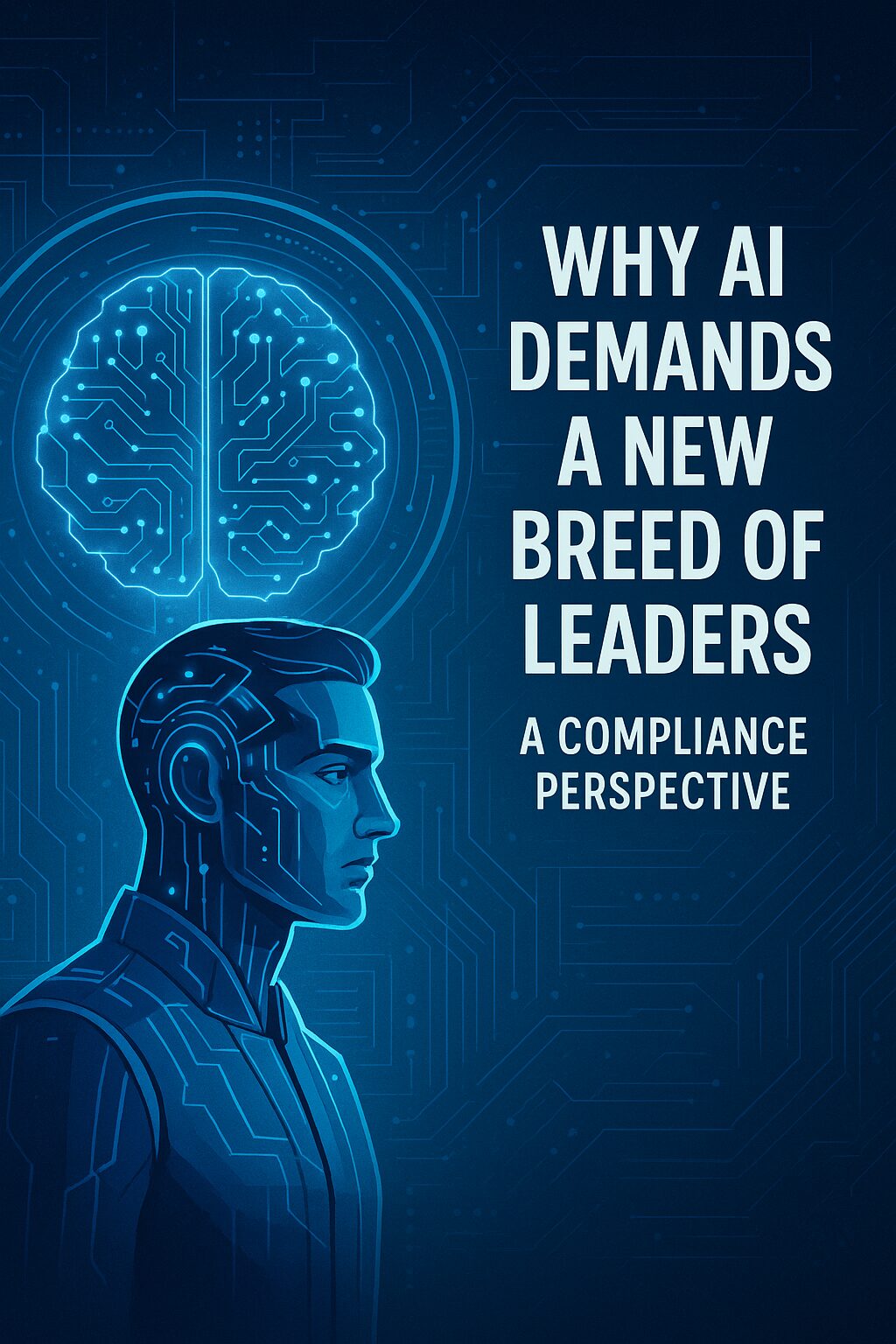
Why AI Demands a New Breed of Leaders: A Compliance Perspective

Artificial intelligence is no longer a distant future state for compliance teams. It is here, operating inside financial crime platforms, powering third-party due diligence tools, driving monitoring engines, and influencing the everyday judgments that regulators scrutinize. Yet too many companies still approach AI as if it were simply another IT project. In a recent Sloan Management Review article, Why AI Demands a New Breed of Leader,” the authors, Faisal Hoque, Thomas H. Davenport, and Erik Nelson, argue that successful AI transformation is far more about people, culture, and leadership than about code.

For compliance professionals, that should sound familiar. Every major enforcement action of the last decade has shown that failure rarely begins with a faulty system. Failure begins with leadership that misunderstands risk, a culture that resists change, and governance frameworks that cannot keep pace with new technologies.

The authors argue that modern organizations require a new category of leader to guide AI adoption, a role that blends technical capability with cultural stewardship, ethical understanding, and organizational change management. They call this the Chief Innovation and Transformation Officer (CITO) or an equivalent title. Whether companies formally adopt the title or not, the message is unmistakable: AI changes the leadership equation, and compliance has a front-row seat.

Why Traditional Technology Leadership Is No Longer Enough

While CIOs are increasingly viewed as changemakers, they often lack the time and mandate to address the organizational disruption AI brings. Compliance officers understand this problem intuitively. You can have the most sophisticated tools in the world, but if the culture is not ready for them, the result will be chaos or even misconduct. The authors cite survey data showing that 91 percent of large-company data leaders believe cultural issues, not technical ones, are blocking progress. That finding mirrors what compliance sees in every DOJ corporate enforcement action. Misconduct thrives not because technology fails, but because people and processes fail.

The article also includes examples of organizations that stumbled by treating AI as a purely technical deployment. The Zillow pricing model collapsed. The swift employee backlash at California State University. The Air Canada chatbot that mishandled bereavement fare guidance. Each case reveals the same lesson: AI without governance becomes a liability. For compliance professionals evaluating AI adoption, these examples should resonate. AI raises questions about transparency, fairness, documentation, accountability, and the human impact of automation. Those are governance issues, not engineering puzzles.

The New Leadership Model AI Demands

The authors describe several competencies required for effective AI leadership, all of which map directly into compliance priorities:

Navigating ethical considerations.

AI introduces bias, harm, and fairness risks, all of which are central concerns for regulators. Leaders must weigh efficiency gains against ethical boundaries.

Driving cultural transformation.

AI adoption changes workflows, reporting lines, incentives, and human-machine collaboration. Leadership must prepare the workforce for new models of decision-making.

Managing human-AI partnerships.

The near-future compliance program will rely on co-decision systems that combine algorithmic outputs with human judgment. Leaders must understand how to balance the two.

Breaking down silos.

AI implementation touches HR, legal, IT, operations, procurement, and compliance. Leadership must connect these functions rather than allow fragmented approaches.

Overseeing citizen development.

Employees across the business can now build AI models without IT involvement. That democratization requires governance and guardrails.

These competencies go far beyond traditional CIO responsibilities. They lean toward behavior, judgment, and organizational change, the same strengths compliance brings to the table.

Emerging Executive Roles Around AI

The article documents the rapid rise of AI-focused executive roles such as Chief Innovation Officer, Chief AI Officer, and Chief Transformation Officer. Compensation is rising, hiring is accelerating, and responsibilities increasingly blend technology, ethics, culture, and strategy.

The authors highlight examples:

  • PepsiCo’s Chief Strategy and Transformation Officer is overseeing enterprise-wide digitization.
  • Standard Chartered’s Chief Transformation, Technology, and Operations Officer.
  • JPMorgan Chase’s governance model for IndexGPT and AI-driven investment analysis.

These roles share a common trait: they embed ethics, cultural change, and strategic alignment directly into AI governance. This direction should reassure compliance officers. Regulators have signaled that they expect AI oversight to be integrated, accountable, and verifiable. A dedicated AI leadership role can help unify these obligations.

AI Persona Management: The Next Frontier of Governance

One of the most intriguing sections of the article describes “AI persona management,” the oversight of digital agents with defined personalities, roles, and decision-making authority. As AI becomes more autonomous, these personas may behave like digital employees. That raises profound governance questions.

Compliance professionals should begin considering:

  • What decision rights will AI personas have?
  • How will we document their logic?
  • How will we audit their behavior?
  • How will we ensure ethical consistency across different personas?

The authors note that Salesforce already uses AI personas internally to guide product decisions. That should serve as a signal: AI agents are not a theoretical concept; they are entering the enterprise now. A compliance professional will need to treat AI personas with the same seriousness as human employees, subject to monitoring, training, policies, escalation channels, and accountability structures.

What This Means for Corporate Compliance Leaders

The article argues that companies must rethink how they manage technology change. AI’s impact is too broad to remain confined to the IT organization. Talent, culture, ethics, governance, and risk management all intersect. The authors present the CITO role as the logical solution for a leader who integrates technical fluency with organizational psychology and ethical judgment.

From a compliance standpoint, this represents both an opportunity and a responsibility. The opportunity is clear: compliance brings exactly the kind of cross-functional, ethics-driven perspective AI leadership requires. The compliance function knows how to document decisions, manage cultural change, develop defensible processes, and build controls around complex risks.

The responsibility is equally clear: AI will soon permeate every corner of the enterprise. If compliance does not assert its role in governance, the organization will drift toward risk. This article provides a roadmap for what strong governance must look like. It tells companies that AI success demands a leader capable of bridging technical, ethical, and cultural domains, the very domains compliance has long mastered.

Now is the moment for compliance to claim its seat at the AI leadership table, helping shape the systems that will define operational and ethical performance for years to come.