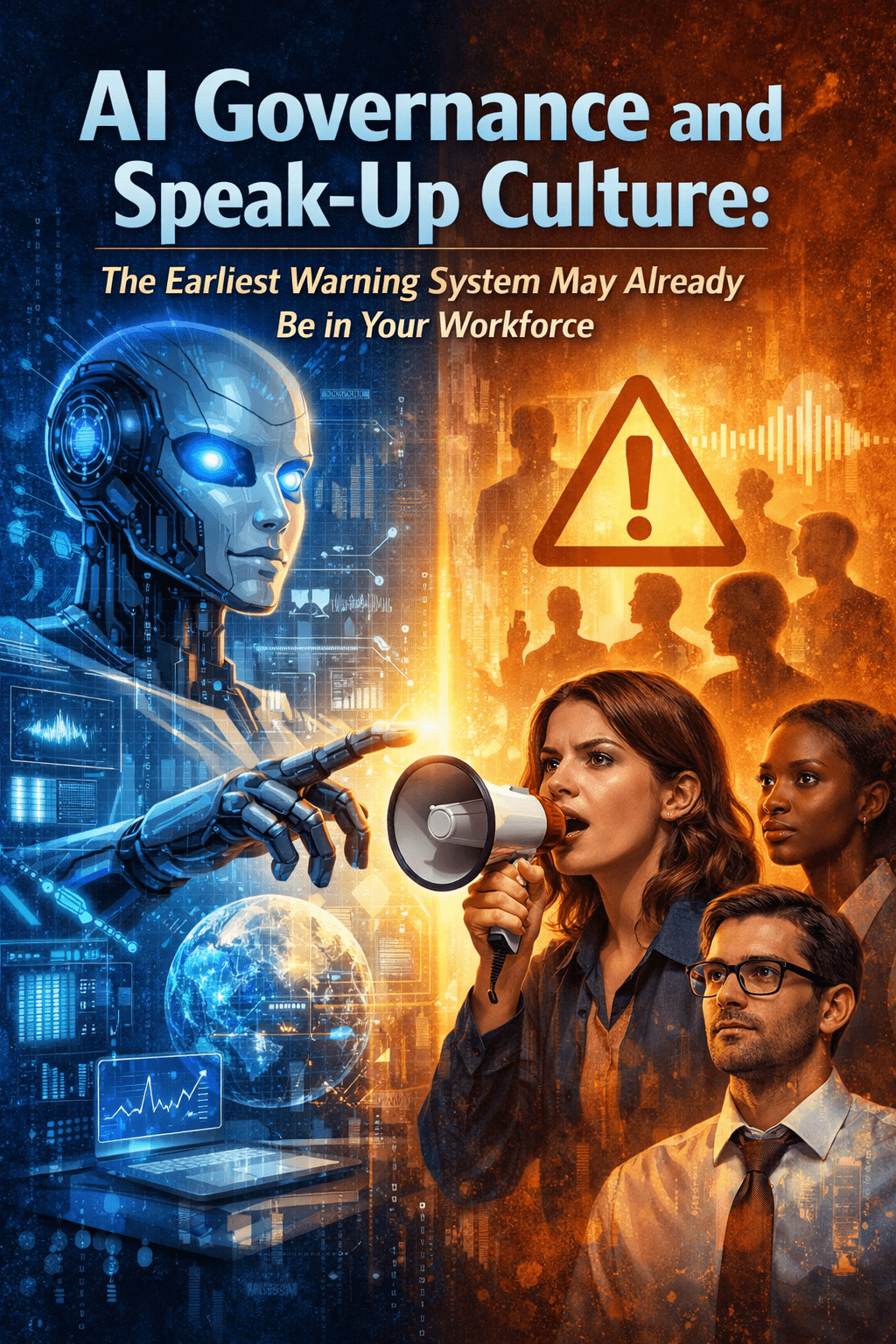
There is a hard truth about AI governance that too many companies are still avoiding: the first people to spot an AI problem are usually not board members, not senior executives, and not even the governance committee. It is the employee using the tool, reviewing the output, dealing with the customer, watching the workflow break down, or seeing the machine produce something that feels off. That is why AI governance is not only about policies, models, controls, and oversight structures. It is also about culture. More specifically, it is about a culture of speaking up.
If employees see an AI tool making questionable recommendations, generating inaccurate summaries, mishandling sensitive information, producing biased outcomes, or being used beyond its approved purpose, do they know that this is a reportable issue? Do they know where to raise it? Do they believe someone will listen? Do they trust that raising a concern will help rather than harm their career? Those are not soft questions. They are governance questions.
In anti-corruption compliance, we have long since learned that hotlines, reporting channels, and anti-retaliation protections are not mere ethical ornaments. They are detection mechanisms. They are how organizations surface risks before they become scandals. AI governance now needs the same mindset. If your employees are your earliest warning system, then your speak-up culture may be one of your most important AI controls.
Why Employees See AI Failures First
AI rarely fails in the abstract. It fails in use. A board deck may describe a tool in elegant terms. A vendor demo may look polished. A pilot may be carefully supervised. But once a system enters daily operations, it interacts with real people, real data, real pressures, and real shortcuts. That is when the problems begin to show themselves.
An employee may notice that a tool is confidently wrong. A manager may realize that staff are over-relying on generated summaries without checking the source material. Someone in HR may see that a screening tool is producing odd results. A sales employee may notice that a customer-facing chatbot is inventing answers. A compliance analyst may find that an AI-assisted monitoring process is missing obvious red flags. A procurement professional may discover that a vendor quietly changed a feature set or data practice.
In each of those examples, the problem shows up at the point of use, not at the point of approval. That is why the old compliance lesson still applies: the people closest to the work are often closest to the risk. In AI governance, that means employees are often the first line of detection. But detection is useless if the culture tells them to keep their heads down.
The Governance Blind Spot
Many organizations are investing significant effort in AI principles, governance committees, acceptable-use policies, and risk classification. That is all important. But many of these programs have a blind spot. They are built as if AI risk will reveal itself only through formal testing, audit reviews, or leadership dashboards. It will not.
Some AI failures will surface through monitoring and controls. But many will first appear as employee discomfort, confusion, skepticism, or observation. Someone will notice that a tool is being used in a way that feels wrong. Someone will catch a factual error before it leaves the building. Someone will realize that human review is not actually happening. Someone will see mission creep. Someone will spot a gap between policy and practice.
If the governance model does not actively encourage employees to raise those concerns, the company has built an AI oversight program with one eye closed. That is a dangerous place to be because AI risk is often cumulative. A small issue ignored today becomes a larger issue tomorrow. An inaccurate output tolerated in a low-stakes setting becomes normalized in a higher-stakes one. A quietly expanded use case becomes a de facto business process. Silence is how minor flaws become systemic failures.
Speak-Up Culture as an AI Control
Let us be clear about terms. Speak-up culture is not simply a hotline number posted on the intranet. It is the set of signals an organization sends about whether employees are expected, supported, and protected when they raise concerns.
In the AI context, a healthy speak-up culture means employees understand that reporting concerns about AI outputs, use cases, data handling, or control failures is part of responsible business conduct. It means managers know that AI concerns are not “just tech issues” to be brushed aside. It means investigators and compliance teams are prepared to triage and assess AI-related reports intelligently. It means retaliation protections apply as much to someone challenging a machine-enabled workflow as they do to someone reporting bribery, harassment, or fraud.
This matters because AI can create a special kind of silence. Employees may hesitate to challenge a system that leadership has praised as innovative. They may worry that questioning the tool makes them sound resistant to change or insufficiently sophisticated. They may assume someone more senior has already validated the output. They may think, “Surely the machine knows better than I do.” That is exactly the kind of cultural dynamic compliance should distrust.
Machines do not deserve deference. Controls deserve scrutiny. A mature AI governance program, therefore, needs to treat employee reporting as a formal part of its control environment. Speak-up culture is not adjacent to AI governance. It is part of AI governance.
What CCOs Should Be Asking
If you are a Chief Compliance Officer, there are several questions you should be asking right now.
First, do employees understand that AI-related concerns are reportable? Many organizations have not made this explicit. Staff know they should report harassment, bribery, theft, and retaliation. They may not know whether to report unreliable AI output, a suspicious recommendation, a data input concern, or a business team using a tool outside its approved scope. If you have not told them, do not assume they know.
Second, are your reporting channels equipped to receive AI-related concerns? Hotline categories, case-intake forms, and triage protocols may need to be updated. If an employee reports that an AI tool is generating misleading outputs in a regulated workflow, who receives that report? Compliance? Legal? Security? IT? HR? Some combination? If ownership is unclear, reports will stall, and stalled reports teach employees not to bother.
Third, are managers trained to respond appropriately when AI concerns are raised informally? This is critical. Many concerns will not begin in a hotline. They will begin in a meeting, a hallway conversation, a team chat, or an email to a supervisor. If the manager shrugs, dismisses, or minimizes the issue, the detection system fails before it starts.
Fourth, are anti-retaliation protections being reinforced in the AI context? Employees who challenge AI use may be questioning a high-profile project, a popular vendor, or a senior executive’s initiative. That can create subtle pressure to stay quiet. Compliance should be ahead of that dynamic, not behind it.
Building an AI Speak-Up Framework
What does a practical approach look like?
The first step is to define what types of AI concerns employees should raise. Be concrete. Tell them to report suspected misuse of AI tools, outputs that appear inaccurate or biased, use of AI in sensitive decisions without proper review, input of restricted data into unapproved systems, unauthorized expansion of use cases, missing human oversight, and vendor or system changes that appear to alter risk.
The second step is to build AI examples into training and communication. Employees need realistic scenarios, not vague encouragement. Show them what an AI red flag looks like. Show them what “raising a hand” looks like. Show them where to go and what happens next.
The third step is to update the hotline and investigations protocols. Add intake categories if needed. Develop triage guidance. Decide when AI matters should be handled as compliance cases, operational incidents, model-risk issues, or cross-functional reviews. The goal is not bureaucracy. The goal is clarity.
The fourth step is to train managers as escalation points. In every effective compliance program, middle management is the translation layer between policy and daily operations. AI governance is no different. Managers need to know when a concern can be resolved locally, when it must be escalated, and when the pattern itself suggests a control problem.
The fifth step is to close the feedback loop. Employees are more likely to report concerns when they believe reporting leads to action. That does not mean revealing confidential case details. Communicating that the company takes these issues seriously, investigates them, learns from them, and improves controls as needed. Silence from management breeds silence from employees.
What to Monitor in an AI Speak-Up Program
Here is where compliance can bring its trademark discipline. Track the volume and type of AI-related concerns. Look for concentration by business unit, geography, or tool. Monitor whether concerns are coming in through formal hotlines or informal channels. Review time to triage and time to resolution. Look for patterns involving data handling, output reliability, human review failures, or scope creep. Compare the reported concerns with the company’s list of approved use cases. If you see repeated confusion or repeated exceptions, that tells you something important about your governance design.
Just as importantly, look for the absence of reporting. If your company has materially deployed AI tools and no employee has ever raised a concern, I would not automatically celebrate. I would ask whether employees know what to report, trust the channels, or believe leadership wants candor. In compliance, no reports can mean no problems. It can also mean no trust. Wise CCOs know the difference is everything.
Why This Is Good for Business
Some executives still hear “speak-up culture” and think of delay, friction, and complication. I hear something different. I hear early detection, faster correction, and better decision-making.
A workforce that feels empowered to raise AI-related concerns provides the company with a real-time sensing mechanism. It catches problems before they scale. It surfaces control failures before regulators, plaintiffs’ lawyers, journalists, or customers do. It gives management better information. It helps the board exercise real oversight. Most of all, it creates a culture where innovation is more sustainable because people are not afraid to challenge what does not look right. That is not anti-innovation. That is responsible innovation.
Compliance has always been at its best when it helps the business move fast without becoming reckless. Speak-up culture does exactly that. It does not tell employees to fear AI. It tells them to use judgment, raise concerns, and protect the enterprise when the technology does not behave as expected.
Final Thoughts
Every company deploying AI should ask itself a simple question: Who will notice first when something goes wrong? In many cases, the answer is your employees. The next question is even more important: have you built a culture where they will say something?
If the answer is uncertain, then your AI governance program has a serious weakness. You may have policies. You may have committees. You may have training modules and vendor reviews. But if employees do not feel empowered to raise a hand when they see a problem, then one of your most valuable detection controls is missing in action.