Categories
Everything Compliance - Shout Outs and Rants

Everything Compliance – Shout Outs and Rants from Episode 98


In this episode of Shout Outs and Rants, we submit the following for your consideration:

1. Jay Rosen rants the Academy of Motion Picture snubbing of the Director of Dune for Best Director when the picture won 6 other Oscars.

2. Matt Kelly shouts out to the Golden Raspberry Foundation, who award the ‘Razzie’s’ for withdrawing their previously created award of Worst Performance by Bruce Willis in a Bruce Willis movie after the actor retired due to Aphasia.

3. Jonathan Armstrong shouts out to Tina Turner for advancing the cause of GDPR and explaining once and for all time ‘what’s love got to do with it.’

4. Karen Woody shouts out to the magic of Harry Potter World in Orlando have what she described as ‘awesome’ roller coaster rides, well worth the 3-hour wait in line.

5.Tom Fox rants Academy of Motion Picture Arts and Sciences for their incompetent response to Will Smith slapping Chris Rock at the Oscars and reminds us that workplace violence is never acceptable. 

The members of the Everything Compliance are:

  • Jay Rosen– Jay is Vice President, Business Development Corporate Monitoring at Affiliated Monitors. Rosen can be reached at JRosen@affiliatedmonitors.com
  • Karen Woody – One of the top academic experts on the SEC. Woody can be reached at kwoody@wlu.edu
  • Matt Kelly – Founder and CEO of Radical Compliance. Kelly can be reached at mkelly@radicalcompliance.com
  • Jonathan Armstrong –is our UK colleague, who is an experienced data privacy/data protection lawyer with Cordery in London. Armstrong can be reached at armstrong@corderycompliance.com
  • Jonathan Marks is Partner, Firm Practice Leader – Global Forensic, Compliance & Integrity Services at Baker Tilly. Marks can be reached at marks@bakertilly.com

The host and producer, ranter (and sometime panelist) of Everything Compliance is Tom Fox the Voice of Compliance. He can be reached at tfox@tfoxlaw.com. Everything Compliance is a part of the Compliance Podcast Network.

Categories
The ESG Compliance Podcast

The Future of ESG In 2022 with Mike Munro


GCMR co-founder Mike Munro joins us as he discusses his predictions for ESG standardization and regulations down the road, his written work, the significance of compliance, and staying open to the possibilities of all components of ESG.
▶️ The Future of ESG in 2022 with Mike Munro:
Key points discussed in the episode:
✔️ Mike Munro lists down his firm’s services and core focus: helping people understand what ESG is all about.
✔️ Mike Munro believes 2022 will be a pivotal year for ESG and his articles aim to put ESG at the forefront.
✔️ Through their directives, the SEC and the EU will bring specificity on what needs to be tracked and reported. The FCC is also expected to issue climate-related standards.
✔️ The EU has become the frontrunner in implementing human rights regulations. Switzerland and Germany have passed a law requiring reporting. The US still needs to improve in addressing modern slavery issues.
✔️The SEC shows growing interest in human capital.
✔️Once the IFRS Sustainability Board puts out standards, verification and auditing will follow.
✔️ With ESG, companies can be part of the solution. Bigger names shouldn’t receive the brunt of the blame as businesses of all sizes should be accountable.
✔️ ESG can be simplified with its focus: getting data accurately and reporting it in an appropriate way.
✔️ The role of compliance is to assist and advise. It helps companies understand the regulations and risks associated with doing business in certain countries. It also promotes educating teams in organizing and collecting accurate and useful information.
✔️ The environmental component is a pain point among compliance professionals. Mike Munro gives advice on how to be more open to the E in ESG: basic knowledge of issues and strong ties with environmental groups.
✔️ Embrace the true value of ESG to your organization. With the understanding of ESG, do your own research and stay curious.
✔️ ESG will continue to gain more attention in the coming years. With more mandates and the recognition of compliance professionals, the future seems optimistic.
Mike Munro is the principal and co-founder of GCMR, an ESG and compliance advisory firm. His previous experience includes being the CCO of Odebrecht Engineering & Construction, a partner at Norton Rose Fullbright, deputy general counsel and CCO of Transocean, and global director of ethics and compliance at Baker Hughes. He is a member of the OECD’s Trust in Business Network (TriBuNet) and a member of the Executive Consultation Group for the OECD’s work on a multi-stakeholder ESG initiative, the Blue Dot Network.
—————————————————————————-
Do you have a podcast (or do you want to)? Join the only network dedicated to compliance, risk management, and business ethics, the Compliance Podcast Network. For more information, contact Tom Fox at tfox@tfoxlaw.com.

Categories
Innovation in Compliance

A Digital Transformation to Compliance with Evgeny Likhoded


Evgeny Likhoded is the founder and CEO of ClauseMatch, a company that provides financial institutions with a modern AI-based compliance platform to transform their regulatory change management process.  Tom Fox welcomes him to this week’s show to talk about ClauseMatch, how it helps its clients, and the evolution of compliance.  


Digital Transformation: The Core of ClauseMatch
Bringing digital transformation to governance risk and compliance is at the core of the ClauseMatch platform. What ClauseMatch has built is a way for companies to collaborate in real time on content, specifically content that needs strict and strong governance processes. “Primarily our platform is used for managing policies and procedures in a way that enables companies to track every single change every time the policy changes,” Evgeny tells Tom. Ultimately it helps clients show their regulators that they have interpreted and incorporated the rules into their own internal governance frameworks, and have communicated that to their employees. 
 
The Evolution of Compliance
Evgeny cautions that it’s not enough to have a compliance manual just sitting around. Compliance regulations and objectives need to be distributed and have engagement with the entire organization. A large part of ClauseMatch’s roadmap is driven by customer challenges, and how they might be addressed and another part is driven by the market. “There are a lot of things that we see on the market that will drive the adoption of compliance solutions,” Evgeny says. Regulated firms won’t be the only ones affected by the changes happening in the market. “Privacy regulations aren’t just for regulated firms,” he adds. Every firm that is holding some form of data for its clients and customers is subject to these regulations. This, along with a greater emphasis on ESG are two prime examples on how compliance has evolved for companies. 
 
Smart and Connected Compliance
Tom asks Evgeny to define smart and connected compliance. Connected compliance is the ability to understand and connect compliance content that comes from many different sources. This means the obligations, procedures, and policies that come from various regulators. “We need to rewrite the policies and procedures we need to make sure that their controls are still compliant with the regulations and obligations, and if they’re not connected you can never estimate the full impact of that,” Evgeny explains. Smart compliance is where individuals can start using machine learning and natural language to understand these connecting links across the organization. 
 
Looking Ahead
Tom asks Evgeny what key trends will shape compliance technology in the future. Evgeny explains that the need for compliance technology will only increase during 2022 and onward. New regulations will be introduced for cryptocurrency activities and assets, as well as various regulatory frameworks with ESG. Cybersecurity will have a lot more scrutiny from regulators and governments as well. 
 
Resources
Evgeny Likhoded | LinkedIn | Twitter 
ClauseMatch
 

Categories
Daily Compliance News

April 5, 2022 the Is Corp Diversity Unconstitutional? Edition


In today’s edition of Daily Compliance News:

  • Companies putting M&A on hold due to war. (WSJ)
  • CA corp diversity law ruled unconstitutional. (Reuters)
  • Is ESG contradictory? (FT)
  • Closing arguments begin in Roger Ng trial. (Reuters)
Categories
Compliance Kitchen

SEC Proposed Rules on Climate Change Risk


SEC issues proposed rules on climate impact disclosures; requests public comment.

Categories
All Things Investigations

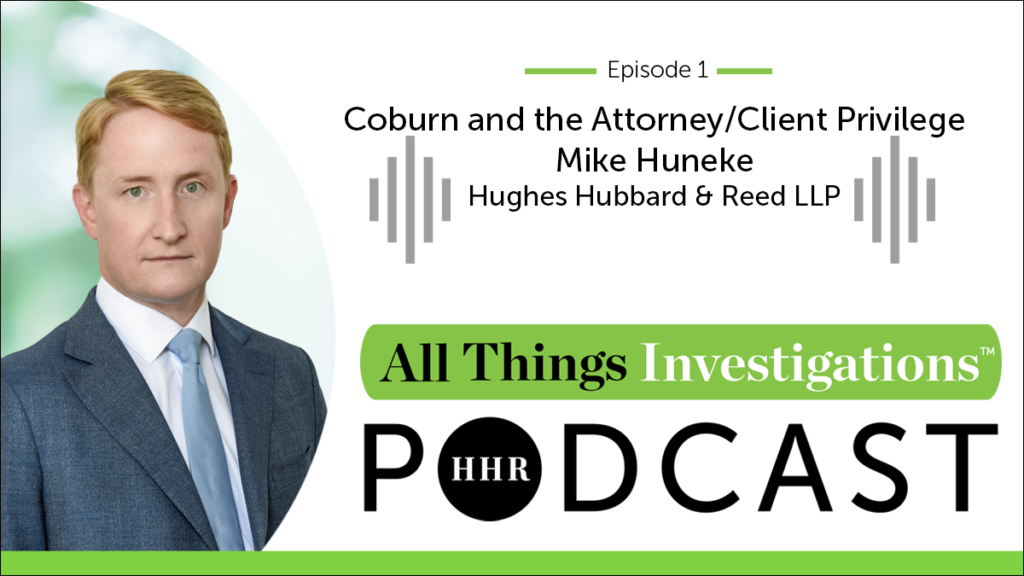
All Things Investigations Episode 1: Coburn and the Attorney/Client Privilege


Welcome to the Hughes Hubbard Anti-Corruption & Internal Investigations Practice Group’s podcast All Things Investigations. In this podcast host Tom Fox and members of the Hughes Hubbard Anti-Corruption & Internal Investigations practice group will highlight some of the key legal issues involved in white collar and other investigations, both domestically and internationally. In this first episode, I visit with Mike Huneke on discovery dispute in the US v. Coburn criminal action.

Mike Huneke is a Hughes Hubbard & Reed partner who has spent his career in both Washington, DC and Paris, France. For his entire 17-year career Mike has been practicing in the anti-corruption space, on everything from investigations and government resolutions, acting as “buffer counsel” to companies subject to compliance monitors, third party and M&A due diligence, and proactive risk assessments and second-level compliance reviews. Most recently, Mike and his Hughes Hubbard colleagues were recognized for their role on the Airbus case by Global Investigations Review.
Key areas we discuss on this podcast are:

  • Individual defendants are wildcards in matters involving privilege claims in FCPA investigations.
  • The dangers of the over-assertion of privilege to the DOJ and to the Courts.
  • The false comfort of “oral” disclosures.
  • The “personal jurisdiction” discussion by the Court.
  • Beware civil discovery in criminal cases.

Resources
Hughes Hubbard & Reed website
Mike Huneke bio
Anti-Corruption and Internal Investigations Practice Group
US v. Coburn, Judge McNulty decision

Categories
The ESG Report

Jared Connors – Using Tech to Support ESG


In today’s ESG Report, Tom Fox is pleased to be joined by supply chain risk management professional extraordinaire, Jared Connors. They’re discussing the work done at Assent Compliance Inc., one of the leading organizations in supply chain sustainability management. 


Becoming a Leader in the World of ESG 
Assent has worked on a variety of regulations to support its clients’ compliance journeys, including substance and modern slavery regulations. Within that context, there are often reputational impacts of compliance. At Assent, the natural extension is to encourage customers to assess their suppliers’ abilities to support and adhere to these regulations. 
 
The Impact of the Conflict Minerals Regulation 
The Conflict Minerals Regulation was one of the first regulations to promote greater transparency of the upstream supply chain and is a pioneering regulation that’s driven companies to look beyond their Tier 1 suppliers. According to Jared, the Conflict Minerals Regulation isn’t just about source of origin verification, but also about chain of custody.

Reputational Damage 
Jared tells a story that highlights the significance of reputational damage, and how it can facilitate an organization’s downfall, “This started out with reputational impacts and led to a lot of other tangible risks from a monetary perspective.” 
 
Direct and Indirect Engagement 
Directly engaging suppliers involves asking them about internal controls, management procedures, and their ability to provide metrics on certain topics. This, however, is insufficient, and therefore, indirect evaluation is required. “You can’t just look at the first level,” says Jared, “You have to get deeper.” These further evaluations are necessary to understand if suppliers can “walk that talk”, because that should have huge implications in doing business with them. 
 
RESOURCES 
Tom Fox’s email
Jared Connors | LinkedIn | Assent
 

Categories
FCPA Compliance Report

Stewart Bishop, Covering the Roger Ng Trial

In this episode of the FCPA Compliance Report, I am joined by Stewart Bishop, reporter at Law360. We discuss his coverage of the Roger Ng trial currently ongoing in New York. Highlights in include:

·      Roger Ng relationship to 1 MDB scandal.

·      Pre-trial issues.

·      Timothy Leissner, direct and cross.

·      Assessing the judge and jury.

·      The discovery dispute.

·      Covering such a lengthy trial.

        Resources

Law360

Categories
Daily Compliance News

April 4, 2022 the Yale Missing $40MM Edition


In today’s edition of Daily Compliance News:

  • S&P Global charged with sanctions violations. (WSJ)
  • Russian oligarchs trying to evade sanctions. (Reuters)
  • Pope backs corruption crackdown. (Religious News Service)
  • Yale employee embezzled $40MM. (NYT)
Categories
Blog

All Things Investigations Joins the Compliance Podcast Network

The Compliance Podcast Network is thrilled to announce its latest podcast, All Things Investigations, a podcast from the law firm Hughes Hubbard & Reed LLP’s Anti-Corruption & Internal Investigations practice group. The group represents many of the premier companies around the world, providing advice on issues spanning the full anti-corruption and compliance spectrum. In this podcast host Tom Fox and members of the Hughes Hubbard Anti-Corruption & Internal Investigations practice group will highlight some of the key legal issues involved in white collar and other investigations, both domestically and internationally. We will tackle topical issues involved in investigations as well as explore how companies can help prevent and detect issues that arise in conducting business on a worldwide basis.
The inaugural episode features partner Mike Huneke, who has spent his career in both Washington, DC and Paris, France. For his entire 17-year career Huneke has been practicing in the anti-corruption space, on everything from investigations and government resolutions, acting as “buffer counsel” to companies subject to compliance monitors, third party and M&A due diligence, and proactive risk assessments and second-level compliance reviews. Most recently, Huneke and his colleagues were recognized for their role on the Airbus case by Global Investigations Review.
The subject of the podcast is the recent US District Court decision by Judge Kevin McNulty in the criminal case of US v. Coburn. McNulty is overseeing the criminal charges against former Cognizant Technology Solutions Corporation (Cognizant) executives Gordon J. Coburn and Steven Schwartz (Coburn; Schwartz or defendants) alleging violations of the Foreign Corrupt Practices Act (FCPA). Defendants had sought discovery from the Department of Justice (DOJ) consisting of materials turned over by counsel for Cognizant (outsourced investigation firm) to the DOJ in the company’s FCPA investigation. The defendants argued that Cognizant waived privilege over a broad category of documents when it disclosed a summary of its investigation findings to DOJ. The waiver, they argued, included “any communications regarding conduct alleged in the indictment and any materials related to Cognizant’s internal investigation.” Cognizant maintained that it did not waive the privilege over the entire internal investigation as the result of simply cooperating with DOJ or disclosing portions of investigative documents.
According to Huneke, Judge McNulty’s decision went back to “first principles. Why are we here? What are we doing? If you are sharing with the United States government privileged information, you have waived privilege by doing so.” That is not particularly controversial or new, but, as Huneke noted, “Judge McNulty then further granted a very broad waiver, a subject matter waiver of the privilege. Not only were interview memorandum from which external counsel read summaries to the government considered to have lost the protection of attorney-client privilege, but all documents supporting those memoranda, cited in those memoranda, drafts, notes or anything else based on which those memorandum were prepared were all ordered by Judge McNulty to be produced.”
It was this second step which Judge McNulty took that garnered much attention in the white-collar defense and FCPA defense bar. While Judge McNulty did not criticize making an oral presentation, he did say that if counsel makes an oral presentation to the DOJ, the underlying basis of that presentation is also not privileged and subject to discovery. Huneke noted, “it underscored there’s no kind of magic secret or magic protection that you get by doing something orally rather than in writing. I think there is a natural preference to maybe have an initial conversation orally with the government. This underscores the importance of reducing it to writing very soon afterwards. I assume that some of the thought behind giving an oral presentation and maybe not reducing it to a writing later is an idea that maybe you have some flexibility afterwards or there’s room to argue. If you are going to waive privilege anyway, it is probably a good practice to document what you think you said. Not only so that you and your client can anticipate what the potential waiver might be, but also to help you later, if you do have to make arguments against individuals who are pleading not guilty and fighting the prosecution about where the waiver line might have been drawn.”
Employees who are individually charged are really the “wild cards” in all of this. Huneke said, “they have nothing to lose at this point. Companies are ongoing concerns for them, the important thing is to resolve the matter and move on and get out.” It could involve the risk of debarment, and the potential impact on their stock price for example. Indicted individuals are often no longer employed. If they were executives there may be a legal or contractual right to advancement of their legal fees. They could well be facing jail time. Huneke concluded, “it is not surprising to see them really throwing the kitchen sink at it in furtherance of their defense. Moreover, they are none too pleased with the perceived infiltration of their legal team by the government or the way, probably in their view, the company turned on them.”
The bottom line is for investigative counsel, whether outsourced or in-house, to understand that their entire investigation, notes, memoranda, ideas and investigations may all be turned over to counsel for defendants if individuals are charged. Huneke emphasized that this ruling does not prevent outside or outsourced counsel from effectively investigating potential FCPA claims or negotiating with the government. If there is a settlement reached, it is “based on full information and everyone having the same information. We would rather the government have more, rather than less information, to make sure we are not accused later, of having not provided something to the DOJ that we should have. It does mean it will create additional burdens on the government to track what information it receives. If the government wishes to take a strict view of its disclosure obligations to then individual defendants, and there will be more documents it needs to carefully track and monitor and make sure it is complying with of those obligations.”
Huneke concluded, “if the DOJ is going to reinstitute the full force of the Yates Memo regarding its prosecution of individuals, it may well create additional cost and a longer tail to the consequence of these things. It could also require, going forward, defense counsel to take a very disciplined and well documented approach with the DOJ.” It certainly does not mean you cannot have informal discussions with the DOJ, but it does mean any document response must be “meticulously detailed, documented, cataloged, including the reasons for any redactions or things held back for privilege otherwise.”
You can check out the full podcast with Mike Huneke on All Things Investigations. To find out more about the Hughes Hubbard Anti-Corruption & Internal Investigations practice group click here. All Things Investigationswill post every other Monday on the Compliance Podcast Network.