Categories
Everything Compliance - Shout Outs and Rants

Everything Compliance -Shout Outs and Rants from Episode 93


In this episode of Everything Compliance Shout Outs and Rants we have the following.
Karen Woody shouts out to the French TV show Call My Agent, reminding us that by watching a French language show with subtitles you can see really funny TV and learn French.
Jay Rosen rants about Boston sportswriter Longtime Boston Globe columnist Dan Shaughnessy for not voting for Red Sox great David Ortiz for the Baseball Hall of Fame.
 Tom Fox shouts out the Joel Coen movie Macbeth and starts Oscar buzz for  Kathryn Hunter as Best Supporting Actress.
Matt Kelly laments about the story of Harmony Montgomery, now missing for over 2 years because no one would take her mother’s speaking up about her disappearance  seriously.
Jonathan Armstrong shouts out to UK artist Tracy Emin who shames British PM BoJo by asking for removal of her art from No. 10.  He ends with the plea BoJo Must Go!

Categories
Innovation in Compliance

Podcasting: Why It Works So Well For Lawyers with Robert Ingalls


Robert Ingalls is Tom Fox’s guest on this episode of the Innovation in Compliance Podcast. He is the Chief Product Strategist at Law Pods, a podcast for busy attorneys. In this episode, Robert and Tom talk about the power of podcasting as a medium for professionals in legal fields, why it works, and what’s in store for the future of podcasting in the legal industry.


What Makes Podcasting Work
Consumer behavior is shifting, and so are people’s learning styles. Nowadays people want to be entertained whilst receiving information; podcasts are a great medium for this, especially for legal professionals who wish to pass on legal expertise to a wider audience. “When you make a podcast you’re asking them to press play and keep living their life,” Robert tells Tom. Audio allows people to consume content in a way that is most convenient and accessible to them.
 
Making The Leap
Lawyers have had the ability to produce audio content for many years. Tom asks Robert why this was never utilized until recently. “Because they don’t need the new thing,” Robert replies, cheekily. A lot of law firms catch up with the trends slowly, and they also hope that the new trends will fizzle out or go away so they don’t have to implement them. However, the legal industry is shifting and lawyers and other legal professionals are making the leap into audio content, and picking up on social media a lot faster than they used to.  They are noticing that other law firms are doing so as well, and that their clients are reacting to it. Law firms are now understanding that consumer culture is shifting and taking necessary measures to stay relevant.
 
The Power of Storytelling
The easiest way to attract someone to your content is via interesting and authentic stories that are also a little informal. “Be a little more informal… relax yourself and tell [your listeners] what you would want to tell them in that kind of [cocktail party] environment and pepper in some stories,” Robert advises Tom and the listening audience. The podcast is a unique area to use your voice to make a connection with someone else. When storytelling attracts your audience, it encourages them to come back, which in turn motivates them to share your content. 
 
What’s Next
In the near future, there will be a period of concentrated growth. People will be able to ask legal questions via their digital assistants and get specific answers from lawyers, that are segmented audio clips from podcasts. Podcasting will no longer be considered something that is a fad to the legal industry but a useful tool.
 
Resources
Robert Ingalls | LinkedIn | Twitter
Law Pods
 

Categories
Daily Compliance News

January 25, 2022 the Kuwait ABC Edition


In today’s edition of Daily Compliance News:

  • Kuwait pursues corruption charges. (Defense News)
  • Activision bad ESG bet? (WSJ)
  • Engage in a hate crime, lose your job. (NYT)
  • Latham Watkins hires partners for its ESG practice. (Retuers)
Categories
Blog

Compliance and a Human Rights Strategy: Part 1

The compliance intersection with Environmental, Social, and Corporate Governance (ESG) continues to drive many initiatives in both the ESG realm as well as compliance. One of the key areas is in found in corporate Supply Chain, particularly around human rights, human trafficking and modern slavery. The Uyghur Forced Labor Prevention Act puts additional pressure on companies who do business with China to be able to affirmatively show no goods or services were produced through forced labor involving the Chinese Uyghur population, much to the consternation of the Chinese government. Most compliance professionals depend on language in supplier contracts which certify that no products are the result of slave labor. A New York Times (NYT) piece, entitled U.S. Effort to Combat Forced Labor Targets Corporate China Ties, reported, “One of the biggest hurdles for U.S. businesses is determining whether their products touched Xinjiang at any point in the supply chain. Many companies complain that beyond their direct suppliers, they lack the leverage to demand information from the Chinese firms that manufacture raw materials and parts.” However, that most basic approach is no longer adequate.
In a recent Sloan Management Review article, entitled “Does Your Business Need a Human Rights Strategy?,authors N. Craig Smith, Markus Scholz and Jane Williams took a solid look at both the risk side of this equation as well developing a corporate strategy to deal with the issue. Over the next couple of blog posts, I will be exploring the article in the context of the compliance professional and a corporate ESG strategy.
While the Chinese response may be painful, it will frankly pale next to the response from the US government and the buying public. With so much increased attention to human rights, the authors believe “businesses that turn a blind eye to violations that occur in their sphere of operations face the risk of being exposed as morally complicit as well as vulnerable to legal action and reputational harm. That’s why it’s critical for companies to have a human rights strategy and proactively consider when and how to take the action needed to fulfill their moral obligations; meet shareholder, customer, and employee expectations; and keep other stakeholders satisfied.”
Three Categories of Human Rights Violations
The authors believe there are three broad categories of human rights issues. They are:

  1. Abuse in the way a company’s products or services are made or delivered. This includes abuse by suppliers or contractors or within a company’s own operations. Although most western companies believe this is not a problem for them, a UK investigation found a slave labor operation within the country itself, which was supplying food products to such UK retailors as Tesco, Sainsbury’s and others.
  2. Abuse in the way a company’s products or services are used. This includes companies that find themselves complicit when customers employ their products or services to do so — if not legally complicit, then at least guilty in the court of public opinion. The obvious example here are the digital surveillance systems sold to Chinese security agencies and used to implement a mass surveillance program against minority groups while creating an overall surveillance state within the country.
  3. Abuse by regimes where the company operates. This may be one of the trickiest to navigate. Obviously working with governments is an important business component but even working with the US government can be trick as McKinsey found out when it contracted with Customs and Borders and “Media reports suggested that the consultancy had been redirected to assist in former President Donald Trump’s clampdown on illegal immigration and was responsible for money-saving recommendations that included cuts in funding for food, medical care, and the supervision of detainees.”

Obligations to Address Human Rights
 Both compliance and ESG have driven the discussion on the role of the corporation in dealing with this issue. The Business Roundtable’s Statement on the Purpose of a Corporation also pointed in this direction. Companies are now being called to engage as responsible corporate citizens in a wide variety of areas, including human rights. The authors see four reasons why a company should consider human rights a priority. (1) Moral reasons. The fight against human trafficking and slavery are moral duties that require not simply a call for action but real action. Inaction is no longer acceptable. (2) Legal considerations. Together with the US, multiple  countries have enacted laws that require organizations to act in ways that protect and promote human rights. (3) Soft laws. Standards may come into play, such as the United Nations’ Guiding Principles on Business and Human Rights, and are becoming more important. (4) Reputation. With social media, amplifying human trafficking and other human rights issues which may have been more inconspicuous in the past, it is making businesses increasingly vulnerable to being accused of complicity.
Corporate Exposure

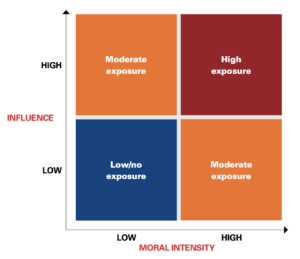
The authors have developed an approach which identifies key factors driving ““corporate human rights strategies and used them to create an exposure” scale. This tool captures both the moral intensity and the potential influence of a company in a specific situation.” Understanding where your organization lies on such a scale can assist a Chief Compliance Officer (CCO) or compliance professional to not only lead a discussion but more importantly help to formulate a corporate response. The twin axis are moral intensity and influence. Moral intensity “captures the degree to which people see a situation as unethical and demanding of action.” Some of the questions you need to consider include what is the magnitude of consequences? The extent of the harm likely to result? What is the social consensus, the extent to which people agree on the moral rights and wrongs of an issue? What is the probability of effect and how likely is harm to happen? What is the “Temporal immediacy. How urgent is the issue? Is fast action required to prevent harm?” How near is your organization to the issue and what part of your stakeholder communities will be affected by the issue?
 
The authors believe that determining influence is even trickier. They believe a nuanced approach should be used when assessing an organization’s influence. Their approach includes reviewing institutional factors, then understand “What are the formal and informal rules and values that shape the environment, including willingness — or pressure — to conform?” Next look at some industry specifics to help understand  “How is influence affected by factors such as the complexity of supply chains, the geographic location of where vital products are sourced, or the degree of concentration or fragmentation of the industry?” From there review your resources to help understand “What can the organization bring to bear to influence the issue?” Such a review would look at both “tangible resources, such as funds, inventory, land, and buildings;” as well as “intangible ones, such as networks, skills, and knowledge.” Finally, consider embeddedness, which is “How closely and on how many levels is the company entangled with the perpetrators of abuse?”
Tomorrow we will look at how you can create a corporate human rights strategy for your corporate compliance regime or ESG program based upon the authors’ model.

Categories
Compliance Kitchen

Guilty Plea for Economic Espionage


The DOJ obtains a guilty plea on conspiracy to commit economic espionage.

Categories
Enron: Trial of the Century

Enron – Trial of the Century: Prelude to the Trial

The five-part series on the Enron Trial kicks off with Tom Fox and actual trial attendee, Loren Steffy. This first episode highlights the major events that led up to the beginning of the trial, many years ago.

Enron in the Early Years 
Enron was once the seventh biggest publicly traded company in America. When natural gas trading was deregulated, Enron made a name for themselves by creating a platform that allowed for easy trade of natural gas contracts. 
The Downfall of Enron 
As Enron grew, they attempted to expand their trading mentality to other markets. There was intense pressure to prove their successes due to being publicly traded, and eventually, they found a way to hide debt and fabricate numbers. However, in mid 2001, their stock began to fall and the questions flooded in. Enron’s lies quickly unraveled, leaving them bankrupt by early December – they went from being the seventh largest company in America, to being broke.
The Arrest and Key Charges 
One of the stunning things about Enron, as a corporate scandal, was that it was really the first time this sort of widespread fraud was seen. In the case of Enron, there were dozens of indictments, but many unindicted co-conspirators. Most of the executives cut plea deals, agreeing to testify against the chairman, Kenneth Lay, and former CEO, Jeffrey Skilling. Though there had been past cases of corporate malfeasance, there had never before been a corporate culture so focused on malfeasance as Enron Corporation. “Looking back at Enron,” Loren says, “it was a culture that really encouraged people to break the rules.” 
Off-the-books Partnerships 
Enron’s partnerships began with an operation called JEDI, done with a small oil and gas company, CODA Energy. Their debt was placed into this entity, and essentially, hidden. This became the model that they used, eventually being done on a larger scale with more interlocking companies passing debt back and forth. A partnership with LJM was where most of the debt was parked. Conflicting documents related to this partnership are what led to the exposure of Enron’s sharp practice.
Other famous partnerships included Enron Broadband, and the Nigerian barge deal. 
Andrew Fastow’s Role 
Andrew was the CFO at Enron, and quite the unusual one, at that. He was more of a behind-the-scenes guy in the company, but became a critical player in the trial. Agreeing to a plea deal, he testified against Lay and Skilling in exchange for a ten year sentence. As an observer in the trial, Loren stated that, “His testimony was very striking. He seemed very sincere in the fact that he believed that the company had done things wrong, and that he had committed crimes.” 
RESOURCES
Loren Steffy | LinkedIn | Twitter 
 

Categories
The ESG Report

How Climate Change and Conflict Lead to ESG with John Katsos


Tom Fox welcomes John Katsos to this episode of the ESG Report. John is an Associate Professor of Management at The American University of Sharjah, a scholar, and a writer. In this conversation, they talk about issues in conflict zones affected by climate change, migration, and corporate responses like ESG to these issues. 


Migration Then and Now
“What’s changed is the scale, but what hasn’t changed is that environmental factors lead to migration,” John tells Tom. The rapid climate changes in this century also mean that more people are being affected. The adverse environmental factors also lead to social strife. John adds that people migrate not only for job availability, but also for food stability, and where the government is able to sustain them. This is only going to get worse in the future as the human population is so much larger than it was in the past. “We’re having to deal with lots of people from lots of places and the ability of countries to manage that is becoming more and more difficult,” John remarks. 
 
A Fraction of The General Global Refugee Population
Tom asks John to share insight into what roles conflict, civil war, and rebellion play in migration. “The two main drivers of people to leave are political instability and violence on the one hand, and then environmental issues on the other hand,” John begins. In conflict zones, most people move around, but usually to neighboring countries. The wave of people migrating to Western countries is not a big fraction of the general global refugee population. “When people are impacted by conflict zones, we often see they’re not traveling far distances,” John tells Tom. When refugees travel far, it is usually because they have the money and wherewithal to do so. 
 
The Potential for Exploitation
The risk of migration is that on one side some people are doing so legally, but on the other, others are using criminal networks and organizations to get them in or out of countries. These same criminal organizations are often exploiting people in other ways. The issue for business professionals with this is that very often, large corporations are not paying enough attention to how those organizations are utilizing their labor. “Companies have to be focused on making sure that they’re not using labor that’s being exploited,” John tells Tom. Another issue is that also, less reputable companies will use cheaper labor and not record it in their books. 
 
Doing Ethical Business In a Conflict Zone
The two main questions business professionals must ask themselves when deciding to operate business in conflict zones are: why are you there, and do you want to be there. Companies need to think critically about this, and make sure that they’re not conducting business that is exploitative. “If you’re there to take something out as quickly and efficiently as possible and sell it somewhere else, you need to be really careful about where your funding is going, who you’re paying, who you’re employing, and how your operations are working next to or in concert with conflict actors,” John stresses. If companies decide that they need to be in these zones, and are providing jobs and necessities for the people there, it is more harmful for them to withdraw. However, each company will have to come to that decision themselves. 
 
Resources
John Katsos | LinkedIn | Twitter


Categories
FCPA Compliance Report

Andrew Neblett and Brian Beeghly Join Ethisphere

In this episode of the FCPA Compliance Report, I am joined by Andrew Neblett and Brian Beeghly, co-founders of Informed360 who recently joined forces with Ethisphere. Highlights of this podcast include:

  1. Tells us about Informed360 platform
  2. Why did you decide to join Ethisphere?
  3. How will the Informed360 solution be integrated into the Ethisphere offering(s)?
  4. As a combined company how will this improve compliance offerings?
  5. How will you be able to take data and provide insights for enhancement of compliance programs?
  6. Their roles at Ethisphere moving forward.

Resources

Check out the upcoming webinar Turning Ethics and Compliance Insights into Action. Register at Ethisphere.com/events

Categories
Daily Compliance News

January 24, 2022 the Burnout in Compliance Edition


In today’s edition of Daily Compliance News:

  • Trouble at Peleton. (WaPo)
  • Bank compliance professionals facing burnout. (WSJ)
  • Family trouble in the Magic Kingdom. (NYT)
  • Congress to probe role of BODs in energy cos misinformation campaigns. (Retuers)
Categories
Sunday Book Review

January 23, 2022 the Business Ethics edition


In today’s edition of Sunday Book Review:

  • Grow the Pie by Alex Edmans
  • Conscious Leadership by John Mackey, Steve McIntosh and Carter Phipps
  • Net Positive by Andrew Winston
  • The Business Ethics Field Guide by Bill O’Rourke, Brad Agle and Aaron Miller