In today’s edition of Daily Compliance News:



Welcome to the Great Women in Compliance Podcast, co-hosted by Lisa Fine and Mary Shirley.
In this episode, Lisa speaks with Joya Williams, who has had a front row seat to some of the most fascinating moments in recent ethics and compliance history at Enron and again with the Gulf Oil spill in 2016. After seeing the fallout from Enron in 2001, and working in ethics and compliance immediately thereafter, she saw the impact and need for that work. That has guided her professional life.
Joya talks about her experiences and how she has built a network for herself and others by building the Greater Houston Business and Ethics Roundtable and working with Smith Texas College to build a compliance program.
As this is the last week of Black History Month, it was important to recognize the work of someone like Joya, who embodies a GWIC in how she gives back to her community – local, professional and educational. She also talks about the importance of increasing the number of Black Chief Compliance Officer roles and to increase diversity in the ethics and compliance space and ends the interview with a wonderful quote from Shirley Chisholm.
You can subscribe to the Great Women in Compliance podcast on any podcast player by searching for it and we welcome new subscribers to our podcast.
Lisa and Mary have extended the Great Women in Compliance brand to the book “Sending the Elevator Back Down: What We’ve Learned from Great Women in Compliance” (CCI Press, 2020) which can be found on Amazon and features valuable wisdom and advice from Great Women in Compliance across the world.
If you’ve already read the booked and liked it, will you help out other women to make the decision to leverage off the tips and advice given by rating the book and giving it a glowing review on Amazon?
As always we are so grateful for all of your support and if you have any feedback or suggestions for our 2021 line up, or would just like to reach out and say hello, we always welcome hearing from our listeners.
Join the Great Women in Compliance community on LinkedIn here.
Compliance into the Weeds is the only weekly podcast which takes a deep dive into a compliance related topic, literally going into the weeds to more fully explore a subject. This week Matt and Tom take a deep dive into one of the most delicious legal decisions recently seen: the attempt by Citibank to recoup $500MM of the $900MM it erroneously wired out on behalf of Revlon.
Some of the issues we consider are:
· How did this Fubar occur?
· What was the role of complexity?
· Why did the employees make this mistake?
· What about training?
· Where were internal controls?
· What is the ‘value for discharge’ defense?
· Does this all just come down to finders keepers?
· What are the compliance lessons?
Resources
Tom’s blog posts on the FCPA Compliance and Ethics Blog:
Too Complex to Succeed: Citibank Incorrect Wires Out $900MM: Part 1 – The Facts
Too Complex to Succeed: Citibank Incorrect Wires Out $900MM: Part 2 – Lessons Learned
The Citibank decision
Effective Compliance Program Hallmark: Training and Communication with Ronnie and Ricardo
Organizations take measures to articulate their policies and guidelines realistically. Doing this ensures that they can promote their compliance and ethics programs to people with unique positions and obligations by meaningful preparation and exchanging knowledge relevant to them.
However, due to their limited understanding of the hallmarks of effective compliance, specifically training and communication, plus the amount of consideration and attention they provide to it, companies sometimes fall far short of the compliance goals.
While several companies and regulatory agencies assume that they treat the training and communication hallmark well, this is the area they sometimes curve out of their most vital point.
The reasons why most organizations struggle to fulfill the criteria of this hallmark can be:
In today’s Compliance Handbook chapter, we’ll dive deeper into the fourth hallmark of effective compliance frameworks: training and communication. We’re joined by two experts in the compliance field, Ronnie Feldman and Ricardo Pellafone.
Key takeaways discussed in the chapter:
Order your copy OR copies of The Compliance Handbook: A Guide to Operationalizing Your Compliance Program. Save 25% off. http://www.lexisnexis.com/fox25
In this podcast, I have been joined by Mikhail Reider-Gordon, Managing Director of Global Affairs at Affiliated Monitors, Inc. We have discussed various aspects of monitorships, including why independence matters, the American Bar Association’s (ABA) Guidelines on Monitors, Gordon’s professorial career at the International Anti-Corruption Academy, cultural differences between international and US domestic monitorships and the continuing evolution in monitorships. In this episode, we consider the continuing evolution in monitorships.
Just as compliance programs and the role of the Chief Compliance Officer (CCO) have evolved, the situations involving a monitor have evolved. We began with a consideration of some of Gordon’s thoughts about how the intersection of law and technology, including privacy, data management and data bias are really driving the conversation with clients around oversight and monitorships. Gordon began with the trend and growth in monitoring entities that have violated data privacy laws. Interestingly, this can come not from any overt or even poor decision on a company’s part or action. It could be from a data breach or it could be they misuse data. Gordon pointed to misuse such as Facebook, under evolving privacy laws. Here Gordon related that “Companies are a little on the back foot.”
The evolution of monitorships has also occurred around timing. Originally, monitors were brought in at the conclusion of an enforcement action. Now monitors are often brought in during and even before an enforcement action begins on a pro-active basis, to get out ahead of the problem. This can be to see if an issue exists or to remediate the issue before the conclusion of an enforcement action. If it is the former situation, it can help to prevent an enforcement action from even getting off the ground. If the enforcement action has already begun, the pro-active approach can help a company garner a declination or if one cannot be obtained prevent a multi-year, post-settlement monitorship from being mandated.
For more information on AMI, check out their website. For more information on Mikhail Reider-Gordon, check out her LinkedIn profile.
The Compliance Life details the journey to and in the role of a Chief Compliance Officer. How does one come to sit in the CCO chair? What are some of the skills a CCO needs to success navigate the compliance waters in any company? What are some of the top challenges CCOs have faced and how did they meet them? These questions and many others will be explored in this new podcast series. Over four episodes each month on The Compliance Life, I visit with one current or former CCO to explore their journey to the CCO chair. This month, my guest is Natalia Shehadeh, Chief Compliance Officer at ABB. In this fourth and final episode with Natalia we look at some of the key lessons she has learned and where the CCO chair may be headed in 2025 and beyond.
Natalia felt they were all unique experiences, joining corporate families at different times of opportunity and challenge. She identified culture, behavior and inclusion as key and need to be the guiding lights for our field. The greater sense of community and common purpose within and cross industries we can bring to the criticality of integrity the better. The more inclusive we can make our enterprise cultures the stronger they will be.
Tom Fox’s guest on this week’s show is Dan Wager, VP of Global Financial Crime and Compliance at LexisNexis Risk Solutions. Dan is an executive with expertise in financial crime compliance and investigations. He and Tom discuss human trafficking, fraud and identifying the patterns of suspicious behaviors within an organization. Tom emphasizes, “All compliance professionals need to understand not only the risks around this area but also what the solutions are… The pandemic has caused an increase in this area because it’s closed down other business opportunities for the bad guys.”
It’s All About Money
Human trafficking, sex trafficking, money laundering and the like are not crimes of passion, Dan points out. “Their focus is to make money and that desire does not stop during an economic crisis and a global pandemic… It all comes back to moving money.” The way in which these crimes are committed is changing, and compliance professionals need to be aware. Tom comments that commercial corporations are being targeted more now because “they’re not set up to fight this scourge.” Dan explains why this is so and gives an example of how banks have been inadvertently used in PPP fraud recently. “These things move together – disadvantaged businesses looking for funds and illicit financiers looking for outlets, people on the narcotics or human smuggling realms looking for ways to make money and retain money in a difficult environment – they all fit together.”
Reputational Risks
Tom comments that your company’s reputation will be severely tarnished if you are found to be even remotely involved in human trafficking and human slavery. Dan says that most companies understand this but are struggling to detect it. You don’t want to be a company that purchased PPE from non-vetted suppliers because you’ll go down along with them, he warns. The reputational damage is just one part of the equation. “What do you think happens to those kinds of workers when you have counterfeit and hard-to-get PPE, in this kind of environment where they can’t even travel across the border or seek other employment? It is exploitation and health dangers on an epic scale,” Dan remarks.
Working From Home & Red Flags
Tom and Dan discuss the increased risk because of the move to work-from-home. Tom also asks about the risk that returning to work may bring. The speed with which remote work had to be implemented opened up new avenues for fraud, Dan says. Work computers are now sitting alongside personal network computers, and bad actors are using various ways to infiltrate both. Few companies are equipped to deal with these changed circumstances, which leaves them vulnerable. The way we conduct business has changed permanently, Dan remarks. This is good in many respects, but it opens up opportunities for fraud. He shares some red flags compliance professionals and financial institutions should look out for. If there is a dramatic change in how a company usually does business, that’s a major red flag, Tom and Dan agree.
Resources
Dan Wager | LinkedIn
LexisNexis Risk Solutions
Welcome to the latest addition to the Compliance Podcast Network, Leading the Way, a StoneTurn podcast. StoneTurn’s Leading the Way podcast series highlights the top compliance, legal and anti-fraud practitioners who are breaking down siloes and setting new standards for excellence worldwide.
In this episode, StoneTurn Partner Valerie Charles is joined by CCO superstar Lisa Steward Hughes to hear the role of the CCO and compliance function in the era of the Coronavirus pandemic, social justice movements and increasingly rapid speed of change in the corporate compliance world. Please note between the time of the recording of this podcast Lisa changed jobs, moving from the SVP, Chief Compliance Officer at Endeavor to Chief Compliance Officer at Factset.
Some of the highlights include:
Big Brains In Compliance is the newest show on the Compliance Podcast Network featuring Tom Fox, the Voice of Compliance, and Stephen Martin, Partner at StoneTurn. In this week’s show, Tom chats with Stephen about the Six Elements framework Stephen helped develop. They discuss why it’s important and how companies can use it to construct a comprehensive compliance program that satisfies government requirements and drives an ethical culture.
The Six Elements
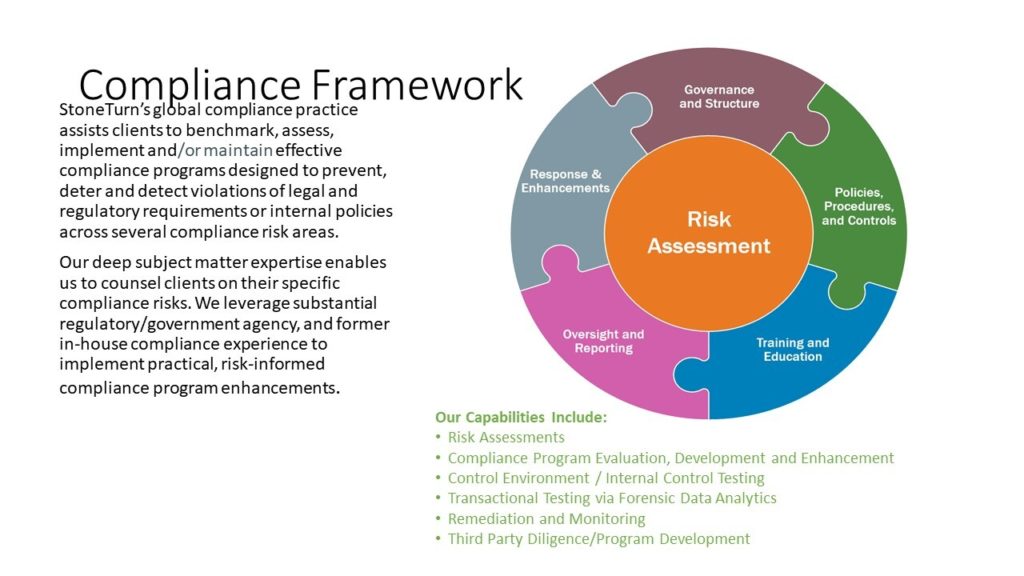
Typically business leaders would either find compliance programs too legalistic, so they would tune out, or believe that they would never run afoul of the guidelines, so they didn’t need to care. Stephen says they created the Six Elements framework for CEOs and companies to have an easily digestible, practical guide to create an effective compliance program for their companies. It helps them to benchmark their existing programs, recognize the gaps, and make enhancements.
“[The Department of Justice] has become much more sophisticated in evaluating the effectiveness of your compliance program,” Stephen points out. The Six Elements allow companies to have a continuous cycle of monitoring and improvement in the key areas of compliance: risk assessment; governance and structure; policies, procedures, controls; training and education; oversight and reporting; and response and enhancements. “It gives you a very nice work plan of how to enhance,” Stephen says, “and it’s something that both helps you as a company but also you can then show to government regulators if you are ever asked about the effectiveness of your compliance program.”
Risk Assessment and Monitoring
Tom comments on the DOJ’s recent statement that you should do your risk assessment whenever your risks change. Stephen adds that the two areas of compliance that companies struggle with the most are effective risk assessment and oversight and monitoring. He shares how his company helps clients build a proactive risk monitoring protocol: this allows them to monitor their risk internally on an ongoing basis. He and Tom talk about the importance of Data Analytics in oversight and monitoring. It’s the number one question compliance officers ask, Stephen says. They all want to use data but they don’t know how. His company again takes a proactive approach by helping clients create dashboards to aggregate the data already present in the organization. This allows them to monitor key issues.
Culture
“How do you help a CCO… to help bring institutional justice and fairness leading to trust and a better culture to an organization?” Tom asks Stephen. Most compliance programs don’t focus on the ethics or culture side, Stephen admits. However, building an ethical culture and giving your employees the tools to speak freely, does more to protect your company than a compliance program in the long run. “Ethical leadership is the best compliance program that you could put in place,” Stephen argues.
Resources
Stephen Martin on LinkedIn